Showing posts with label BBC Symphony Orchestra. Show all posts
Friday, 3 November 2017
Quiescence: Sakari Oramo and Nan Shepherd
This was serendipity. Last Friday I encountered for a second time the great Finnish conductor's unique way with one of Sibelius's most elusive movements, the hypnotic centrepiece of the Third Symphony with which he also made the 2011 BBC Symphony Orchestra debut that got him the job as Principal Conductor. I was in the middle of reading Nan Shepherd's masterpiece of writing about nature, The Living Mountain (you may remember that I mentioned buying it in the Lighthouse bookshop during my blissful day at large in Edinburgh last month.
Why the connection? Because we all surely have at one time or another the feeling that music and its interpretation are reaching to some hidden truth that we think we glimpse, only for the intuition, revelation, call it what you will, to fade away. Another way of looking at it is that we become fused with the 'thing in itself', Kant's 'Ding an sich'. Shepherd touches time and again on this, and it is not cheating the gist of her small, perfect book to quote from her very last paragraph:
I believe that I now understand in some small measure why the Buddhist goes on pilgrimage to a mountain. The journey in itself is part of the technique by which the god is sought, It is a journey into Being: for as I penetrate more deeply into the mountain's life, I penetrate also into my own. For an hour I am beyond desire. It is not ecstasy, that leap out of the self that makes man like a god. I am not out of myself, but in myself. I am. To know Being, this is the final grace accorded from the mountain.
Shepherd, who lived in the same house outside Aberdeen for 87 years, made the Cairngorms her intimate friend, if that's the right word - she was never sentimental about them, and knew that 'Summer on the high plateau can be as delectable as honey; it can also be a roaring scourge'. In the second paragraph of The Living Mountain, written just after the Second World War but not printed until 1977 and only recently rediscovered as the glory it is, she tells us what her approach is to be:
The Cairngorm Mountains are a mass of granite thrust up through the schists and gneiss that form the lower surrounding hills, planed down by the ice cap, and split, shattered ad scooped by frosts, glaciers and the strength of running water. Their physiognomy is in the geography books - so many square miles of area, so many lochs, so many summits of over 4000 feet - but this is a pallid simulacrum of their reality, which, like every reality that matters ultimately to human beings, is a reality of the mind.
Shepherd moves chapter by chapter from the inanimate, like water* - 'like all profound mysteries, it is so simple that it frightens me...it does nothing, absolutely nothing, but be itself' - to the living creatures created thereby,
for the mountain is one and indivisible, and rock, soil, water and air are no more integral to it than what grows from the soil and breathes the air. All are aspects of one entity, the living mountain. The disintegrating rock, the nurturing rain, the quickening sun, the seed, the root, the bird - all are one.
The most miraculous single chapter, for me, is the one entitled 'Sleep,' about 'quiescence', dwelling 'in pure intimacy with the tangible world' in that moment before losing consciousness out on the mountain, and waking, 'opening eyes that have human cognisance behind them upon what one has been so profoundly a part of. One has been in.'
This, finally, is where the connection with the Andantino con moto, quasi allegretto of Sibelius's Third in Oramo's interpretation last Friday comes in (top photo by Mark Allan). The circling mystery is somnambulistic, and seemingly repetitive, but it takes one to the heart of 'being in'. The more careful the pacing, the more intense the piano and pianissimo of the divided cellos, the deeper it goes. The first two bars reproduced here are their third statement, the most inward of all.
Everything in this work seems to come from a deeper place, even the subtle emergence of what will be the final C major triumph (see also what Oramo had to say about the background around the time of his 2011 performance here). It's always impossible to say which Sibelius symphony has the strongest pull; given Oramo's love and knowledge, and the way those are imparted to players who equally love him - one of theme said they had never been unanimous about a chief conductor before - each one seems to be the greatest at the time of hearing it.
Last Friday's concert was remarkable, too, for Jean-Efflam Bavouzet's thrilling teamwork with conductor and orchestra in a work he can truly call his own, Ravel's Concerto for Left-Hand Piano. I agree with everything my Arts Desk colleague Peter Quantrill had to say about the evening (I went on a night off, so to speak) and recommend that you listen to the concert, or at least its second half, on the BBC Radio 3 iPlayer. Looking forward to the remaining four in this series; can't afford to miss a single programme. In the meantime, I'd say that Leif Ove Andsnes' recital on Tuesday several times touched a similar point of quiescence.
*The two images to go with Nan Shepherd's description of water are taken from our time in Sweden's Fulufjället National Park. Probably the geology doesn't entirely connect to the Cairngorms, which I've never visited except for a bit of ill-advised skiing on Glen Shie's nursery slopes; I do remember seeing the plateau from the plane flying to Inverness a couple of years ago. But for me there was an essence on that walking trip, too.
Thursday, 3 September 2015
Cat Kullervo
Mauri Kunnas's image of the hero setting off to war in his children's classic The Canine Kalevala is actually used to illustrate another heroic adventure in the Finnish epic, the journey of Lemminkäinen to woo the Maiden of the North, but it's still a brilliant parody of the famous Akseli Gallen-Kallela fresco which I also used as the lead image for Sebastian Scotney's review of a transformative Prom (as my notes were reprinted, it wouldn't have been right to take it for myself).
Because Lemminkäinen's mother is the real heroine of his not terribly heroic tale, there she is in Kunnas's picture trying to stop him setting out. And since this Lemminkäinen is a member of 'a small but tough clan of cats' who live between 'a tribe of wild and woolly dogs' in the land of Kalevala and 'a pack of mean and wicked wolves' in 'the gloomy North', he can't have a wolf as companion, so an old crow takes that place. Why didn't Kunnas tell the Kullervo story? Because a tragic tale of accidental incest followed by the suicides of the siblings would probably be too much for his young audience. Though he doesn't steer clear of Lemminkäinen's gruesome death in the waters of Tuonela and his mother's arrival to bring him back to life. Here's the famous original image
and Kunnas's version. The gormless Swan can just about be seen top left, while the bee is flying in to sting the corpse back into action.
We'll have a couple more of these comparisons at the end, but first I want myself to sing the praises of Sakari Oramo's amazing Proms performance with his own empurpled BBC Symphony Orchestra and nearly 140 male voices from the stunning Polytech Choir of Helsinki singing alongside the BBC Symphony Chorus. I call it 'transformative' because previously I'd had total faith in the second, third and fifth movements of Sibelius's early mythological canvas, but perhaps not the opening call to arms nor the battle. Now I think it's a masterpiece from start to finish. Never have the foreshadowings of Janáček- whose first great opera Jenůfa was still some years in the future when Kullervo was premiered in 1892 - been more striking in the speech-melodies and especially the scene where Kullervo seduces his sister. Oramo made it all sound fresh, original and gripping, doubling the woodwind parts and making sure every word could be heard from his choir, the Wagnerian lyric-dramatic soprano Johanna Rusanen-Kartano and handsome young baritone Waltteri Torikka, pictured here at a different performance.
I'll keep it general, but I have to show a selection of images from last night's performance at the Lahti Sibelius Festival, because that's where I'm heading shortly - a ceremonial duty at the Tower of London this afternoon kept me in London, more on that in a later post - and because the great Chris Christodoulou wasn't there on Saturday. These pictures, all by Juha Tanhua and uploaded onto Lahti's website with Proms-like swiftness, suggest that it was also a great occasion there too (certainly pics I haven't used of a standing ovation confirm that). The BBC Symphony Chorus men didn't travel to Lahti, but then the hall isn't quite as large as Albert's Colosseum. The Polytech men by themselves still made a huge impression, I'm told.
Sakari with his soloists looks as proud and happy as ever.
One more of the main man. Several of my pals from the BBCSO are in there too.
I ought also to include a picture of BBCSO leader on this occasion Natalie Chee. She's good enough to be a world-class soloist, as we heard last year from her part in Strauss's Suite from Le Bourgeois Gentilhomme, and I think she has what it takes to be a co- rather than just a guest leader.
Roll on the orchestra's 2015-16 season with Mahler 3; before that there's a fascinatingly programmed Nielsen/Ives Prom, and tonight in Lahti they're playing more Sibelius under great but elusive Okko Kamu, whom I see in action on Saturday with the resident orchestra.
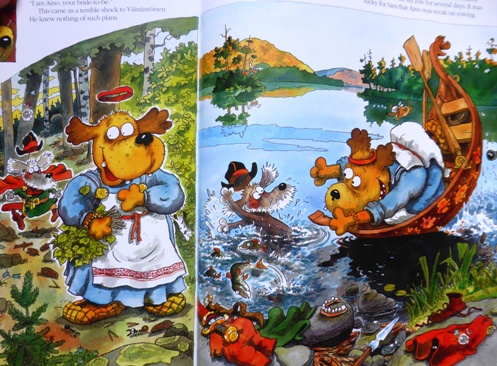
Coda: a few more Kunnas parodies: a delicious piss-take of fair Aino pursued by old man Väinämöinen. These are the two panels of the Gallen-Kallela triptych in question:
And here's Kunnas's witty reversal of roles in the central image: Aino pursues the old dog rather than vice-versa.
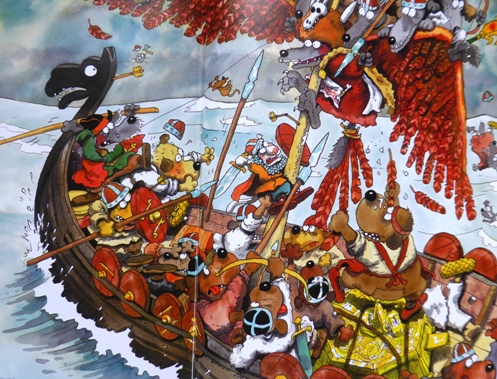
Towards the end of the saga, Väinämöinen and his crew are sailing home with the magical-properties Sampo they forged, gave to the northern folk and stole back when Louhi, crone-queen of the North, attacks them as a giant eagle.
The wolves seem to be in on this one together in The Canine Kalevala.
Still, the Kalevalan heroes all get to live happily ever after, for thanks to the all-providing Sampo, 'all of the heroic dogs' wishes were fulfilled and they were able to bid farewell to 'their wearisome wild and woolly life'. Only the cat Ahti Lemminkäinen, remaining on the outside, manages to aggravate their otherwise calm and overfed lives.
Wednesday, 24 April 2013
Getting Tippett
Remember when there was a lot of stuff about 'Get Carter' around the time of the BBC's minifestival for that now-late composer? Well, I never have got him and never shall (get him). But slowly and surely I and my City Lit students on the BBC Symphony Orchestra course are getting some of Tippett's orchestral works. We've had to, because that fabulous band has been featuring all four symphonies and the Piano Concerto this season.
It's been a bumpy ride, nothing like as welcome or easy as the Martinů year, which I knew would be exciting before I even began. As for Tippett, we started with the late-ish Triple Concerto, parts of which are undoubtedly extremely beautiful and soundwise very arresting; but the mosaic-like stop-starts and some of the greyer music defeat me.
None of us could find any sort of soft spot for the Third Symphony, with those ludicrous last-movement blues written for a soprano who doesn't really exist (you can see the absurdity in what happened with the choice of soloist for the performance: Wagnerian soprano Susan Bullock was booked, light coloratura - and wonderful singing-actress - Marie Arnet took over). At least Tippett's awkward settings of his own faintly embarrassing texts turned me back to the inspiration - ha! - of Bessie and Louis in 1925.
Head back to before Tippett's 1960s watershed - King Priam is the very last, that's to say only the second, of his operas I can take, which is why I decided we'd cover it during next year's Opera in Focus course - and there, to my ears, are the masterpieces. I came to love the Piano Concerto not just for its luminous, tonally very rooted beauty but also for the logically developing parade of sounds. The interpretation which converted me was Steven Osborne's with Martyn Brabbins conducting the BBC Scottish Symphony Orchestra on Hyperion.
And there are still those piano sonatas to get to know.
Similarly, how could you not be swept up by the pounding Vivaldi-inspired Cs in the bass, the pulsating horns, the flurrying strings which kick off the Second Symphony?
Here, too, the perfectly imagined parade of sounds somehow develops, above all when the strings, having failed to push forward their bewitching melody at the heart of the second movement, take flight in the finale and propel us to a really satisfying apotheosis.
I've written about the BBCSO's ravishing Barbican performance, also conducted by Brabbins, on the Arts Desk; what a shame early Colin Davis with the London Symphony Orchestra is so hard to find on CD. Hickox, rhythmically weak, is the only current YouTube contender, and he won't do; try Spotify for LSO/Davis. As for the concert, you have until Friday evening to listen again on the BBC iPlayer. There's a second chance this year to hear the Second Symphony live, at the Proms, where the BBCSO will be conducted by another firm favourite, Oliver Knussen. Addendum (30/4): don't miss a far too rare BBC blog post from the orchestra's sub-principal viola Phil Hall on the last time the players did a Tippett cycle 20 years ago and took two of the works into the recording studio...with hair-raising results brilliantly described.
In the main season, we only have the First to go, and I must look at the Fourth with the score I have here (couldn't get to that performance). But I think it's fair to say that the 1950s, such a grey time with the Darmstadt school holding sway, was Tippett's heyday. There are enough masterpieces from then to put him in the very front row of original thinkers among composers. And he was in danger of vanishing from the concert scene altogether, so bravo to the BBC for making us agnostics partial believers.
With Poulenc, I've needed no persuasion. The Southwark Cathedral Gloria left me wobbly-ecstatic, and I can't wait to hear these forces, radiant soprano Lizzie Watts included, joining others in Gloucester Cathedral as part of the Cheltenham Festival (Fauré's Requiem is the other work on the programme). Again, look at the date: 1960, such an unlikely time for tuneful exuberance outside the world of musical theatre. I'd already been playing over and over Stéphane Denève's sensational new disc with his Stuttgart orchestra of Les Biches - can't get it out of my head - and the Stabat Mater.
That liturgical masterpiece I hardly knew at all, and was hoping the Proms might do something for the 50th anniversary of Poulenc's death. But there's nothing large-scale at all, only the Sextet. Bizarre. In the meantime, don't miss adorable Stéphane's BBCSO concert on Friday: the suite from the La Fontaine-based ballet Les animaux modèles- I'd hope for the whole ballet - with Ravel's L'enfant et les sortilèges, a desert-island opera which Denève will be certain to do superbly. In the meantime, this is already on my shortlist of the year's best discs.
The Poulenc path led me to a previously unplayed disc of two-piano and chamber works. Perhaps the simplest, but typically affecting, is the Elégie 'a la memoire de Marie-Blanche'. Poulenc's instruction to his pianists in the score is characteristic: 'This Elegy should be played as if you were improvising it, a cigar in your mouth and a glass of cognac on the piano'. Pity the performers here aren't listed, but the fishtank effect is rather fun..
As if the to-be-read pile wasn't big enough already, with post-Sicily literature accumulating by the day, I splashed out at Travis and Emery yesterday on the long out-of-print collection of Poulenc correspondence Echo and Source (Gollancz). I loved what I'd already encountered of the composer in his own words so had to get it. Will report back anon.
The Bach cantata 'pilgrimage' continues to unearth new and original beauties, though I was seriously behind with the Sunday ritual until I caught up by listening to three in a row four days ago.
'Halt im Gedächtnis, Jesum Christ', BWV 67, illustrates the mixture of fear and belief in the resurrected Christ; the first Sunday after Easter is the intriguingly titled Quasimodogeniti. I'll call it 'Doubting Thomas Day', which allows for the magnificent Caravaggio above. I've seen Thomas's finger, you know, in Rome's Church of Santa Croce in Gerusalemme, or so they tell me.
The cantata starts with one of Bach's most intoxicating choral fantasias, typical of the instrumental riches in the composer's first Leipzig year: corno di tirarsi, flute and two oboes d'amore elaborate. There are frightened hiccoughs on 'schreckt' in the tenor aria's phrase 'what frightens me still?', and the real dramatic/operatic novelty is the contrast in No. 4 between the assured bass with woodwind chords proclaiming 'peace be unto you' and the lively strings which assail each of the chorus's combative responses before fading into agreement with the Christ-figure. Let's hope Suzuki's soloists here are better than Gardiner's, my own listening last Sunday.
Second Sunday after Easter is Good Shepherd time - I prefer Samuel Palmer to any representations I found of Christ with lamb -
so cue delicious flowing (9/8, 12/8) pastorals in 'Du Hirte Israel, höre', BWV 104, also from the first Leipzig annus mirabilis 1724 with three appropriately bucolic baroque oboes. The tenor is still tracing graphic 'feeble steps in the desert'; prefaced by four compellingly varied instrumental phrases, the bass raises us to a heavenly kingdom on earth. These are obviously winsome arias, but again wretchedly sung on the only disappointing JEG instalment so far. Here we trust in Harnoncourt's Kurt Equiluz and Philippe Huttenlocher.
The spectacular strikes in 'Ihr werdet weinen und heulen', BWV 103, from the second Leipzig year. Here the post-Easter contrasts of human weakness bolstered by divine assurance are at their most vivid; Christ consoles the disciples with intelligence of the Second Coming (Russian icon depiction below). I'd love to sing in the opening number crowned by a flauto piccolo - our stalwart descant recorder - where the chorus get to deliver chromatic howls and exuberant jubilates. Bass-Christ pops up to declare 'ye shall be sorrowful', to which they answer with yet more expressiveness 'but your sorrow shall be turned to joy'. This is the gist of Brahms's soprano in the German Requiem's 'Ihr hab nun Traurigkeit', another great setting where serenity encompasses sadness.
Here are two more arias that follow querulous human searching with divine response. The alto has the flauto piccolo for company on the journey - with Suzuki, the superb Dan Laurin - while the bass banishes passing worries with the aid of a trumpet, heard for the first time. Irresistible. Let's try Koopman for this one.
Thursday, 28 February 2013
Haneke, Bergman and last rites
I finally caught up with Michael Haneke's Amour last night at the Curzon Soho, the first unquestionable masterpiece I've seen in the cinema since Des hommes et des dieux*. Let's first dismiss the Oscars nonsense, written up with a touch of saeva indignatio by the marvellous Matt Wolf: I haven't seen the other 'competitors' in the Best Actress category, but it was absurd that the unsparing, unsurpassable Emmanuelle Riva, just turned 86 when she arrived in Los Angeles, should walk away empty-handed. Actually she should have been up for a joint award with the equally remarkable Jean-Louis Trintignant (pictured with Riva above and below), her loving husband of the watchful gaze in the film. But who cares?
I can't add much of value to what my colleague Emma Simmonds and the first of her commentors write on The Arts Desk. The film is simply note-perfect (well, except in the very minor detail of the right arm placement above hands which we don't see on the piano keyboard - sometimes in the wrong area of the instrument - which is odd, since a very, very fine pianist, Alexandre Tharaud, appears in the film as himself). Having had the humiliating experience of watching Haneke's Hidden from the back row of the Gate Cinema Notting Hill, and not seeing the crucial detail in the tableau at the end, we sat in the front this time and were enveloped by every detail of the old couple's flat in which, after an unforgettable early scene in a concert hall, the film entirely takes place. I wept very nearly uncontrollably when Trintignant's carer tries to get his love to drink water - no more details needed - but came out feeling not exactly purged but clear-headed, almost serene.
Comparisons are odious and probably unnecessary, but I couldn't help wishing my idol Ingmar Bergman in his last film, Saraband, had asked as much of his senior couple, Erland Josephson and Liv Ullmann (pictured; the Fårö post relevant to all this, one which as I think I've written before is closest to my heart, is here). Actually the scenes between them are very touching, but on a first viewing I found some of the old self-disgust packed into the father-son dialogues melodramatic and the handling of music in the film slightly clumsy alongside Haneke's unstinting truth and his less theatrical take on performing artists.
On the other hand, Amour is rather like those earlier Bergman masterpieces Wild Strawberries, Cries and Whispers and Autumn Sonata (Ingmar and Ingrid, no relations and no great friends, pictured above) in that it puts you through the mill and leads you by the hand whole and perhaps a little wiser out the other side. The difference is that you can argue about what you liked or didn't like in Bergman; whereas I should like to meet the individual who finds anything to challenge in Haneke's work of real, honest genius. How amazing that films like this, without any music other than that played in real time, should still be made.
I've been using the word 'flawless' quite a lot over the last couple of weeks: it's also applicable to two concerts I reviewed on The Arts Desk within six days of each other: a brilliantly programmed one by Edward Gardner conducting the Philharmonia Orchestra and another which was simply electric all the way through - despite the challenges of Bloch's not-so-great Schelomo - thanks to conductor Thomas Dausgaard and a simply stunning cellist I've not heard before, Jian Wang (pictured below by Xu Bin).
Double-checked with BBC Radio 3 folk to make sure the cello wasn't miked; from where I was sitting in the hall, the sound was the biggest I've ever heard emanating from that instrument, but so refined. Here's the man I need in order to pay attention to every note of the Bach cello suites. What a happy coincidence with Bergman to find so inward and low-vibrato a performance of the Sarabande from the Second Suite (there was bags of vibrato, incidentally, in his hair-raisingly intense Schelomo, as you would expect, so it's a question of adapting the style).Both film-makers would surely be moved by this, though the Sarabande of Bergman's film is the one from the Fifth Suite.
*If we're including comic masterpieces, and why not, then Julie Delpy's Two Days in Paris qualifies. We soon caught up with the sequel, Two Days in New York, and laughed almost as helplessly in places, though it's such a loss that Delpy's mother died when the filmmaker/actress had already planned out the film, an event which made her change course. The enlarged role for the nightmare sister with an awful boyfriend in tow to some extent fills the gap.
Wednesday, 5 December 2012
Klezmer for two
BBC Symphony Orchestra violinists Celia Waterhouse and Danny Meyer visited the class last week to play and chat (I missed my chance to snap them before the instruments returned to their cases, so they obliged by getting colleague Anna Smith to take a fine double portrait in Maida Vale the following day). The outer panels of their triptych tied in with last Saturday's Mahler Resurrection and this coming Friday's Berio. Either side of very pretty 1791 variations on 'Der Vogelfänger bin ich ja' and 'Bei Männern' from Mozart's Magic Flute, they played a selection of Berio's elliptical, effect-full and melodically striking duos and three klezmer pieces (to tie in with that passage in the ever-amazing slow movement of Mahler's First Symphony, which they also demonstrated).
The klezmer arrangements were by a name I blush to say I hadn't heard before, Aleksey Igudesman. His 7/8 version of 'Hava Nagila' makes it sound absolutely fresh; there was a lively wedding number with an out-of-kilter rondo refrain, and a well-tempered meeting of Valkyries and bridesmaids in 'Richard wouldn't like it'.
The Petersburg (Leningrad) born violinist/arranger is well known - though less so in the UK, it seems - as part of a musical comedy duo, Igudesman and Joo (who is as brilliant a pianist as AI is a violinist). Now I don't usually warm to such stuff, despite - or more likely because of - being dragged along to Victor Borge concerts at a young age. Danny told me to go home and look up on YouTube 'Rachmaninov had big hands', which involves Igudesman handing Joo various notched wedges of wood to add a plethora of notes to the C sharp minor Prelude. A clip which gives a better example of both their skills submits Mozart's Rondo alla Turca to orientalisation. Do stick with this longish strand for the klezmer/eastern effect on an old favourite.
There's plenty more worth watching where that came from (try the collaboration with Kremer and Co in 'I will survive'). Anyway, we learnt a lot from Celia and Danny in the conversation which followed their playing. Danny's role as union representative and his knowledge of the politicking reassured us, among other things, that the BBC orchestras will be taking a ten rather than 20 per cent cut; had it been the latter, one of them might not have survived. But a couple of other institutions may not be with us for much longer; it would be presumptuous to name them.
Danny was interesting on one crucial difference between two visiting conductors. The first, who shall also remain nameless though named he was and Danny made clear he certainly respects him, comes to rehearsals with everything already planned out for his interpretation. The other, Haitink, gets the orchestra to play through the work(s) in question, listens to their sound and adapts, which surely gets more inspiring results.
We also talked about contemporary pieces which get the violin to do everything under the sun except play what (perhaps narrowly) we think of as 'violinistically', in other words to make a phrase with the bow on the string. That was very much the impression in two out of the four new (or newish) pieces in the Mercury Quartet's 'Inspired by Debussy' concert at King's Place last Monday. I went with the diplo-mate, who had co-ordinated the event and supported the commissions via EUNIC. The two pieces in question were a short bit of mood-music which might as well have been an improvisation by a Polish composer and a more dynamic journey in Cypriot Evis Sammoutis's Metioron, which started randomly but gradually coalesced into a piano-led scherzo and haunting final slow section.
The real excitement was seeing the youthful commitment the Mercuries (pictured above, and led by Romanian violinist Vlad Maistorovici, who I'm told is a rather brilliant composer in his own right) brought to their contributions. There was also a trio-Nocturne for flute (Ana de la Vega), harp (Claire Iselin) and voice (soprano Patricia Rozario, who had learnt her parts at 24 hours' notice, and seemed totally in command) by Estonian Malle Maltis - pure Debussy pastiche, but superior of its kind; and a short assemblage of fragments, including the only direct reference to Debussy in a descending phrase from Nuages, by Thomas Oehler. The Debussy works we heard were a surprisingly blowsy early song, Flots, palmes, sables, with a strange, rather redundant meeting of piano and harp, and the chimerical Cello Sonata, in which pianist Antoine Francoise especially excelled. An uneven programme, then, but what vivacious guides we had in the performers.
Thursday, 18 October 2012
Other Annas, other Rings
Forgive the note of unusual negativity in a blog which is
mostly about sounding enthusiasms: this is a post about why I’m not going to
the movies to see Keira Knightley as Anna Karenina, and why I’ve not returned to
Keith Warner’s Royal Opera production of Wagner's Ring after an underwhelmed first visit. The
positives are rather retrospective, but ideals are difficult to shift once
you’ve witnessed them. There can only be new experiences of visions which work very differently but on the same level or else disappointments in store.
As for Anna Karenina, first of course you should read (or
re-read: note to self) Tolstoy’s novel, and
then head not to the cinema but to DVD to see the old BBC serialization
with an unforgettable central performance by Nicola Pagett (pictured above).
Why? Most obviously because the leisure of a multi-parter is always going to be more apposite to Tolstoy’s panorama than a film, even one that’s more than the standard 90 minutes long (a notable exception is Sergei Bondarchuk’s epic, still selective take on War and Peace). The Garbo version, by the way, is beyond bad. But above all I think the BBC casting of Tolstoy's protagonist was so right, possibly because for me as a teenager Pagett WAS Anna before I came to read the book, and even the reading didn't change that. A revisit suggests she’s still apt in so many ways – not least for the nervous intensity, the hectic flushes, which we now know were part of this talented, bipolar actress’s burden in real life. Pagett’s is a vulnerable heroine for whom you want the best, even when you know she’s doomed not to realize it.
The BBC series also gave proper weight to the parallel, equally significant strand of Tolstoy’s self-portrait – following bits of himself projected into both Prince Andrey and Pierre in War and Peace – as Levin. When I heard that the new film doesn’t bring Levin and Anna together, as they must be brought in any adaptation, that was another nail in the coffin of its reputation.
Of course the 1970s television production values were not as high as they’ve become in recent classic serials: Bleak House and Little Dorrit being atmospheric good examples, the recent Great Expectations a misapplication of misty gloom (and vanity casting) over the vitality of Dickens’s novel. But when the performances are as good as they were in the BBC Anna – and that includes Stuart Wilson, Eric Porter and Robert Swann – they overcome the creaky sets and garish studio lighting. A return to the BBC War and Peace, on the other hand, proved disillusioning: though Anthony Hopkins plays Pierre with extraordinary nuance, Morag Hood’s Natasha is too old for the impetuous teenager and lacks charm throughout. The 70s hairstyles, too, are more than a circumstantial liability.
Reports from trusted sources have suggested that many of the
major drawbacks in the Royal Opera’s Ring revival still loom large. Not that I
probably could have got a ticket even if I wanted to: the house was not giving any to The Arts Desk or any online reviews site, and getting a paid seat was going to be
next to impossible. But on my previous visit I hadn't taken away any favourable impressions of the way Keith Warner swilled around a lot of half-cooked ideas, not at least beyond Rheingold, which is in any case
a rather theoretical box of tricks and in this case promised more than the rest delivered. And Warner’s real weakness was to pay too
little attention to the chemistry of all the crucial one-to-ones; this is where
any great Ring production, whatever you think of its mises-en-scene, makes its
mark.
I’m glad if Pappano has more grasp of the oceanic tides than back in 2006-7, and if great Bryn now has the strength to make it as Wotan and Wanderer (he was tired out by the end of Walküre when I saw it, but still a major reason for going). Yet while Covent Garden has done right by Sue Bullock, as it should have in the first place when the house cast Lisa Gasteen, she of the shot top, as Brünnhilde, the Siegfried problem continues: Stefan Vinke makes a horrid noise, or did when I heard him labour his way through Proms performances of Mahler’s Eighth and Janáček’s Glagolitic Mass. I wouldn’t hold out much for his skill as an actor, either. (UPDATE - 11/2/2019 - how wrong I was on that count, seeing him as the Siegfried Siegfried this season. Fabulous forging scene too)
The point is, if you're keen to experience the whole marathon for its own sake, your money will at least have been decently spent. It might be worth while tuning in to Radio 3, currently halfway through its broadcasts from the Royal Opera. But the Ring remains, for me, the sum of the great cycles I’ve seen which worked: Chéreau’s incendiary Bayreuth Centenary staging
– my way in as watched, one act per week, on TV during my student years;
Kupfer’s first take, which I was lucky enough to see at Wagner’s home shrine,
and if I never get there again, I’ll at least have had my vision; and the
Richard Jones production at Covent Garden. Not all of it worked, but there Jones's radical ideas resonated throughout the four operas as Warner's much less rigorous rattlebag did not (and Jones's Siegfried was sheer genius). Even the Phyllida Lloyd staging for ENO had
unforgettable hits among the misses – I nearly left her Valkyrie after Act One, but Lloyd
upped its game from Brünnhilde’s annunciation of death to Siegmund onwards, and
the Twilight was inspired as a production from start to finish.
Anyway, talking of potted adaptations, I wonder what we
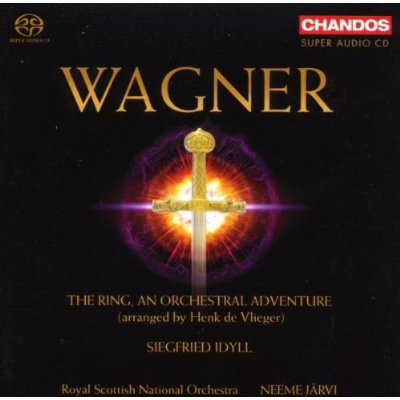
shall make of Henk de Vlieger’s 60-plus minute symphonic tour of Ring
orchestral highlights, due from the BBC Symphony Orchestra under the excellent
Mark Wigglesworth tomorrow night (and already espoused by Neeme Järvi and the
Royal Scottish National Orchestra on Chandos, a recording I have yet to hear).
On Tuesday with the BBCSO course students, I had one hour on Tippett’s Triple
Concerto, the first work in the concert – triggering a heated debate of pros
versus cons, with me somewhere in the middle – and one on the essence of the
Ring, with glimpses of the beginning and the end and in between, a couple of
selections from the momentous later stages of Rheingold and Walküre to deal with transformation/dramatic introduction
of the leifmotifs, and a gallery of nature pictures – water, air, fire and
earth.
Those should all be there tomorrow, but will the experience add up? Sometimes charisma can make it work - I love mad Stokowski's 'symphonic syntheses' from the Ring, Tristan and Parsifal, especially in his portamenti-laden Philadelphia recordings from the 1930s. Here's his take sans voices on Act Three of Parsifal.
As for Wigglesworth's Wagner (and Tippett), if you can't be there at the Barbican, the concert is broadcast live on Radio 3. STOP PRESS (20/10): It worked, it truly did (and the Tippett was compelling, too). Listen to the concert for the next seven days here and read the Arts Desk review here.
Those should all be there tomorrow, but will the experience add up? Sometimes charisma can make it work - I love mad Stokowski's 'symphonic syntheses' from the Ring, Tristan and Parsifal, especially in his portamenti-laden Philadelphia recordings from the 1930s. Here's his take sans voices on Act Three of Parsifal.
As for Wigglesworth's Wagner (and Tippett), if you can't be there at the Barbican, the concert is broadcast live on Radio 3. STOP PRESS (20/10): It worked, it truly did (and the Tippett was compelling, too). Listen to the concert for the next seven days here and read the Arts Desk review here.
Monday, 12 December 2011
A great Britten symphony

Had he not styled it a Sinfonia da Requiem, and run its three continuous movements - 'Lacrymosa', 'Dies Irae' and 'Requiem Aeternam' - at a highly compressed 20 minutes, Britten's early masterpiece would be officially up there with Elgar's and Walton's two symphonies and the best of Vaughan Williams's nine, not to mention the darker monuments of Shostakovich and Prokofiev. Britten's two, showing he could achieve symphonic continuity outside the opera house, are this and the even thornier Cello Symphony for Rostropovich, which I love yet more dearly. This CD is an indispensible one, though Rattle's recording of the earlier work is one of his best.

Our new Rattle, Ed Gardner, dared to harrow us with the Sinfonia da Requiem right at the start of another BBC Symphony Orchestra blockbuster event on Saturday, and you can hear the results this afternoon on Radio 3; for some reason, broadcast has been delayed, but it will soon be on the iPlayer for the next week. My colleague and perceptive Britten scholar Alexandra Coghlan reviewed the concert for The Arts Desk. As I'd discovered for the class, and consequently for the pre-performance talk, there were several points of connection with the other epic bookender, Walton's Belshazzar's Feast, which I haven't heard in concert for years. That reminds me I ought to get to the John Martin exhibition soon; his doomy canvases used to appeal to my adolescent love of extremes.

The links? Not only were Walton in 1929 and Britten a decade later young men still in their twenties when they set out on adventures which changed course; both works start - though Walton's takes time to settle - in a D minor lament. Britten's resolves in D, Walton's in the relative major, F, with jazzy accents to the last and a hint at the tritone which, of course, holds the tension to the end of Britten's later lamentatory masterpiece, the War Requiem.
Much to illustrate in the talk, then - too much bearing in mind the BBCSO brief of covering all bases, which meant a not unwelcome injection of what I could bring to bear on the three fascinating Sibelius orchestrated songs in the programme - 'On a terrace by the sea', much blacker than its title suggest, also holds tritonal terrors and modernistically anticipates the Finn's Fourth Symphony by some years - and Sibelius's little suite of incidental music to another Belshazzar's Feast, modest but personal as ever. One thing I hadn't realised at the time was that Sibelius made his orchestration of the Twelfth Night setting 'Come away, death' just before his death in 1957. Delighted to find it on YouTube in Jorma Hynninen's performance. I'd been blown away by his performances of the songs when I was preparing the talk, and though Gerald Finley was fine and cut through a sometimes very heavy orchestra, he doesn't have Hynninen's lower centre of gravity.
All the more fascinating, given the terminal circumstances of the arrangement, that the last chord leaves matters unresolved. 'Komm nu hit, död' ties in two other dying composers' significant end-pieces, Rachmaninov's piano transcription of Tchaikovsky's 'Cradle Song', written in the year of the junior master's birth, and Stravinsky's instrumentation of two pleading-with-God Wolf songs.
So it was quite a death-haunted programme as we enter the silly season; and we can still go deep this Friday when that phenomenal Sibelius interpreter Jukka-Pekka Saraste conducts Sibelius's Sixth and Seventh Symphonies. Why the Bosch above? Well, partly because the Sinfonia da Requiem is a triptych, too, though with a fast-motion hell at the middle, and partly because that Dies Irae's fluttertonguing flutes and muted brass delineate Boschian creatures while not forgetting to hothouse the terror and weave in on alto sax the ever-changing lament of the first movement (it achieves resolution in the finale, but not a falsely triumphalist one).

Such details would have led me to guess that the work was influenced by Shostakovich's even more harrowing Eighth Symphony, were it not for the fact that the Russian masterpiece had not been composed at the time of the English one's belated premiere. That took place under Barbirolli in New York in 1941, the Sinfonia having been unsurprisingly exiled from the concert for which it was commissioned, a 200-player celebration of Japan's 2,600 year old empire at which Richard Strauss's noisy occasional-piece Japanese Festival Music WAS performed, and at which the Nazi salute was held during the playing of the Japanese national anthem. Once again, the unwitting Strauss was in the wrong place at the wrong time; but so would Britten, and Britain, have been, had the Japanese royal representatives not objected to his 'gloomy', 'discordant', 'Christian' and of course very uncelebratory work of youthful genius.
Thursday, 10 November 2011
Ballad without words

Apparently every Czech schoolchild knows (or used to) at least partly by heart the verse fairy-tales of Karel Erben, just as every Russian schoolchild knows (or used to) Pushkin's Tale of Tsar Saltan and Golden Cockerel. We don't, and English translations are extremely hard to find, so what Dvorak was trying so uniquely to do in his symphonic poems of the 1890s may be even more liable to misunderstanding.
That, and what I construe to be the dead hand of the prescriptive 1950s, decreeing that all music which tells a story is suspect and that therefore any but the most established tone-poems are doomed to extinction, may account for why I've never heard The Golden Spinning Wheel and its companion pieces, no less wonderful in orchestration and invention (The Wood Dove, The Noonday Witch and The Water-Sprite), in the concert-hall. In fact it's a marvellous couple of days for hearing great music live for the first time; last night I revelled in the LSO's championship of Nielsen's Flute Concerto and Zemlinsky's The Mermaid, and wrote about that enterprising event on The Arts Desk.
So tonight I'm going to hear how The Golden Spinning Wheel pans out in live performance, and our BBCSO class is actually in quite a lather about a fabulous Czech programme which only Jiri Belohlavek could mastermind. More of the rest anon, but a word or two about The Golden Spinning Wheel. What I'm hoping is that Belohlavek will give an introduction with musical pointers, because unless you know the story you could well be lost in its nearly half-hour span*. And the subtlety of the technique will pass all of us who don't know Erben's poetry by. For Dvorak has set the text to music with the words merely implied - a pioneering idea which may have encouraged Janacek in his search for naturalistic speech-melodies. I don't know of how much of the piece this is true, but I enjoyed listening to my pal Stephen Johnson's eloquent BBC Radio 3 Discovering Music on the work, where he points out that the very first hunting-theme sets the opening two lines ('Okolo lesa pole lan,/hoj jede, jede a lesa pan').

This is music that tells a story at every point, and while the invention is superlative throughout, if we don't know it, we'll be lost. It's true there's a kind of rondo form, with a clutch of forest rides as the link, but the repetitions will certainly be puzzling without the story. I'm delighted that there's a complete film of Tomas Netopil conducting an Italian orchestra (it doesn't say which one) so that I can give the pointers in the shape of a few timings.
No trouble identifying the beginning: a king riding through the forest. He stops at a cottage to ask for a drink of water and falls instantly in love with the maiden Dornicka, who brings him the water and returns to her spinning wheel. Her music is as lovely in the heroine's in that great opera Dvorak had yet to write, Rusalka, and uniquely scored (cor anglais, four solo second violins and one first, before clarinets proceed with the spinning - 2'28 in the film).

The King has to ride back later and ask Dornicka's stepmother for her hand in marriage. We can tell she's a wicked old bag (the oboe pops the request, clarinets and bassoons cackle back - 6'31).
Sure enough, the stepmother and her daughter, riding with Dornicka through the forest (8'47), murder her (9'58), cutting off her arms and feet, plucking out her eyes and for some obscure reason taking the body parts to the palace, where the 'false Dornicka' - see Odette/Odile - marries the King. He goes off to war. Meanwhile, a mysterious old man finds Dornicka's torso in the forest (brass chorale, 15'16) and sends a boy to the palace to ask for the body parts (innocent flute, 15'55). This is where you have to know why the process is repeated three times: the boy gives a golden spinning wheel in exchange for the feet, a golden distaff for the hands and a golden spindle for the eyes. The old man restores Dornicka to life.

The King returns from the wars, his wife plies the golden spinning wheel - and it creaks out the awful truth (22'20 - shades of Mahler's Das klagende Lied, where a flute made out of a murdered youth's bones reveals a fratricide). The King finds Dornicka in the forest and they live happily ever after. Somehow Dvorak passes over the wicked women's being torn to pieces by wolves in hot pursuit, but he needs to get to the end in as lush and jubilant a manner as possible.
Tonight's concert will conclude with another, earthier tale - Janacek's Taras Bulba - which is going to connect neatly with a much later work by Martinu, his Rhapsody Concerto for viola and orchestra. Like so many of the exile's great later works composed in America, Martinu's modest little masterpiece harps on the cadence we know as the 'Julietta chords', from their emancipating role in that fantastical masterpiece of an opera (which I've just heard Richard Jones will be staging for ENO next season, hurrah).

Did Martinu mean by the chords to evoke his lost love, the talented composer Vitezslava Kapralova, who died at the tragically young age of 25 in 1940? We'll probably never know; Martinu had to cover his tracks even for his biographer, Milos Safranek, so as - I guess - not to further wound the feelings of his French wife. But the fact is that the 'Julietta chords' first turn up at the end of Taras Bulba. So they could equally well signify the rapture of Czech liberation, and of what his homeland meant to Martinu.
At any rate most of the later works are shot through with significant quotations, or near-quotations, and I spotted another in the second movement of the Rhapsody-Concerto: a poignant recollection of the lyrical second theme in the first movement of Dvorak's American Quartet. For some strange reason a good performance of that isn't on YouTube, only the first movement in the magnificent interpretation of Josef Suk with the Czech Philharmonic Orchestra conducted by Neumann. The Julietta chords are all over this movement, too, starting seconds into the piece.
The second movement is the more dynamic and unpredictable of the two; amazing the use Martinu makes of rattling side-drum in postponing the ultimate peace, though that does come. It's a good time to remember all those geniuses, as well as all the rest of suffering humanity, displaced by war. Given that Remembrance Day is tomorrow, I'll leave you with a recording of perhaps Martinu's best-known orchestral work, the memorial to the Czechs massacred by the Nazis in Lidice.
*He didn't. Instead he cut the work by a third, leaving my students puzzled as to what was going on. All this now detailed in the Arts Desk review.
Monday, 31 October 2011
Sibelius's 'Virgin' Symphony?

We’re talking not any of those Kalevala maidens from Luonnotar to Aino, depicted above evading old man Väinämöinen in an early triptych by Sibelius’s friend and contemporary Akseli Gallen-Kallela, but the BVM, no less.
The news was broken to me by that nice BBC man Mark Lowther, bounding up enthusiastically at the interval of Friday night’s concert (which I was reviewing for The Arts Desk, but had been determined to catch under any circumstances). Had I heard what conductor Sakari Oramo had to say about new research on the Sibelius Third Symphony, in which he was about to conduct the BBC Symphony Orchestra? I hadn’t, but Mark gave me the gist and I caught Oramo succinctly mentioning it again in the broadcast between Luonnotar and the symphony.
In short, says Oramo, ‘this music or material of it was originally part of an oratorio project about the Virgin Mary, and you can I think relate to a lot of this music thinking it has a religious – albeit it is a pagan-religious or folk-religious – background, and I think this explains a lot of the chorale textures, it explains the nature of the final hymn.’
Indeed – hurrah for ongoing Finnish scholarship, and how frustrating that unless we master that impossible language, the rest of us are shut out from the more interesting developments until someone like Oramo draws our attention to it. Anyway, that’s enough to justify inclusion of a couple of images from the Barbara altarpiece by the north German Master Francke, which resided in the church in Kalanti from about 1410 to 1883 and is now in Helsinki’s National Museum of Finland.

Not that the news changes the essential character of the symphony, which has the feeling of a journey like the earlier ones in the Lemminkäinen Suite and En Saga. But how difficult to put one’s finger on what makes this music strike so profoundly, apart from its deep-wired structural surprises (what an amazing solution to let the chorale out of the bag in the finale when he does). I found myself in tears minutes into the second movement, which for swathes does little more than oscillate around an intermezzo-like, runic melody. Järvi's Gothenburg performance is one of the few to capture the same sort of inscaped magic.
I’d been in a gloomy mood all week, mostly triggered by ongoing dental surgery, and this lifted me completely as Chailly’s Beethoven on Wednesday couldn’t.

Same goes for Luonnotar, the Finnish creation myth as adapted from the Kalevala, and illustrated above and below by Gallen-Kallela. The depicted stanzas deal with Luonnotar/Ilmatar’s floating on the water and her raising of a knee for a teal to nest on.

From the teal’s egg are fashioned the solid earth, the lofty arch of heaven, the sun (its yolk), the moon (its white) and the stars (its speckled shell). I’ve written enough already in the Arts Desk piece about the BBCSO/Oramo partnership with the wonderful Mrs. O., Anu Komsi, who’s previously dazzled us with twin Piia in Salonen’s Wing on Wing. There’s communication for you. Mattila amid wavescapes will do here (be patient with the opening soundtrack, which fades before the music begins), but Friday night's performance was even more extraordinary, and the communication cried out to be seen as well as heard.
Komsi WAS the Virgin of the Air cast plaintively upon the waters, and earlier she even convinced me that there might be more to Saariaho than what so briefly tickles the ear: here was substance as well as texture. But of course it’s Sibelius who still sounds freshest and continues to give perhaps the greatest spiritual sustenance of any composer I know. I still count those four hours spent last March at his home of Ainola (pictured again below - this of course is where he composed the Third Symphony), prompting four entries starting with this one, as among the most impression-filled of my life. And Sibelius's unflagging genius - the miniatures are as individual as the compressed epics - has come to feel like the strongest of all musical companions through life.
Subscribe to:
Posts (Atom)