Showing posts with label Walton. Show all posts

Thursday, 29 December 2022

Zoom courses: from Vaughan Williams to Nielsen

What an enriching term it's been on the orchestral front (opera, too, but that's another story). The ten autumn classes on the British symphony from 1907 to 1960 had anniversary genius Vaughan Williams at the core. I came to love those of the nine symphonies I'd either had a problem with - the Third and the Fifth, so much more going beneath the surface and not at all the placidity I'd imagined - or didn't know well (above all Eight and Nine). 

The biggest revelation was how much VW can extract from a couple of chords or an enharmonic shift, often with a distinctive turn of phrase above them. You've got a colossal case right at the start of A Sea Symphony. And then I realised that the stomach-flipping sequence towards the end of Pastoral Symphony's exposition - in that case, B flat minor to G major and back - fuels more explicit conflicts in the embattled symphonies to come. Deryck Cooke made a brilliant analysis of the Sixth focused on the essential elements of musical vocabulary it exploits so originally. Even the English-idyll intervals which can sometimes get a bit repetitive (think Lark Ascending) can be transformed according to the harmonies under them - the melancholy-hallucinatory Ninth is a striking example. 


The big enigma remains about the multitudes contained within VW's outwardly lovable and wholesome personality. Whence all that violence and discontent in 4, 6 and 9 especially? He rarely discussed his music in autobiographical terms, though John Bridcut's documentary puts its finger on some of the "passions". I think second wife Ursula gets too big a role, but the frustrations he must have felt looking after the invalid first, Adeline, immobilised by arthritis. I wonder if some of the floating wastes have to do with her frozenness. Telling that after her funeral he came back and threw a chair across the room in rage. Just came across this photo I hadn't seen before of them together back in 1917 (and of course VW's service in WW1 must have been another source of anguish).

This was also a good opportunity to listen more intently to the cycles I had to hand - Boult's and Handley's. And then at a lateish stage, when I found YouTube helpful for showing the score above another performance, I discovered Bernard Haitink's recordings with the London Philharmonic: surpassing the others for the intensity and extremity of the pianissimos, the tonal beauty throughout. Haitink doesn't often do electrifying, but his Sea Symphony is just that. What a remarkable range of sympathies he had. 

A student who didn't join last term told me I needed more than 10 Thursday afternoons to accommodate other figures on the scene. But by stopping at 1960, I ruled out the later Tippett symphonie (which baffle me) and more on Malcolm Arnold. Still, while I know his Second and Fourth Symphonies well, the First came as a revelation. The first movement has great gestures, but the finale is a tour de force from start to finish. This is an electrifying performance from Rumon Gamba and the BBC Philharmonic not available on CD.

There's an even more sophisticated brilliance about Walton 2, which reveals more every time you hear it. I still don't think I've grasped the slow movement yet, but the others show this fastidious composer adding to his palette and making forms which take the art of the symphony in yet another direction. 

Let's see if enough folk are attracted to the next term, focusing on Nielsen's magnificent six, but with more than sideways glances at Berwald, Stenhammar and Langaard. Here's the flier: click to enlarge for details and let me know if you're interested. 

Monday, 12 December 2011

A great Britten symphony


Had he not styled it a Sinfonia da Requiem, and run its three continuous movements - 'Lacrymosa', 'Dies Irae' and 'Requiem Aeternam' - at a highly compressed 20 minutes, Britten's early masterpiece would be officially up there with Elgar's and Walton's two symphonies and the best of Vaughan Williams's nine, not to mention the darker monuments of Shostakovich and Prokofiev. Britten's two, showing he could achieve symphonic continuity outside the opera house, are this and the even thornier Cello Symphony for Rostropovich, which I love yet more dearly. This CD is an indispensible one, though Rattle's recording of the earlier work is one of his best.


Our new Rattle, Ed Gardner, dared to harrow us with the Sinfonia da Requiem right at the start of another BBC Symphony Orchestra blockbuster event on Saturday, and you can hear the results this afternoon on Radio 3; for some reason, broadcast has been delayed, but it will soon be on the iPlayer for the next week. My colleague and perceptive Britten scholar Alexandra Coghlan reviewed the concert for The Arts Desk. As I'd discovered for the class, and consequently for the pre-performance talk, there were several points of connection with the other epic bookender, Walton's Belshazzar's Feast, which I haven't heard in concert for years. That reminds me I ought to get to the John Martin exhibition soon; his doomy canvases used to appeal to my adolescent love of extremes.


The links? Not only were Walton in 1929 and Britten a decade later young men still in their twenties when they set out on adventures which changed course; both works start - though Walton's takes time to settle - in a D minor lament. Britten's resolves in D, Walton's in the relative major, F, with jazzy accents to the last and a hint at the tritone which, of course, holds the tension to the end of Britten's later lamentatory masterpiece, the War Requiem.

Much to illustrate in the talk, then - too much bearing in mind the BBCSO brief of covering all bases, which meant a not unwelcome injection of what I could bring to bear on the three fascinating Sibelius orchestrated songs in the programme - 'On a terrace by the sea', much blacker than its title suggest, also holds tritonal terrors and modernistically anticipates the Finn's Fourth Symphony by some years - and Sibelius's little suite of incidental music to another Belshazzar's Feast, modest but personal as ever. One thing I hadn't realised at the time was that Sibelius made his orchestration of the Twelfth Night setting 'Come away, death' just before his death in 1957. Delighted to find it on YouTube in Jorma Hynninen's performance. I'd been blown away by his performances of the songs when I was preparing the talk, and though Gerald Finley was fine and cut through a sometimes very heavy orchestra, he doesn't have Hynninen's lower centre of gravity.


All the more fascinating, given the terminal circumstances of the arrangement, that the last chord leaves matters unresolved. 'Komm nu hit, död' ties in two other dying composers' significant end-pieces, Rachmaninov's piano transcription of Tchaikovsky's 'Cradle Song', written in the year of the junior master's birth, and Stravinsky's instrumentation of two pleading-with-God Wolf songs.

So it was quite a death-haunted programme as we enter the silly season; and we can still go deep this Friday when that phenomenal Sibelius interpreter Jukka-Pekka Saraste conducts Sibelius's Sixth and Seventh Symphonies. Why the Bosch above? Well, partly because the Sinfonia da Requiem is a triptych, too, though with a fast-motion hell at the middle, and partly because that Dies Irae's fluttertonguing flutes and muted brass delineate Boschian creatures while not forgetting to hothouse the terror and weave in on alto sax the ever-changing lament of the first movement (it achieves resolution in the finale, but not a falsely triumphalist one).


Such details would have led me to guess that the work was influenced by Shostakovich's even more harrowing Eighth Symphony, were it not for the fact that the Russian masterpiece had not been composed at the time of the English one's belated premiere. That took place under Barbirolli in New York in 1941, the Sinfonia having been unsurprisingly exiled from the concert for which it was commissioned, a 200-player celebration of Japan's 2,600 year old empire at which Richard Strauss's noisy occasional-piece Japanese Festival Music WAS performed, and at which the Nazi salute was held during the playing of the Japanese national anthem. Once again, the unwitting Strauss was in the wrong place at the wrong time; but so would Britten, and Britain, have been, had the Japanese royal representatives not objected to his 'gloomy', 'discordant', 'Christian' and of course very uncelebratory work of youthful genius.

Thursday, 4 November 2010

Let's hear it for Hindemith


Took the BBCSO students through this coming Friday's programme to be conducted by the often electrifying Yan Pascal Tortelier. I always have so much to say about Musorgsky's Pictures at an Exhibition both in its piano original and its thousandfold arrangements that I knew I wouldn't have much time to talk about Hindemith's Concert Music for Brass and Strings. Yet it fascinated me all the same. We've got it all wrong about the mighty and humane German composer, labelled by his notorious claim for Gebrauchsmusik, 'utility music'.

Yes, he was prolific and yes, he saw it as his obligation to compose for the less familiar instruments, in which respect I suppose he was very much like his near-contemporary over the border, great Bohuslav Martinu (both, of course, ended up in America, where PH is pictured above in 1945). But even Martinu didn't write a chamber piece to showcase the heckelphone, that lowest member of the oboe family analogous to the bass oboe. Of course I would be fascinated by that as oboist manque, wouldn't I? It plays quite a part in the creepiness of Strauss's Salome, but Hindemith was surely the first major composer to bring it to the forefront. Here's the second movement of his quirkiest trio.


It was the opera Mathis der Maler which first hit me with an emotional force I hadn't expected (a brief firework in the Royal Opera's more adventurous programming some years back, directed by Sellars and conducted by Salonen). But I find plenty of melodic heart, too, among the counterpoint of Hindemith's Kammer- and Konzertmusiks. The students were hugely entertained both by the one that's popping up in tomorrow's programme and by Walton's jolly, unashamed ripoff in the finale of his First Symphony. I still treasure that fabulous Storgards programme in Helsinki twinning the two composers, and a couple of conductors I've spoken to think it would be a fascinating idea. So come on, Vladimir, stick your neck out and do it, please.

In the meantime, there's a film of Hindemith conducting on YouTube, but it can't be embedded. So here's the first movement of the Konzermusik in question from his 1950 Philharmonia recording. You can always go on to the second if you're hooked.


On a not unconnected brass note, I was sorry to hear that the doyen of orchestral trumpeters, Maurice Murphy, had died. I'll remember for ever the way he played the sassy blues solo of An American in Paris during Tilson Thomas's LSO series The Gershwin Years. I loved a comment referred to on one message board about Gabriel now being out of a job up there.

And news of distinguished musicians' deaths does seem to be coming thick and fast this year. Radio 3's In Tune just rang to tell me that the admirable Rudolf Barshai - viola-player (like Hindemith), arranger and conductor - has died at the age of 86. I'll be popping into the studio later*, and though I'm much taken up with Raskatov's opera A Dog's Heart at the moment, will squeeze in a hour to reflect on Barshai's Greatest Hits. Which will include his performances in the early Borodin Quartet, his string-orchestra transcriptions of Prokofiev's Visions fugitives and Shostakovich's Eighth String Quartet, and his Shostakovich symphonies cycle on Brilliant Classics (outstanding Fourth and Thirteenth). Is there no end to the wonders of YouTube? Someone's even put up the Prokofiev recording, which I have only in mono. This may not be the most soulful of the tracks, but it does highlight what the intended antiphons sound like in stereo:


*You can hear the chat with Sean Rafferty - before he and other presenters went on strike over the BBC pensions debacle - for the next six days on the BBC iPlayer. It's about 41 minutes into the programme.

Tuesday, 6 April 2010

Sibelius at home IV: portraits


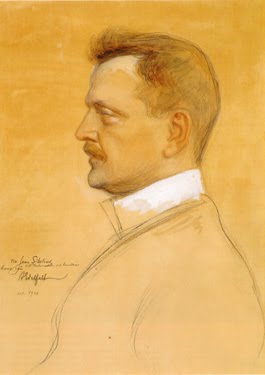
In addition to John Munsterhjelm's 1909 bronze of the composer - into which Sibelius inserted a lucky horseshoe - two of the most important portraits are to be found at Ainola. One faces you on the other side of the window to the bust as you enter the drawing room.


This is Albert Edelfeldt's study, made in 1904 as a preparatory sketch for his three-part mural in the University of Helsinki's main auditorium. I had a feeling I might get to see it on my much-anticipated visit to hear the Helsinki Philharmonic that evening. The deplorable situation with the main Finlandia Concert Hall means that either of the city's two main orchestras can be ousted if a more lucrative conference booking so decrees, and that's what happened on Thursday evening - with the result that, owing to the subscription sales outstripping the seating facilities at the university, I was told a ticket at the smaller venue would be very hard to come by. And this for a programme of Walton and Hindemith you'd be lucky to get half an audience for in London.

Anyway, I did get in, and as it turned out there were plenty of empty seats owing to the subscribers' prerogative of turning up or not (the still very large audience, though, proved a healthy mix, attentive and enthusiastic). I had the huge pleasure of top Finnish designer (and very modest gentleman) Markku Piri's company, and he took me down from our balcony seats to look at the main hall in the interval. I think that, for all his knowledge, he was rather surprised to find that Sibelius did indeed feature in the mural. There he is in the procession of figures in 17th century dress leading the Turku University inauguration, just behind Governor Per Brahe.


Forgive the pointillist overlay, but I couldn't find any better image than my own on the web. Here's a more professional shot of the handsome neoclassical hall.


It's a rather small venue for a large symphony orchestra, and there was nowhere for the Helsinki Phil players to hide from the audience. Not that they needed to: John Storgards did a splendid job with a brilliant programme, three-quarters of which I've never heard in a UK concert. First half started with Walton's Spitfire Prelude and Fugue, followed by the Hindemith Cello Concerto, its cheeky march-finale anticipating the pleasures of the more familiar Weber Metamorphoses. Spot-on Torlef Thedeen formed a true concerto partnership with this lively team (characterful principal clarinet, later first flautist and oboist, had a very individual sound). After the interval, the orchestration of Walton's Hindemith Variations, its theme derived from the slow movement of the Concerto, was pure sleek pleasure, an altogether trickier fugue to cap it all followed by a decadent slow fade. I told Markku he was in for a treat with the Turandot March of the Hindemith Variations; sure enough, he smiled and even laughed at the jazzy bit. Lots to think about, he said at the end, and so there was.

One notorious artistic glimpse of Sibelius at large in Helsinki I didn't get to see: while I've already noted the surprise of Gallen-Kallela's triptych, his celebrated take on a drinking 'symposium' at the happening Kamp Hotel was, we were told by the hotel's reception, locked in a safe. Yet there seems to be a version at the Gosta Serlachius Foundation.


No prizes for guessing why the depiction of Sibelius on the right gave him a bad name, and almost led the Jarvenpaa worthies to refuse him the land at Ainola (the other reprobates, left to right, are the artist, Merikanto and Kajanus). Another drinking bout may be the reason why Aino looks so weary in this marvellous portrait by her brother Eero Jarnefelt, hanging to the left of the Ainola dining-room entrance.


Only someone close, I reckon, could have caught that look - it reminded me of something similar in Thomas Eakins's study of his embittered wife. But I don't think Aino was embittered long-term. She looks rather jolly in some later photographs; Sibelius rarely, but there is just one equivalent to 'Garbo laughs', which seems like a good way to end this penultimate instalment about the house.