Showing posts with label Ainola. Show all posts

Thursday, 8 April 2010

Sibelius at home V: instruments


This is the last entry on Ainola, I promise. And it might seem to be a bit of an empty shell, like the violin case above. It's precious in itself, because it housed the instrument of the musician who declared he was 'too nervous to be a really good player'. I hope I'm right in saying that Sibelius kept with him the Steiner violin passed on by his Uncle Pehr, and that he passed it on to a granddaughter who still plays and teaches in Parma (correct me, Hilkka, if I misremembered; I should have brought out my notebook).


There is, however, one very beautiful instrument in the same upstairs room where odds and ends are housed, by and large away from the prying eyes of regular visitors to Ainola: a 38-string kantele on its own matching table, given to Sibelius in 1950 by a local craftsman. It's of handsome design and sonority.


The more primitive, five-string variety was, of course, essential in folk music, and Sibelius was certainly inspired by it when he went out hunting down runic songs and listening to the singer Larin Paraske, whose song-range would seem to correspond to the five notes of the folk instrument. Only the evocative name of the kantele is truly unique to the Finns - the Persians have their santoor, the Austrians the zither, the Russians the comparable gusli - but nevertheless its revival has been quite extraordinary, incorporated into popular music and very popular with the young. I won't claim any great musical revelation about this clip of Finnish schoolchildren, but it does tie in nicely with the country's amazing musical education programme.


And here's a Japanese exponent, Mitsuko Sato, playing the famous patriotic song at the heart of Finlandia:


I could go on; YouTube is the most extraordinary medium for leading you from one thing to another. Little did I imagine I'd end up hearing one Peter Pringle playing the electric kantele, theremin and even accompanying himself on the hurdy-gurdy in stanzas from Beowulf...rich pickings indeed.

Tuesday, 6 April 2010

Sibelius at home IV: portraits


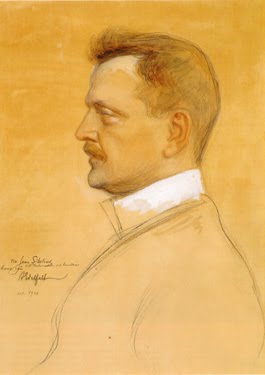
In addition to John Munsterhjelm's 1909 bronze of the composer - into which Sibelius inserted a lucky horseshoe - two of the most important portraits are to be found at Ainola. One faces you on the other side of the window to the bust as you enter the drawing room.


This is Albert Edelfeldt's study, made in 1904 as a preparatory sketch for his three-part mural in the University of Helsinki's main auditorium. I had a feeling I might get to see it on my much-anticipated visit to hear the Helsinki Philharmonic that evening. The deplorable situation with the main Finlandia Concert Hall means that either of the city's two main orchestras can be ousted if a more lucrative conference booking so decrees, and that's what happened on Thursday evening - with the result that, owing to the subscription sales outstripping the seating facilities at the university, I was told a ticket at the smaller venue would be very hard to come by. And this for a programme of Walton and Hindemith you'd be lucky to get half an audience for in London.

Anyway, I did get in, and as it turned out there were plenty of empty seats owing to the subscribers' prerogative of turning up or not (the still very large audience, though, proved a healthy mix, attentive and enthusiastic). I had the huge pleasure of top Finnish designer (and very modest gentleman) Markku Piri's company, and he took me down from our balcony seats to look at the main hall in the interval. I think that, for all his knowledge, he was rather surprised to find that Sibelius did indeed feature in the mural. There he is in the procession of figures in 17th century dress leading the Turku University inauguration, just behind Governor Per Brahe.


Forgive the pointillist overlay, but I couldn't find any better image than my own on the web. Here's a more professional shot of the handsome neoclassical hall.


It's a rather small venue for a large symphony orchestra, and there was nowhere for the Helsinki Phil players to hide from the audience. Not that they needed to: John Storgards did a splendid job with a brilliant programme, three-quarters of which I've never heard in a UK concert. First half started with Walton's Spitfire Prelude and Fugue, followed by the Hindemith Cello Concerto, its cheeky march-finale anticipating the pleasures of the more familiar Weber Metamorphoses. Spot-on Torlef Thedeen formed a true concerto partnership with this lively team (characterful principal clarinet, later first flautist and oboist, had a very individual sound). After the interval, the orchestration of Walton's Hindemith Variations, its theme derived from the slow movement of the Concerto, was pure sleek pleasure, an altogether trickier fugue to cap it all followed by a decadent slow fade. I told Markku he was in for a treat with the Turandot March of the Hindemith Variations; sure enough, he smiled and even laughed at the jazzy bit. Lots to think about, he said at the end, and so there was.

One notorious artistic glimpse of Sibelius at large in Helsinki I didn't get to see: while I've already noted the surprise of Gallen-Kallela's triptych, his celebrated take on a drinking 'symposium' at the happening Kamp Hotel was, we were told by the hotel's reception, locked in a safe. Yet there seems to be a version at the Gosta Serlachius Foundation.


No prizes for guessing why the depiction of Sibelius on the right gave him a bad name, and almost led the Jarvenpaa worthies to refuse him the land at Ainola (the other reprobates, left to right, are the artist, Merikanto and Kajanus). Another drinking bout may be the reason why Aino looks so weary in this marvellous portrait by her brother Eero Jarnefelt, hanging to the left of the Ainola dining-room entrance.


Only someone close, I reckon, could have caught that look - it reminded me of something similar in Thomas Eakins's study of his embittered wife. But I don't think Aino was embittered long-term. She looks rather jolly in some later photographs; Sibelius rarely, but there is just one equivalent to 'Garbo laughs', which seems like a good way to end this penultimate instalment about the house.

Monday, 29 March 2010

Sibelius at home


200 words in a BBC Music Magazine article on my top composer houses won't do justice to the four-plus wonderful hours I spent last Thursday at Ainola, the home of Jean and Aino Sibelius just outside Jarvenpaa, half an hour's commuter train journey from Helsinki. So I thought I'd expand on the house, the paintings and some extraordinary tributes from Sibelius's confreres in several blog entries over time.

Hilkka Helminen, the house-museum's director, met me on an icy Jarvenpaa station platform in clear blue skies - the last day, as it turned out, of the extended Finnish winter. Her love and enthusiasm for the spirit of place seemed to be reflected by the other Finns I met - with one exception, who found the house 'oppressive'. I couldn't have disagreed with him more. On a sunny winter day, with the snow gleaming outside, light flooded in from all the big windows of Lars Sonck's humble national-romantic construction.


You approach the house up a snowy track through the wooded hill - or rather I, and a few privileged others, did at this time of year because it's only open to the public from May to September (the last visitors to sign the guest book were Olli Mustonen and his family). Without the cordons that marshal the many visitors in season, and with only Hilkka to guide me, it was just like being welcomed into someone's home by the housekeeper when the hosts were absent. Because Sibelius and his wife lived here from 1904 until his peaceful death in the downstairs bedroom on 20 September 1957, and because, following Aino's death at the age of nearly 98 in 1969, the descendants - who still visit and celebrate on birthdays - passed it on to the Finnish state with all contents intact, it has more the feel of a great artist's living home than any I've visited.


The drawing room is a homely mixture of inherited antique furniture, striking paintings and, crucially, the Steinway grand which replaced an upright in 1915, when 144 admirers of Sibelius clubbed together to buy it for his 50th birthday.


Curiously, the keyboard faces a grim painting, Rukous or Prayer by Oscar Parviainen, in which a young girl is claimed by death just as in Kuolema - and in real life, though the Sibeliuses' third daughter Kirsti was little more than a year old when she died. He claimed that he needed the reminder every day when he sat at the piano. No photograph was taken, so upstairs in Aino's bedroom, part of the house not open to the public, Kirsti is represented above the five daughters who lived by a Van Dyck child.


I'll mention some of the other pictures in a later entry. Now we move into the dining room, pictured with Hilkka in the foreground.


The great green fireplace is one of only two features on which Sibelius himself insisted. Apparently he 'heard' its colour in F major - I didn't know about his synesthesia - just as another Parviainen of a funeral cortege to the left apparently resounded in D major. The dining table is seen below with more treasure paintings behind lining the staircase wall


while a small table and a window seat helped me to place that 1915 photo I posted back in 2008 when I was working on Sibelius 6 for Radio 3's Building a Library.


Off the dining room is the big kitchen and the room for the two servants who stayed with the Sibeliuses for most of their time here and the bedroom in which Sibelius died with his second study (the first was upstairs), his familiar hat and cane on a chair in the corner (pictured above).


Adjoining bedroom and dining room is the comfortable library, converted from children's rooms in 1935.


I could hardly believe I was seeing the original of the triptych with the missing third panel by the great Akseli Gallen-Kallela.


It contains his symbolic (mis)interpretation of Sibelius's 'fairy tale' En Saga with the tousled, attractive portrait and the empty panel which Sibelius refused to fill with a quotation from the tone poem. More anon on the books and the gramophone collection.

We spent the whole morning there, and I was very surprised when Hilkka offered a return visit after lunch at the excellent catering school nearby. This was when we went through the contents of the 78s and I discovered still more wonders. She was also game enough to accompany me through the thigh-deep snow to the site of the graves of Sibelius and Aino, covered at this time of year, of course


and the sauna, designed by the multitalented Aino (whose gardening skills were not, of course, evident at this time of year).


It wasn't until 3.30 that Hilkka dropped me back at Jarvenpaa station.


I was rather amused by this quartet - the old stationmaster and his wife in the photos on the wall, the new generation beneath - in the comfortable waiting room.


Then I labelled my thoughts on the crowded train back, Luonnotar once again running through my head as it had on the outward journey, before stepping out at Helsinki's famous Central Station, designed by Eliel Saarinen and opened in 1919.


To help plan your essential trip to Jarvenpaa, there are further details and photos on the Ainola website. More can be found on the individual artworks at www.sibelius.fi.