Mauri Kunnas's image of the hero setting off to war in his children's classic The Canine Kalevala is actually used to illustrate another heroic adventure in the Finnish epic, the journey of Lemminkäinen to woo the Maiden of the North, but it's still a brilliant parody of the famous Akseli Gallen-Kallela fresco which I also used as the lead image for Sebastian Scotney's review of a transformative Prom (as my notes were reprinted, it wouldn't have been right to take it for myself).

Because Lemminkäinen's mother is the real heroine of his not terribly heroic tale, there she is in Kunnas's picture trying to stop him setting out. And since this Lemminkäinen is a member of 'a small but tough clan of cats' who live between 'a tribe of wild and woolly dogs' in the land of Kalevala and 'a pack of mean and wicked wolves' in 'the gloomy North', he can't have a wolf as companion, so an old crow takes that place. Why didn't Kunnas tell the Kullervo story? Because a tragic tale of accidental incest followed by the suicides of the siblings would probably be too much for his young audience. Though he doesn't steer clear of Lemminkäinen's gruesome death in the waters of Tuonela and his mother's arrival to bring him back to life. Here's the famous original image

and Kunnas's version. The gormless Swan can just about be seen top left, while the bee is flying in to sting the corpse back into action.

We'll have a couple more of these comparisons at the end, but first I want myself to sing the praises of Sakari Oramo's amazing Proms performance with his own empurpled BBC Symphony Orchestra and nearly 140 male voices from the stunning Polytech Choir of Helsinki singing alongside the BBC Symphony Chorus. I call it 'transformative' because previously I'd had total faith in the second, third and fifth movements of Sibelius's early mythological canvas, but perhaps not the opening call to arms nor the battle. Now I think it's a masterpiece from start to finish. Never have the foreshadowings of Janáček- whose first great opera Jenůfa was still some years in the future when Kullervo was premiered in 1892 - been more striking in the speech-melodies and especially the scene where Kullervo seduces his sister. Oramo made it all sound fresh, original and gripping, doubling the woodwind parts and making sure every word could be heard from his choir, the Wagnerian lyric-dramatic soprano Johanna Rusanen-Kartano and handsome young baritone Waltteri Torikka, pictured here at a different performance.

I'll keep it general, but I have to show a selection of images from last night's performance at the Lahti Sibelius Festival, because that's where I'm heading shortly - a ceremonial duty at the Tower of London this afternoon kept me in London, more on that in a later post - and because the great Chris Christodoulou wasn't there on Saturday. These pictures, all by Juha Tanhua and uploaded onto Lahti's website with Proms-like swiftness, suggest that it was also a great occasion there too (certainly pics I haven't used of a standing ovation confirm that). The BBC Symphony Chorus men didn't travel to Lahti, but then the hall isn't quite as large as Albert's Colosseum. The Polytech men by themselves still made a huge impression, I'm told.

Sakari with his soloists looks as proud and happy as ever.

One more of the main man. Several of my pals from the BBCSO are in there too.

I ought also to include a picture of BBCSO leader on this occasion Natalie Chee. She's good enough to be a world-class soloist, as we heard last year from her part in Strauss's Suite from Le Bourgeois Gentilhomme, and I think she has what it takes to be a co- rather than just a guest leader.

Roll on the orchestra's 2015-16 season with Mahler 3; before that there's a fascinatingly programmed Nielsen/Ives Prom, and tonight in Lahti they're playing more Sibelius under great but elusive Okko Kamu, whom I see in action on Saturday with the resident orchestra.
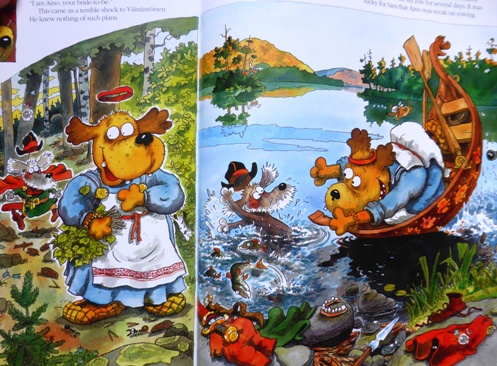
Coda: a few more Kunnas parodies: a delicious piss-take of fair Aino pursued by old man Väinämöinen. These are the two panels of the Gallen-Kallela triptych in question:

And here's Kunnas's witty reversal of roles in the central image: Aino pursues the old dog rather than vice-versa.
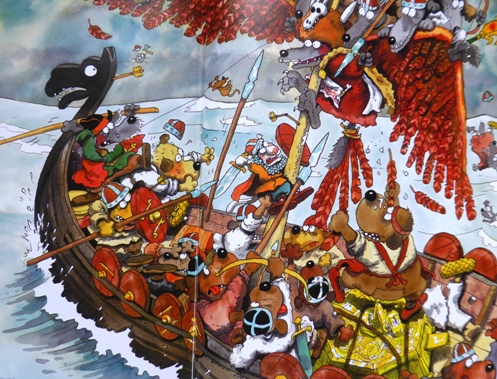
Towards the end of the saga, Väinämöinen and his crew are sailing home with the magical-properties Sampo they forged, gave to the northern folk and stole back when Louhi, crone-queen of the North, attacks them as a giant eagle.

The wolves seem to be in on this one together in The Canine Kalevala.
Still, the Kalevalan heroes all get to live happily ever after, for thanks to the all-providing Sampo, 'all of the heroic dogs' wishes were fulfilled and they were able to bid farewell to 'their wearisome wild and woolly life'. Only the cat Ahti Lemminkäinen, remaining on the outside, manages to aggravate their otherwise calm and overfed lives.


 Posts
Posts