Showing posts with label Göttingen. Show all posts

Monday, 29 May 2017

The frogs of Göttingen - and Seeburger See


Anyone who's hung around this blog for a long time may remember my account of first acquaintance with the more unexpected choruses of the Göttingen International Handel Festival, when I fell in love with the symphony of brekekekexes in the University of Göttingen's magical Botanical Gardens. On two subsequent visits, their stridency was rather muted - last year's epiphany with a mallard and his drake made amends - but not this past week. It meant a fair bit of hanging around, though, until I finally saw the above fella on one of the lilypads and, in following his progress, got the full sonic works. There's a lot of jumping, but blink and you'll miss the bubble-gum inflating to make the noise early on.


As I explained in last year's blog, the time of the Festival depends on where in the calendar the Germans' Ascension Day holiday falls. This time we were back to the end of May, when the aquilegias are flourishing


and providing a major source of nectar for the bees.


I actually got a double dose of ranine activity on the first full day of my visit to the Festival this year. Not ideal, sleepwise, since I'd got up at 5.30am on Wednesday morning for an early flight and had to do so at 3.30am on Thursday for the GIHF's second 'sunrise concert'. Still, it had to be done: my all-day Messiaenic birdsong experience at Aldeburgh last year taught me that. So after a stunning performance of  a work which came as a revelation to me, Handel's early (and pre-Bach St Matthew and John) Brockes-Passion on Wednesday evening, I decided it made sense to skip Continuum's late-night event and get something approaching four hours' sleep (by the way, all the events I did attend I'll be writing up on The Arts Desk next weekend).

As at Aldeburgh, the dawn chorus was one attraction. It seemed to be starting up in the tree-lined streets of Göttingen as I walked through the near-darkness at 4am to get the coach to our destination. But on arrival at the Seeburger See 45 minutes later, with the red glow of pre-sunrise across the lake,


the full thing was definitely in full spate. You may not see much of what I could, as  I walked through the woods near the lakeside in this short film, but you'll hear what you need to. Of course, our ranine friends soon come into earshot by a small pond.


Then I joined the few other concertgoers who hadn't gone straight into the warm on arrival


seeing this to the left
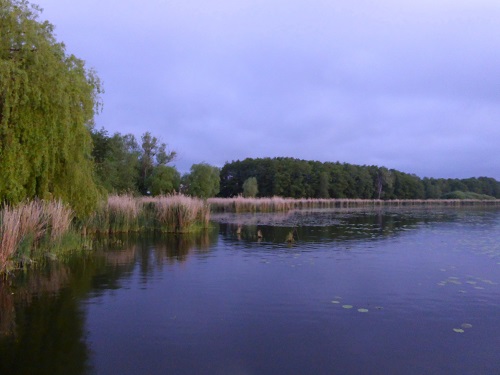

and some old boathouses to the right.


The one-hour concert began at 5am on the first floor of the Restaurant Graf Isang (est. 1925), with candles lighting our way upstairs and strategically placed in front of the surprise instrument - a clavichord, no less, the first time I've ever heard one live in concert.


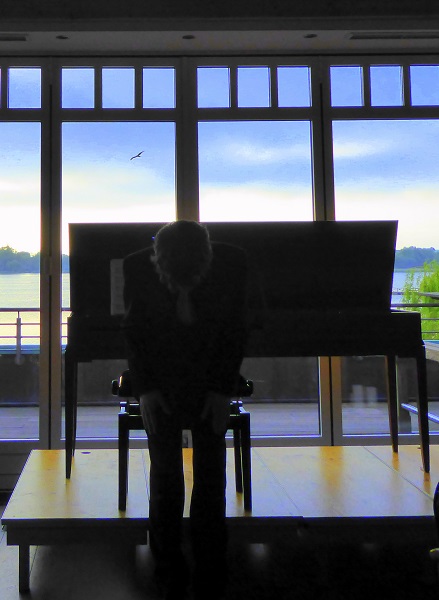
Although the actual programme is the territory of my Arts Desk piece, we must just see young Avinoam Shalev, one of the already more than promising prizewinners in which the GIHF has placed justified faith. Israeli by birth, Hanover trained and now living in The Hague, he led us into a mesmerising meditation on the sounds and colours possible within the quieter end of the dynamic range the instrument inhabits. The sun actually rose behind the willows to our left at about 5.25am, as he was in to the first movement of Haydn's G minor Sonata Hob. XVI: 44. I took this picture, of course, in a break between movements, not during, as no official photographer was present.


A bow to a wildly enthusiastic if necessarily small and select audience: note the bird of prey in the first complete window pane on the left behind our clavichordist.

The sun went behind early morning clouds - by 9am a clear blue sky would emerge - but that didn't deter me from taking my breakfast out on to the terrace.


This turned out to be a good idea, or maybe it was just a case of attracting kindred spirits, because first our coach driver, a very interesting and friendly guy called Jan who'd stood for the whole recital, asked if he could join me. Then Avinoam appeared (pictured left), followed by our chaperone Enno (who said he had to stay out of this picture so as not to block the lake view) and Lisa Kraemer from the GIHF Artists' Office.


So we had a happy time - and there was plenty of it, the coach not due to leave until an hour and a half after the concert - mainly fulminating about Brexit and Trump (the legs you may see in the background belong to a bizarre dummy who had an unfortunate resemblance to the latter). This wasn't the only occasion at Göttingen this year where I have cause to invoke the suitable observation of Kurt Vonnegut's uncle on blessed gatherings in lovely places, 'if this isn't nice, what is?'

In fact that was also true of a last meeting yesterday (Sunday) morning at our favourite haunt in Göttingen, the Cafe Botanik. Pictured here, our wonderful co-ordinator, now a friend, Victoria Viebahn, critic Luca and his friend Christian.


You may also have read on this blog before about the Botanik, still run by an Iranian whose menu is small but perfect. On a hot afternoon I had a refreshing glass of sharbat as well as a hummus plate, and yesterday saffron cake was the only option in the absence of croissants - but delicious.


Inevitably, with less than an hour to go before my train back to Hanover Airport, I had to make a last homage to the frogs, taking Victoria with me, and the inhabitants of the noisiest pond were still to be found.


Their neighbours several blocks to the south set up quite a racket, too, and this time the birds were obliging, both aurally and visually.


So I said this farewell to another inhabitant,


found another bee nectar-sipping, this time in a peony


and noted various positive signs of Germany today - funny, isn't it, how its chancellor is now officially the Leader of the Free World - including this sign in the rather deracinated part of the garden (it's now in need of more finances, and too dependent on volunteers)


and these papers and magazines on a rack inside the Cafe Botanik, snapshotting Obama's meeting with Merkel in Berlin as well as Macron, 'dear friend'*,


 and made my way back to the station via the lovely town museum, currently housing a neat little exhibition on Lutheranism arriving in Göttingen (relatively late, in 1529, with predictably disastrous consequences). Maybe more on that in a future entry, but the ensemble is irresistible.


*It actually turns out to need taking in its other meaning of 'expensive', as two folk have pointed out to me; the subheading is how Macron will cost Germany. But the leader actually ends with the conclusion that togetherness for European countries is the only way ahead.

Wednesday, 23 January 2013

Elgar the European


No doubt those Little Britainers who want to batten down the hatches against Europe will be using ‘Nimrod’ or Pomp and Circumstance yet again as the background to their frothing diatribes. Which makes me mad because no composer was more of a true European, or for that matter a true citizen of the world, than Edward Elgar (and I’m talking not of his conservative outer life but his musical world-within-world). He may have suffused his scores with the essence of Worcestershire/Herefordshire woods, hills and rivers, but that hardly amounts to callow nationalism, and it's one of the reasons I love him so deeply.

Forgive me if I repeat myself, but ‘Nimrod’ is a classic example of misrepresentation. It’s actually the portrait of an Anglicized German, A J Jaeger (pictured below), and has its roots in a summer evening conversation Elgar held with his beloved publisher friend about Beethoven’s slow movements. The result is, of course, based on the Adagio cantabile of the ‘Pathétique’ Sonata. So, music about a German based on a German. The stout and steaky tune seconds in to the first Pomp and Circumstance March? Listen to the 'Cortège de Bacchus' from Delibes’s Sylvia, a movement cited by Elgar in a different context, and you’ll hear where the rhythmic idea comes from, note for note (though not pitch for pitch). Bizet and Massenet are other strong influences.


Elgar’s phenomenal orchestration came partly from his many trips to Germany to see Wagner’s operas. There Richard Strauss hailed him, after a performance of The Dream of Gerontius, as ‘the first English progressivist’. His love of Italy follows Strauss’s example in the ‘concert overture’ (essentially tone-poem) In the South, and surfaces elsewhere when least expected. During the First World War, he didn’t so much thump a narrowly patriotic tub as show his musical solidarity with Poland and Belgium. 

More than anything, Elgar is truly international and a world-class composer, as my City Lit students agreed when we looked at the First Symphony and went to hear Andrew Litton's outstanding interpretation of it with the BBC Symphony Orchestra at the Barbican. Unfortunately my effusions over Cockaigne the following week - I was amazed to find it has no less than eight memorable themes - were undermined by the bizarre performance of it, which I heard on the Radio: the aptly named Long Yu dragged every slow passage out to an eternity. Inside information told me that the interpretation clocked in at 2m40s longer than the longest previous BBC performance (they keep records of timings, helpfully). 

Which for a 15-minute piece is absurd, of course. Elgar as conductor or Boult will put you right. Boult's Cockaigne was twinned on the original LP with the most opulent recording of the Second Symphony (though it was Boult's classic 1944 recording that I chose on Radio 3's Building a Library).


Anyway, I hope I can enlarge on some of the international and/or European aspects when I join Anthony Payne and Dr Heather Wiebe in a Royal Philharmonic Society discussion before Saturday’s performance of Gerontius.  It’s dauntingly titled  The Edwardian Era: Empire, Society and Culture, and as I can’t contribute too much to that, I’ll be hoping to sound the trumpet for Elgar as part of a wider musical movement. Also hoping to catch James MacMillan’s earlier talk exploring ‘what role faith and mysticism have in artistic vision’.

All the above is loosely connected with Cameron’s long-awaited speech today. To paraphrase a friend of a friend, what it comes down to is a case of one foot forward, two feet back, half a foot forward again: a) the European Union is OK; b) no it’s not, they all have to dance to our tune and if they don’t we’re not playing; and c) actually we’d better play after all. In a muddled message that will generate years of uncertainty, the upshot is that he renegotiates terms to get some of the UK's powers back, and then asks the British people whether they like that or not. That doesn’t account for what happens if, as seems likely, he fails to get what he wants from the other EU countries.


At least the pro-Europeans are beginning to get their voices heard in the surrounding kerfuffle. It’s high time someone of eloquence spelled out the advantages of Europe to counter all the falsehoods in the Mail and the Torygraph (apparently the press office at the European Commission sends correction after correction to the papers, but they never listen – not even the Guardian, which for some reason is giving the appalling Farage houseroom as a funny guy).

So – cue lots of facts and links – let’s try and set the record straight. If this first fact were spelled out, people might begin to think differently. It’s this: that the size of the administration is NOT bloated, as most people believe. The entire staff of all EU institutions, agencies and other bodies totals 55, 000. The Commission on its own employs 32,000 people – smaller than the staff of Birmingham City Council.

Are EU civil servants overpaid? Hardly. According to one source, ‘comparative studies confirm that the remuneration package…is similar to what is offered by other international organisations that employ expatriate staff. In fact, for many job profiles the EU civil service offers the lowest entry-level salaries amongst international organisations’.

What has the EU/EEC ever done for us? Please read this dazzling list in a letter from Simon Sweeney to The Guardian. That should do the trick. And the TUC is in no doubt of what our government’s up to here. At an Executive Committee Meeting on 15 January it declared that ‘the Government wants to take away the rights working people have gained over the last thirty years from the European Union. Social Europe has provided working people with more equality, more protection from redundancy, more information about what's happening at their workplace, as well as a shorter working week and paid holidays. The Government wants to take that away from working people, and make them work longer hours for less pay’. It goes on to point out the obvious, that Cameron’s ‘dithering’ will play havoc with our economic interests.

If you’re still with me, the full facts of EU policy can be found here (economic benefits), here (social and employment policy) and here (working time directive). Unfortunately I'm probably preaching to the converted, but it's good to have chapter and verse in hand. Now we need a really charismatic apostle to go out and fight the good fight to halt the re-feudalisation of blinkered Blighty: a recommendation also made by Polish Foreign Minister Radek Sikorski in his Blenheim Palace speech last year, full of further strong arguments from a man who might have been expected to be a Eurosceptic.

Finally, a reconciliatory footnote. 50 years ago this Tuesday de Gaulle and Adenauer joined their countries' hands together again by signing the Elysée Treaty. The BBC put up a lovely little piece about a song that encapsulated a respect regained: 'Göttingen', French chanteuse Barbara's hymn to the German university town she adored (and which I came to love at first sight two Junes ago). The sound version of the song in French there (Barbara also recorded it in German) is the best, but here's a filmed performance to complement it.


Friday, 17 June 2011

Göttingen: churches and facades


In a couple of weeks I'll be exploring for the first time one of Göttingen's twin towns, Cheltenham, which as a johnny-come-lately spa visited by Handel - only connect - shortly after its development by one Captain Skillicorn presumably doesn't have the medieval legacy of Germany's great university town. Not that Göttingen's old churches haven't been majorly restored compared to many of ours - and this, I'm told, not due to bombing (only two per cent of the town was affected in WW2, allegedly as a pact between enemies: spare Oxford and Cambridge, we won't touch Göttingen and Heidelberg). Anyway, you have to be charmed by the attempt to revive the candy columns of the 1480s in the Jacobikirche, Lutheran St James, still evangelising its good works. The gaudiness extends to the west porch.


Alas, the tower was under scaffolding, so that famous view of four churches from the marketplace was incomplete, and there was no climbing to the top. But the essential treasure is the Wandelaltar. Its outer panels show the legend of St James, the 'Sunday side' the life of Christ. When I visited the 'Festtagsseite' was on display, with statues of the prophets. Not of the sharpest, this image, but I wasn't going to use flash in the church.


The church also has the water-regurgitator from the tower, which stood outside the museum for some years and seems pleasurably pagan in this context.


A little way up Weender Strasse, past the drug addicts and down-and-outs who gather for Jacobikirche charity, is No. 62, built by cloth merchant Jürgen Hovet in 1549, abounding in mermaids and green men as well as biblical figures.


Most of the neighbouring buildings date from the 1860s.


Raphael Hahn's family at No. 60 showed its pride not only with two dates but also with stars of David. Weh mir, why do the teeth in the windows remind me of Olivier's sadistic dentist in Marathon Man?


It's worth remembering at this point that in the 1930s, along with the synagogue, the university's great tradition of science and mathematics was systematically destroyed by the Nazis. 'Jewish physics', symbolized by Einstein, had to go. In 1933 Göttingen lost most of its greatest academics. I found them duly listed, so the names must be recalled: Max Born, Victor Goldschmidt, James Franck, Eugene Wigner, Leó Szilárd, Edward Teller, Emmy Noether, Richard Courant...

Still, the university flourishes up to a point, and it has the usual necessary core of radicalism (young Germans do really make me very optimistic for the future). Up the Rote Strasse, a medieval home for a casino - which at least shows that Göttingen isn't pickled in tourist aspic -


gives way to what looks like a jolly student squat.


This is the east quarter, with the most ancient of the churches, Albanikirche, founded before 1012, a reminder of the old town.


Also in this quarter is the neoclassical Aula of the University in Wilhelmsplatz, overlooked by their and our William IV, his plinth healthily defaced


and the Junkernschränke in the splendidly named 'Bare Foot Street' once trodden by shoeless Franciscans. Built in 1446 but substantially remodelled a century later, it boasts a jutting oriel - though nothing, of course, to compare with fabulous Schaffhausen - and its brightly-repainted figures, like those of No. 62 Weender Strasse, are the German fantastical equivalent of our roof-bosses (think Norwich Cathedral especially) and misericords.


Gosh, I'm going on here in my attempt to cover all the poles, but better take a glimpse south to the much-restored St Michael's with its neobaroque tower, with the Schwarzes Bär serving up black beer (pun intended, of course) in the foreground


before moving on to the Johanniskirche as taken from Paulinerstrasse. Its unequal towers were used for different purposes - the south as the belfry, the north for the watchman to sound the fire alarm.


It was here that we heard the great blaze of Handel's coronation anthems - duly reported in my Arts Desk 'letter from...' - alongside rather less individual Lalande, expertly done by the nice young choristers and Musica Alta Ripa ensemble seen in a festival publicity shot.


I could have continued with photoreportage of the late-night venue, the Marienkirche, which is perhaps the most suggestivo of all, but you may be relieved to hear I'd stopped snapping by then and was just enjoying the mellow near-midnight vibes.

Thursday, 9 June 2011

Brekekekex alla tedesca


They'd be more appropriate as ambient noise for Rameau's Platée than Handel's Teseo, which is what I went to Göttingen to hear. But one thing's for sure: German frogs croak and ribbet their hearts out far more than any British ones I've ever come across (if anyone can direct me to a noisy pond anywhere in my vicinity, I'd be grateful). I'll never forget the wild sounds echoing over the lakes in Dessau's shaggy park when we visited friends Lottie and Andrew there during pre-unification days, and from the perhaps slightly over-manicured water-zones of Göttingen's botanic gardens came sporadic bursts of a similarly forceful projection. I took this little film for the sound rather than the picture, but watch out for a tiny bit of frog action around the 13-second mark.


Even the blackbird seems to sing louder than ours! Anyway, this is above all for Maria-Jesus, who oddly waxed lyrical about the froggy gang-bang of my Broughton entry. It's not often you get such perfect nymphaeae in bloom with ranae to boot perching on the lily-pads or, in this case, under the flower.


The Alter Botanischer Garten provided a welcome refuge on my only, baking-hot full day's sightseeing in Göttingen. Where there's a top university, there's usually a fine botanics, and this one was planned by Albrecht von Haller shortly after the academic foundation of 1737. I'm told the staffing here has dropped radically in recent years, but it seems pretty well kept to me, and it has its shaggy zones, too, almost as wild as Dessau's. So via the gunnera


to the rose garden


where Honoré de Brabant was giving off a heavenly scent


and bees buzzed around Francofurter.


I also had a decent lunch in the Botanic's easy-going cafe, run I think by an Iranian-German, hence a good array of spicy, rosewatered tea


and cardamom coffee, both of which I sampled before hitting the best sale of cacti and associated rarities I've ever come across. I baulked at the fact that I probably wouldn't get a plant through customs. Ruefully examined the exotica that I couldn't buy before taking a look at the fern house, converted in 1910 from its original 1857 use as an orangery and recently restored to its former glory.


Then it was back into town to tick off the remaining churches and exotic housefronts. Later I hired a bike from the hotel and puffed up the hill, ostensibly in search of panoramic views down on Gottingen's towers and spires. Even though I didn't have time to find one, I did marvel at the big old trees of the Hainberg forest


and the abundant wildlife; in the early evening light deer were leaping across the path in great numbers. But I had no time for further natural wonders: Handel's Coronation Anthems and Lalande's Te Deum were summoning me to the church of St John.