Showing posts with label Boris Godunov. Show all posts
Saturday, 2 April 2016
Barry and Jones at the Frontline
Alas, a 'Twin Peaks' event, as the composer wryly put it, was not to be. Gerald Barry had a slipped disc so couldn't fly over from Ireland to join us at the Frontline Club* on 14 March, but Richard Jones made it, after rearrangement, an hour earlier than scheduled, since there was a final lighting rehearsal from 3-6pm at the Royal Opera before his new production of Musorgsky's Boris Godunov opened that evening. And very, very grateful we were to him for that.
Likewise to Gerald, who came along on 29 March before HIS first night, albeit a revival of The Importance of Being Earnest.
Ask any of the students from my Opera in Depth class who made the talks, and each will tell you both visitors were such fun as well as eye-opening with regard to the mysteries of composing and directing. Let's take the first in order of appearance. Richard, who's visited three times now, still seemed rather startled that we'd spent six weeks on the two versions of Boris (he does bemusement well).
When he summoned me to a preliminary chat about Musorgsky's masterpiece over a year before the production, he was toying with all sorts of ideas, admitted he loved the different atmosphere of the Polish act in the revision, not to mention the Kromy Forest scene which replaced the encounter between tsar and Yurodivy outside St Basil's Cathedral, at least in 1872 (Tarkovsky's so-called 'supersaturated' edition at Covent Garden included both). Ultimately, though, it was Kasper Holten's choice, and he wanted unadulterated 1869 since the Royal Opera hadn't done it. Below: Bryn Terfel as a troubled Boris in the Coronation Scene, one of two images by Catherine Ashmore for the Royal Opera.
My feeling is that too many other companies havc, and Richard admitted that it's quite cerebral, mostly keeping the viewer at an emotional distance - through a glass darkly, as it were. But, struck as I was this morning by watching an interview with Martyn Brabbins, it's clear that what he said about conductors, at least of new works, applies to directors too: they are re-creators, artisans who work with the given material. Jones, of course, is a visionary artisan and only he could take a single line from the text - when Shuisky describes the corpse of the murdered tsarevich Dmitry still clutching a spinning top - to permeate the entire ritual. The killing of a masked, red-headed 'child' is repeated at crucial points, and the parallels with Boris's own son, not always brought out, are marked here both by another red wig and the pathos of a treble to sing Fyodor.
I've written all about this typically thoughtful, engaging and haunting production over on The Arts Desk, so no need to repeat myself here. I should mention, though, that in class I ended up using far more of Calixto Bieito's Munich vision than I'd intended - partly because that's undiluted 1869, unlike every other version which had promised to be so, partly because the relationships seemed so much more real than several of the other DVD versions (though it's always good to reference the post-Chaliapin melodramatic style incarnated in Nesterenko and others). I still think Bieito's productions, with its law of diminishing returns on the violence as usual, has the best Boris death scene thanks to the extraordinary and harrowing portrayal of Alexander Tsymbaluk.
Terfel would certainly repay another look, though, especially in the close-ups of the livescreening (which I guess I can see when it appears on DVD, as it must). Subtle, nuanced, of a piece with Pappano's precise fusion of stage action and orchestral commentary. Richard talked about this essential collaboration, and I don't think it's a betrayal of what he told us to mention that he felt his Gianni Schicchi had worked less well this time simply because the conductor, the very good Nicola Luisotti, was more pit-involved - I got the sense that also meant self-involved - than Pappano had been. After he'd gone, we watched the original Schicchi and I marvelled especially at how superbly the young, handsome tenor playing Rinuccio, Francesco Demuro, used his hands to lead his body and express his lines in a way that only Jones seems to be able to get.
Richard was happy with the performances of his singer-actors in this Boris, especially a very relaxed John Tomlinson and the relationship that Terfel's Boris had developed with John Graham-Hall's Shuisky: they had evolved between them a sense of class distinctions, though their director wasn't quite sure that came across and, costuming apart, it didn't. Otherwise, it seemed to have been a wholly positive experience and I hope we'll have a Khovanshchina from him anon. And I breathe a sigh of relief that the first collaboration between RJ and Mark Wigglesworth at the beginning of ENO's next season - I know what it is but still can't say - should still be going ahead.
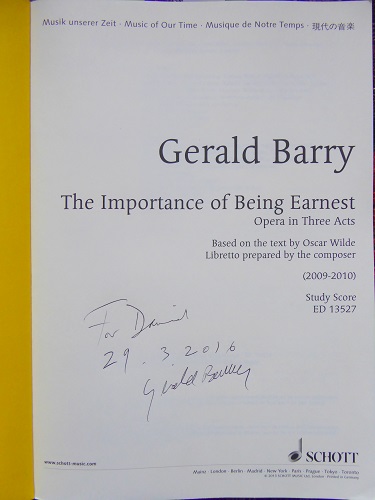
It seems to me, the more I study The Importance of Being Earnest in its pared-down but hysteriaed up operatic version, that Gerald Barry composes in one way at least much as Richard Jones directs: he takes a brilliant and original gesture or style and mines but never over-exploits it before moving on to the next idea. Certainly he hates the idea of chaos onstage, and Earnest is anything but. He and RJ worked together on The Bitter Tears of Petra von Kant - wish Richard had been with him to enlarge on that, since he'd told me that the cast spent every day crying, without explanation - and they undoubtedly will again. But possibly not on Barry's Alice opera, which receives its Barbican concert premiere later this year: 'he told me he'd only direct if I didn't put either "Alice" or "Wonderland" in the title'. The latter has been obviated by calling it, as Carroll did his original, Alice's Adventures Under Ground, but can RJ accept the unavoidable name?
Time will tell. Meanwhile, we heard about Barry's surprise at the LA premiere of Earnest when the audience laughed; he had, quite a bit, while working on it, but at first was disconcerted by the noise. He seemed to have a special attachment to Anthony McDonald's Irish-based production among the few to date, but on a second viewing, I still think Ramin Gray's update is very successful and, above all, directly communicative both between singers and orchestra onstage and - crucially - between singers and audience (below image of the entire cast, Hilary Summers' Miss Prism being ganged up on in the denouement, by Stephen Cummiskey). Here's the rave on The Arts Desk. We talked about the very precise if deliberately skewed word-setting, and GB gave us a magnificent demonstration of Lady Bracknell speaking in a monotone. He's a bass, so maybe we'll get his version on stage ere long.
With Gerald's permission, I tried to record the talk, but my mp3 stopped after 30 minutes because I had no idea it was reaching its capacity of interviews and I hadn't wiped any. Might be nice to transcribe what I've got, so maybe I'll wind up here for now. Just to add that, having spent a successful class and a half on the opera before Gerald's visit, once he'd left to go back to his London lodging and change for the evening, I took the liberty of repeating the extraordinary megaphoned spat between Cecily and Gwendolen, as punctuated by the smashing of 40 plates, wind machine(s), jackboots, telephone and gun. Here's the Cecily of Claudia Boyle, the major and splendid new addition to the original cast.
I set it up for comparison with the hit-and-miss version in Anthony Asquith's film, with Dorothy Tutin and the inimitable Joan Greenwood (I saw her once, at the Savage Club's Roy Plomley Memorial Concert, declaiming Liszt melodramas in English with Rhonda Gillespie at the piano. Elisabeth Welch and Frankie Howerd were among the other performers - quite an evening).
Unexpected coda to the Jones 'n Schicchi afternoon was a special guest, my good friend Chris Gunness's 18-year-old nephew Andrew Lavelle, playing movements from Bach Cello Suites as transcribed for viola. This was a spontaneous happening to an audience of five after the rest had left; Andrew had picked up the instrument for trial from a London shop so it was chance that he had it with him. I should add that I didn't take the photo until he'd finished his official mini-concert, just got him to fiddle a bit more for the camera.
Andrew had recently auditioned for the major American music schools and colleges; after he'd returned to Texas, we heard first that Juilliard had offered him a scholarship, then that the New England Conservatory and Cleveland Institute of Music had followed suit. Of course I hope he goes to New York but it depends very much on who's the right teacher for him. He was gratifyingly swept up by the Schicchi film and fascinated, as which true musician wouldn't be, by the infinite possibilities of London. He also took the pics of Richard and me at the end of the talk, for which I'm very grateful.
If you haven't seen or got tickets for the Barbican performances of Earnest, it's being livestreamed on the Royal Opera's YouTube channel tonight and will be available there for the next month. I hold to the belief that it's one of the handful of operatic masterpieces I've experienced in my lifetime close to the premiere - the others are Nixon in China (the other Adams operas come very close) and James MacMillan's The Sacrifice. Time and closer acquaintance only confirm the hunch. Let's hope Alice can make the grade, too. Given Barry's fascination with the balance of fantasy and precision, which he shares with both Wilde and Carroll, it should.
In the meantime, if you're interested, there are still some places available for the summer term of Opera in Depth - 10 glorious weeks on Tristan und Isolde, starting on Monday 18 April, regular time of 2.30-4.30pm. If you don't have my e-mail address, leave me a message with yours, I won't print it and I'll reply in turn.
*In replying to a malicious attack in The Spectator online (who reads it, anyway?), Frontline founder Vaughan Smith provided a good introduction to the Club in a Guardian article here. I need hardly add that I'm very proud to support it by hiring the top floor on Monday afternoons. Whilst I don't get to talk to the other members, the staff have been wonderful throughout and I find it an incredibly welcoming place with the best facilities.
Saturday, 13 February 2016
Tsars now and then
This one
stands roughly in relation to that one
as did Boris Godunov (c.1551-1605)
to Ivan IV, 'the Terrible' (1530-1584)
Why do I make the point? Because until Russian history stops repeating itself, we are likely to go back to truth-telling poets of the past to find the present in what they write. It was a scene in Pushkin's Shakespearean history-drama Boris Godunov not in either of Musorgsky's operatic versions which pulled me up short in the opera class last week. The poet uses one of his ancestors, a not exactly admirable plotting noble, to make the second of the comparisons above. 'He rules as did Ivan,' claims Afanasy Pushkin in James E Falen's admirable trnalsation:
What good that public hangings are no more;
That on a bloody stake, for all to see,
No longer do we sing our hymns to Christ;
That we're not burnt alive upon the square,
The Tsar to rake our ashes with his staff?
Are our poor lives in any way more safe?
We're threatened every day with some disgrace:
Siberia...the dungeon...or the cowl,
And there, in some forsaken place, to die
From hunger or a strangler's knotted rope...
Remove the religious associations - though those, of course, are coming back under a repressive Patriarch - and subtitute the psychiatric ward and the carefully chosen poison* for the cowl and the strangler, and you have a proper equivalent to how Putin wields his power as a Stalin for our times. In one way, it's devilish cunning: as Peter Pomerantsev puts it in his giddying evocation of his recent years in Russia, Nothing is True and Everything is Possible, this political system thrives on 'democratic rhetoric and undemocratic intent'. Plus the belief that if you lie often enough, people might start to believe you (look at Medvedev's bare-faced declaration that Russia is not bombing anybody but IS in Syria, that the west is creating a cold war. The Lithuanian President retorted that Russia is doing everything it can to make this a hot war.
Pomerantsev's subjects are chosen and paraded to give a lurid whirligig of absurdity and horror. He worked on Russian TV documentaries, so he knows that state control of Ostankino is making the country into one big grotesque (non) reality show. He gives us a terrifying portrait of Vladislav Surkov (pictured below speaking for his horrible creation Nashi, the new version of the Hitler Youth), the clever, cynical amoralist who has 'privatised the Russian political system', whose style of authoritarianism 'climbs inside all ideologies and movements, exploiting and rendering them absurd...The Kremlin's idea is to own all forms of political discourse, to not let any independent movement develop outside of its walls. Its Moscow can feel like an oligarchy in the morning and a democracy in the afternoon, a monarchy for dinner and a totalitarian state for bedtime'.
The different aspects are tellingly exemplified: the models and mistresses whose coaches turn back to pumpkins when their multi-timing masters have tired of them, and who turn to the kind of cults not unknown here but operating on a more sinister scale there, a route ending in madness and suicide; the businesswomen who finds herself, totally innocent, caught in the mesh of corruption and an imprisonment which she's told can only be terminated by a large bribe to a lawyer - she turns to another route which only works because of a bigger political expediency; the hood who's a hero in his home town; the brutality facing army conscripts; the Russian 'offshore' in the rest of the world; the very differing fates of the former oligarchs now that all wealth is under state control: and the wholesale destruction of old Moscow - I knew very little about this and haven't been back since 2000 - so all businesses can be physically close to the Kremlin, the dead centre of all things.
What's fast being knocked down is chronicled by one of the few good guys in the book, Alexander Mozhayev, a kind of architectural Pimen (and definitely not to be confused with the pro-Russian separatist). What's going up, in the plethora of kitsch styles, includes such throwbacks to the 1950s as this
and this.
All government-approved politicians are adept at using the jargon of western capitalist companies, a trick learned by the proliferation of the latter in Russia during the 1990s. And everyone plays the game, knowingly or not; a dissident individual or organisation can be given a brief limelight, only to be dragged out of the spotlight the next day.
In fact this is the most potent aspect of the whole thing which reminds me what I read about Stalin's game - the rules could be changed daily or by the week, so that no-one ever knew where they stood. Keep everyone in a state of fear. At the moment, this is why it's impossible to win within the country, though some unimaginably brave individuals still keep on trying. Eventually this madness has to come to an end, but will Putin have succeeded in his biggest wish, to drag down Europe before Russia itself totally implodes? I know this: that I have never lived through worse times for the world. This article on The Interpreter, superbly expressed, offers no comfort at all.
We have our own Surkovs, of course, though they're not as clever. Thankfully we also have the freedom to bring pressure to remove them. It's hard work but it can be done.
Please sign this UK Government and Parliament petition against one of the biggest liars in the Conservative Party (and that's saying something) before he takes our precious NHS beyond repair. A reminder, too, that the ENO needs saving from its own management in a microcosm of what's happening with the junior doctors (chorus and orchestra shouldn't be in the line of fire). If you haven't already done so, sign and comment on The Spirit of Lilian Baylis's petition.
stands roughly in relation to that one
as did Boris Godunov (c.1551-1605)
to Ivan IV, 'the Terrible' (1530-1584)
Why do I make the point? Because until Russian history stops repeating itself, we are likely to go back to truth-telling poets of the past to find the present in what they write. It was a scene in Pushkin's Shakespearean history-drama Boris Godunov not in either of Musorgsky's operatic versions which pulled me up short in the opera class last week. The poet uses one of his ancestors, a not exactly admirable plotting noble, to make the second of the comparisons above. 'He rules as did Ivan,' claims Afanasy Pushkin in James E Falen's admirable trnalsation:
What good that public hangings are no more;
That on a bloody stake, for all to see,
No longer do we sing our hymns to Christ;
That we're not burnt alive upon the square,
The Tsar to rake our ashes with his staff?
Are our poor lives in any way more safe?
We're threatened every day with some disgrace:
Siberia...the dungeon...or the cowl,
And there, in some forsaken place, to die
From hunger or a strangler's knotted rope...
Remove the religious associations - though those, of course, are coming back under a repressive Patriarch - and subtitute the psychiatric ward and the carefully chosen poison* for the cowl and the strangler, and you have a proper equivalent to how Putin wields his power as a Stalin for our times. In one way, it's devilish cunning: as Peter Pomerantsev puts it in his giddying evocation of his recent years in Russia, Nothing is True and Everything is Possible, this political system thrives on 'democratic rhetoric and undemocratic intent'. Plus the belief that if you lie often enough, people might start to believe you (look at Medvedev's bare-faced declaration that Russia is not bombing anybody but IS in Syria, that the west is creating a cold war. The Lithuanian President retorted that Russia is doing everything it can to make this a hot war.
Pomerantsev's subjects are chosen and paraded to give a lurid whirligig of absurdity and horror. He worked on Russian TV documentaries, so he knows that state control of Ostankino is making the country into one big grotesque (non) reality show. He gives us a terrifying portrait of Vladislav Surkov (pictured below speaking for his horrible creation Nashi, the new version of the Hitler Youth), the clever, cynical amoralist who has 'privatised the Russian political system', whose style of authoritarianism 'climbs inside all ideologies and movements, exploiting and rendering them absurd...The Kremlin's idea is to own all forms of political discourse, to not let any independent movement develop outside of its walls. Its Moscow can feel like an oligarchy in the morning and a democracy in the afternoon, a monarchy for dinner and a totalitarian state for bedtime'.
The different aspects are tellingly exemplified: the models and mistresses whose coaches turn back to pumpkins when their multi-timing masters have tired of them, and who turn to the kind of cults not unknown here but operating on a more sinister scale there, a route ending in madness and suicide; the businesswomen who finds herself, totally innocent, caught in the mesh of corruption and an imprisonment which she's told can only be terminated by a large bribe to a lawyer - she turns to another route which only works because of a bigger political expediency; the hood who's a hero in his home town; the brutality facing army conscripts; the Russian 'offshore' in the rest of the world; the very differing fates of the former oligarchs now that all wealth is under state control: and the wholesale destruction of old Moscow - I knew very little about this and haven't been back since 2000 - so all businesses can be physically close to the Kremlin, the dead centre of all things.
What's fast being knocked down is chronicled by one of the few good guys in the book, Alexander Mozhayev, a kind of architectural Pimen (and definitely not to be confused with the pro-Russian separatist). What's going up, in the plethora of kitsch styles, includes such throwbacks to the 1950s as this
and this.
All government-approved politicians are adept at using the jargon of western capitalist companies, a trick learned by the proliferation of the latter in Russia during the 1990s. And everyone plays the game, knowingly or not; a dissident individual or organisation can be given a brief limelight, only to be dragged out of the spotlight the next day.
In fact this is the most potent aspect of the whole thing which reminds me what I read about Stalin's game - the rules could be changed daily or by the week, so that no-one ever knew where they stood. Keep everyone in a state of fear. At the moment, this is why it's impossible to win within the country, though some unimaginably brave individuals still keep on trying. Eventually this madness has to come to an end, but will Putin have succeeded in his biggest wish, to drag down Europe before Russia itself totally implodes? I know this: that I have never lived through worse times for the world. This article on The Interpreter, superbly expressed, offers no comfort at all.
We have our own Surkovs, of course, though they're not as clever. Thankfully we also have the freedom to bring pressure to remove them. It's hard work but it can be done.
Please sign this UK Government and Parliament petition against one of the biggest liars in the Conservative Party (and that's saying something) before he takes our precious NHS beyond repair. A reminder, too, that the ENO needs saving from its own management in a microcosm of what's happening with the junior doctors (chorus and orchestra shouldn't be in the line of fire). If you haven't already done so, sign and comment on The Spirit of Lilian Baylis's petition.
*17/2 Monday's announcement of the death of Nikita Kamayev, former head of Russia's anti-doping agency Rusada, prompts the worst thoughts in the wake of the doping scandal. A heart attack at 52? Well, it's Russia and men die young there, but still...he's the second person in the organisation to disappear conveniently from the picture within the past couple of months.
Subscribe to:
Posts (Atom)


