Showing posts with label Oscar Wilde. Show all posts

Saturday, 2 April 2016

Barry and Jones at the Frontline


Alas, a 'Twin Peaks' event, as the composer wryly put it, was not to be. Gerald Barry had a slipped disc so couldn't fly over from Ireland to join us at the Frontline Club* on 14 March, but Richard Jones made it, after rearrangement, an hour earlier than scheduled, since there was a final lighting rehearsal from 3-6pm at the Royal Opera before his new production of Musorgsky's Boris Godunov opened that evening. And very, very grateful we were to him for that.


Likewise to Gerald, who came along on 29 March before HIS first night, albeit a revival of The Importance of Being Earnest.


Ask any of the students from my Opera in Depth class who made the talks, and each will tell you both visitors were such fun as well as eye-opening with regard to the mysteries of composing and directing. Let's take the first in order of appearance. Richard, who's visited three times now, still seemed rather startled that we'd spent six weeks on the two versions of Boris (he does bemusement well).

When he summoned me to a preliminary chat about Musorgsky's masterpiece over a year before the production, he was toying with all sorts of ideas, admitted he loved the different atmosphere of the Polish act in the revision, not to mention the Kromy Forest scene which replaced the encounter between tsar and Yurodivy outside St Basil's Cathedral, at least in 1872 (Tarkovsky's so-called 'supersaturated' edition at Covent Garden included both). Ultimately, though, it was Kasper Holten's choice, and he wanted unadulterated 1869 since the Royal Opera hadn't done it. Below: Bryn Terfel as a troubled Boris in the Coronation Scene, one of two images by Catherine Ashmore for the Royal Opera.


My feeling is that too many other companies havc, and Richard admitted that it's quite cerebral, mostly keeping the viewer at an emotional distance - through a glass darkly, as it were. But, struck as I was this morning by watching an interview with Martyn Brabbins, it's clear that what he said about conductors, at least of new works, applies to directors too: they are re-creators, artisans who work with the given material. Jones, of course, is a visionary artisan and only he could take a single line from the text - when Shuisky describes the corpse of the murdered tsarevich Dmitry still clutching a spinning top - to permeate the entire ritual. The killing of a masked, red-headed 'child' is repeated at crucial points, and the parallels with Boris's own son, not always brought out, are marked here both by another red wig and the pathos of a treble to sing Fyodor.


I've written all about this typically thoughtful, engaging and haunting production over on The Arts Desk, so no need to repeat myself here. I should mention, though, that in class I ended up using far more of Calixto Bieito's Munich vision than I'd intended - partly because that's undiluted 1869, unlike every other version which had promised to be so, partly because the relationships seemed so much more real than several of the other DVD versions (though it's always good to reference the post-Chaliapin melodramatic style incarnated in Nesterenko and others). I still think Bieito's productions, with its law of diminishing returns on the violence as usual, has the best Boris death scene thanks to the extraordinary and harrowing portrayal of Alexander Tsymbaluk.


Terfel would certainly repay another look, though, especially in the close-ups of the livescreening (which I guess I can see when it appears on DVD, as it must). Subtle, nuanced, of a piece with Pappano's precise fusion of stage action and orchestral commentary. Richard talked about this essential collaboration, and I don't think it's a betrayal of what he told us to mention that he felt his Gianni Schicchi had worked less well this time simply because the conductor, the very good Nicola Luisotti, was more pit-involved - I got the sense that also meant self-involved - than Pappano had been. After he'd gone, we watched the original Schicchi and I marvelled especially at how superbly the young, handsome tenor playing Rinuccio, Francesco Demuro, used his hands to lead his body and express his lines in a way that only Jones seems to be able to get.


Richard was happy with the performances of his singer-actors in this Boris, especially a very relaxed John Tomlinson and the relationship that Terfel's Boris had developed with John Graham-Hall's Shuisky: they had evolved between them a sense of class distinctions, though their director wasn't quite sure that came across and, costuming apart, it didn't. Otherwise, it seemed to have been a wholly positive experience and I hope we'll have a Khovanshchina from him anon. And I breathe a sigh of relief that the first collaboration between RJ and Mark Wigglesworth at the beginning of ENO's next season - I know what it is but still can't say - should still be going ahead.
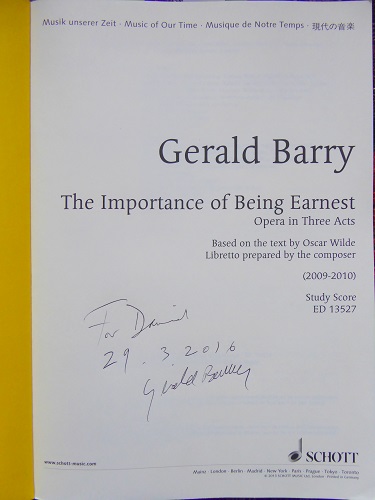

It seems to me, the more I study The Importance of Being Earnest in its pared-down but hysteriaed up operatic version, that Gerald Barry composes in one way at least much as Richard Jones directs: he takes a brilliant and original gesture or style and mines but never over-exploits it before moving on to the next idea. Certainly he hates the idea of chaos onstage, and Earnest is anything but. He and RJ worked together on The Bitter Tears of Petra von Kant - wish Richard had been with him to enlarge on that, since he'd told me that the cast spent every day crying, without explanation - and they undoubtedly will again. But possibly not on Barry's Alice opera, which receives its Barbican concert premiere later this year: 'he told me he'd only direct if I didn't put either "Alice" or "Wonderland" in the title'. The latter has been obviated by calling it, as Carroll did his original, Alice's Adventures Under Ground, but can RJ accept the unavoidable name?


Time will tell. Meanwhile, we heard about Barry's surprise at the LA premiere of Earnest when the audience laughed; he had, quite a bit, while working on it, but at first was disconcerted by the noise. He seemed to have a special attachment to Anthony McDonald's Irish-based production among the few to date, but on a second viewing, I still think Ramin Gray's update is very successful and, above all, directly communicative both between singers and orchestra onstage and - crucially - between singers and audience (below image of the entire cast, Hilary Summers' Miss Prism being ganged up on in the denouement, by Stephen Cummiskey). Here's the rave on The Arts Desk. We talked about the very precise if deliberately skewed word-setting, and GB gave us a magnificent demonstration of Lady Bracknell speaking in a monotone. He's a bass, so maybe we'll get his version on stage ere long.


With Gerald's permission, I tried to record the talk, but my mp3 stopped after 30 minutes because I had no idea it was reaching its capacity of interviews and I hadn't wiped any. Might be nice to transcribe what I've got, so maybe I'll wind up here for now. Just to add that, having spent a successful class and a half on the opera before Gerald's visit, once he'd left to go back to his London lodging and change for the evening,  I took the liberty of repeating the extraordinary megaphoned spat between Cecily and Gwendolen, as punctuated by the smashing of 40 plates, wind machine(s), jackboots, telephone and gun. Here's the Cecily of Claudia Boyle, the major and splendid new addition to the original cast.


I set it up for comparison with the hit-and-miss version in Anthony Asquith's film, with Dorothy Tutin and the inimitable Joan Greenwood (I saw her once, at the Savage Club's Roy Plomley Memorial Concert, declaiming Liszt melodramas in English with Rhonda Gillespie at the piano. Elisabeth Welch and Frankie Howerd were among the other performers - quite an evening).


Unexpected coda to the Jones 'n Schicchi afternoon was a special guest, my good friend Chris Gunness's 18-year-old nephew Andrew Lavelle, playing movements from Bach Cello Suites as transcribed for viola. This was a spontaneous happening to an audience of five after the rest had left; Andrew had picked up the instrument for trial from a London shop so it was chance that he had it with him. I should add that I didn't take the photo until he'd finished his official mini-concert, just got him to fiddle a bit more for the camera.


Andrew had recently auditioned for the major American music schools and colleges; after he'd returned to Texas, we heard first that Juilliard had offered him a scholarship, then that the New England Conservatory and Cleveland Institute of Music had followed suit. Of course I hope he goes to New York but it depends very much on who's the right teacher for him. He was gratifyingly swept up by the Schicchi film and fascinated, as which true musician wouldn't be, by the infinite possibilities of London. He also took the pics of Richard and me at the end of the talk, for which I'm very grateful.

If you haven't seen or got tickets for the Barbican performances of Earnest, it's being livestreamed on the Royal Opera's YouTube channel tonight and will be available there for the next month. I hold to the belief that it's one of the handful of operatic masterpieces I've experienced in my lifetime close to the premiere - the others are Nixon in China (the other Adams operas come very close) and James MacMillan's The Sacrifice. Time and closer acquaintance only confirm the hunch. Let's hope Alice can make the grade, too. Given Barry's fascination with the balance of fantasy and precision, which he shares with both Wilde and Carroll, it should.

In the meantime, if you're interested, there are still some places available for the summer term of Opera in Depth - 10 glorious weeks on Tristan und Isolde, starting on Monday 18 April, regular time of 2.30-4.30pm. If you don't have my e-mail address, leave me a message with yours, I won't print it and I'll reply in turn.

*In replying to a malicious attack in The Spectator online (who reads it, anyway?), Frontline founder Vaughan Smith provided a good introduction to the Club in a Guardian article here. I need hardly add that I'm very proud to support it by hiring the top floor on Monday afternoons. Whilst I don't get to talk to the other members, the staff have been wonderful throughout and I find it an incredibly welcoming place with the best facilities.

Sunday, 23 June 2013

The importance of composing comedy


Great comic opera, that is. Let's say it with carnation flinging and shout it through megaphones: the filleted-Wilde, stylised anarchy that is Gerald Barry's The Importance of Being Earnest has to be the best work of musical theatre since MacMillan's The Sacrifice. At times it's tear-jerkingly funny, always contradictory and unexpected (in the first of Stephen Cummiskey's production photos above, that's Miss Prism on the left as played by Hilary Summers, not Lady Bracknell, who's the pin striped gentleman in the ensemble).

Lucky those who were present at the already historic Barbican concert performance last year. As was my hard-to-please Arts Desk colleague Igor, who wrote a dazzling review of it but was less impressed by the first UK staging in the Royal Opera's Linbury Theatre. I couldn't fault it as a production. We got into the final performance yesterday evening only at the last minute, when nice Emily Benson in Kasper Holten's office found a couple of tickets to buy (the show was sold out the minute booking opened). And was it worth it.

As the best chamber opera, surely, since Britten's The Turn of the Screw, Barry's Earnest could not be better placed than it was in the Linbury, on Ben Clark's stage of shallow steps with the superlative Britten Sinfonia's ensemble of 22 players, flawless under Tim Murray, taking up half the space and the singing-actors, along with minimal props including a plate-rack and vases of white flowers, the rest.


Since the music goes against the grain of Wilde's crisp if subversive Victoriana, scattergunning a perceived subtext of rage, director Ramin Gray underlined the absurdity with an everyday contemporary look going increasingly awry - but not, dramatically speaking, out of control or overegged. Lady Bracknell was taken for granted as a megalomaniac businessman, the lovers ordinary young people - until they opened their mouths. Franz Peter David's quick-change lighting was a stripped-down version of the wonders Mimi Jordan Sherin is simultaneously achieving in the main house's Gloriana - what a parallel universe - and Christina Cunningham's costume colour scheme clashed deliciously.

Barry's style is now unmistakeable: the text is pattered out, sometimes robotically, on regular beats while the wind- and brass-dominated ensemble burps and shrieks between the words. The fury beneath what's said or sung is blatantly exposed. I first realised Barry's genius, having been totally baffled by his first opera The Intelligence Park at the Almeida, when English National Opera got Richard Jones to stage The Bitter Tears of Petra von Kant: now there was a Prelude to grab you by the scruff of the neck.

The abrasive style could quickly become wearing and/or enervating. But Barry is a master of scenic contrast. Lady Bracknell and Jack repeat some of their lines to a G&S jig-duet; there are two hilarious non-Beethovenesque settings of Schiller's Ode to Joy for bass and contralto in first and second acts respectively (if the Ninth Symphony has been re-ordered therein, I couldn't make it out); and many of the orchestral interludes grab the imagination. Horns buzz like monster-mutant flies or bees in between the Act Two pastoral and there's a refrain punctuating one-note declamation which for some odd reason reminded me of Strauss in Ariadne mode, very memorable. The four-note refrain in the introduction to Act Three is unforgettable, and the players' vocal participations a delight.


Hysterical highlight, though, is a Cecily v Gwendolen bitchfest as funny as in the Australian two-hander Wilde production I saw in the Barbican's Pit, where drag Gwendolen was a bunny-boiler from the start. Timed declamation through megaphones is punctuated by the ear-splitting smash-up of plates by percussionist Helen Edordu (above with Stephanie Marshall's Gwendolen), complemented by mallet, welly boots, buzzer, pistol shots and wind-machine: the wildest operatic percussion tour de force since the mould-breaking chase in Shostakovich's The Nose.


The vocal writing is of an insanely wide compass. The two singers who coped with it most flawlessly were the dazzling high/coloratura soprano Ida Falk Winland (above) and tenor Paul Curievici, more impactful lovers than the perfectly good Marshall and the OK Benedict Nelson (below,  Curievici with Marshall).


Alan Ewing's Bracknell and Hilary Summers's Prism, consummate actors both, had a bit more trouble with the upper reaches; but then Barry probably wants the sense of strain. Anyhow, the musically irreproachable ensemble work's the thing. Though, sadly, the Linbury performances are now over, this opera will run and run. Must get hold of the full score and can't wait for the NMC release of the Barbican concert recording, scheduled for release later this year. On a more pressing note, finally, don't forget the livescreening to cinemas around the world of the Royal Opera Gloriana tomorrow. There's a link which should eventually get you to venues at the foot of my Arts Desk review.

28/8  Trying to track down the plate-smashing duet for Sue Scheid, I found various short clips in amongst interesting talking heads, but perhaps the most intriguing snippet is here with Gerald Barry demonstrating alongside Thomas Adès. Stephen Fry seems fixated on the play in this five-minute precis of a 28 minute conversation and hasn't seen the opera, but he does come up with the treasurable image of Barry's applying a machete to a soufflé.

Thursday, 6 May 2010

Three Oxford colleges


And the good news is that most of the inmates favour the Lib Dems, at least according to my adorable mole Carla of Magdalen, who gets to vote for the first time. No doubt there's a neoBullingdon bunch of hearties who actually like the look of Cameron's smug face, as Carla's boyfriend and his mates emphatically do not. But I think I'm right in saying that Oxford central is surefire Lib Dem territory, as my own borough, sadly, is not.

Until I took the train to Oxford on Saturday and read The Guardian from cover to cover - something I very rarely do - I felt honour-bound to take one of two options: vote Green, because that was the only party which bothered to reply to my local ecological concerns, or Lib Dem. Then Polly Toynbee told me I must bow to an imperfect system and vote tactically. So it's Labour again, though I seethe with resentment at injustices both here and nationwide. The die is cast. But PLEASE don't think your vote doesn't count, or all parties are the same. The fact that we live in a flawed democracy is such a luxury.


For the nostalgic visitor to Oxford, though, such questions are suspended. I'm deep in Dorothy L Sayers's most autobiographical novel, and probably her masterpiece, Gaudy Night, in which Harriet Vane, writer of detective novels, returns to her old college in middle age for a 'gaudy'.

If only one could come back to this quiet place, where only intellectual achievement counted; if one could work here steadily and obscurely at some close-knit piece of reasoning, undistracted and uncorrupted by agents, contracts, publishers, blurb-writers, interviewers, fan-mail, autograph-hunters, notoriety-hunters, and competitors; abolishing personal contacts, personal spites, personal jealousies; getting one's teeth into something dull and durable; maturing into solidity like the Shrewsbury beeches - then, one might be able to forget the wreck and chaos of the past, or see it, at any rate, in a truer proportion. Because, in a sense, it was not important. The fact that one had loved and sinned and suffered and escaped death was of far less ultimate moment than a single footnote in a dim academic journal establishing the priority of a manuscript or restoring a lost iota subscript. It was the hand to hand struggle with the insistent personalities of other people, all pushing for a place in the limelight, that made the accidents of one's own personal adventure bulk so large in the scheme of things.

But she doubted whether she were now capable of any such withdrawal. She had long ago taken the step that put the grey-walled paradise of Oxford behind her. No one can bathe in the same river twice, not even in the Isis. She would be impatient of that narrow serenity - or so she told herself.


We lapped up that 'narrow serenity' after a lunch in the converted church that is Freud's cafe - mediocre food (including an unspeakable crumble), superb atmosphere and service (though not, of course, in this crumbling shrine, of the religious sort).


Worcester College was open for the afternoon, that 18th century 'ornamental pile' adding to the monastic buildings of the former Gloucester College, of which the medieval south side of the Quad remains (back side pictured above). The handsome north range, seen here from the Hawksmoor-inspired facade, dates from 1753-9.


The gardens were glorious, even on a bitterly cold May afternoon, with water everywhere


and a lovely walk along the lake with its overhanging horse chestnuts.


After a quick dip into the Ashmolean, it was time for evensong in Sir George Gilbert Scott's overlofty Exeter College Chapel, modelled on Paris's Sainte Chapelle


though of course with glass that can't compare. There is, however, a splendid Morris tapestry of the Adoration of the Magi, partly designed by Burne Jones, the first of ten, one of which (from Manchester) I reproduce below.


The purpose of attending evensong was to hear not so much the rather strident choir of girls and men but an address by Michael Symmons Roberts, whose libretto for MacMillan's The Sacrifice I've so admired. Jimmy was also in Oxford on Saturday for the premiere of a new choral work - as I only later twigged having seen from afar a familiar face at the Berlin Phil concert, and ascribed it to a half-remembered German musician (stop press: Jimmy told me at last night's world premiere of the Violin Concerto that it couldn't have been him). In a muddying acoustic, Symmons Roberts read several of his poems dealing with the practicalities of resurrection: what would Jesus and Jairus's daughter have had to eat? The short, pithy poems came from his collection Corpus, which I've just ordered up.


Then we decided to drop in on Magdalen and see if Carla was about. She was, and took us exuberantly on a tour. It's a college I've always wanted to see, and never until now succeeded. The cloister is probably the most beautiful in Oxford, though Christ Church, of course, has a different, loftier claim.


The sculptures which adorn it don't get so much as a mention in my Pevsner, though they're famous for inspiring C S Lewis, fellow for many years, to transform them into the statues which adorn the White Witch's courtyard in The Lion, The Witch and The Wardrobe. Everyone loves the twins.


The chapel was mostly restored, heavily but well, by Cottingham in the early 1830s, but its antechapel has some splendours, including the grisaille windows of 1632


and a set of very characterful misericords. Of course I snapped the lot, as it's my obsession, but I'll take the liberty of only reproducing a grotesque face and one particularly naughty specimen.


As for famous forbears, T E Lawrence was here; C S Lewis lived in the New Buildings of 1733


and Oscar Wilde had a room on the High Street side, though no one seems sure which one it was. Carla, of course, fell in love at first sight with the whole place and its deer park, which is why she chose it. And very happy she seems to be there, too. Ah, the young. It won't be long now before the godchildren are aiming for Oxbridge, so I'm much looking forward to bringing Evi, Alexander and Rosie May on a visit.