Showing posts with label Neeme Järvi. Show all posts
Tuesday, 21 August 2018
Perfect Pärnu day
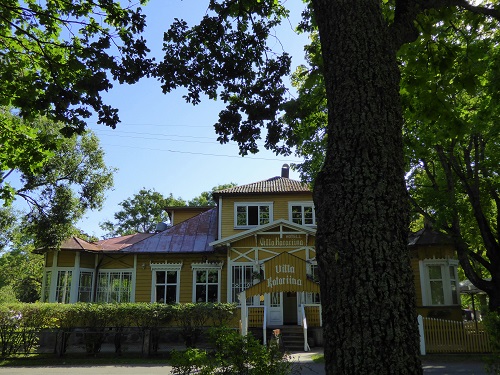
This routine was adopted during my annual favourite week of the Pärnu Music Festival in time for my special visitor, who arrived two days after I did, and his birthday, followed by 'linden boys' Kristaps and Artis from Riga on the Friday. In the end, I'm glad I chose the slightly down at heel but ever so characterful Villa Katariina in Pärnu's garden zone next to the beach as a base, with its slightly sullen staff who left you to your own devices.
I'm sorry, owing to the evening concerts and the gatherings thereafter in the Passion Cafe, to have missed a glimpse of the tango and karaoke nights held at the hotel; J arrived back earlier one evening to see a scene featuring three people straight out of a Kaurismäki movie.
Breakfast at 8am under one of the fruit trees in the garden. A watchful eye was necessary; when I crossed the lawn to fetch something from another table, the resident crow made off with an entire bun.
Cross the road to the park on the other side. Once I spied a hedgehog
which I took as a good omen because, not having seen one since I used to garden, as a student, for a neighbour, over 30 years ago, I'd also spotted another in an equally beautiful place, the churchyard of Saint-Cybard de Cercles while waiting for the eclipse and escaping part of an organ recital (report on the Itinéraire Baroque here).
The park is full of healthily-lichened oaks which fringe the protected coastal meadows
but there are also stands of other trees, including the silver birches which have been suffering in Sweden (here temperatures went back up to 31 degrees for two days, but all remained green)
and it's good to see vegetable plots for all.
Turning out to walk alongside the Pärnu river with the docks on the other side, you pass garganeys ducking and diving, though on the first hot day they were very much idle.
I first saw a pair by the legendary stone pier
while on the other side the cattle grazing on the peninsula were reintroduced through the EU-funded 'Urbancows' programme, 'to restore the traditional semi-natural habitat of the area via livestock grazing'. The first day I saw them doing their thing,
but with the return of the heat they were all sheltering under the lone tree.
This end of the beach is the quietest for swimming; I've never seen the main strand so busy in any of the previous three years I've been here. There's the jetty to one side
from which you may look back up the river towards town,
and general views across the grasses to the peninsula.
To swim you must wade quite some way out in the warm, shallow waters off the eight-mile curve of the sandy beach. This is our largest posse, also including that greatest of clarinettists Matt Wolf. A distant people shot is as close as I'm allowed...
Next part: to walk along the water's edge back, passing large naked sunbathers and swimmers and the Women's Beach,
and then to the hotel to change. Heading for a second breakfast, you may encounter something as enchanting as this in the park on the other side of the road - 'are you performing somewhere soon?' 'We're not good enough!' -
and even - bizarrest - a Christmas bazaar in aid of a local musical organisation.
There is only one cafe to lounge at - the beautifully designed Supelsaksad (the term translates as 'the snobby dippers'). Its cinnamon and cardamom buns are the best in town; there's quite a queue for them when the establishment opens at 10am. We arrive later, sometimes just in time for lunch (also superb); the birthday lounge must have extended over some hours.
The garden's full of sparrows, which may be pests on the continent, but since we have so few in the UK now, I was happy to let them peck the plate clean once I'd finished.
Options now diverge. If there's a message that 'Arvo/Neeme is coming to the rehearsal', then you don't hang around but go straight to the concert hall. Where on the Wednesday lunchtime I found the master of the Third Symphony to be performed that evening intent with the score before hoiking himself up on to the platform to listen and advise.
Järvi Senior was there on Friday afternoon to rehearse the young Academy Orchestra in a fun little nothing of a march.
Afterwards he beckoned me to a chair and we chatted. I had no idea the great Kaupo Kikkas was lurking with his camera. He says he likes this shot because he knew our long-term story and thinks I'm looking pensive about it - though I fancy I was not ignoring Neeme but responding to viola-player Mari Adachi, whom I'd caught as she was passing us.
Another alternative haunt on some afternoons was the little wooden building and garden taken over the previous month by the cafe/restaurant Pipermunt - though we rather took agin the previously charming lady in charge when she was sniffy about serving us up plates of hummus and carrot salads before a concert ('the kitchens are very busy' - ha! Supelsaksad wouldn't do that). Still, I loved my place under a crabapple tree, where I managed on several occasions to get some work done,
with views across to St Catherine's Orthodox Church (1764, commandeered by the Empress of that name on a visit)
and the amusement of a tit at the crabapples.
Later, of course - with the option of a late-afternoon nap - there were the concerts, six spectacular nights, and the option of chats at the Passion Cafe. Not sure how the musicians managed it, staying up until 4am or later - which I did on the last night, but they had a Prom in two days' time.
Let's just say the love and adrenalin just kept flowing. Paavo Järvi commandeers the magic of the music-making by choosing his players carefully and then making everyone feel welcome; but Pärnu itself is a very special quiet place to work and thrive. And a perfect Pärnu day means a perfect day, period.
Sunday, 17 September 2017
Rouvali electrifies in Sibelius's Kullervo
It's clearly the start of a new golden age for the Gothenburg Symphony Orchestra (Göteborgs Symfoniker). While the UK establishment was going ape over Rattle's first official night at the helm of the London Symphony Orchestra on Thursday, I still guess I was getting a better deal over on the west coast of Sweden, where the GSO has appointed 31-year old Finn Santtu-Matias Rouvali as its chefdirigent (pictured above by Ola Kjelbye). Exactly the sort of new adventure on which I'd hoped the LSO would embark - Ticciati would have been my ideal choice - before it settled for our most famous, and only fitfully brilliant, cultural export to Berlin, now back with fanfares galore. Name recognition, I guess. As it is, I reckon the Philharmonia is a more exciting London orchestra with Esa-Pekka in charge, Rouvali and another brilliant younger-generation spark, Jakub Hrůša as principal guest conductors (both appointed, I gather, with Salonen's input alongside the players').
My report of first acquaintance with Rouvali was going to tie in with a very quirky interview which will appear on The Arts Desk before his first Philharmonia concert of the season on 5 October. But I can't contain my excitement about the concert in question until then. It was, in any case, quite an emotional visit - though I've returned to Sweden many times in recent years, I hadn't been to Gothenburg since 1990. The previous year I was invited there to leave with Neeme Järvi and the orchestra on tour to Estonia, the first time he'd been back to his homeland since he in essence defected with his family in 1980. The next trip was to hear him recording Prokofiev's The Fiery Angel. Järvi's momentous tenure in Gothenburg lasted from 1982 - I actually heard the team for the first time in London in 1980, first remembered here - to 2004. I was happy to see a bust of the great man in the Konserthuset foyer
not far along from Nielsen and Grieg (Stenhammar is also here, of course, represented both as composer and as the GSO's principal conductor between 1907 and 1922).
Järvi's successor, Mario Venzago, left little impression; Dudamel was snapped up in 2007 and gave some excellent concerts with the orchestra but his heart was still in Venezuela and LA. The principal post remained unfilled for five years, until now.
The bar for Sibelius's first authentic large-scale work was set impossibly high: nothing could surpass the Kullervo of Sakari Oramo, the BBC Symphony Orchestra and a wall of stalwart Finnish male voices with the BBC Singers at the 2009 Proms, my highlight of that season (and now on one of the best BBC Music Magazine cover discs ever). Read all about it alongside an illustrated population of cats and dogs from the Kalevala here. This was simply on the same extraordinary level, and stupendous on very different terms (since it would not be possible to surpass what Oramo and his team achieved). Rouvali's precise beat combined with a dance-like bendiness means that everything is riveting; there's no such thing as peaks and troughs - even the few pianissimos buzzed with inner life. Only in the battle sequence, potentially repetitive, did he grade the intensity.
The reaction may also have something to do with where I was sitting - in the middle of the raised seats at the back of Gothenburg's magnificent 1935 concert auditorium, 'a crab in a rectangle,' as architect Nils Einar Eriksson described it in relation to its outer shell. The sound is very in-yer-face there, with woodwind sounding individually spotlit (the repeated-note oboe figures in the second movement were disconcerting, but in the right way). Sibelius's telling of a typical unhappy-hero sage from the Kalevala is unique, rough and direct, full of startling sounds and balances that need to be carefully worked through (Rouvali had made some of his own emendations to the score to foreshadow stuff in the symphonies to come - more on that in the interview).
So the orchestral playing was magnificent. Leading question, though: could the men of the famous Orphei Drängar from Uppsala possibly match the impact of the Finns at the Proms? They did - I have it on good authority that their Finnish articulation was impeccable - and similarly raised goosebumps on their first entry, tears at the last. Here are two of them walking towards the hall not long before the performance.
The weather, incidentally, was magnificent each day until late afternoon - more on my time by a Swedish lake and in town anon. Just as a taster, this is what I was doing on the morning of the concert, some way north.
But I digress, with the hope that Sibelius might approve. To return to the concert, the big central drama, where Kullervo seduces a maiden who turns out to be his own long-lost sister, an unhappy twist on the Siegmund-Sieglinde predicament, seemed more operatic than ever. Real-life sister and brother Johanna and Ville Rusanen entered from opposite sides during the kick-off, and the soprano suggested that she would already make a magnificent Brünnhilde (she also sang Kullervo's Sister for Oramo). In the absence of a professional photographer, I took one curtain call shot which is OK enough to use here.
I felt as if I'd lived through a big Wagnerian experience every inch as involving as that of the Budapest Ring. But Sibelius is not in thrall to Wagner, or Bruckner; if anything, this 1892 work anticipates Janáček's originality by nearly a decade. And you'll have gathered that the performance was well worth the trip. It should be back up on the orchestra's excellent website not too long after the livestreaming of the Saturday performance. In the meantime, take a look there (scroll down) at Rouvali's performances of other Sibelius, Stravinsky's Petrushka and Janáček's Taras Bulba - the last two only available until 1 October - and watch this 360 degree experiment in which first horn Lisa Ford introduces Rouvali in a rehearsal of Smetana's "Vltava" from Má vlast before the complete live experience (at around the five-minute mark, if you don't want the chat). It makes Rouvali's special qualities very clear.
Exciting times for orchestras all around the world at the moment with so many new major talents popping up everywhere.
Tuesday, 22 August 2017
Neeme Järvi: from 1980 to 80
If only I could have made the entire, exceptionally long stretch of Pärnu Festival this year to hear Neeme Järvi in his 80th birthday year conduct the Tallinn Chamber Orchestra, and - I gather - an encore with the Academy Orchestra in the first week as well as what I did hear in the second - four terrific concerts from the Estonian Festival Orchestra and its soloists. Alas, Proms duty as speaker called on the intervening Sunday so I couldn't get out there - starting in Latvia, a country I'd never visited before - until last Monday. It's looking as if I may have to wait until next February when Järvi père is scheduled to conduct the work he's always pleaded to do at the Proms, Tobias's massive oratorio Des Jona Sendung (Jonah's Mission), in Berlin. Well, he told me that the knee problems which had stopped him returning to his beloved Royal Scottish National Orchestra earlier this year - I was all set to go - seem to be sorted, so fingers crossed.
He was, of course, a benevolent presence at the last night in Pärnu, where after the concert older son Paavo, the festival's presiding genius, generously and movingly feted his father as the critical guiding spirit. I got to have a chat with him at the party, and was especially happy with my day's discovery - a copy of one of his 1980 Melodiya recordings of Haydn's symphonies. He's holding it above, flanked by Paavo's two daughters Leah and Ingrid, with Mrs J, Liilia, to the right (two special Pärnu pals can just be made out in the background - New Best Orchestral Friend, horn-player Catherine Eisele, and the wonderful administrator/bassoonist Tea Tuhkur looking on). And an official photographer - not sure who, since this is from a batch on the Estonian Festival Orchestra's Facebook page - caught me leaning earnestly forward from my seat at the feet of the master.
Two of those LPs were released, the rest suppressed and his name wiped from the record when he emigrated to the west later that year. It was also when I first got to hear this then unknown-to-me conductor and orchestra (the Gothenburg Symphony) under circumstances which I explained a couple of years back on the blog. No harm in reproducing a second time the photo taken of him outside the Gothenburg Concert Hall, also from 1980.
Neeme expressed surprise when I showed him the LP, and assumed I'd brought it from London. The circumstances under which I came to it seem serendipitous. I'd bought two Melodiya box sets from the shop on Pärnu's Supeluse, the main road to the beach - one of The Barber of Seville with the great Kozlovsky as Almaviva and Mark Reizen as Basilio, conducted by Samosud,
and the other of Prince Igor with - as I thought - of Lemeshev, Reizen again and Melik-Pashayev conducting. But when I got it back to the hotel, I saw that the booklet actually listed two recordings, and this was the later one under Ermler, which I have on CD. So I took it back and, just as I seemed to be drawing a blank for a replacement - other Melodiya boxes with fun designs turned out to be Soviet pressings of Callas in Lucia and Toscanini's Otello - the shopkeeper brought out another pile of classical LPs. Neeme's early Haydn happened to be among them. Of course I had to get him to sign it some 37 years later.
The performances, which I listened to this morning, are full and spirited, not at all over-romanticised in any way; and of course the humour is fully appreciated.
As Estonian Festival Orchestra clarinettist supreme - and one of the handful of the world's best - Matt Hunt pointed out once we'd rolled on from the concert hall to the nexus of festival socialising, the Passion Cafe in the old town, what wouldn't most of us give to be 80 and propping up a bar at 3am? Neeme finally left shortly after that time to another speech by Paavo, to which he graciously responded,
shared another laugh with Matt and Paavo,
and headed off down the street supported by stick and loyal son (here's leader Florian Donderer, of whom Neeme thinks so highly, heading towards me. With apologies for the poor quality of the night shots - with or without flash, they don't come out very well, but there's no alternative record).
It seems a shame that because I wasn't there, I won't be able to use pictures of NJ's earlier appearances on the Arts Desk piece when it's ready, especially as they were taken by resident masters, Kaupo Kikkas (the first below) and Taavi Kull (the third), with one of many excellent complementary and equally professional shots by David Kornfeld (the intervening triple portrait). So the blog will do. Here he is conducting the brilliant young Academy players at the end of the concert shared by the various conductors on the Masterclasses he takes annually (see some pics from last year here),
with fellow masterclass takers Leonid Grin and Paavo,
and with Paavo at the end of the concert.
Next year, if I'm invited back (and even if I'm not), I have to do it all. In the meantime, coming home was not such a bump since back at the Proms I heard a good-in-parts Schoenberg Gurrelieder from Rattle, a glorious Bach triple whammy on Sunday very much crowned by the best St John Passion I've ever heard live and last night another exceptional Balt, Lithuanian Mirga Gražinytė-Tyla, conducting 'her' City of Birmingham Symphony Orchestra in a dazzling programme. The future looks good in hands like this. Photo courtesy of Chris Christodoulou/BBC.
And now for two concert-free nights with some time for digestion of abundant riches.
UPDATE (24/8) The full Arts Desk report on the Estonian Festival Orchestra's concerts in Pärnu and Jūrmala is now up and running.
Subscribe to:
Posts (Atom)