For me, the players and their inspiring conductor Paavo Järvi always were (on a high), at each of the three festivals in the lovely southern Estonian seaside town of Pärnu I've been privileged to attend: reports on The Arts Desk of 2017 here, 2016 here and 2015 here. But now the rest of the world is getting a chance to catch up. So far it's been Europe, with triumphant visits to Turku, Stockholm, and Copenhagen following last summer's festival, and at the start of Estonian Centenary Year Brussels, Berlin, Vienna and Luxembourg.

Kaupo Kikkas, photographer without peer - and not just in the world of classical music - took the images I'm posting here from the most recent mini-tour, starting on home turf in Tallinn (first photo). As a respected colleague, and a musician himself (clarinettist, I seem to remember), he is well placed to catch the spirit of his friends, that heady mix of Estonians and leading players of great character from other famous orchestras.

The second shot reminds me of how the Lucerne Festival Orchestra players used to react at the emotional ends of their miraculous concerts with Claudio Abbado. I'd place the Paavo effect on a level very close to that - now the great Abbado is no longer with us, and the LFO, though still superb, sounds like many other top orchestras, the EFO experience is the next best thing. Below, the orchestra in Berlin's Philharmonie.

The Pärnu 'family', as part of which I'm honoured to have been included, does have its concerns: will too much touring change the special identity? What happens when (as happened on the recent tour) some key players can't leave their other posts to join their colleagues? Will Paavo and the orchestra be able to resist excess demands from the big agents now in on the act?
In the meantime, the worldwide launch has been ballasted by their first CD together. Quite a few of us put our oar in as to what we'd like to see/hear. For me personally, the best combination would have been a mix: their unforgettable performance of Arvo Pärt's short but significant orchestral-version Swansong, maybe the electrifying Mullova performance in Pärnu of Sibelius's Violin Concerto or the radical characterisation of Strauss's Duett-Concertino by principal clarinet Matt Hunt and Estonian sometime principal bassoon Martin Kuuskmann (though now I have the live performance on file, I realise it would need a patching or two).

Certainly the Shostakovich symphony we have here is the right choice; Nielsen would have done just as well. I personally wasn't so sure it should be all Shostakovich, and though the Stassevich version of the Eighth Quartet shows off the adaptability of the strings to fine effect, I don't much care for the timpani role; Barshai's 'Chamber Symphony' is still best.
No question, though, the Sixth Symphony is the most powerful of calling-cards; I'll never forget the shock of the bass-vivid opening in Pärnu. The booklet is graced by Kaupo's photos, but I also get a spread (thanks, Lucy) with some amateur shots of the beach and town, dramatic cumulo-nimbus clouds doing much of the work. Very honoured indeed to be in such company.

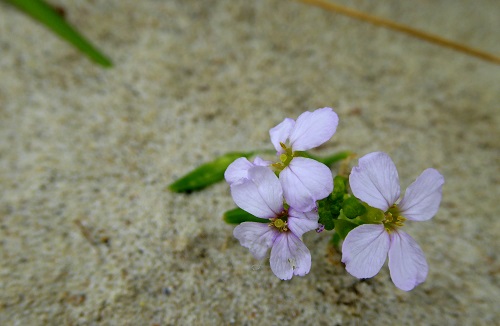
I realise that though I waxed blog-lyrical about discovering Riga for the first time last summer, I didn't revisit Pärnu in pictures, so here's another indulgent phototour of the town, because it makes me happy and longing for the summer months. Let's start on the beach, from microcosm - what is this geranium-like flower which flourishes in the sand? -
to the bay seen from the roof of the spa hotel where the senior Järvis were staying last year.

Back down to the beach: a sign for the impending visit of the Dalai Lama above the dunes

and another, closer beach shot, with, in the distance, Kristaps and Artis, my dear Riga pals who accompanied me north from my first time in Latvia,

who are seen below (A. left, K, right) at the cafe they discovered, Supelsaksad, on the road leading to the beach (Supeluse).

It really does serve the best cakes in town; at opening time, leisurely mid-morning, there's a queue for the fresh, on-premise baking. The owner is a true artist - on the inside wall of the conservatory-porch

she's painted tromp l'oeil miniatures.

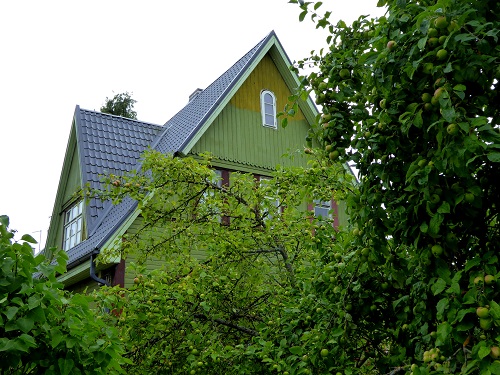
More wooden houses in the garden zone: this one I liked

and this is the side of the dacha which David Oistrakh used to rent when he came, along with Shostakovich, as far west as Soviet citizens could in those days. It doesn't seem too well cared for - I'd love to buy it and set up the ground floor as a museum of Oistrakhiana (well, I'd settle for a selection of photographs).
Miscellany: roses

and sunflower,

plus a resident making repairs on a house in the shadow of the big Estonia Spa Hotel,

I almost neglected the two most splendid buildings closest to the beach - the neoclassical mud baths which have been preserved as conversion to a top hotel, the Hedon (not exorbitant by our standards)

and since one of the wings is lopped off the pic, here it is at closer quarters.

Just a bit further along is the Kuursaal from the 1880s. I'm sorry for the changes since our first visit - the menu is nowhere near as good and the dance-hall interior has been stripped of its hunting trophies, though the statue of popular singer-accordionist Raimond Valgre outside still plays music as you walk past.

Besides, the Kuursaal remains a good place to have a drink on the terrace, though probably avoid the food now unless you want a burger.
I enlarged upon the Villa Annende, the other luxury hotel,

in a previous blog visit, but it's worth taking another glimpse into the central hall.

Rather dark to stay there, I'd say, but fascinating to visit, and concerts take place here every festival.

The canal basin fringing the dacha zone is one of many pleasant park areas in the green belt; the wooded zone nearer the sea is the perfect picnic place.
Now we head for the old town, through the only surviving 17th century gateway in the Baltic countries, built between 1675 and 1686 (probably by a Swede). Ladies were selling their knitted wear either side of the portal on this occasion.

Probably the town's most famous son, Olev Siinmaa left his mark in what has been called '"Pärnu Resort Functionalism", chiefly in the splendid hotel by the beach. But the little miracle is surely his own house at 1a Rüütli Street, just behind the above bastion, constructed in 1932-1933.

It fits neatly into a triangle which continues with traditional wooden houses.

In the centre of town, the main drag depicted here with banners for the festival (and some restoration going on to the right, I'm pleased to see - building preservation seems quite hit and miss),

the interloper is the Russian Orthodox Church of 1784-8, named after Catherine the Great.

Close by is the Town Hall.

And then, if you cross Pärnu's only busy road, you're in the complex of new buildings which includes a shopping mall - can't deny the citizens something of the latest trends - and the concert hall which, needless to say, is the building in which I've always spent the most time. More, though, probably, on the beach...
Watch this space, anyway, for your chance to catch the Estonian Festival Orchestra without having to travel to Pärnu (though I can't recommend that too strongly). And meanwhile, last night at Milton Court there was another chance to hear the excellent Estonian Philharmonic Chamber Choir offering more revelations of the choral repertoire - my Arts Desk review is here.




 Posts
Posts