Showing posts with label Dialogues des Carmelites. Show all posts

Sunday, 2 July 2023

Ten days of great Zoom visitors


I rely upon the kindness of great performers for adrenalin highs in my Zoom classes, and a recent run has, though I say it myself, been spectacular on both the Opera in Depth and Mahler 1 courses - I might as well drop the names right now: Anna Larsson, Golda Schultz, Robin Ticciati and Mark Wigglesworth. You may need to click to enlarge a lot of these screenshots, and I've tried to reduce them to a cross-section rather than the full crowd, but above, bottom right, is glorious Golda, part of a very special duo of visits. 

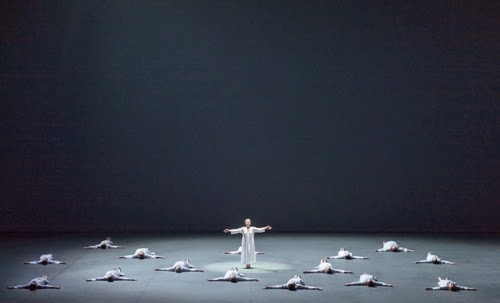
Robin Ticciati decided he'd like to see us between final rehearsal and first night of the sensational (opera production of the year?) Dialogues des Carmélites at Glyndebourne, and for it was better since I wouldn't be prone to gushing about the first night, so overwhelming that I took the liberty of snapping a full company bow, Ticciati and director Barrie Kosky included.

I reviewed that here on theartsdesk; you might conversely say I'd drunk the Ticciati kool-aid, but what I think of as the professional relationships I have with the great and good are based on total respect in the first place. Of course I'm at liberty to say if there was a style mismatch, or I didn't think the work was quite as great as the performer did - The Wreckers, prepared at the very highest level, was a case in point. But we know how Poulenc's masterpiece - one of the greatest in all opera - never fails, even if I wasn't prepared for the cruelty and devastation of Kosky's vision. 

After a very excited RT phoning on Thursday to say he was ready to talk, Friday's visitor was very reflective - clearly tired, but so friendly with everyone, and so eloquent as ever. He talked, among other things, of the joy and necessity of being there at the start of rehearsals, how inspiring Kosky was in his first speech to the company, the special nature of silences (something that had struck me when I first met him, sharing a panel at the end of a study day on Jenůfa, which he conducted on the Glyndebourne tour) and finally - very movingly - the nature of home. Which is now, for him and his wife, very much Sussex. Over six years in Berlin, he loved the experience of living in the city but never felt entirely at ease with the level on which he could converse in German. And the Glyndebourne experience is, at its best, the most enriching you can have in the operatic world.

Golda, whose presence was due to another positive spirit who's just joined my course, Julia Noakes, was bright and bouncy on the Monday afternoon. She'd had the day after the first night to come to herself, and the parallels with the down-to-earth, forthright, empathetic and incorruptible Madame Lidoine, the second Prioress, whose arrival brings a breath of air in to the claustrophobic world so emphasised in Kosky's production, are striking. Golda thought of becoming a nun at 17, but her priest-advisor suggested her gifts might be used on other ways. And so they are. A marvellous human being in every way. I'm going to segue to my next guest via two production shots, cropping to emphasise the connections (credits: Glyndebourne image, Richard Hubert Smithl Garsington image, Julien Guidera, I think - I got sent three different sets of photos). It's amazing how strong an image is a reassuring hand laid on another, and Schultz's Lidoine does that in Kosky's production, more than once.

It's also a very moving moment in Bruno Ravella's Garsington production of Strauss's Ariadne auf Naxos when Young Woo Kim's Bacchus places his right hand on top of the left hand of Natalya Romaniw's Ariadne.

I'd never been more moved by this scene. and never heard a Bacchus as good live. The South Korean tenor is adored by his colleagues, another blithe spirit, as I think one can tell from his performance on stage. In my review for theartsdesk, I suggested that though Carmelites and Ariadne are very different operas, the respective Glyndebourne and Garsington achievements are on the same extraordinary level - thoughtful production, perfect cast, and radical but perfect conducting: in this case from my long-term generous visitor to the classes Mark Wigglesworth. 

I enlisted MW's help in my Mahler 1 course, covering Symphonies 1-5, Das klagende Lied and the earlier songs (the second term, starting in late September, will deal with 6-9, Kindertotenlieder and Das Lied von der Erde). He's conducting the BBC Philharmonic in the First Symphony at the Proms on 18 July, but was heavily involved in Ariadne rehearsals when we covered that. So just before the last of the 10 classes, on movements 3-5 of the Fifth, he visited for a more general discussion, but again with fascinating chapter and verse (I must summarise at some point, but need to watch again).

First of the visitors, and absolutely not least, was the great Anna Larsson. I used a mixture of DVDs for complete movements, and when it came to the Second and Third Symphonies, it had to be Abbado in Lucerne; AL is his mezzo/contralto soloist in both, on stage from the beginning and engaging directly with the audience sans score. and she confirmed that these performances were beyond any others. 

I'm glad my New York student Alan compared her with Christa Ludwig and asked if they'd met, because we had a fascinating chronicle of how Abbado, having first heard Larsson in audition, told Ludwig she must hear her. Intense sessions followed. Here's another performer with feet firmly on the ground, colleagial and warm (we'd become friendly when I visited the musically excellent Rheingold she facilitated in the barn of the family farm in Dalarna, in which she sang both Fricka and Erda). But then I think it's true of (nearly) all artists who are truly at the top of their profession: they are secure in what they do, and generosity flows from that. 

Finally, a sadness. Sondra Arning's son gave his mother the present of joining these classes. She has been a vibrant contributor, with so much to say about all the music she experienced and - as a singer - participated in while living in New York. Soon her husband Patrick also joined up; they both attended both courses this term, sometimes on separate screens, sometimes together (as pictured above). Having made some pithy observations as usual, Patrick had to leave the last Mahler class early to go to see his doctor. On the Friday he felt il in an interval at the Wigmore Hall, where they were regular visitors. He died of a massive heart attack on the Saturday. A huge shock to everyone, above all to Sondra - they had been married for 51 years - but in one way, since he'd reached a great age, a blessing, as there was a lot wrong with him and cancer had just been detected. 

Patrick will be with us in spirit when we embark on the summer course, Wagner's Parsifal, in association with the Wagner Society of Scotland (it's a while back that I began an adventure which began with the first two Ring operas up in the Trossachs, the last two online, followed by Tristan and Meistersinger). More on that, and the season proper, anon.

Thursday, 13 April 2023

More Opera in Depth cross-dressing


Hardly surprising if I love the above image by Bill Knight of the sexy-in-any-wear Régis Mengus in Poulenc's Les Mamelles de Tirésias. Laurent Pelly's Glyndebourne double bill kicks off with the most unusual and powerful staging of La Voix humaine I've seen; little surprise if it was one of my top performances of the year in the 2022 Arts Desk 'Best of Opera'. So was the English Concert semi-staging of Handel's Serse at St Martin-in-the-Fields with five classy women (Emily D'Angelo pictured below by Paul Marc Mitchell, Lucy Crowe, Paula Murrihy, Daniela Mack and Mary Bevan) and vivid playing under Harry Bicket.

So I've chosen these three operas along with Poulenc's masterpiece, Dialogues des Carmélites, for summer's Opera in Depth classes. Not least because I hope Robin Ticciati, steeped in Poulenc at Glyndebourne over two seasons, will join us along with some of the singers and Bicket from the EC Serse. The Glyndebourne Carmélites opens on 10 June.

We certainly did well over the seven Rosenkavalier classes. First came Paula Murrihy, one of the best Octavians in the world today, and conductor Fergus Sheil, giving us quality time after a day's rehearsal ahead of the Irish National Opera spectacular.

Then, in the last class, a Marschallin and Ochs for the ages, Dame Felicity Lott and Sir  John Tomlinson, appeared TOGETHER (quite a dream come true; you'll have to click for the bigger picture but I wanted the two to appear as we all saw them - FLott is top left and JT on the right of the second row). 


Students have agreed that FLott's characterisation is the most moving and gracefully real of all; it's a shame there's not more of John Tom's Ochs to be seen.

And in a last-minute bonus, Richard Jones and his inspiring choreographer/movement director Sarah Fahie, whose Glyndebourne Rosenkavalier was the most meticulous and inventive movement-wise of just about any opera production I've seen, were able to join us once their stupendous ENO Rhinegold was up and running, so we got quite a bit on that from them too. 

What had to be cut out of the chat on Richard's request - that Bertie Carvel will be taking the role of Henry Higgins in his (RJ's) Pygmalion at the Old Vic - can now be revealed as it's official. Shaw's play, fascinatingly, was premiered only two years after Rosenkavalier, in 1913, and (very surprising, this) at the Hofburg Theatre, Vienna, in a German translation. 

Anyway, full details of the new term, which starts on Monday (17 April) below - click to enlarge (do join us, from anywhere in the world - if you can't make the live class I always send a video).

Tuesday, 17 November 2015

Priez pour paix


Having noticed this piece from January 2011 rising up the most-viewed list, I make no apologies for republishing it now. Not only does it embed the exquisitely simple Poulenc song which is one possible response to the weekend's events - though I hasten to add I don't think of 'prayer' in narrow Christian terms - but it also reminds me to go back and watch one of the greatest films possibly ever. Unless you seek total escapism, it's the right thing to see at the moment, though you'll weep. My review DVD is still in the hands of our Meknes host at the Riadh Laboul, so I'd better get another copy.

I make no apologies for juxtaposing the peaceful song-title - bearing in mind Poulenc's inward setting of Charles d'Orleans's invocation under threat of war - and the violence implicit in Caravaggio's painting. Both the juxtaposition and the image play key parts in Xavier Beauvois's near-flawless film Of Gods and Men (Des hommes et des dieux): Luc (the infallibly sympathetic Michael Lonsdale) leans against the wounded body in a poster of the picture on the wall of his Algerian monastery and we begin to understand what 'love of Christ' might actually mean.

In fact all the best aspects of faith are to be found in the exquisitely chosen dialogues and quotations of the film's awe-inspiring script, with the Koran playing almost as large a role as the Bible. I'm hoping to obtain a copy of the text as it's a collection of wisdom in itself. In the meantime, read Dom Christan de Cherge's testament, written in Algiers on 1 December 1993, produced at his monastery of Our Lady of Atlas in Tibhirine on New Year's Day 1994 and opened on Pentecost Sunday 1996 shortly after the murders of Christian and his fellow Trappists (is it possible to talk about this film without foreknowledge of its end? I don't think so, though clearly an audience which didn't know the outcome would find it even more suspenseful). This is the voice not of a missionary - the director had said he would have found it hard to make a film about that - but of someone who dearly loved Algeria and his Muslim brothers.


Of Gods and Men works simply on so many levels: as a meditation on sound and silence - the popcorn crunching next to me soon stopped, and the Curzon Mayfair was still for the rest of the screening - in which music plays a minimal but essential role, Tchaikovsky as much as religious chant, and we understand what's not verbalised (as when, for instance, Lambert Wilson's Christian touches the trunk of a huge, ancient tree); as an unsentimental embodiment of what it might really mean to live and work in a community which may worship differently; and above all, ultimately, as a palpitation-inducing speculation on whether fear or faith will have the last word (the final procession which melts into the snow leaves the question open).

Unusually, I don't want to say much more, or to sully the film with any clips: just go see for yourselves. If only it could be screened in Iraq and Egypt in their current times of trouble, too*: not, of course, as anything as crass as a Christian tract, but just for its simple reflections on the 'all men are/should be brothers' line. It's enough, as Golaud says in Pelleas et Melisande, to make stones weep. But not in a bad way.

Anyway here's Poulenc's 'Priez pour paix', the first of four songs delivered here by Charles Panzéra with his wife at the piano (I wanted the Ann Murray recording, but it's not on YouTube; now - 17/11/2015 - Felicity Lott is there with Pascal Rogé, but for some reason not embeddable). The simple poem is by Charles d'Orleans (1394-1465)


And how could I not reproduce the most moving final scene in all opera, the nuns to the guillotine in Poulenc's Dialogues des Carmelites? This is perhaps director Robert Carsen's finest achievement, seen in the Scala production conducted (magnificently) by Riccardo Muti and with Dagmar Schellenberger giving a stunning performance as Blanche. When I encountered Carsen at a BBC Music Mag awards gathering, I asked him what working on it had signified. He replied with tears in his eyes that his mother had just died and it meant the world to her. A pity we don't get the brutal Prokofiev-style march before the Salve Regina here, the equivalent to the simultaneous noise of hovering helicopter and chant in one of the film's most powerful sequences.


The Carmelites, of course, have high-profile martyrdom thrust upon them; one of the points in Of Gods and Men is that the brotherhood wants to live as long as it can simply to do good to its flock as - in the words of one village lady - the branch on which they sit, and does not seek death. But the way in which the men individually come to terms with what it means to stay or to leave is another remarkable aspect of this cinematic masterpiece.

*17/11/2015 Hard, isn't it, to think of a time when Syria wasn't ripping itself apart (that started in March 2011, two months after I wrote this post)? Or that any of us wandered free and happy through the souks of Damascus and Aleppo, or the ruins of Palmyra and Qalaat Samaan, meeting kindness at every turn.

Wednesday, 18 June 2014

Nuns and chisellers


The French word 'ciseleur' is preferable, and, embracing as it does 'engraver', gives a better sense of the guild to which that master goldsmith and fantasist Benvenuto Cellini belonged. But the point here is to contrast the feminine strength of Poulenc's Dialogues des Carmélites with the testosterone-driven wonders of Berlioz's liveliest opera - indeed, possibly the liveliest opera in the repertoire - which I had the good fortune to see on consecutive nights last week (Royal Opera images by Stephen Cummiskey; ENO photos by Richard Hubert Smith).

We've spent seven weeks apiece on these operas in my City Lit classes, and I've never been more absorbed (equally, certainly, but not more). I wish I could say the same about one of the two productions. By the way, for Cellini I used the only DVD so far, from Salzburg - great idea with the robots, spirited performances from Maija Kovaleska and Laurent Naouri especially, don't mind the feeling of Broadway show, but there's a general sense of trying too hard - and all the recordings. The first Sir Col with Gedda is peerless, though interesting to hear alternatives on the recent John Nelson edition.

Let's get the reservations out of the way first. Terry Gilliam's return to Berlioz is a bit of a mess in its first half. I don't think he's worked on the crucial Personenregie: we hardly give a damn about Benvenuto's amatory escapade, and poor Corinne Winters, though she sings reliably throughout, can't make much of Teresa in a bad blonde wig (though I don't think the aria is anything like as animated in detail as Nicole Cabell's marvellous Cardiff prizewinning performance).

There's always too much business going on, too many scene changes happening while the set pieces are winding up. The should-be-funny guys, father Balducci (Pavlo Hunka) and comic suitor Fierramosca (Nicholas Pallesen), just aren't; the Roman carnival should be disciplined but is just a lot of chaotic milling around, albeit colourful.


Part (Act) Two is so much better, and soon lifted me from my interval despondency. Edward Gardner's conducting, which had been much too heavy and exaggerated for any needlepoint comedy - the featherlight trio wasn't helped by having the singers too far away, and too high up - came into its own for weightier matters, and even Charles Hart's arch translation brought some unexpected pleasures. It beats me how those commenters on Alexandra Coghlan's Arts Desk review could advise us to leave at the interval ('the party's over'). What do they want, just more froth? Because while the only number in Berlioz's score which is marginally less involving than the rest, the second duet for Cellini and Teresa, is cut, there are a string of beauties: the duet for Teresa and Ascanio against the monk's chanting, the great ensemble with the Pope - how I loved both Gilliam's high camp for his entry


and Willard White in fine voice frou-frouing around, even getting a bit nasty when his statue looks as if it might elude him


- and then the best set-pieces of the evening: the lovely rondo for Ascanio sung perfectly by Paula Murrihy, the only singer not to put a foot wrong throughout and a real Octavian in waiting (wish there was more of her in the picture selection than just a supporting role in this image)


and the wistful 'wish I were a country man' solo for Cellini.


Michael Spyres sounds surprisingly hefty for the Rossini tenor his biography suggests, and can't quite maneouvre around the insane heights, but he carried this off well, and Gilliam let him do it in peace. The forging of the Perseus was, I reckon, done as well as it could be on stage, even if I heard Michael Palin in the audience as we left wryly refusing to tell someone what hadn't gone quite according to plan. Anyway, the point is that I left exhilarated, when I might have left precipitately deeply disappointed.

No major reservations about the arrival of the now-classic Robert Carsen Dialogues des Carmelites at Covent Garden (even bigger audience star-check: within seconds on exiting, I saw Jonas Kaufmann, Fiona Shaw and Deborah Warner). Carsen's painterly instincts for a nearly bare stage informed by evocative lighting brought us one stunning, apt tableau after another, none more haunting than the body language and grouping of the nuns in prison awaiting their sentence. There doesn't seem to be a better photo of that than this one.


I think for me this was the most choking moment of all in an emotional evening, so quietly and authoritatively did the strange-toned but always compelling Emma Bell deliver Madame Lidoine's words of wisdom. Here she is earlier in the action.


Nobody was found wanting. Sally Matthews' is an odd technique, sometimes cloudy, but she sent the sound up top with emotional truthfulness, fell to her knees very eloquently and conveyed the sense of Bernanosian limitless fear superbly. How we jumped when she dropped and broke the statue of the Infant Jesus, even if we knew it was coming.


Deborah Polaski's First Prioress may not have gone through her death agonies with as much harrowing realism as the peerless Anja Silja on the DVD of the same production from La Scala, but she sang the role with far more refinement and dynamic variation.


Anna Prohaska almost over-coloured Soeur Constance but she's a precious new talent on the scene, and Sophie Koch redeemed her baffling Octavian here some years back with a compelling and ultimately touching Mere Marie.


Equal star to Bell for me was Yann Beuron, such a powerful lyric tenor and an extremely sympathetic actor, as Blanche's desperate brother


and he was well offset in the first scene by Thomas Allen's baffled father. The final scene, of course, had both of us trying to restrain ourselves from sobbing out loud


and the lady next to us, come to see it for a second time because her two sons were in the people's ensemble (which she said had raised a few hackles with Equity, but they certainly added another dimension)

This was a redemption, too, for Simon Rattle: one of the best things I've heard him do recently, though come to think of it his Pelleas in the same house was very fine too, and it helps to have conducted that vital inspiration for Poulenc first. The chop-change style, modelled sometimes, I feel, on Prokofiev's mosaic operatic technique, suits him well; the extremes of dynamics were striking throughout and having the harp in a box made those great upbeat swooshes clutch at the heart. Slightly disconcerted by the brass vibrato which sometimes made it sound like a Broadway show (ditto the overamplified guillotine). But otherwise, nothing but praise for the dedication of the players.

It's been an amazing operatic couple of weeks - all this, Feuersnot in Dresden, the shattering and surprising Owen Wingrave at Aldeburgh on my birthday - an action-packed occasion I hope to chronicle here - a meeting with the galvanizing Kristine Opolais and her first night as Manon Lescaut yesterday with Jonas Kaufmann and Antonio Pappano, all three just about transcending the vague sterilities of Jonathan Kent's production. Here's a photo I couldn't fit into the review from Bill Cooper.


Both Benvenuto Cellini and Manon Lescaut have the benefit of livescreenings around the world (Cellini, I note, got the HD treatment last night; Manon is due soon). Dialogues des Carmélites did not, but at least an earlier incarnation of the Carsen production, as I've mentioned above with reference to Silja, provides a different document. Much more troubling is the removal of Adams' challenging, ambiguous The Death of Klinghoffer from the Metropolitan Opera's HD schedule. This blog post, linked originally by my somewhat erstwhile blog friend Jon Dryden Taylor, expresses everything I feel very succinctly (albeit from a different perspective, that of a 'left-wing, liberal Jew')*.

We still have half a class left to go on Carmelites: I can't leave these nuns, or their various authors alone. And that means I'm skimping on my beloved Ariadne. But this has been an awfully big adventure through a score which, as with Cellini, I didn't know in detail. Grim times ahead, sadly, for the City Lit: a bombshell fell this week. But I need to get my facts together before I report and protest. I leave you with an astonishing film, courtesy of our Australian wanderer, of Joan Sutherland in a role I had no idea she'd taken on beyond the Royal Opera premiere, where Poulenc apparently adapted on hearing her. The diction up top is mush, as usual, but what authority, what passion in the voice.


Wonders will never cease - there's also the 1958 recording of the same scene at Covent Garden, conducted by Kubelik. Of interest if only to compare the change in vocal weight over decades.


*19/6 Further light in the darkness in some of John Adams's responses quoted here.

Tuesday, 3 June 2014

Bernanos and Robinson: states of grace


The strange world of Georges Bernanos has enveloped me since I began City Lit Opera in Focus classes on Poulenc's Dialogues des Carmélites, a work I'm now more convinced than ever is one of the great 20th century masterpieces. It's already prompted the most probing conversations with the students on essential matters of life, terminal illness and faith; I look forward to seeing Robert Carsen's already celebrated production at the Royal Opera next week. The source is rather extraordinary, too, a swansong screenplay written by Bernanos in the last year of his life when he knew the end was near ('is it not high time to die when one is 59?' asks young, naive and yet startlingly assured Sister Constance).


It is, like his best-loved novel The Diary of a Country Priest, about fearing one 'should not know how to die when the time came', and about the fear of fear embodied in terrified Blanche, which takes us back further to the semi-factual novella on which the screenplay is based, Gertrud von Le Fort's The Last on the Scaffold. I found it in a funny religious imprint by The Neumann Press, Long Prairie, Minnesota translated as The Song at the Scaffold (another rather lurid church publication illustrated below).


The 'song' of course is the Salve Regina which the nuns intone as they face the guillotine, the voices cutting off one by one at the swish and thud of the blade in perhaps the most shattering conclusion to any opera. And they did so in truth, along with the Veni, Creator Spiritus, in July 1794, as recorded by Mother Marie of the Incarnation, who happened to be in Paris on business when her sisters at Compiègne were arrested, and who lived on (until 1836) to tell the tale. Blanche, the protagonist, is a fictional creation, the embodiment of that fear which fascinated and to a certain extent afflicted Bernanos all his life.


His approach to it is also foreshadowed in von Le Fort's book, written in 1931 at a time when the author must have sensed another forthcoming cataclysm in her own country (she was persecuted by the Nazis and driven to Oberstdorf on the Austrian border). Into Sister Marie's mouth she puts the rhetorical question: 'Must fear and horror always be evil? Is it not possible that they may be deeper than courage, corresponding much more closely to the reality of things - the terrors of the world and especially our own weakness?' In religious terms, it's paralleled with Christ's agony - hence Blanche's appellation 'of the Agony of Christ', a title we learn the first Prioress also took - and clearly outlined in her assertion that 'there has never been more than one morning, Easter Day and every night is that of the Blessed Agony'.


You think I'm going all Catholic?* Well, all I can say is that Bernanos's grasp of the dark side of human nature is what makes his books so compelling and real. His characters pass through depression, the valley of the shadow of death, spiritual crisis, call it what you will. The nameless country priest is so badly shaken that his dark night of the soul cannot be written about. He lacks confidence, and doesn't realise the good he does simply by talking to the tormented. He knows that 'man is always at enmity with himself- a secret, sly kind of hostility', a hostility which explodes in the slippery nightmare world of Monsieur Ouine, a troubling read as I'm currently experiencing it.


There, in the work he regarded highest of all among his novels, Bernanos throws at us in a slimy, stream-of-consciousness ooze suggestions of awful depravities. The worst in The Diary of a Country Priest is, its protagonist writes,

the sin against hope - the deadliest sin, and perhaps also the most cherished, the most indulged. It takes a long time to become aware of it, and the sadness which precedes and heralds its advent is so delicious! The richest of all the devil's elixirs,his ambrosia.

One of the priest's worst moments is 'a mad rush of thoughts, words, images. In my soul, nothing. God is silent. Silence.' The link with Bergman, and above all with Winter Light, is striking (the wonderful Gunnar Björnstrand pictured below).


No wonder that Robert Bresson, another great filmmaker, was inspired by Bernanos to make Mouchette as well as the Diary (time I saw this again).


These great artists penetrate the darkest corners of the human psyche. By the way, the French film that eventually resulted from Dialogues used very little of Bernanos's script. Still, to judge from the cover of the book illustrated up top, it stars Jeanne Moreau, always worth seeing. Unfortunately the movie doesn't seem to be available on DVD at the moment.

In the cold light of Bernanos's biography - and I picked up an excellent one second-hand by Robert Speaight, whose Shakespeare study is one of my bibles - he shouldn't have anything to offer me. He started his career as a deeply conservative Catholic, anti-semitic and far too allied with the Action Française. Already, in 1926, he was tortured by his own 'grim lucidity': 'I am between the Angel of light and the Angel of darkness, looking at them each in turn with the same enraged hunger for the absolute'. His polemic could be egotistical, his satire overloaded, and that remained true even when, having stuck out the war in exile, he returned to France and railed against its post-1945 compromises. But in an important way he also became free, almost an anarchist at times.

Despair and disgust were never far away; they are partly what make his writing so powerful. His own death was almost as painful as that of the first Prioress in the Dialogues - a scene which would surely have given the Catholic church a few qualms. When Poulenc took up the thread, he gave it an extra dimension, a real spirituality similarly disrupted by doubt and pain. The human condition is at its most intense in both screenplay and opera.

A more poised, sparely-worded compassion for the soul's dark night and the possibility of grace irradiate the extraordinary novels of Marilynne Robinson.


Gilead is the book everyone urges you to read, but I'd insist that it has to be accompanied by the situation seen from a different perspective in Home. I only hope that when the time comes to turn these books into a film, it will be a long two-parter - the first seen from the Rev John Ames's viewpoint as he tries to explain it to his son, the second from Glory Boughton's. It would be invidious to declare which is the greater book; if, simply as a matter of personal taste, I prefer Home, it's because the very nature of Gilead is the narrative of a good but emotionally circumscribed man's attempt to put his deeper feelings into words and grapple with the unfamiliar devil of jealousy, while Home goes to the piercingly human heart of the damaged soul who is the real, and infinitely fascinating, subject of both books, the prodigal Jack Boughton.


Home embodies its piercing truths in dialogue and situation; Gilead gives us a few more excerptable reflections. There are several that bring us full circle to the preoccupations of Bernanos. One is this:

The history of the chuch is very complex, very mingled. I want you to know how aware I am of that fact. These days there are so many people who think loyalty to religion is benighted, if it is not worse than benighted. I am aware of that, and I know the charges that can be brought against churches are powerful. And I know, too, that my own experience of the church has been, in many senses, sheltered and parochial. In every sense, unless it really is a universal and transcendent life, unless the bread is the bread and the cup is the cup everywhere, in all circumstances, and it is a time with the Lord in Gethsemane that comes for everyone, as I deeply believe.


The second is when Jack asks Ames if he believes some people are predestined to perdition. What does he reply to people who ask him about it?

'I tell them there are certain attributes our faith assigns to God: omniscience, omnipotence, justice, and grace. We human beings have such a slight acquaintance with power and knowledge, so little conception of justice, and so slight a capacity for grace, that the workings of these great attributes together is a mystery we cannot hope to penetrate.'

Jack remains unsatisfied with the answers. But moments of grace towards the ends of both novels brought tears to my eyes. As in Bernanos, there are no simple, glib solutions to the agony of life, but some hope remains in the bottom of Pandora's jar.

*On reading which, the diplo-mate wryly pointed me in this horrifying direction.