
The French word 'ciseleur' is preferable, and, embracing as it does 'engraver', gives a better sense of the guild to which that master goldsmith and fantasist Benvenuto Cellini belonged. But the point here is to contrast the feminine strength of Poulenc's Dialogues des Carmélites with the testosterone-driven wonders of Berlioz's liveliest opera - indeed, possibly the liveliest opera in the repertoire - which I had the good fortune to see on consecutive nights last week (Royal Opera images by Stephen Cummiskey; ENO photos by Richard Hubert Smith).
We've spent seven weeks apiece on these operas in my City Lit classes, and I've never been more absorbed (equally, certainly, but not more). I wish I could say the same about one of the two productions. By the way, for Cellini I used the only DVD so far, from Salzburg - great idea with the robots, spirited performances from Maija Kovaleska and Laurent Naouri especially, don't mind the feeling of Broadway show, but there's a general sense of trying too hard - and all the recordings. The first Sir Col with Gedda is peerless, though interesting to hear alternatives on the recent John Nelson edition.
Let's get the reservations out of the way first. Terry Gilliam's return to Berlioz is a bit of a mess in its first half. I don't think he's worked on the crucial Personenregie: we hardly give a damn about Benvenuto's amatory escapade, and poor Corinne Winters, though she sings reliably throughout, can't make much of Teresa in a bad blonde wig (though I don't think the aria is anything like as animated in detail as Nicole Cabell's marvellous Cardiff prizewinning performance).
There's always too much business going on, too many scene changes happening while the set pieces are winding up. The should-be-funny guys, father Balducci (Pavlo Hunka) and comic suitor Fierramosca (Nicholas Pallesen), just aren't; the Roman carnival should be disciplined but is just a lot of chaotic milling around, albeit colourful.

Part (Act) Two is so much better, and soon lifted me from my interval despondency. Edward Gardner's conducting, which had been much too heavy and exaggerated for any needlepoint comedy - the featherlight trio wasn't helped by having the singers too far away, and too high up - came into its own for weightier matters, and even Charles Hart's arch translation brought some unexpected pleasures. It beats me how those commenters on Alexandra Coghlan's Arts Desk review could advise us to leave at the interval ('the party's over'). What do they want, just more froth? Because while the only number in Berlioz's score which is marginally less involving than the rest, the second duet for Cellini and Teresa, is cut, there are a string of beauties: the duet for Teresa and Ascanio against the monk's chanting, the great ensemble with the Pope - how I loved both Gilliam's high camp for his entry

and Willard White in fine voice frou-frouing around, even getting a bit nasty when his statue looks as if it might elude him

- and then the best set-pieces of the evening: the lovely rondo for Ascanio sung perfectly by Paula Murrihy, the only singer not to put a foot wrong throughout and a real Octavian in waiting (wish there was more of her in the picture selection than just a supporting role in this image)

and the wistful 'wish I were a country man' solo for Cellini.

Michael Spyres sounds surprisingly hefty for the Rossini tenor his biography suggests, and can't quite maneouvre around the insane heights, but he carried this off well, and Gilliam let him do it in peace. The forging of the Perseus was, I reckon, done as well as it could be on stage, even if I heard Michael Palin in the audience as we left wryly refusing to tell someone what hadn't gone quite according to plan. Anyway, the point is that I left exhilarated, when I might have left precipitately deeply disappointed.
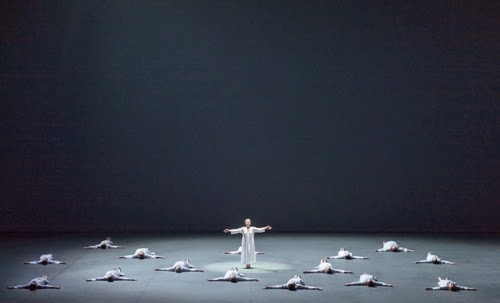
No major reservations about the arrival of the now-classic Robert Carsen Dialogues des Carmelites at Covent Garden (even bigger audience star-check: within seconds on exiting, I saw Jonas Kaufmann, Fiona Shaw and Deborah Warner). Carsen's painterly instincts for a nearly bare stage informed by evocative lighting brought us one stunning, apt tableau after another, none more haunting than the body language and grouping of the nuns in prison awaiting their sentence. There doesn't seem to be a better photo of that than this one.

I think for me this was the most choking moment of all in an emotional evening, so quietly and authoritatively did the strange-toned but always compelling Emma Bell deliver Madame Lidoine's words of wisdom. Here she is earlier in the action.

Nobody was found wanting. Sally Matthews' is an odd technique, sometimes cloudy, but she sent the sound up top with emotional truthfulness, fell to her knees very eloquently and conveyed the sense of Bernanosian limitless fear superbly. How we jumped when she dropped and broke the statue of the Infant Jesus, even if we knew it was coming.

Deborah Polaski's First Prioress may not have gone through her death agonies with as much harrowing realism as the peerless Anja Silja on the DVD of the same production from La Scala, but she sang the role with far more refinement and dynamic variation.

Anna Prohaska almost over-coloured Soeur Constance but she's a precious new talent on the scene, and Sophie Koch redeemed her baffling Octavian here some years back with a compelling and ultimately touching Mere Marie.

Equal star to Bell for me was Yann Beuron, such a powerful lyric tenor and an extremely sympathetic actor, as Blanche's desperate brother

and he was well offset in the first scene by Thomas Allen's baffled father. The final scene, of course, had both of us trying to restrain ourselves from sobbing out loud

and the lady next to us, come to see it for a second time because her two sons were in the people's ensemble (which she said had raised a few hackles with Equity, but they certainly added another dimension)
This was a redemption, too, for Simon Rattle: one of the best things I've heard him do recently, though come to think of it his Pelleas in the same house was very fine too, and it helps to have conducted that vital inspiration for Poulenc first. The chop-change style, modelled sometimes, I feel, on Prokofiev's mosaic operatic technique, suits him well; the extremes of dynamics were striking throughout and having the harp in a box made those great upbeat swooshes clutch at the heart. Slightly disconcerted by the brass vibrato which sometimes made it sound like a Broadway show (ditto the overamplified guillotine). But otherwise, nothing but praise for the dedication of the players.
It's been an amazing operatic couple of weeks - all this, Feuersnot in Dresden, the shattering and surprising Owen Wingrave at Aldeburgh on my birthday - an action-packed occasion I hope to chronicle here - a meeting with the galvanizing Kristine Opolais and her first night as Manon Lescaut yesterday with Jonas Kaufmann and Antonio Pappano, all three just about transcending the vague sterilities of Jonathan Kent's production. Here's a photo I couldn't fit into the review from Bill Cooper.
+BILL+COOPER.jpg)
Both Benvenuto Cellini and Manon Lescaut have the benefit of livescreenings around the world (Cellini, I note, got the HD treatment last night; Manon is due soon). Dialogues des Carmélites did not, but at least an earlier incarnation of the Carsen production, as I've mentioned above with reference to Silja, provides a different document. Much more troubling is the removal of Adams' challenging, ambiguous The Death of Klinghoffer from the Metropolitan Opera's HD schedule. This blog post, linked originally by my somewhat erstwhile blog friend Jon Dryden Taylor, expresses everything I feel very succinctly (albeit from a different perspective, that of a 'left-wing, liberal Jew')*.
We still have half a class left to go on Carmelites: I can't leave these nuns, or their various authors alone. And that means I'm skimping on my beloved Ariadne. But this has been an awfully big adventure through a score which, as with Cellini, I didn't know in detail. Grim times ahead, sadly, for the City Lit: a bombshell fell this week. But I need to get my facts together before I report and protest. I leave you with an astonishing film, courtesy of our Australian wanderer, of Joan Sutherland in a role I had no idea she'd taken on beyond the Royal Opera premiere, where Poulenc apparently adapted on hearing her. The diction up top is mush, as usual, but what authority, what passion in the voice.
Wonders will never cease - there's also the 1958 recording of the same scene at Covent Garden, conducted by Kubelik. Of interest if only to compare the change in vocal weight over decades.
*19/6 Further light in the darkness in some of John Adams's responses quoted here.


 Posts
Posts