This (the destination for my second jab last Wednesday)

has, in essence, made possible this,
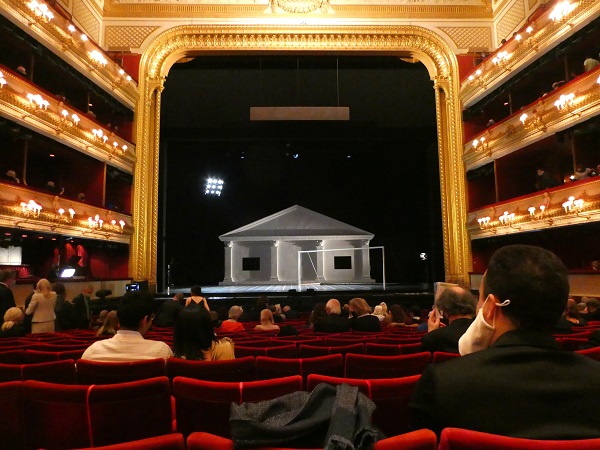
namely my first sight of an auditorium since December, and my first time within the main Royal Opera House since March 2020. Does the classical curia give a clue? It's Richard Jones's production of Mozart's La clemenza di Tito, all of a piece with the superlative conducting of Mark Wigglesworth and a vibrant cast, half of whom I'd never heard of, but all of whom were classy indeed (just heard that Emily D'Angelo, the Canadian-Italian mezzo who sang Sesto, has a contract with Deutsche Grammophon. Seems that RJ wants the Vitellia, Nicole Chevallier, for Weill's Lady in the Dark, as she loves musicals and is a real stage animal). The Arts Desk review of first night is here. Later in a week of wonders, I filmed a Zoom interview with Richard for the fifth of my Zoom Opera in Depth classes on Clemenza this Monday.

Mark W and Ian Page of the Mozartists, a generous presence throughout the classes, joined us live and we watched the first 22 minutes of the interview; I ran the rest in an extra half hour. Living with this incredible music, Mozart often as minimalist, has been like treading air while dealing with heavier stuff on the Russian Music course.

There was nothing heavy about Tuesday's London Symphony Orchestra concert back at the Barbican (queueing for a very well-organised entry pictured above). Simon Rattle actually prompted the tears that hadn't flowed in the excitement of the previous night in his opening speech (a one-off, he said). The music to excite 'that noise you make with your hands' was celebratory with a dash of wistfulness: Britten's Young Person's Guide to the Orchestra, three numbers from Faure's incidental music to Pelleas et Melisande, Dvorak's first set of Slavonic Dances. Review here and photo below by Mark Allan.

After this, the first of the two LSO concerts, I had time before the 'finissage' of partner J's first exhibition for a year at the 12 Star Gallery, so I paused for a blissful coffee and caramel brownie outside Konditor in Waterloo. Then on to the show, where the select few (or rather more than a few) had temperatures taken before admission. Simone Bergmann's photos of the 1970 Isle of Wight Festival - or rather of the happily naked attendees rather than the performers have created quite a stir, The exhibition finished on Friday, but this little film is still worth watching,
Our lovely friend Katharina von Ruckteschell-Katte, head of the London Goethe Institute, who features in the film, also made a speech on Tuesday evening alongside head of the European Parliament representation in London Susanne Oberhauser. Would you believe it, this photo by the resident expert Jamie Smith was banned from Facebook because of the bottom in between them. And some attendees were irritated that other private parts weren't properly shown (though there are some distant willies). Anyway, this prudishness or prurience are both irrelevant - it's a joyous celebration, a symbol of what we're missing. And they're fab photos.

Susanne used some good lines, but didn't adopt J's 'Arsch for Art's Sake'. And that is probably Best Bottom, but what I particularly like is that the cool dude has round his neck what look like gun cartridges but turn out to be harmonicas.
We were allowed to take our masks off once seated at tables with a good distance between us. So good to be able to meet and talk to friends. I look a touch ernst here talking to Lucy Hannah (on the right) and her surgeon godson.

General shot, good as always from Jamie.

Probably the first time in ages I've been a bit hungover (from several glasses of wine). and there was no lingering on Wednesday morning as it was second jab time. J had booked his for 10.50, mine was at 10.30 so we overlapped and I was able to stroll around the Science Museum for a bit.

It was especially exciting to look a bit closer at the spare section, as I've just finished reading the two Cosmos books by Carl Sagan and his wife/widow Ann Druyan, scientific humanists both: more on those in a future post.


My vaccinator turned out to be opera singer Annabel(le?). We started chatting because she commended my EU mask, and I just happened to have one in my bag to gift her. She seemed very spirited but obviously disappointed because Savonlinna, where she was due to be covering Rosina, had just cancelled its operas for the year, The following week she was auditioning for English National Opera; I hope it went well for her. As I left I heard her calling after me: I'd left my precious vaccination card on the table. That at least meant I could take a shot of her in the main area.

There was a lively protest/bit of street theatre outside against the Science Museum's acceptance of Shell as a sponsor for an exhibition about the environment.

Then we went on to have coffee in the sun outside the South Ken Comptoir Libanais, and I cycled off through the parks to Wigmore Street, where it has another branch, to hear Sean Shibe's lunchtime recital at the Hall: haven't been parted from live concerts there for quite so long. The system for admittance is as admirably rigorous as ever.

The programme was a mesmerising winner; review here. And as, unusually, it wasn't livestreamed/broadcast on BBC Radio 3. I had to take a curtain-call shot of Sean in his ruff.

Hmm. He can just about carry it off, as he did the reddy-pink boiler suit for his electric guitar shocker the last time I heard him at the Wigmore. Glad that most of the programme, plus magical Rosewood pieces by Irish composer David Fennessy (which he played in the quieter half of the previous Wigmore spectacular), has been captured in his recital for the delightful and enterprising Fiachra Garvey's West Wicklow Festival, also from London but sans ruff.
Here you get some enlightening chat (at 15m6s) before the recital at 28m50s. Love it that one of his earliest memories is his dad (potter Paul Tebble of a great Edinburgh institution, the Meadows Pottery, with Sean's mum Junko Shibe) singing him and his sister to sleep with 'anti-Thatcherite coalminer anthems'. Then there are some deliciously off-piste observations, which briefly fox even Fiachra.
Being in the vicinity of Regents Park, I cycled up there - haven't been for months - and was pleased to find St John's Garden open again. Still some wisteria at the gate,

irises flourishing against an early rose of sorts

and a beautiful, post-rains light for general views across to the villa which once owned this garden.

Then on, eventually, to divobass Freund Peter Rose around the corner, where his usual mirthfulness was doubled with the presence of director Paul Curran. Photos I have of them aren't very good, unfortunately.
More garden scenes, but also rain again, for the opening of the Glyndebourne season: kudos to the Christies for agreeing to four productions, three new, a concert staging and quite a few concerts too. The decision was taken a year ago - very bold. As was Damiano Michieletto's production of Janáček's Káťa Kabanová, which is not to say I liked it or thought it served high musical values well. Here's why I didn't. If only the angels had stayed in shadowplay; this, among many images by
Richard Hubert Smith, makes the production look better than it
ultimately was, though focus was retained throughout.

Only wish I'd thought of David Thompson's thoughts when the Act 3 curtain for the storm rose, very predictably, on more gyrations: 'it's raining men'.
It was raining cats and dogs when my friend Deborah and I emerged to take up our place on a bench at the head of the lake, so we moved our picnic stuff to the wonderful new covered area they've put up on the croquet lane. Gone are the exterior excrescences; this looks good (pictured later, when the rain had cleared away).

We did manage a good stroll before the performance, everything uncut looking lush after so much rain.

Deborah, who has been on a campaign near her home in Lacock to stop the National Trust cutting down bee orchids for a car park, was thrilled to see numerous specimens of the least exciting looking variety by the lake, the Common Twayblade (Neottia ovata; like the Dunnock, it may look ordinary but has a fascinating sex life, as Darwin pointed out). Couldn't decide which shot to choose, so take your pick.


Copper beech beyond the fence at the far end of the lake (quite a few of them in the vicinity) looking handsome

and even once the rains set in, there was a poetry (apart from these people, we had the lake to ourselves).

Windows of the Organ Room through budding mulberry (soon it will be too thick to see them).

Can't resist reproducing Deborah's cartoon in the card that arrived yesterday:

Just joyful to be there - especially as I have finally liberated myself from DJ conformity with my advance birthday present from J, a Nehru jacket - and clearly the staff felt the same; there was a wonderful energy about the peripheral circumstances, and great care too, though people WOULD keep taking off their masks once they were seated.
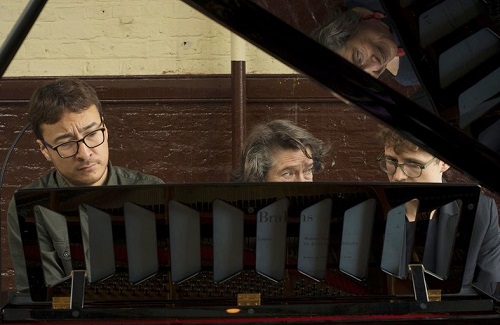
Friday, Saturday and Sunday evenings were devoted to the white-heat-as-usual Ragged Music Festival of pianists and partners Pavel Kolesnikov and Samson Tsoy. I've written myself out on the subject for The Arts Desk here, but again the peripherals are fun. Hadn't taken the canal path behind the row of buildings before. Usual suspects among birds, Canada Geese and coots, but their offspring were amusing, and Saturday afternoon was the first time I've ever been to the Ragged School Museum when it wasn't raining (it was on Friday and Sunday).


Irises had been planted in front of the graffiti-ed walls

and this was a novel approach (for me) to the building

After the renovation, it will have changed beyond recognition, and I wonder if the atmosphere Pavel and Samson love will have gone. Probably best, though, because there must be health hazards. There's beauty in peeling paint and general decay, though.

One last glimpse of the journey there on Sunday afternoon: geese contrasting with Canary Wharf skyline

and obstructing the towpath. You don't mess with protective parents. I and the cyclist heading for them had an amused chat about it while we waited for them to move.

This week has seen a necessary break from concerts and opera, and a return to more consistent nature here :the London Wetlands Centre, where the hides are now open again, and Chiswick House, where we saw the massive walled garden for the first time. But that's for another time.




 Posts
Posts



