Showing posts with label Elisabeth Leonskaja. Show all posts

Sunday, 11 October 2020

Round and round the Ragged School


Four times in all, three for the advertised concerts in the phenomenal Ragged Music Festival organised by pianists and partners Pavel Kolesnikov and Samson Tsoy, a fourth for a spontaneous 'musical party' scheduled for 6pm on the third day of the festival; expecting amuses bouches, we got three full, meaty sonatas plus a Mozart finale and the Schubert Fantaisie. Read more about the event, which has blitzed me and spoiled me for everything else for some time to come, here on The Arts Desk.

Two years ago we found a house in a terraced row close to Mile End tube which seemed perfect: it had a garden, and even a dog seemed possible when I discovered the green lung that runs from south to north (where Hackney's Victoria Park takes over). In the end, the additional costs proved impossible and we stayed put in the west But I loved the area, and I love it even more now that I know it embraces the Ragged School Museum, reached by a walk from the tube through aforementioned green lung. What's been done with urban nature here is so impressive, starting with the green bridge joining up the two 'wings' of Mile End Park over five lanes of the M11 near the station.

As Isabella Tree points out in her must-read Wilding, this is (or was at the time she wrote the book) only one of two land bridges in the UK. The Netherlands, she reports, has 62 such 'ecoducts', so there's a lot of catching-up to be done.

I know Erica Davies, its enterprising director, from Freud Museum days (I think she was just beginning there when my year as a guide under the Manpower Services Commission scheme came to an end). We shared a table, at a respectable distance of course, when Samson gave his first recital with Alina Ibragimova at the Fidelio Orchestra Cafe (a momentous meeting which led to the phenomenal musician's collaborations with Pavel, Samson and their friend/mentor Elisabeth Leonskaja here). But I knew nothing more than the slightest hearsay about the RSM. I can see why the pianists fell in love with the place as an atmospheric setting for their festival. All concerts took place in the former boys' schoolroom on the top floor.


A brief history is given here on the RSM website, but let me paraphrase and quote from it. Irish doctor Thomas Barnardo was horrified by conditions in the East End of the mid-19th century, not least an appalling cholera epidemic, and set up schools to provide free education for children whose families wouldn't otherwise afford it (even where they might have been admitted elsewhere, if they couldn't afford decent clothes, they would be excluded. Not in Barnardo's set-ups). 


In 1877, 'Barnardo’s Copperfield Road Free School opened its doors to children and for the next 31 years educated tens of thousands of children. It closed in 1908 by which time enough government schools had opened in the area to serve the needs of local families.

'The buildings, originally warehouses for goods transported along the Regent’s Canal, then went through a variety of industrial uses until, in the early 1980s, they were threatened with demolition.

'It was then that a group of local people joined together to save them and reclaim their unique heritage. The Ragged School Museum Trust was set up and the museum opened in 1990.' 


Richard Griffiths Architects won a competition to set about sensitive conversion in 1988, but more remains to be done, and they will be involved again in a major renovation. As it is, of course, I love the multiple staircases and the odd showpiece like the schoolroom where thousands of children still learn what it was like to be educated here in the 19th century, My distinguished student Robin Weiss went and was rapped over the knuckles for writing with his left hand.


Clearly much remains to be done over the next few years, and I like the idea of a cafe with a terrace on to the canal at the back, but I hope the essential character won't change. 

The display on the ground floor is very informative


and benefits from local donations, including charity collecting tins and boxes,


At any rate it was all remarkably atmospheric on a weekend where it hardly stopped raining. On the Sunday we had a very cosy lunch at the Afghan/Persian restaurant Ariane before the 3pm concert. Warmly recommended for setting, starters like the mix of salad leaves and herbs called sabzi khordan with lavash bread cooked in the nearby kiln


and a menu of food most of us won't have had in this shape or form - when we travelled round Iran, all we ever got in restaurants was cholla kebab with a raw onion - but the main dishes seemed rather underspiced. Still, it's right opposite the museum on the other side of the 'lung', so that was useful for not having to get too wet moving from one place to the other.

Finally, a few more pics of the occasion itself, which is still reverberating with me a week later. Here's a photo Samson proposed of the line-up - five out of the six performers: Andrei Ioniță, Samson, Alina, Elisabeth Leonskaja and Pavel.

I turn to photographer Eva Vermandel for a few more pics I wasn't able to use in the Arts Desk review: to complete the line-up, clarinettist Nicolas Baldeyrou

and this intriguing shot of Samson, Leonskaja and Pavel in their trio effort at the end of the Brahms waltzes sequence. 
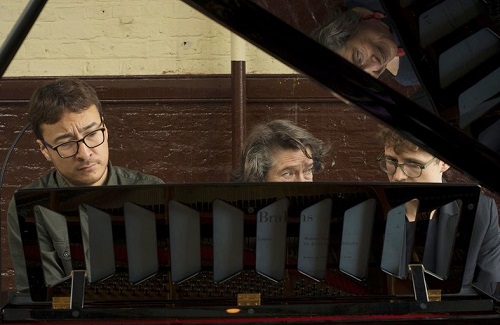

I love it that you can't tell EL is smiling from her eyes, but then you look at the reflection in the piano lid. What a miracle that she could come, and how ecstatic she seemed at the end of proceedings. As were we all - but I even wonder if the artists didn't end up less exhausted than the audience. It's demanding work, being an active listener...

Thursday, 9 August 2018

Leonskaja embraces the Pärnu spirit


Shouldn't pre-empt too much the Pärnu Music Festival piece I owe The Arts Desk for the fourth successive year, this time ahead of the Estonian Festival Orchestra's Prom on Monday (for which, I'm proud to say, I played my campaigning part). UPDATE (13/8) - here it is. But I have to recapture the amazement of turning up at the first concert of the week, less than an hour off the coach from Riga, to be knocked sideways by the opening work on the programme. From the website, we knew to expect the excellent Eldbjørg Hemsing in Massenet's Meditation from Thaïs and Saint-Saëns's Introdcution and Rondo Capriccioso, as well as the Järvi Academy Sinfonietta in Musica Profana by Lepo Sumera, the Estonian composer whose symphonies knocked me for six in the 2016 and 2017 Estonian Music Days.


The rest, however, had been put together over the past week. Elisabeth Leonskaja, my goddess among pianists, here to play the Grieg Piano Concerto with the Estonian Festival Orchestra - which she did, with unique deep musicianship, last night - decided she wanted to get involved with the players in chamber music. Hence Beethoven's early Quintet for piano and winds, also like you never heard it before nor will again. Two of my other favourite players in the world, EFO regular clarinettist Matthew Hunt and horn master Alec Frank-Gemmill, were there alongside her, to my amazement - Matt (pictured with Leonskaja above - all photos by the superlative Kaupo Kikkas) knows her well and they sea-bathed together at 8am on several mornings -


plus two other superb wind players not known to me, José Luis Garcia Vegara (whose playing in La Valse last night was out of this world) and bassoonist Jesús Villa Ordóñez (much Hunt humour about 'playing with Jesus').


'Lisa' wanted broad, floated playing, taxing the winds to the very extremes of their breath control, but she was right to ask for it. As for how good it was, don't ask me but rather Triin Ruubel, co-leader of the EFO but unable to travel with them this year because of her advanced pregnancy. I met her on my way into the hall here yesterday to witness Arvo Pärt listening to a rehearsal of his Third Symphony - it's that kind of place - and she said she had to leave the concert after the Quintet because she had 'never heard a more perfect performance in my life'.


The following evening, Triin contributed to the unearthliness of a real underrated near-masterpiece, Eduard Oja's Piano Quintet, which Leonskaja had also undertaken to learn and more or less conducted from the piano: stunning, unforgettable. That's the two of them above with Triin's fellow violinist Adela-Maria Bratu. But that, and the rest of this amazing week, must wait until later coverage... Next, however, was this, from yesterday's rehearsal of Pärt's Third Symphony. Photo by Karima Morooka Elsamny.

Tuesday, 25 July 2017

Leonskaja's Schubert: CD gold


'Who are your idols?,' I once asked a colleague while we were waiting to record a BBC World Service chat in Bush House. 'I don't have idols, I'm a professional critic' came the ludicrous reply. Well, just as I haven't 'grown out of' Der Rosenkavalier, as another pompous Brother in Apollo told me I would, I still have idols, and Elisabeth Leonskaja is the living pianist I'd rather hear more than any other; readers of The Arts Desk will know that I cover every UK appearance of hers that I can, and I still count it as one of the musical highlights of my life that I got to hear four late-night concerts in her 2010 Schubert cycle at the Verbier Festival - the first time she'd ever tackled them all - even if the Verbier experience per se wasn't an especially happy one for either of us (I've no desire to go back, much as I loved the solitary walks in the heights).

My seminal experience in Schubert's piano music dates back to March 1989 and Sviatoslav Richter's Chichester Cathedral recital, when I first heard the heavenly and hypnotic length at which he unfolded the first movement of the G major Sonata D894.


Leonskaja has her own very distinct voice in Schubert, but as Richter's protégée she was bound to follow his example in several respects (there's also a DVD on the lavish set I'm discussing here of the two playing Grieg's two-piano transcriptions of three Mozart piano sonatas and C minor Fantasia which I have yet to watch). One is that you don't EVER omit a Schubert repeat. When I interviewed her in Verbier, she recalled Richter's demands of students who dared to cut the inspiration short: 'what, you don't love Schubert's music?' And how the hell did Brendel dare to inculcate in pupils like Imogen Cooper a truncation which would mean omitting as inspired a passage (eight and a bit bars of first-time link back to the repeat) as this?


That of course occurs in arguably the greatest, certainly the most heavenly, of all Schubert's sonata first movements, the Molto moderato of D960. Unthinkable not to have the seismic rumble the only time it appears ffz in the movement (though apparently there's been some debate about the dynamic marking). We get all repeats, of course, on the four CDs in eaSonus's luxurious presentation - and never have I been happier to see such a homage, made to follow on the heels of Leonskaja's 70th birthday in November 2015. It comes with 48 pages of mini-biography in the form of more in-depth interviews than mine, enriched with a fine selection of personal photographs you won't have seen anywhere else. I have to quote two specific answers by the great lady. One is to the question: 'what do you try to pass on to students in a master class?'

1.   Love of music.
2.   Respect for the composer.
3.   Avoiding laziness.
4.   Self-confidence without arrogance.
5.   How to master the technique of playing the piano freely. In Moscow they used to tell us over and over again to sit comfortably and play freely and that's my approach now. That means free thumb (very important!), free elbows and wrists, and sitting comfortably at your instrument. All this leads to an unobstructed energy flow. At the beginning I find all this much more important than to work on the details and specific aspects of a particular piece.
6.   It's very important for me to be friendly, without too much finger-wagging. I simply concentrate on whatever I believe is blocking the student's progress.
7.   Passing my experience on to students without being condescending to them. It is essential to have a good atmosphere in order to work intensely and constructively.
8.   During the lesson, life takes a back seat, only music is important while we work. Teaching is an intimate and transcendental moment.

And to 'What are your sacred rules, your everyday doctrine?':

I think every day about what [Heinrich] Neuhaus [the greatest of pedagogues] used to say: 'Don't look for yourself in the music, but find the music in you'.

And Richter always used to say, 'It is not the what that matters, but the how'.

The 'how' of Leonskaja's Schubert I've tried to grasp over the years, but its essence is absolute clarity, an ability to switch from well-weighted orchestral pianism (something I always think of as the essence of the Russian school) to delicacy in a split second. She talks of wanting the public to have left a concert 'with the feeling of having found the grail', and that's happened to me, right from the first re-connection in the second half of her Chopin recital back in 2009. In the performance of the 'Trout' Quintet at Crail Church as part of this year's East Neuk Festival, I found myself within minutes of the first movement's beginning in that profound state of transport yet total awareness you only get in the best meditations. It's a shame there wasn't an official photographer to document her appearances; my post-performance shots, taken without flash of course, are inevitably fuzzy. See this as an imperfect souvenir.


Nothing is more phenomenal than Leonskaja's 'Wanderer' Fantasy, like the work itself an encyclopedic wonder of the world - I hope a recording will feature on the sequel to this set, due early next year - but she can also be wry and funny with total lightness, as in the finale of the 'Gasteiner' (D850). The physical energy and focus of D958's tarantella-finale are something you have to experience live to quite believe. And not even Richter produced as much shattering power as the time-bomb of D959's slow movement explodes at its terrifying heart.

I'm so grateful to Leonskaja, too, for proving that Schubert's quirky and lovable personality is there right from the first, five-movement sonata, D557, which I heard both in Verbier and Crail (again, I trust it will be included in Volume Two). The relatively early A minor Sonatas sound pretty miraculous in her hands, too; D784 is simply colossal. It's only when you get back to the last five that you realise the difference between great and supernaturally great. Here's to many more years of performances; in her seventies Leonskaja has lost nothing of the strength and clarity which are her trademarks, so there's no reason she shouldn't carry on as long as she wants to.


By way of a Schubert footnote, though it deserves pride of place and should have been included in my 'Music for a few' post, the duo recital of Martino Tirimo and Atsuko Kawakami at the Reform Club back in May (pictured above) reminded me very movingly what a great masterpiece is the F minor Fantaisie D940. Martino, a real gentleman and a seriously underrated top interpreter of Schubert, Mozart and Chopin, understands the ethereal yet still humanly bittersweet quality of late Schubert so well, and the sound of his former pupil was perfectly co-ordinated to match (Martino took the lower part).


The real surprise was Eduard Langer's transcription of Tchaikovsky's Nutcracker Suite - on the above front page it's clear that Tchaikovsky made the one for two hands, Langer for four - reminding one just how elaborate the composer's genius is in these miniature gems and how wonderful the counterpoint. An especially lovely touch was Atsuko side-tapping a tambourine for those essential ta-ta-ta-ta-taaas in the Arabian Dance. Afterwards I asked if they knew Rachmaninov's similar transcription of the Sleeping Beauty Suite, which they didn't, so I loaned the score to Martino when he came to the Frontline Club. Looking forward to their performance of it. Though if that, too, is to be at the Reform Club, the promoters will have to work a bit harder to get more folk in the audience than they did. These first-rate musicians deserve much better.

Wednesday, 25 November 2015

Once a Bishop


From his birth in 1940 until 1975, he was plain Stephen Bishop, named after his stepfather (typically, he plunged in at the deep end in his recording career with Philips, recording Beethoven's Diabelli Variations in 1968, sleeve pictured above). Then he added his Croatian father's name and became Stephen Bishop-Kovacevich. For many years now, he's been not-so-plain Kovacevich, and as such he celebrated his 75th birthday in high style with former other half Martha Argerich at the Wigmore Hall. Here they are playing Debussy's En blanc et noir - roles were swapped for a stupendous performance of Rachmaninov's Symphonic Dances -  with thanks to Clive Barda.


I reviewed the curate's-egg programme - still can't quite decide what I thought about the very speedy Schubert D960 Sonata, so very different from his Hyperion version - on The Arts Desk, preceding it with a long, long interview. Which was a privilege and an honour, but how much more I could have got out of it had the Universal box of all his Philips recordings made a timely arrival.


It was, at any rate, a pleasure to dive in and dig out the performances he specially rated: Brahms One and Schumann Concerto with Colin Davis, Bartók's Sonata for Two Pianos and Percussion with Argerich, and of his many recordings of the Brahms solo piano works, he singled out the Capriccio, No. 8 of Op. 76 as something very special and oh, so hard to play well. The set also plays to my being suckered-in by original sleeve artworks, sadly not of course reproduced at the size of the original LPs, but some are so very 1970s.


I've spent much time with the rest of the 25 CDs - amazed by his Chopin, a composer with whom we tend not to have associated him, and returning most often to the sets of late Brahms piano pieces (Opp. 116-119). He switched me on to some of these elusive, often very interior masterpieces in a 1981 Edinburgh Queen's Hall recital during my first year as a student (it may just have been Op. 117, and certainly a Beethoven sonata was also on the programme - though whether 'Tempest' or 'Waldstein', I can't remember - one of those because I made an only partially successful attempt to learn both in the early 1980s).

These are certainly top of the heap - in the interim, I've also played Nicolas Angelich's interpretations - and no-one captures better or more supernaturally the weird introspection of, say, Op. 116's No. 5 in E minor or the first two of Op. 119. The titanic and the intimate side by side which mean Kovacevich IS Brahms for me are most extreme in the first of the Op. 79 Rhapsodies.


Kovacevich's delicious solo rendition of Brahms's Op. 39 Waltzes provides an appropriate link to a more consistently miraculous birthday celebration more recently at the Wigmore - divine Elisabeth Leonskaja's 70th, surrounded by friends both young and (relatively) old. Again, I've written a review, this time a total paean, over on The Arts Desk, and I was thrilled to hear Jörg Widmann live as clarinettist for the first time - what a complete performer - but the four-handed Waltzes were a special delight.

Fireworks came from Samson Tsoy and Pavel Kolesnikov; taking over for some of the more inward numbers were 'Lisa' and acolyte Alexandra Silocea - whom I've known since writing the notes for her Prokofiev debut CD and like a lot, ditto her delightful husband Sébastien Chonion, who's been garnering awards for his production work at Glyndebourne. I'm assuming he took this picture of the happy Brahms foursome (update: he tells me he didn't, and only Alexandra, giving a Manchester Bridgewater Hall lunchtime recital even as I write, can identify the photographer). Kolesnikov is on the right.


Another good pic of the evening - which wasn't officially snapped - came from Tweeter Odetta. I hope she won't mind my reproducing this one, an alternative to Sebastien's group shot which I used on TAD. Sorry you can't see more at this size.


As for bumper boxes, I finally got to the end of 86 CDs - 50 in a Sony box, 36 from Universal - of Stravinsky, and talked about the experience with Andrew McGregor for about an hour on Saturday's CD Review, with some choice excerpts. I can honestly say it's been a constant enlightenment, and probably no composer weathers such consecutive listening better. Listen to a fraction of the thoughts I had about the two sets for the next 28 days on the BBC iPlayer. The chunk starts at about the 1hr48m mark.

Friday, 18 November 2011

Every cut a little death


Brutal chops in a couple of large-scale works I've heard over the past ten days reminded me of what Sviatoslav Richter had to say, recounted with warmth by his one-time duo partner Elisabeth Leonskaja when I had the huge pleasure of interviewing her at last year's Verbier Festival. We were talking about various approaches to the Schubert sonatas and I said how surprised I was, much as I liked the lady's general approach, by Imogen Cooper's omission of the exposition repeats in the Big 'Uns. Like D960, for instance, where by missing out the eight bars linking back to the first-movement repeat, she deprived us of essential music including a terrifying new appearance of the subterranean rumble which threatens the movement's stability.


Anyway, according to Leonskaja re Richter, 'If someone did not play a repeat, his question was: "You don’t love Chopin? You don’t love Schubert? Why?" [Does humble pupil voice] "Yes, I love it." "But why don’t you repeat?" And very often he said, "You know, for the public everything is interesting, only for the musicians is it not interesting to repeat." '

So I would have the same question for, of all people, that ardent champion of his fellow Czechs' music Jiří Bělohlávek when, last Thursday evening, I heard him reducing the admittedly long and involved symphonic poem I discussed below before the concert had taken place, The Golden Spinning Wheel, by about a third: 'You don't love Dvořák? Why?' Admittedly an elaborately descriptive piece such as this has its problems, but if you're going to do it, do it properly and, ideally, give a short introduction drawing in the orchestra to play a few signpost-snippets to help unacquainted listeners.


I'm assuming Bělohlávek must also do the same in his Chandos recording of The Noonday Witch, for again the timing comes out about five minutes shorter than the Rattle interpretation, which is one of Sir Si's finest achievements in terms of both colour and - surprising, but in this instance true - phrasing. At any rate, no-one would cut The Wood Dove, the most Mahlerian of the pack and very much more to the point. But I love all four; whatever the scene being depicted, Dvořák's genius for melody and unorthodox orchestration seems to burn at its brightest.

A more familiar casualty, and in this instance conductors take the cue from the doubtful composer himself, is Tchaikovsky's Manfred Symphony. It would be ungracious of me to cite the recorded performance I've just written the notes for, and been edited for my pains in pointing out what's not so good about the cuts in question.


Suffice it to say this isn't the first time I've heard a Russian slashing and burning the work. Yuri Ahronovitch many years ago took us aback by cutting the finale short with a straight reprise of the first-movement coda, denying Tchaikovsky's Manfred the very unByronic redemption which usually comes as a stick-in-the-throat apotheosis (though Vladimir Jurowski convinced me it could work).

That doesn't worry me as much as the lopping of some decidedly strong stuff earlier, especially in the finale's underground orgy. Ever since I deduced that the voices in the central fugue depict the five tempter spirits, I've doubled my pleasure in it; but in any case I reckon Tchaikovsky is unfairly lambasted for the few fugues, or fugatos, he does write; they seem to work pretty well to me. And much as he may have thought of dropping three of his four Manfred movements, much of the invention here is as fine as anything he wrote, and certainly unique in terms of orchestration.


On a not entirely unrelated note, I've followed a convoluted trail to watch some very significant threads and patches of what may be Sibelius's Eighth Symphony as performed by the Helsinki Philharmonic under John Storgårds. Wouldn't it be wonderful, as I wrote at the end of this Arts Desk Buzz piece, if Saraste could append these startling fragments to his upcoming instalment in the BBCSO's Sibelius cycle?

Tuesday, 3 August 2010

Verbier: extra nectar


Somehow even when I'd rambled on about Verbier for The Arts Desk, I found there were peaks of the experience I'd still missed out. Who knows if Sarah Chang, Nicolas Angelich and company in Pfitzner and Saint-Saens might not have been another such? I can't regret not having experienced it when my time on that last morning was spent up in the heights gaping at rocky perspectives and looking down at Alpine flowers like the above which I wish I was able to identify (a study, or at least a little book on the subject, beckons).

Anyway, in anatomising what went wrong with the performance of Strauss's Don Quixote on Sunday night, for all its sturdy guidance by Dutoit, I quite forgot to wax passionate about one of the greatest living violinists, Leonidas Kavakos, in the Bartok Second Violin Concerto of the first half.


Such a collegial chap (pictured above for the festival by Nicolas Brodard, who also took the shot of Gringolts and Suzuki below), bending in to his fellow musicians: just the kind of soloist a youth orchestra needs. But quite apart from that, what a sound. I heard him play the concerto last year at the Proms with even more idiomatic partners, Ivan Fischer and the Budapest Festival Orchestra. Yet oddly this time I didn't fidget so much at Bartok's late cut-and-paste technique, perhaps because I was virtually under this compelling player's nose. And there's a special magic about a solo encore given possibly even more for the benefit of the orchestra than for the audience. The most moving thing of all was to watch the young musicians so immobile and intent, hanging on every note. Of whatever it was. Ysaye, perhaps? I confess my ignorance.

Later: aren't YouTube and medici.tv a wonderful thing? Here it ia already. And, yes, Ysaye was a good guess, as it transpires. You'll probably need to click on the screen to get the original YouTube full format.


And then Leonskaja to follow in one of the most ineffable of all Schubert sonatas, D959 with its time-suspending, and timequaked, slow movement (Aline Paley snapped the pianists for Verbier). A high note from which to take my leave of the Verbier music.


It was her fault, and Pires's at the Wednesday late night Prom, and Kit Armstrong's, if I hadn't been able to settle to the stiffer presence of Yevgeny Kissin. His Chopin Nocturnes, by comparison, went for nothing, though he finds more in the spring of the Mazurkas. But still it wasn't relaxed in any way. I fled at the interval, probably rather foolishly missing what was by all accounts much more engaging Schumann.


Not much to say about Ilya Gringolts and Masaaki Suzuki in Bach sonatas, unhelpfully swathed in the darkness and disco lights of the horrible church interior. But again, perfect, sprightly and unfussy music-making for a morning in the mountains.


Sounds from Jessica Duchen's blog like I should have plumped for the last weekend and the Gergiev/Voigt Strauss Salome, of which I'd been wary (sure enough, the wayward maestro didn't show up in town until rather late in the day, but according to Jessica that didn't inhibit the thunderstruck results). But then I wouldn't have heard so much Leonskaja, the essence of the experience, and in any case we can all see the concert opera for ourselves on medici.tv's Verbier selection for free. One last fond look down, then, on Verbier from another point of Alpine superiority.

Friday, 30 July 2010

Verbier fare


No. it wasn't all lotus eating. For the most part I kept myself to myself, stocked up on delicious local produce and fresh bread in my self-catering flat (the second, after I'd moaned about the dark, viewless first, just perfect) and missed a couple of banquets because of my devotion to late-night Leonskaja after the main concerts of the evening.

Bit of a pity, that, on my second night, because there was a big do out at a restaurant near the golf course. I arrived at 11.40pm, delirious from Leonskaja's Schubert D850, just in time to find the only folk I actually knew on the point of departure. The food was finished, but not all the distinguished guests had gone. As Bashmet, Maisky and other familiar faces flitted past, I saw the divine Anne Sofie von Otter (pictured below for the Verbier Festival by Nicolas Brodard singing the ballad of Faure's Melisande in that evening's concert) and wanted to tell her how much her tribute to Anthony Rolfe Johnson had meant. Yes, she said, so many famous losses already this year, and several others close to her. And we talked a bit about Tony's warm and ever-helpful collegiality.


Spoke to that romantic young cellist Andreas Brantelid about the morning's Debussy trio revelation. Also saw Bengt Forsberg, and wanted to press the flesh after that totally individual recital he'd given at the Wigmore. Never met a friendlier artist. He was there with his daughter, and told her delightedly I was the one who'd given him that review, and how I'd understood his intentions. I pressed the Grainger celebrations idea next year on him, and quick as a flash he came up with the relevant Percy dates.

So there was talk if nothing more than a cream eclair to go with it. Earlier, at least, some of us had enjoyed a sumptuous reception at the simple but obviously first-rate Grange Hotel where I chatted with the delightful Laurence from the tourist office about Edinburgh, where she'd au paired in days gone by. Dvora and Michael Lewis and I agreed that the above tuna and mango spoons and all the other bonne bouches were the best we'd ever tasted. Dix points for presentation, too: how's about this for confectionery?


Even so, I was very happy to potter around delis, patisserie and Migros seeing what Valaisian fare was on offer. Bought some choice local meats and was pleased to find seasonal raspberries, apricots and the best cherries ever, many of which I consumed on the balcony of my lodging staring over at the western peaks.

Tuesday, 27 July 2010

An Olympian in the Alps


I've turned Schubert-crazy again. As with Wagner, the mania comes and goes in waves. It all started with The Greatest Piano Recital I've Ever Heard, Richter's at Chichester Cathedral in March 1989, when he took an hypnotic half-hour over the first movement of the G major Sonata (D894). Then I hunted out all his recordings of the sonatas, and found his heavenly length the only way I wanted to hear Schubert. Now his one-time duo partner and protegee Elisabeth Leonskaja has come out from under the Richter shadow and forged her own great interpretations. And it's the palmy days of Richter all over again, though with a very different musical personality at the helm.


At Verbier high in the Alps, where I've just been privileged to spend three and a half music-and-walking-packed days, Leonskaja is currently working her way through the complete Schubert sonatas - half of them for the first time ever, as she told me in an interview which will appear probably around the time of her return to London to play D894 later this year. She clearly had as much smiling affection as I did for the first of the three late-night programmes I was privileged to hear in the vast temporary construction of the Salle des Combins. There, having moved from an apparently disastrous encounter with a poor piano and rough acoustics in the Verbier Cinema, she played the Sonata in B major, D575, and the unusual five-movement E major, D459. Hardly a couple of bars pass without Schubert revealing his own lovable, harmonically wayward personality, and you can rarely predict the progress of a melody (the third movement of D459 struck me forcibly in this respect).

So what is it that makes Leonskaja's Schubert so special? I came late to her extraordinarily deep and thoughtful concert-hall approach - music as a sacred rite - with the second half of her Chopin recital late last year. Here, it seemed, the range was extended. She can indeed be as Olympian as Schubert himself (her word for the opening movement of D850), with that fabulously weighted full sonority; but she catches the essence of his ability to leap from the thunderously epic to the intimately lyric. So we ranged - forgive the corny images prompted purely by a desire to put up a couple of Verbier snaps - from the babbling, high-altitude brook of D850's delicious finale


to the forbidding heights, glaciers and cataracts that disrupt the ineffable slow movement and finale of D959 (a performance which brought an instant standing ovation, as the colossal D major Sonata should have done the previous evening).


The articulation is phenomenal, the emotional commitment total. And the stern, concentrated figure on the platform is in extraordinary contrast to the vivacious, humorous woman you meet offstage - though one thing, a great humanity, connects the two.

And for now I'd better stop waxing lyrical, return to Verbier another day (due for a big Arts Desk piece on Sunday) and just count myself lucky to have heard great pianism in hugely contrasting styles, from Lewis and Pires at the Albert Hall on Wednesday to the 18 year old Kit Armstrong pouring forth musicality and playfulness in a Verbier trio concert and, of course, Leonskaja magisterially at the heart of it all.