Sunday, 5 September 2021

Strauss conducting Tristan

'Now I’ve conducted Tristan for the first time, and it was the most wonderful day of my life'. I used the same quotation - the 27-year-old Richard Strauss to Wagner's widow Cosima, on 17 January 1892 - to introduce my review of the Glyndebourne performance at the Proms earlier this week, because I surmised Robin Ticciati felt that way on conducting his first Wagner opera for the first time too.The above photos were sent, signed, from Weimar to fellow-composer Humperdinck, whose Hänsel und Gretel Strauss premiered in that beautiful town in 1893. 

Tristan und Isolde at Weimar starred Strauss's future bride, Pauline de Ahna (also a favoured Elisabeth at Bayreuth) and his pupil Heinrich Zeller, for whom he wrote the insanely taxing role of Guntram in his hyper-Wagnerian first opera. There were no cuts - rare then, and still not so common now (the Aix production conducted by Rattle this year has a whopping one in the dialectics of night and day, love and death, the lovers indulge in before the Liebesnacht proper gets going. I think we should hear it all - there are no commonplace bars in Tristan). 

We have one precious sound-document of how Strauss approached this most elusive of all great masterpieces: a recording of the Prelude made in 1928 with the Berlin Philharmonic Orchestra (the best sound is on the DG pressing, but that's not downloadable here).

Yes, it's fastish - difficult to compare timings with other Preludes because there's a 'concert ending' which takes us to the Liebestod music - but the rubato, the ebb and flow, are masterly and above all human. That's the difficulty for the conductor to decide: human or oceanic? Others prefer slower tempi, surprisingly so Toscanini (but then remember that the biggest discrepancy in Parsifal Act Ones at Bayreuth was between Strauss and Toscanini, who took half an hour longer...). In my first Opera in Depth class on Tristan und Isolde, I played both the Strauss and this NBC recording.

All the students who spoke preferred the Strauss; I was delighted. Though it's very much a matter of choice and temperament, when Wagner only writes 'Langsam' ('slow') at the start. Conductors would be wise to observe his tempo fluctuations thereafter. Anyway, in the second class, I played the way to the climax in performances by Stokowski (very volatile, masterfully conducted, and played by the Philadelphia Orchestra) and, for slow-burn intensity, by Mravinsky and Pappano. Personally, I felt a 'yes, this is how it should be' once the drama of the Prelude properly flows from Ticciati at the Proms. You would be well advised to listen to the complete performance while it's still available on BBC Sounds (until the end of this month).

We've now passed the halfway mark in Class Five last Wednesday, and of course I have nothing in my head but the sounds of the 'Liebesnacht'. The compelling but deeply unsettling way that director Krzysztof Warlikowski handles it in Munich, with spellbinding performances from Jonas Kaufmann and Anja Harteros (pictured above) and superlative conducting from Kirill Petrenko, seems to me the best approach I've seen. 


Soundwise, I'm constantly shifting in examples between so many recordings, but predominantly Lauritz Melchior and Kirsten Flagstad with Beecham (or Reiner), Bayreuth '66 (Nilsson and Windgassen with Böhm conducting), Vickers and Dernesch with Karajan, Margaret Price and Rene Kollo with Carlos Kleiber, Linda Esther Gray and John Mitchinson with Goodall. Linda is returning to talk to us next week, and Peter Rose will appear to discuss Marke's monologue. Later we hope to welcome Robin Ticciati and Antonio Pappano, and Anne Evans in the final class. More in the pipeline. It's rich!

Friday, 27 August 2021

Hovs Hallar: chess on the beach

I won't pretend that this shot on one of the primeval beaches of Hovs Hallar in south-west Sweden is anywhere near an accurate reconstruction of one of cinema's most feted scenes, where Max von Sydow's knight, washed ashore with his jester-squire Jöns  (Gunnar Björnstrand) and two horses, starts a game of chess with Death (Bengt Ekerot) as a means of playing for time.

Nevertheless it was convenient that Agustin Blanco Bazán had a raincoat with a hood and that Peter Krause's haircut had sufficient correspondence to von Sydow's; and it was a bit of what Bergman would call a 'schnappsidee', though our fuel at this point was coffee in flasks. Our expedition was planned by the Birgit Nilsson Museum magnificent hosts for three glorious days - I've done my bit on the musical side now for The Arts Desk - in conjunction with an excellent local guide, Ingrid Persson Skog. Here she is on the beach with three of us - photo taken by our other excellent cicerona, Lucy Maxwell-Stewart - showing Bergman's sequence on her iPhone.

As for the museum people's thoughtfulness, it's summed up in one piquant detail - the chessboard biscuits they provided with the coffee.


It was here to Hovs Hallar, the rockiest part of the otherwise mild and beautiful Bjäre peninsula in the northwest of Skåne, that Bergman came to shoot two celebrated scenes - the opening sequence with the chess game and the Dance of Death, an improvised shot with two tourists drawn in because some of the actors were hung over after a last-night party, as well as the idyllic picnic shared by young parents Mia and Jof. The whole thing was completed, as stipulated, in a mere 36 summer days, the bulk of it on Svenska Filmindustri's studio plot in Råsunda. Better get the iconic shot of Death in here to complement the above, more or less the same positioning.


I had it in my head that Hovs Hallar was an island because the second film to use it as a location, the horrific The Hour of the Wolf (1966), takes place on an imaginary equivalent. Both films use the relatively level ground before the path descends at times. Johan (von Sydow, this time playing a Bergman alter ego), the tormented protagonist of The Hour of the Wolf, attacks Heerebrand, who describes himself as a curator of souls, as they walk along the upper ground

while knight and squire encounter the first victim of the Black Death as they head towards the nearest settlement.

There's now a hotel in the middle of this nature reserve, and various boards, maps and signposts. The most fascinating tells us that this is a site designated by the European Film Academy as a 'treasure of film culture', a place 'of a symbolic nature for film culture' - one of 11, apparently.

From here, there's little sign of the drama to come, only - in cloudy, windy weather such as we had at the start of our walk - a hint of desolation with a lone tree.

But soon, on the descent, the true nature of the magnificent land and sea scape becomes apparent.

You see something of this close to the beginning of The Seventh Seal when a voiceover tells us of the plague time


and a view of the beach immediately below the path when knight and squire make their ascent.

The rocks are red gneiss, heaving up in a geological fault, as dramatic as the stacks on the west coast of Fårö, the island which Bergman made his home and to which he transferred much of his outdoor magic (I wrote about the unforgettable experience of Bergman Week on theartsdesk).

But note how this is far from being a barren landscape. Rowan trees have sprouted up everywhere; there are honeysuckle, crab apple trees and blueberry bushes.

Lichen grows on the pebbles and rocks...

...if they're left alone. Unfortunately human curiosity has taken upon itself to make stacks on the first beach you reach, 

which look suitably weird but can't rival the real, natural thing. 

The further you walk, scrambling over rocks between beaches, the more wild it seems to become. Not everyone progresses beyond the pile-up bay, though after our coffee break, more folk were arriving; pleased that we started so early.

I thought of the terrifying scene in The Hour of the Wolf where Johan is bitten in the neck by a young demon, whom he kills and hurls out to sea.

Then there we were, on the familiar beach with the cave, seen here behind the Knight in The Seventh Seal.

Lucy and Ingrid are on the beach, Agustin and Peter by the cave.

We were not alone. Cormorants lined the rocks, just as at Pittenweem in the East Neuk, my previous coastal destination.

While there were spots of rain as we listened to Ingrid, sipped our coffee and ate our chessboard biscuits, the expected downpour never came, and the sun came out for our route back.


Then we were off for a picnic and a swim on what I thought would be milder territory - but the sea swell was rather alarming - and an afternoon looking at the concert hall and art gallery just being completed, plus a wonderful if short time in the main town of Båstad. But that's for another post.

Saturday, 7 August 2021

Pärnu festival spirit - felt from afar


For the first time in seven years - yes, I even got to go to Estonia last summer, my only foreign travel in 2020 - I had to miss my favourite music festival in the world. Plans were laid, flights (reluctantly, since it's something I'm still trying to avoid) and hotels booked. Then my mother was rushed into hospital and, though much better by the time I was due to leave, still needed daily visits from me: when you're 90, your morale is the thing that most needs sustaining (she's home and in good spirits now). 

I have no doubt I did the right thing; I discovered natural beauties on the way to and from the cottage hospital, and I saw wonders operatic in London as some compensation. Every Pärnu concert, moreover, was filmed and streamed live on the website's TV channel for free (last year there was a very reasonable charge). You can still watch until the end of the month (tbc). The images here are all by photographic artist Kaupo Kikkas, an essential presence at every festival and one of quite a few good friends made in Pärnu (I know which are the real ones by now...) OK, the lineup is seriously blokey, but we've had soloists like Lisa Batiashvili and Viktoria Mullova at past festivals.

I'll confess I still have to see some of the events featuring the excellent Academy Orchestra; the first priority was the three Estonian Festival Orchestra concerts under doyen Paavo Järvi (he sent a very nice recorded message to say I was missed via the wonderful Lucy Maxwell-Stewart, who organised everything as usual). I get the feeling that each of the top soloists was inspired to give of his very best, working with that warmest of super-orchestras and conductors. It was vital to Paavo to get the pianist Lars Vogt along; the pianist has spoken so eloquently and with amazing perspective of his cancer here in an interview in  VAN Magazine, and we hope with all our hearts that he will pull through. Here are conductor and soloist together.

What follows is nothing like a review - it's some time since I watched the first concerts, after all - but a general impression remains that Vogt's playing in Mozart's C minor Concerto, K491, was on a level of sensitivity and response to everything around that I've not experienced before. Of course the wind, so crucial in the Larghetto, are among the best in the world - but this time I listened as much to the piano as I did to them. What a perfect encore, too, consolation and sorrow side by side so lightly etched in Brahms's  A major Intermezzo, Op. 118. 

The EFO repeated much of the same programme the following evening, but with Dvořák's Violin Concerto replacing the Mozart. Unlike that masterpiece, the Dvořák isn't among my concerto favourites, and memories of Truls Mørk in the Cello Concerto at the 2019 festival were still vivid. 


So I was taken aback by the sheer agile, febrile intensity with which Joshua Bell played it - again, visibly inspired by his colleagues, and sweating more than any of them (it was very hot and humid in Parnu that week, I'm told. You wouldn't hear this work played at a high pitch of brilliance anywhere.

I'll confess I was a bit disappointed in the choice of works announced for the visit of Emmanuel Pahud, the world's finest living flautist (that I know of - if anyone else has other information let me know). After all, Mozart's Flute Concerto isn't even as interesting as the one for flute and harp, and it seemed odd to resort to an orchestration of Poulenc's Flute Sonata. Why not Nielsen? 


But Pahud's artistry is compelling in itself, and there was a delicious surprise before the Mozart minuet finale - the perfectly apt interpolation of Arvo Pärt's Estländler (2006/2009). It's a joy to watch the amusement and pleasure of the orchestra's flutes, too, especially the smiles of Maarika Järvi (Paavo's sister, such a lovely person), as Paavo holds up the score for Pahud to follow.  I loved the complicity of the EFO woodwind, too, in Lennox Berkeley's Poulenc arrangement. The encore after the whole audience went wild a second time was Debussy's Syrinx - again, hard to imagine a more perfect arrangement.

There was equal magic from the players of the magnificent EFO - I persist in thinking it's like the Lucerne Festival Orchestra when Abbado was alive - in the chamber gala, always a highlight. I was, of course, cheering on my treasured friends Andres Kaljuste and Sophia Rahman, who were honouring the Tubin works in one of the main programmes - more anon - by performing the composer's transcription for viola of his Saxophone Sonata (1951). 

Not perhaps a work in which you can spot a clear identity - the second movement is utterly different in style from the first - but these two top musicians made magic of it.

The whole programme was well programmed as a classical/romantic sandwich with Estonian filling - on the other side of the interval came the sublime simplicity of Ester Mägi's Duos in National Idiom (1983). What a supremely subtle artist is Sharon Roffman, someone else I've come to treasure through Pärnu acquaintance, duetting with Maarika. 

I'm so proud that we picked a Mägi winner for the Europe Day Concert back in May - everyone loved the compact mood-shifts of The Sea. Any excuse to go back to that great concert, rendered all the more moving in this case by the nearly-100-year old composer's death the following week: I'll post the YouTube film without further comment.


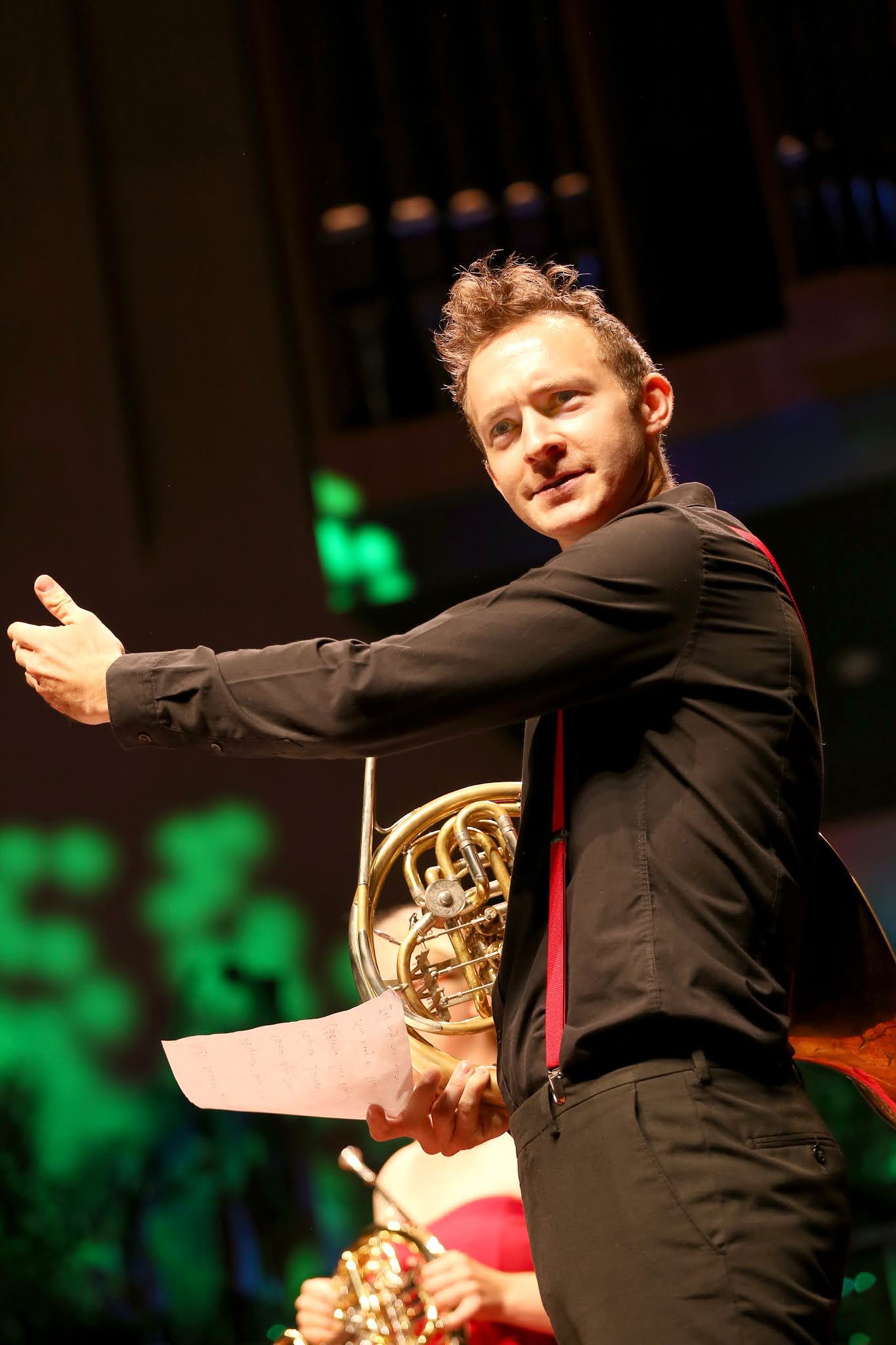
Back at the Pärnu gala, let's just say about the horn quartet transcription of Carmen interludes that the work itself is a terrible mistake - there are other bits of the opera that would actually work in this combination. But it was so delightfully presented by another of the world's best instrumentalists, Alec Frank-Gemmill, and done with such visual panache that I shouldn't be too hard on it.


Here's another of Kaupo's best, of Alec in action. Not for nothing does KK have a reputation as the best photographer of musicians in the business.

As for the grand chamber finale, I kinda thought, Mozart Clarinet Quintet again, really? But never underestimate the creative takes of the orchestra's chief mascot, Matt Hunt. What fantasies he wrought with ornamentations on repeats; what freedom from all five players. I've never heard a performance of a great masterpiece quite as alive as this. Theodor Sink - star of last year's festival in Lepo Sumera's Cello Concerto - seemed perpetually tickled and delighted to be playing alongside the great clarinettist

and look at the fun - you may need to click to enlarge - shared between these two, leader Florian Donderer (playing viola on this occasion), fellow front-desker (and leader of the Estonian National Symphony Orchestra, another fine soloist too) Triin Ruubel and second violinist Emma Yoon.

Kaupo also took some great shots of Florian playing - this is just one.

A final note about the other orchestral works in the main programmes. Again, nothing had excited me in the prospectus. But while Tubin's Music for Strings of 1963 is so typical of much sombre music produced around that time, there are some real firecrackers in the suite from the ballet score Kratt (The Goblin, 1938-43, rev. 1960), and a chance for so many of the players to shine. Here's the unique trumpet of Vladislav Lavrik in the lineup.

About the premiere in the main concerts, Ülo Krigul's The Bow, I have nothing more to say than that when a new work starts with bells and dissonant brass, you know how it's going to go. Infinitely more fresh is Berwarld's Fourth ('Naive') Symphony of 1845. I actually used it as a stick to beat an entirely derivative symphony composed a century later, Ruth Gipps's Second Symphony, a waste of 20 well-executed minutes in the CBSO Prom on Thursday. The Swedish composer must have been a happy and wholesome kind of chap. A lot of his best ideas seem to stem from the fairy music of Mendelssohn, but have their own identity, like the quirky syncopated second theme of the Naive's first movement, delectably counterpointed by bassoon second time around. I'm now on a Berwald binge, courtesy of Järvi senior's two-CD set of the four symphonies with the Gothenburg Symphony Orchestra. Not on YouTube, so I give you  a mono recording by Igor Markevitch and the Berlin Philharmonic.

This is lovely, but the affection and light-spiritedness of the Estonian Festival Orchestra is even finer. Watch these concerts while you still can.

Monday, 26 July 2021

Bosky pleasures on hospital visits


Most recent contributor to the long silence here on the blog has been daily hospital visiting - my 90-year old mother is still in New Epsom and Ewell Cottage Hospital convalescing after a difficult time at its big sister in Epsom proper. The smaller establishment is in beautiful countryside, on what was once the mental-hospital conglomeration located on the Horton Estate by London County Council starting in 1900. At one time the patients made up 10 per cent of Epsom's population. I remember going to St Ebba's and West Park with the Epsom Youth Orchestra. Now it's a combination of quite pleasant housing, nurses' training schools, outpatients' facilities and NEECH.

I think I've made the most of visiting. Even when mum was in Epsom Hospital, I found solidarity among the stallholders of the market that's sprung up around the Clock Tower, made by narrowing the high street road to a single lane and building out the pavement area. The coffee and falafel sellaers have been good people to chat to. One Saturday was especially lively, and I was surprised to come across the Caldegrave Ensemble, wind dectet, at the centre of the action.

When slimmed temporarily down to wind quintet, they played some pieces I haven't heard since I played in the Glyn [Grammar School] Wind Quintet - a wayward bolero with a quirky oboe tune I remember having to practise rather a lot. So this was a nice link with the locale as I remember it from more than 40 years ago (daily school journeys were 164 bus to Epsom, 293 to Glyn or a 20-minute walk).

I also discovered how, on days when I didn't take the E10 bus, I could walk to and fro via Epsom Common. Growing up in Banstead, part of the happier aspect of my childhood was biking around Banstead Downs with my chums; but this natural paradise on the other side of Epsom was something I only ever saw from the car. On foot, the quickest route is via West Hill, where there are a few old houses among the suburban build, and down to Stamford Green, where the Cricketers Pub was one of several drinking establishments in the country we used to frequent as teenagers once we had our driving licences. There are also attractive paths nearer NEECH, one on the other side of the road from a rather good garden centre serving the only good coffee (or anything, for that matter) in the vicinity. Twice I startled this deer.

The bus also displayed useful information about local rarities in the fauna. I saw that if I looked carefully, in the shade, on honeysuckle or brambles, I might descry the now-endangered White Admiral - and on an afternoon devoted to that quest across Epsom Common, I finally caught one resting, albeit with a broken wing.

A gorgeous Purple Emperor also flew above my head at the Stew Pond, but too fast to snap. I did at least catch this dragonfly (which one? If anyone can identify, I'd be grateful) settling

and this duck from the place where I saw the Purple Emperor.


Couldn't work it out at all until entering 'duck with white eye-stripe' on Google produced evidence that male Mandarin ducks, so gloriously plumed in winter and spring, shed all their glory in the summer to look like this. Moulting has produced some surprises - the goldfinches still at the feeder in the back yard at home have lost their black polls and red sidebars


 and the blackbird is looking less glossy

though I did see the young 'un being fed a mulberry by dad on the wall this morning.

But back to the Common exploration. While the smaller pond had patient fishermen sitting around it, the big 'un is nicely preserved from human invasion on all but its north side, from which you get this vista.

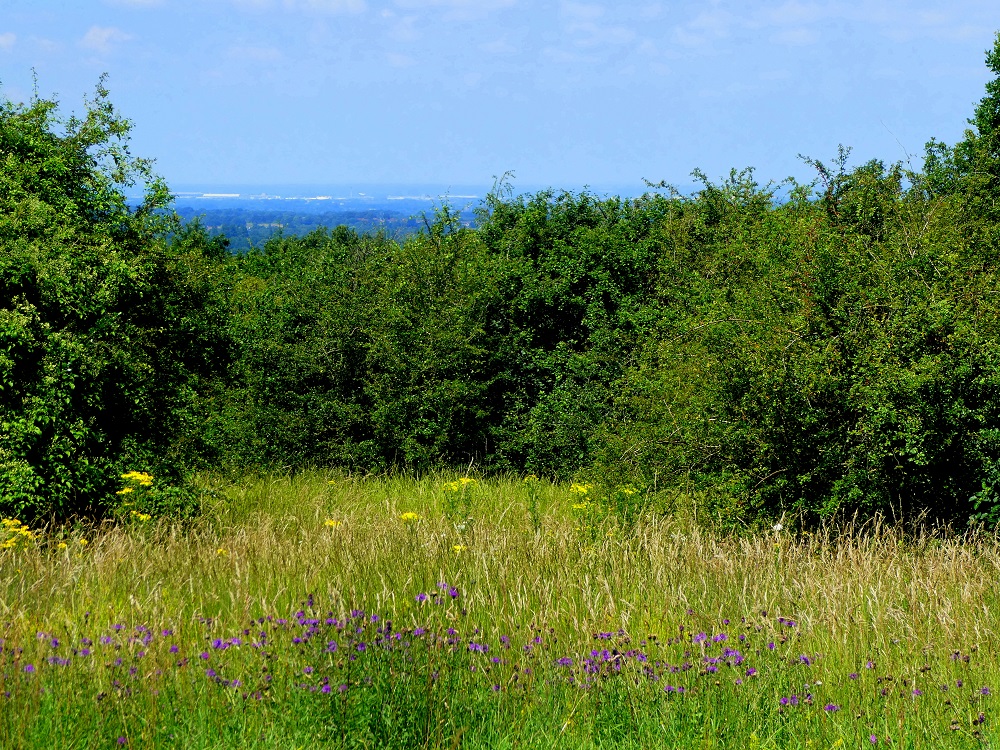
That was a glorious discovery. So, too, was making a virtue out of the necessity of Sunday train chaos by going to Epsom Downs Station (which is not Tattenham Corner Station, as I had thought - initial confusion at the start of the route) and walking from there to the hospital on the hottest day of the year. Fortunately I was sustained by plentiful supplies of water and eventual shade - though not on the Downs, where the views down over London were captivating, but the long grass verges on the edges of the gold course even more so.

Here I saw plenty of Veined White butterflies, but not at rest, and this Brimstone,

as well as a fair few Pyramid orchids.

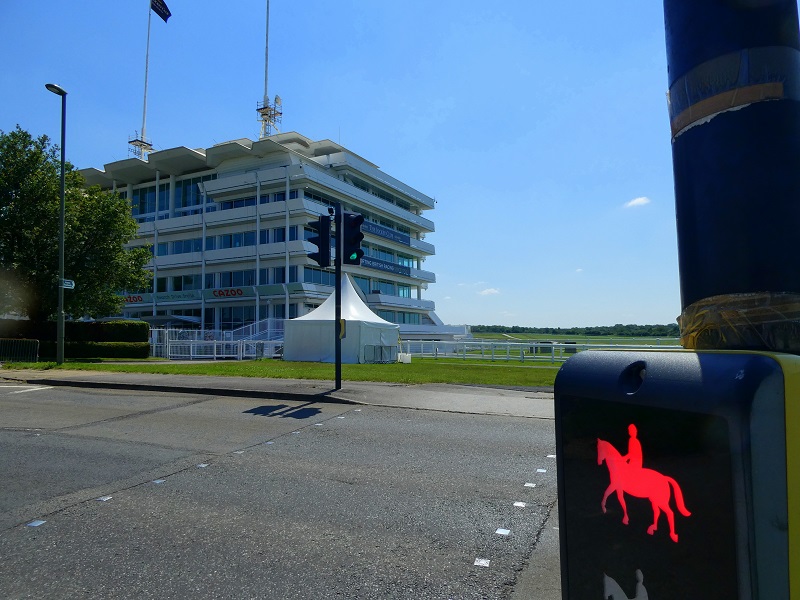
Crossing by the Grandstand

I took the shady route down Chalk Lane, with horse paddocks on either side

and saw for the first time The Durdans, grand old house with gates from elsewhere, where my schoolfriend's mother, who worked there, claimed to have seen a headless horse.

Funnily enough, this route took me out by Epsom Hospital, a grateful stop because I needed more liquids and a sandwich for lunch. Then I crossed Epsom Common via the Wells Estate, and found a new route to NEECH. 


The patient by now, enlivened by plenty of physio and an abatement of her COPD, was in good shape - not bad for 90 - and managed to stay cool throughout the heatwave.

They're very careful at NEECH to keep Covid at bay, so only one designated visitor can book in for an hour each day, though others can arrange a visit outside if they can manage the exclusive table-and-chairs slot. We sat outside again last Tuesday and enjoyed the view - a meadow with plenty of butterflies, sadly shorn on Thursday, plus the pine trees to the left.

That stormy-looking sky did not develop. Of course on a crucial Monday when storms and floods hit London and the area to the south, I would not have walked. I intended to, but when I reached the bus stop just outside the Horton estate, the sky looked like this

and I thought better - the E10 arrived with the first spots and torrents poured as I sat on the train from Epsom. At West Brompton, the downpour went on so long that I stopped sheltering, left my bike there and walked home with an umbrella for only partial protection.

On Saturday, thinking that would be my last visit since mum was due to be released today - it will now be Wednesday since they're sending her to Leatherhead for a test tomorrow - I planned a big route back, this time to Ashtead Station. Even the lane to the common is full of interest - what I saw here is, I think, a rare Jersey Tiger moth which flies about in the day as well as the night. Its russet interior is as colourful as the zebra stripes on the outside.

Epsom Common yields to Ashtead Common with a private wood in between, permissive paths around it. I meant to take the bridleway passing a Roman villa, but turned off too soon - on the Epsom side of the private wood - though this long path still yielded beauties like this stand of oaks

as well as identification of a butterfly I'd seen previously using its camouflage with folded wings on a dead leaf

as a Speckled Wood

alternating on brambles and bracken with the Gatekeeper or Hedge Brown.

What looks like a bee resting on a nearby leaf,

a hoverfly on the notice board at a junction (look carefully, it's taking the yellow path)

and more moulted mandarins in the shade by a small, over-algae-d pond.

Had an interesting chat with a man out walking his lovely collie; he told me this land, bought up by the City of London in 1870, was used for army training in World War Two, and you might find a black lipstick, remnant of camouflaging. Soon I found my way to the lovely meadow about Ashtead Station

and found a large flock of sparrows - not such a common occurrence these days - dustbathing and flitting just before the level crossing.

Dependency on public transport certainly doesn't leave one free as a bird. There was a bus replacement service to Epsom; station attendant told me to hop on the one outside, and it took me in the opposite direction, towards Dorking. So half an hour wait for the right one at Leatherhead. Still, these are peripheral irritations to visits that have much more pleasure in them than I'd anticipated. I may have sacrificed my usual time in Estonia at the Pärnu Music Festival - been lucky at least to watch the concerts on the festival's TV channel - but I know I did the right thing.