Showing posts with label Bryn Terfel. Show all posts

Tuesday, 27 March 2018

Devilish music-drama in Zurich and Lucerne


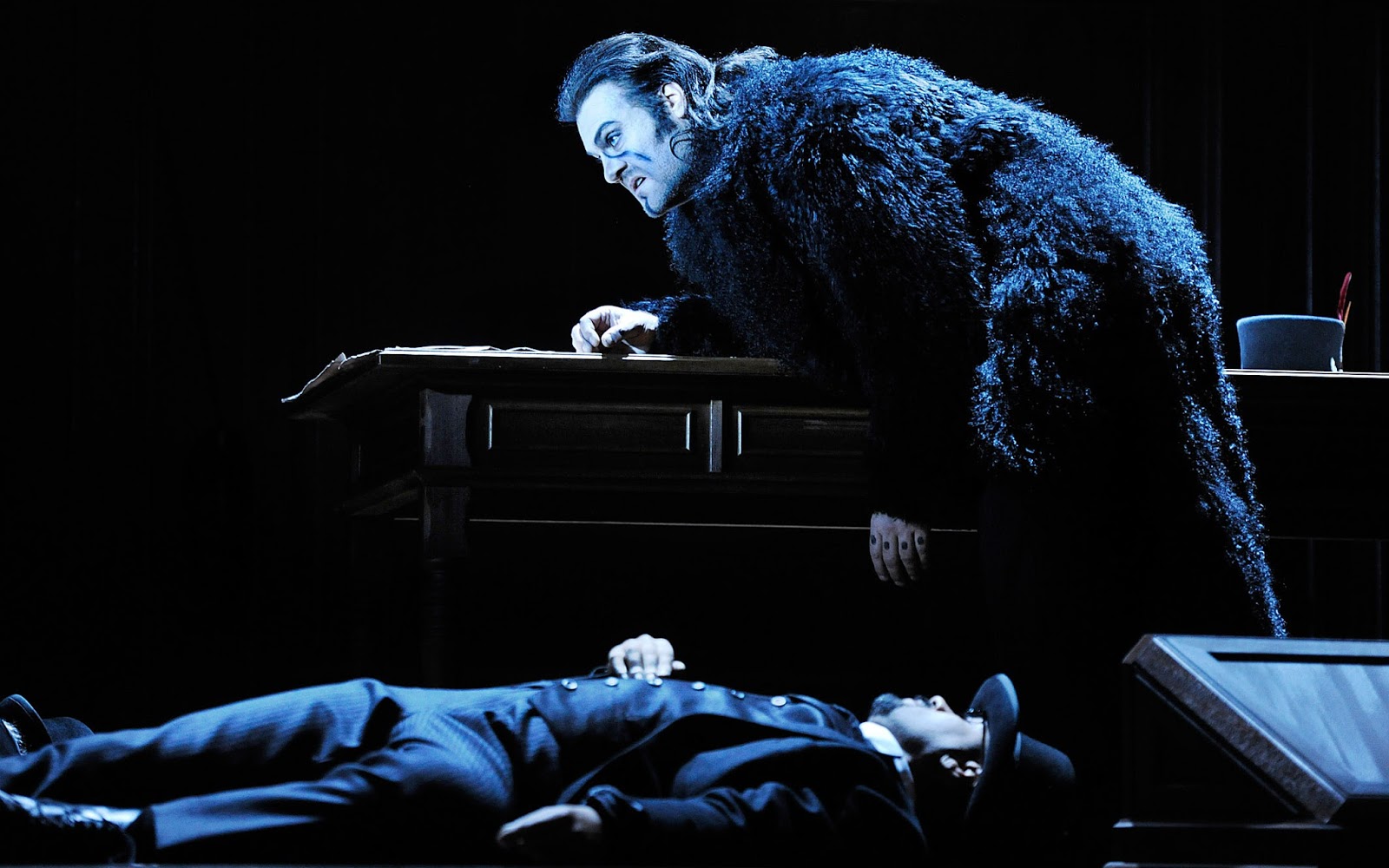
Catching Wagner's Der fliegende Holländer at Zurich Opera with the greatest living interpreter of the title role was serendipity, a bonus preface to my days at the Lucerne Easter Festival,

and I wasn't expecting an optional extra in Lucerne, the resident opera company's site-specific experiment with Schumann's Faust-Szenen, to have such an impact.


None of us present will ever forget the Zurich concert performance of Dutchman at the Royal Festival Hall. There Anja Kampe (pictured below with Terfel in production photos of the first run - no new ones were taken for this cast, sadly) and Matti Salminen were very much Bryn's equals in holding the stage. This time Steven Humes was, as they used to say, merely faxing it in as Daland; though if Camilla Nylund's more-lyric-than-usual Senta kept something in check in Act 2, it was worth it for the final transfixing commitment before the abrupt end of the tragedy (Zurich's version sticks to the brutal Dresden original, without the Tristanish epilogue in Overture and finale). There was huge intensity and interest in Marco Jentzsch's imposingly psychotic Erik, and promise for that role and other Wagnerian tenor parts from Omer Kobeljak's Steuermann.


If Bryn has suffered some of the vocal wear and tear inevitable in singing Wagner round the world across the four-plus years since his first Zurich Dutchman, he is still totally compelling. The colour and inflexion are there from the very first phrase ('Die Frist ist um,' spine-tingling), and the hyper-flexible, sensitive conducting of  Markus Poschner enabled him to hover just that little bit longer in mid-phrase. Besides, he only has to stand there - or even, in one effective instance, sit to the left of the stage with his back to chorus and audience - to command the stage with his undeniable charisma. Irrelevant to the performance, perhaps, but a chorus member who told me that he was always solicitous in helping her find her way in the wings without her spectacles signalled that he's still the same team player whom I first encountered in person making tea for everyone in the Dundee recording sessions for Mendelssohn's Elijah.


The original photos of 2012 had made me keen to see Zurich Intendant Andreas Homoki's production. The concept is handsome in Wolfgang Gussmann's design: it all takes place in a 19th century merchant's headquarters, but seascapes hang on the walls and in one instance the red ship bobs across turbulent waves as the central painting comes to life. The chorus are very hard-worked and onstage for much longer than usual; they play some of it for comedy, though I wasn't quite convinced by the colonial statement made in the crucial choral Act 3 confrontation between what should be two ships' crews. The expanded map of Africa with settlements marked catches fire - fine, up to a point - and a black, be-fez-zed servant turns into a warrior, rather cheesy.


Some overacting though no cheesiness bedevilled the Lucerne Scenes from Faust, but the impression it's left is far bigger than that. At 9pm on my last evening in town, I'd made my way straight from Mariss Jansons' first, unstintingly impressive Bavarian Radio Symphony Orchestra concert in the KKL - more on that in my forthcoming Arts Desk piece - and stood outside the Jesuit Church witnessing hollow-eyed, bleeding-from-the-mouth kids holding up religious placards as the scattered chorus began a Lutheran chorale. Then the doors of the church were flung open and Schumann's Overture began from the excellent orchestra under young conductor Clemens Heil.


Forbidden to sit and listen, kept at the sides, we then moved quickly to the theatre where Part One and two-thirds of Part Two were played out in near-darkness, the stage in the tiny auditorium built out so that we were very much involved in Faust's fantasies, the orchestra relayed from the church through speakers. Plausibly, the Gretchen scenes were played out as phantasms of the protagonist in (one presumed, though fortunately there were no props or set to underline it) an asylum. A parallel with Schumann's madness, but not a contrived one; director Benedikt von Peter gauged his alternative psychodrama very sensitively. As in a remarkable production I've seen of Ibsen's Peer Gynt - many parallels there with Goethe's Faust - the narrative running through a tormented man's head made the supernatural dimension more, not less, convincing, with spirit voices unseen from upstairs and only a couple of video projections to detract from the Faust-Gretchen-Mephisto dynamic, plus a mesmerising descending light-bulb which gradually became the artificial sun of Faust 'out in the world'.


Baritone Sebastian Geyer had a hard task keeping the constant state of anxiety and horror going, but he carried it off, sang well and was plausible when still; and I bought the general idea, Rebecca Krynski Cox's heroine as lily-carrying Madonna wafting across the stage and then spectral distressed, pregnant girl wiping blood over the hallucinating Faust.


Bass Vuyani Mlinde, familiar from his days with the Royal Opera's Jette Parker Young Artists Programme, was quite a brooding presence. The dynamic between Faust's negative force, the essence of his madness, and the beset inmate reached its climax in the scene of Faust's death outside in the Theaterplatz - Mlinde declaiming from an upstairs window of the theatre across to Geyer on the roof of a wooden construction beside the church.


To the sounds of Schumann's magnificent brass chorus - I'm completely in love with this music, which like the Beethoven Mass in C earlier in the evening I've never heard live before - we were escorted back inside the Jesuitenkirche.


I was anxious - did the clergy know what they were in for when they gave permission (especially as we know the Catholics are less happy about profane events in their ecclesiastical buildings)? The quasi-religious 'Journey to Heaven' continued to be stage-managed by Mephisto with mockery from adult and childrens' choruses.


But the giant Madonna-Gretchen on a screen was contradicted by the real human being, perhaps the girl who had lost her man to the asylum.


The ending was very moving - a now completely still and blank Faust approached by an elderly person from the street who took off coat and became helper, guiding him to the west door. And so, nearly five hours after the first work in the KKL concert had struck up, a remarkable evening came to an end. Quite an alternative Passion for Easter. I can't wait to hear the music again - must get Britten's recording with Fischer-Dieskau. Even outside the less obviously inspired and fantastical moments - the garden scene, the Ariel music, certain choruses in the final journey, which Schumann treats in quite a different way to Mahler in his Eighth Symphony - the idiom now feels right to me, thanks to John Eliot Gardiner's recent journey of rediscovery.


Lucky Lucerners: I hope that anyone with an interest in theatre will rush to this. Needless to say, the surfeit of great events precluded catching the new Holliger opera with Christoph Gerhaher in Zurich the following afternoon; we spent it recuperating in the warm spring sunshine in the Rietberg Park with Lottie and friends. More on the al fresco side of the trip anon; I need to catch up on my Arctic experience first. Meanwhile, a full report on the Lucerne Easter Festival experience, with more succinct words of praise for the Faust-Szenen is now up and running on The Arts Desk.

Production photo credits: for Dutchman, T + T Fotografie / Toni Suter + Tanja Dorendorf; for Scenes from Faust,  Ingo Höhn

Thursday, 20 December 2012

The primrose path


In Sondheim’s Merrily We Roll Along it leads backwards in time from the hell of compromise and failure to the sunlit plains of youthful optimism. In Meyerbeer’s Robert le Diable it meanders ineffectually until finally fizzling out in the face of an equally pallid angelic challenge. Having seen the two works on consecutive nights – the opera first at Covent Garden, the musical next at the Menier Chocolate Factory - I know which path I’d rather take. But let’s put duty before pleasure and have done with the French devil first.

Is Robert really a grand opera? Its length and scenario would suggest so; the music, apart from the passing low brass threat, would better be suited in selective dollops to semi-disposable opéra comique. That Meyerbeer could write a good tune we know from Constant Lambert’s arrangements in Les Patineurs, drawn from Le Prophète – yes, it really did have a roller-skate ballet – and L’Etoile du Nord. There’s arguably one catchy number here, the Sicilian song in the first act. Otherwise you wait and wait for the promised improvements in later acts. Like so many second- or third-rank operas, this one always seems about to deliver and always stops short at foreplay.


 Instrumental colour can be interesting – good girl Alice’s arrival in a dangerous place is marked by a sweet woodwind chorus – and one ungainly novelty stands out, the a cappella trio in which the tenor and soprano shoot up to insane heights while the bass hits rock-bottom (its concluding counterpart makes the most of its half-tune, blueprint perhaps for the better effort towards the end of Gounod's Faust). If Princess Isabelle’s plea to Robert to forsake his wicked ways is another hit, the second replacement coloratura, Sofia Fomina, failed to make it so despite the support of harp and cor anglais.


In fact of the four principals only Bryan Hymel, a surprisingly beefy tenor capable of hitting the top notes, seemed in technically good shape. Usually reliable bass John Relyea (pictured above with Hymel) struck gravel in his upper register and the picture-pretty Marina Poplavskaya did her usual of swooping in and out of focus and tuning (so frustrating – there’s certainly something there if only a good teacher could bring it out). Conductor Daniel Oren didn’t seem to be helping anyone much. Laurent Pelly’s production restricted itself to naff rhythmic steps for the chorus and didn’t bother much with trying to mine any psychological truth from the principals (probably there’s no point). 


Some of the 19th century style picturebook designs were fun, but only the ballet of zombie nuns in the graveyard where Robert has come to claim a magic branch, strikingly choreographed by Lionel Hoche, managed to triumph over anodyne music. Worth staging? I think not. A concert performance would have been enough to show us the bits that influenced Wagner* – and Sullivan, so much creepier in Ruddigore. If the Royal Opera wants to do a French grand opera, albeit one of less historical significance, it could try Massenet’s Le Cid. But no more Meyerbeer, please.

On, vitement, to Merrily We Roll Along. I hadn’t really wanted to bother with it again, having taken away so little from the Donmar production 12 years ago with Daniel Evans and the gorgeous Julian Ovenden. But then I learned from colleague Matt Wolf's enthusiastic review that the leading trio this time round included Damian Humbley, so dazzlingly good in the ill-fated and unfairly maligned Lend Me a Tenor, and lovely lady Jenna Russell, outstanding star of the Regent’s Park Into the Woods. Josefina Gabrielle, who eclipsed Tamsin Outhwaite in the Menier’s Sweet Charity, was also playing a chunky role. So I decided to give it another try.

Even before the night, assisted by the 1992 Leicester Haymarket cast recording with Maria Friedman – the present production’s clearly able director – I was hooked. The show is based on a Kaufman and Hart play and follows the blueprint of a (usually resistable) self-referencing showbusiness rise and fall, but told in reverse. As Sondheim points out in the excellent Finishing the Hat, Merrily not only traffics in the regular 32-bar songs of the musical golden age but, thanks to the time-travelling premise, previews them in fragmentation or dissolution before piecing them together in their pristine state. Thematic transformation is almost as skilful and pervasive as in Into the Woods, a work of incredible musical sophistication. The winning song penned by the musical’s composer and lyricist, ‘Good Thing Going’, is cheesy but earwormy, and there’s an infallible blend of post-G&S patter with pathos.


The Menier cast was, as anticipated, flawless. Russell (pictured above with Mark Umbers) doesn’t really get the limelight she deserves as Mary, but manages the backward transition from overweight, outspoken drunk to hopeful author beautifully. Humbley brings the house down with impeccable timing in Charlie Kringas’s self-destructive rant against his sellout buddy Franklin Shepard ‘Inc’ during a 1973 TV interview. Handsome Umbers achieves the difficult task of winning our sympathy as we regress to understanding a little more about Frank’s compromises.

The biggest transformation is realized by Clare Foster as his first wife Beth, maintaining a stillness in heartbreaking anguish in the first, divorce-scene rendition of ‘Not a Day Goes By’ – no easy task considering we’ve only just met her – before lighting up the stage with her younger enthusiasm (Foster's in the top picture with Russell, Umbers and Humbley). Gabrielle (pictured below with Glyn Kerslake), like Russell, doesn't quite get to strut all her stuff. She's a terrific dancer and the show number adapted with Sondheim's permission could give more room to that. As her first husband, Joe Josephson, Kerslake comes magnificently if briefly into the limelight in the middle of the fabulous young-professionals number 'Opening Doors'. 


The scene-changes are evocative bearing in mind the Menier’s limited space, the band excellent, but I have the one usual cavil in this place: why mike in a small theatre? You can’t tell where the voices are coming from in ensemble scenes, and you lose their natural timbre. Anyway, on with the West End transfer, and here’s to Broadway for Friedman and Co.

It's been an equally mixed week for Arts Desk assignments. I'll be damned if the Zurich Opera's concert performance of Wagner's Die Fliegende Holländer wasn't the best event of 2012 thanks to the Senta (all-giving Anja Kampe) and Daland (relaxed veteran Matti Salminen) rising to the superhuman level of Bryn's Dutchman.


But then there was a 26th-revival Copley Bohème at Covent Garden cruelly exposing the current problems of Rolando Villazón, and no-one else really making it worthwhile (though Elder's orchestra, despite being too loud and slow at times, revelled in the detailed beauties of Puccini's fabulous score). As for the old Copley production, at least Act Three looks good - below, Villazón with Maija Kovalevska's bright but unItalianate Mimì.


*though I reckon the Abbate/Parker claim that Senta's Ballad would not have been possible without the example in Robert's Act One must be wrong; the one in Marschner's Der Vampyr, which when I saw that opera in Munich struck me as close to the world of Dutchman, predates Meyerbeer's example by three years.

Production photos of Merrily We Roll Along by Tristram Kenton for the Menier Chocolate Factory
Production photos of Robert le Diable and La Bohème by Bill Coooper for the Royal Opera
Photo of the Zurich Dutchman by T+T Fotografie

Wednesday, 24 August 2011

Having so much fun with R&H


Not last night, it has to be said, with a lacklustre revival of Rodgers & Hammerstein's South Pacific at the Barbican less than fresh from what was by all accounts a much better show at New York's Lincoln Center Theatre. Samantha Womack's Nellie Forbush, pictured above by Simon Annand as dyke's delight with Alex Ferns's dragged-up Luther Billis in 'Honey Bun', seemed OKish, and you had to make allowances for a broken toe. But then Matt Wolf, who kindly sent me off to cover the revival for The Arts Desk, pointed me in the direction of her Broadway predecessor Kelli O'Hara, and there's just no comparison. This is the real thing, and it's quite a feat to do your own stuff after Mary Martin and Mitzi Gaynor.


It didn't help yesterday evening that I'd spent some time revisiting the original Broadway cast recording and the Hollywood soundtrack. There's mezzo Mary with her sassy tones, and Mitzi with her hairwashing pizzazz; there, too, are Ezio Pinza and Giorgio Tozzi (Rossano Brazzi's voice dubber) seducing - not entirely appropriately with their Italianate diction since Emile is of course a Frenchman - in a way that even the excellent baritone Paulo Szot cannot. And much as I admired his show delivery of 'This nearly was mine', one of the classic tracks of all time now happens to be the way Bryn Terfel weaves a special, smoky magic on his 'Something Wonderful' disc.


Rumour has it that the R&H estate hated the Trevor Nunn production a decade ago, but I got so much more out of it than I did with last night's routine. And it didn't help to have a classic replica of the Broadway audience, chattering through the overture, whoo-whooing even the mediocre and of course rising to their feet for no good enough reason at the end. I won't say I'm going straight back to the film - its war sequences are horribly over-extended; but I can dip into bits of it. And then there's the much earlier (1949) Martin/Pinza team in magic moments like the (revolutionary at the time) 'Twin Soliloquies'.

Saturday, 7 August 2010

Wanted: home help for Nuremberg cobbler


It's up on YouTube, and the BBC put it there: the comic highlight of last week's Sondheim Prom. To get the gag, and the headline, you'll have to hang around for the last of the four or so minutes, when the most famous living Welshman other than Tom Jones sashays along with the rest and even does a little skip (especially nice choreography there). The others are Simon Russell Beale, Daniel Evans and the delicious Julian Ovenden. Best go full-width by clicking on the screen once you've set it going and flipping over to the site.

I put this and the following at the bottom of the Arts Desk review, but since I only discovered them yesterday, and many Proms have passed under the bridge since the piece went up, they might have gone unnoticed, so here's an extra shrine for them.


Seeing Dame Judi in close-up highlights what an unflashy star she is, already preparing to launch straight into heartbreak from the minute she steps on to the platform to receive the roars of the crowd (for some reason the entry seems to have been shorn since I last looked). And I repeat what I think we discussed earlier: not having much of a singing voice doesn't matter if you have the right sense of musical timing. Have you ever heard 'the one that I wanted' done with greater yearning? Takes me back to her treasured Sally Bowles in Cabaret - a performance I'm too young to have seen on stage, but delighted to have it captured for posterity on the original London cast recording. Here she is back in 1968.


It's certainly a bit irritating to be told that she and our Stately Homos Fry and Beale are National Treasures, and to hear how the home counties roar at anything they do, but there's a good reason for it.

Thursday, 15 July 2010

Charlie for aye


No, I never called him that, and 'Jack' Lanchbery was the only colleague of his I've met who did know him as the legendary 'Charlie Mackerras', but on the other hand he never insisted on the 'Sir' either. The most comprehensive conductor of our time, and to my mind the world's greatest Mozart interpreter without any shadow of a doubt, has died at the age of 84. It was no shock - that came when I phoned last Summer and Lady M told me candidly that Charles was down in Dartington being treated for his terminal myeloma. I hadn't known, so that was upsetting.

The only surprise was that he went without fulfilling all the engagements in his diary (still pencilled in for the Proms and next season). But miraculously, or perhaps simply naturally and humanly, I believe he did conduct every one of his Cosi performances at Glyndebourne. He'd had to withdraw from the Ariadne-in-English recording for Chandos and from what was advertised as his last Beethoven Ninth with the Orchestra of the Age of Enlightenment, but conserved enough strength to see through Janacek's Cunning Little Vixen at the Garden. Characteristically brisk and colourful, it did, I think, show a few signs of waning power, but then the recording remains, and always has been since I first heard it, a Desert Island Disc.


Ismene Brown just summed it all up perfectly in an e-mail: 'He is the Forester in Vixen - knows better than anybody how life is
fulfilled and then ends'. He felt it painful that his illness wouldn't allow him the stamina to get through complete Wagner operas in the last years, but there was no need to apologise for bleeding chunks at his Wagner concert with the Philharmonia and the divine Christine Brewer last December.

Visiting Hamilton Terrace, I always felt like a student attending a tutorial with a very wise professor (or, let's face it, a son in search of a father). Each time we talked about a specific work or composer: Beethoven's Leonore/Fidelio, Mozart's Magic Flute and Cosi, his Sullivan potpourri-ballet Pineapple Poll, Janacek, Britten's Gloriana. If he was testy - and he could be a bit of a martinet back in the 1950s, I'm told - I never saw it; only total collegial enthusiasm. Prize memory: sitting in with him and Felicity Lott during Edinburgh recording sessions for Cosi as they tried out alternative ornamentations for Fiordiligi's 'Per pieta'. Since she's such a modest lady, too, they asked me which I liked best. And that, in fact, was the one they used on the recording, though I've no idea whether my choice had anything to do with it in the end.

Here, finally, then, is the rest of the postcard from which I took the above sign-off. I'd sent him a card from Janacek's Hukvaldy, so Smetana seemed like a good riposte.


It's all I have from him in writing, though I was going to pay a visit and get him to sign my old LP of Pineapple Poll and the New Janacek Edition score of Katya Kabanova. He did say two priceless things in interview: in passing he talked about 'people like you, who are publicists for music', which is a nice way of looking at a critic, and at the end of one occasion, he said how much he liked the Gramophone interviews we'd done: 'I don't usually read interviews with myself - but yours I do read, because they give a sense of the person'.

But this is becoming All About Me - hell, if I can't stick it here, where else can I? I loved that man, anyway, and his recordings will be with us always. This morning I remembered him with the jolly Prague Mozart 41 and another Jupiter - the one in Strauss's Die Liebe der Danae, which he recorded with BBC forces and Norman Bailey.

A listening postscript - what makes me sadder than remembering a life well lived to its natural end is how many of the great singers on Mackerras's recordings died before their time. Lorraine Hunt Lieberson on his Idomeneo. Jerry Hadley on his Flute and Cosi. Lucia Popp on The Cunning Little Vixen. Philip Langridge on the Gloriana. But, again, at least we have them caught forever. I'm off to listen to the Idomeneo quartet now.

A second listening postscript - thanks to 'Tannengrin' on Parterre for linking to this YouTube sound-only track. I didn't know where to start for Mackerras recordings, but Bryn's rather stylish appropriation of tenor Jupiter's (that name again!) 'Where'er you walk' from Handel's Semele, with our late master conducting the Scottish Chamber Orchestra, makes a perfectly well-tempered farewell.

Tuesday, 22 June 2010

Solstitial


Being driven back in smooth style the day after reeling joyously from the longest celebration of Midsummer in all opera, we were drawn as if magnetically to the standing stones of Avebury. Of course it didn't take us long to realise that the opposing forces of then-genial police and ruddy travellers with their cohorts of dogs and children in tow had gathered to celebrate the solstice. A little further on, beyond Marlborough before joining the mundane motorway, we saw this very midsummery down covered in poppies.


St John's eve and day, the Johannisnacht and -tag which see chaos incorporated into order in Wagner's 16th century Nuremberg, are of course slightly later - 23/4 June rather than the longest day of the year, the 21st - but it comes to much the same thing. I never thought to see a Meistersinger with a Hans Sachs as great as Norman Bailey, possibly the most remarkable performance I've ever seen on a stage, but Bryn, essaying the role in its entirety for the first time with Welsh National Opera in Cardiff, certainly was, in his own very different way. The result of spending ten weeks on this Meisterwerk with my City Lit students rubbed off in a review as long as a dissertation for The Arts Desk. I make no apology.

On the way back we made a return visit to stay over at the dreamlike house of one of our companions in Lacock. I've dealt with it before here, but that wasn't midsummer, so the gardens were at their peak this time. We went back to Lacock Abbey for the benefit of our fourth friend, and Deborah and I wandered in the fairly new botanical zone, not a patch on hers but at least boasting a gorgeous liriodendron or tulip tree in flower.


Idyllic lunch followed. The usual strawberries are of course in season


but have you tasted the little white ones? Deborah has a whole carpet of them in her garden, and she duly gathered the latest crop. They're much like the pink wild strawberries, but they do look rather different:


And now it's head down to get the script for my Building a Library on Delibes's effervescent Coppelia ready for Radio 3's CD Review. As I stepped in at the last minute, it's being recorded just before the broadcast on Saturday. I adore the work more than ever, but I've had to sacrifice other pleasures to get on with the task, including tonight's Royal Opera first night for the new Laurent Pelly production of Massenet's Manon. The hedonist with a heart is to be embodied by her glitzy alter ego, Anna Netrebko. Never mind, I've had my vision for the week, month, year with that Meistersinger.

Friday, 28 May 2010

Fliedermonolog


So what is it, the tree under which cobbler Hans Sachs sits and reflects in Act 2 of Wagner's Die Meistersinger, praising its scent 'so mild, so strong and full'? Does it matter? Well, it does to me, because now that I've reached the fourth of ten City Lit classes on the opera - what a luxury - we can walk out and smell the lilacs. Flieder was originally the German for 'elder'; but when the lilac was introduced - some time after the period which Meistersinger is supposed to depict - it was called 'spanische Flieder' ('Spanish elder'). As a note I found on the net tells us, 'eventually, the 'Spanish' part was dropped and lilac was simply called "Flieder" while elder was called by its alternate name, "Holunder" '.

Pedantry? I insist not. Anyway, if lilac is an anachronism in the Nuremberg of the Mastersingers, elder, I'm told, wouldn't have been in bloom on 'Johannistag'. The above illustration and the one below, from a wonderful site devoted entirely to antique postcards of Wagner's operas, confirm the hunch. And gardening doyenne Deborah van der Beek wrote to me that 'lilac sounds more likely and very Victorian, elder being a shade catty and rather sneezy.' To complicate matters, there should also be a lime tree in any staging of Act 2, but that's by Pogner's house, while the Flieder is in front of Sachs's cobblery.


But the music's the thing, and of course it's the perfumed airs of a summer night as well as the inspiration of what Sachs has heard Walter sing in St Catherine's Church earlier that day which matter. Two horns waft the scent, and the phrase of infinite yearning dogs Sachs's meditation. I went through half a dozen versions, and easily the most tender, the oakiest and the best phrased was Norman Bailey's on the much-maligned (and occasionally miscast, but which recording isn't somewhere?) Solti recording. Our Norm kicked off my Wagner craze singing Sachs under Gibson in Scotland in the early 1980s, and I still count his interpretation, simple goodness personified, as one of the top ten, top five probably, I've seen of anything.

Alas, Norm's not on YouTube, but two will do. One is an historic interpretation to set alongside the much more famous Friedrich Schorr - a very distinguished bass sound, this, too, from Michael Bohnen:


The other is from the man we expect so much from next month when Richard Jones's Welsh National Opera production is unveiled in Cardiff, Bryn Terfel. I listened to a rather soft-grained Fliedermonolog he recorded with Abbado, but this is better, and actually suits the usually ponderous Thielemann well, too. Like Norman, Bryn brought tears to my eyes. Enjoy.


And the latest news is that Welsh men of a certain age, preferably bearded, are being asked to hie down to Cardiff's Millennium Centre to be photographed for Richard Jones's wall of masters. What fun! And I wonder if he's going to turn the whole thing into a kind of Eisteddfod. It would fit. Can't wait.