Showing posts with label Tove Jansson. Show all posts

Saturday, 9 August 2014

A Babel of hope and possibility


The phrase is not mine but my bright young colleague Alexandra Coghlan's on The Arts Desk, penned about Berio's Sinfonia, which preceded a shattering but nuanced interpretation of Shostakovich's Fourth Symphony at Tuesday night's Prom. I choose to apply it to the superlative team which gave one of the best Proms I've ever heard, our already-beloved European Union Youth Orchestra, and further, to the even younger members of nine British youth orchestras they mentored in an inspiring workshop featuring 180 young musicians on the platform of the Royal Albert Hall the morning after the EUYO triumph.


All photos here by the wonderful Chris Christodoulou, with whom I managed to have a good chat as the players lined up on the steps in front of the hall's south side. Above, below and in the last photo are some of them on Wednesday morning conducted by likeable young motivator Duncan Ward and playing to a small audience of friends, family and a handful of scribblers like me.


A big question which I intend to peck away at: why did the BBC not ask Chris to snap one of their most photo-friendly evenings? He tends to come to everything he can, but the press folk only ask him for so many Proms. More bizarrely, why did BBC Television choose not to film the EUYO concert for broadcast (Radio 3's transmission is on the iPlayer for the next month)? The fact that they'll be transmitting the National Youth Orchestra Prom is no excuse: it shouldn't be a case of either/or, but both. And what better to spell out the message that there IS a future for great orchestral music than the enthusiasm and commitment of these photogenic young players with their handsome young conductor, the already great Vasily Petrenko (replacing an indisposed Semyon Bychkov, who would also no doubt have trained them up to the hilt)? Was it politics or is there a less sinister explanation? Shame on you, Beeb - you should be helping to tell the world that this is what we're fighting for in Europe. True internationalist Sir Henry Wood would have thought so too. I asked Chris especially to snap this one for us.


Anyway, I was there on Tuesday evening with the diplo-mate - having to break his rule of avoiding all Proms, and he couldn't have admired it more - in the EU invitees' zone close to the stage, leaving Alexandra to write up the event for TAD. I didn't sway her beyond a very late message saying that if she didn't give it five stars, she would be exiled to an island of exclusively baroque music. There was no need: she'd already written the piece by then, and she touches on just about everything I would have done, very much in her own eloquent style, so I don't have to reduplicate here.


Just a few points of my own, then: first, that I've never heard a more detailed, coherent or intelligent performance of the baggy-monster Fourth. Petrenko, at times sexy-sinuous, at others rhythmically taut, amazingly so in the Berio, drove a line through Shostakovich's most outlandish orchestral work without ever being over-emphatic.


There was much more more lyricism than we've come to expect, more sheer fun in the concerto-for-orchestra parade of solos and groups, while never losing sight of the terrifying overall rhetoric. And what an extra layer of emotion there was in hearing a first-half work which seemed to think that 'classical' music had shattered into fragments, never to be pieced together again, and an even greater masterpiece ending in total annihilation, and finding them in the hands of a future which is as bright performer-wise as it is in the new wave of post-Darmstadt, post-modern composers who are no longer afraid of the kind of cornucopia Shostakovich loved so much.


I've written about the Inspire Workshop event over on TAD, but the BBC were slow in getting Chris's pictures over to me, which is how I can indulge in a few more here. That was fun, but the EUYO concert has burned itself on my heart as what will have to be the most extraordinary Prom this year, however much of excellence is no doubt still to come.

Young and old alike must rejoice that today is the 100th anniversary of Tove Jansson's birth, a special day she shares with her Moominpapa (anyone's guess), the diplo-mate (thirtysomething, of course) and his mother Wyn (86, doing pretty well by the sea yesterday). Shot of the last two at St Leonard's from behind only due to privacy wishes.


I raise my special Hemulen mug to the great author, and like to think of her like this below in 1956 on her special island with her partner Tuulikki Pietilä and her beloved mother Signe Hammarsten-Jansson, the 'Grandmother' of the volume I most often gift, The Summer Book  (remember this to young Sophia, countering the child's insistence of 'a big, enormous Hell': 'You can see for yourself that life is hard enough without being punished for it afterwards. We get comfort when we die, that's the whole idea').

 
Tove would approve last Saturday's outing to Holland Park and Will Todd's splendid opera for children Alice's Adventures in Wonderland (or should that perhaps be 'New Adventures') with goddaughter Mirabel. I managed to sneak in a picture of her with the lovely Fflur Wyn, Alice personified, to the Arts Desk review, but felt it might be overload there to include Keel Watson's very friendly Caterpillar
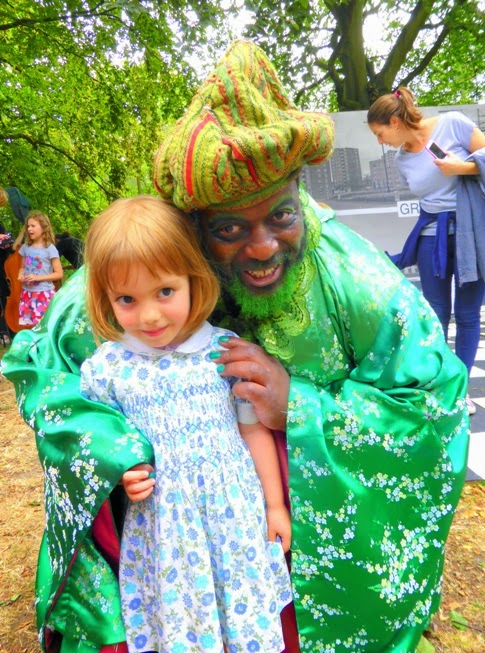

and the family bear of long wear and tear, Special/Spesh, occupying the White Rabbit's cage in the opera's Grimthorpe Pet Shop.


Fortunately they all lived happily shortly after: Spesh was released to join Mirabel,  ma Edsy and auntie June for tea and scones chez nous.

Wednesday, 29 December 2010

The year of reading Ulysses


I must have cast my eyes over those opening words at least a dozen times (opening of the 'Telemachus' chapter as illustrated by Robert Berry courtesy of the excellent ulyssesseen website. Or rather, courtesy assumed, as they adopted one of my pix in their blog section, so I'm assuming mutual fair use). But only this year did I get to the end with, if not exactly full understanding, an awed appreciation of what Joyce was trying to do, the breadth and humour of his references, the ephiphanic attitude to the everyday.

Much of what I felt was neatly summed up in Declan Kiberd's Ulysses and Us: The Art of Everyday Living (Faber), which adopts the Bryan Magee approach of explaining the complicated in simple, direct language. Kibberd's basic premise is that Ulysses follows the great traditions of the Odyssey, the New Testament, Dante's Divine Comedy and Hamlet, as 'wisdom literature' - the wisdom reposing mostly in the everyday living of Leopold Bloom rather than the thickety consciousness of Stephen Dedalus. Of course it doesn't make us feel better to know that the third episode, getting inside young Stephen's head, is precisely the one at which most readers give up because it's so knotty, and is supposed to be.


Kiberd sometimes seems to lose his way, and his style: why does 'Singing', on the Sirens instalment, read so badly? But I like his opposition to the navel-gazing academic approach, which is why I gave up fairly soon on Richard Ellman's Ulysses on the Liffey.

Anyway, life's too short to read piles of secondary literature. And I don't think I've ever had a more rewarding year in terms of discoveries. It began with Hilary Mantel - J's reading Wolf Hall was the lynchpin, but I started with Beyond Black in January and only worked my way through to the historical novels much later. Very much on a par with them is the Norfolk/Africa family saga A Change of Climate. I've only got Eight Months on Ghazzah Street still to go, but I've been steeling myself to feeling robust when I read it.

Which is a bit rich bearing in mind that I've been steeped in misery lit for the past six weeks. Yet never was there a better saying than the epigraph to Dostoyevsky's From the House of the Dead, 'in every human being a spark of God'. Clearly not every, as Hans Fallada's Alone in Berlin so hideously demonstrated*. But it only needs some to make it worth going on living.


No-one puts that better than the steely-brilliant Hannah Arendt in Eichmann in Jerusalem: A Report on the Banality of Evil. She's been holding to account the testimony of a German army physician on the killing of Jews in Sevastopol. He points out that totalitarianism's skill in 'disappearing' people makes a visible protest useless. She counters:

It is true that totalitarian domination tried to establish holes of oblivion into which all deeds, good and evil, would disappear, but just as the Nazis' feverish attempt, from June, 1942, on, to erase all traces of massacres - through cremation, through burning in open pits, through the use of explosives and flame-throwers and bone-crushing machinery - were doomed to failure, so all efforts to let their opponents 'disappear in silent anonymity' were in vain. The holes of oblivion do not exist. Nothing human is perfect, and there are simply too many people in the world to make oblivion posssible. One man will always be left alive to tell the story. Hence, nothing can ever be 'practically useless', at least, not in the long run. It would be of great practical usefulness for Germany today [Arendt's account was first published in 1963], not merely for her prestige abroad but for her sadly confused inner condition, if there were more such stories to be told. For the lesson of such stories is simple and within everybody's grasp. Politically speaking, it is that under conditions of terror most people will comply but some people will not, just as the lesson of the countries to which the Final Solution was proposed is that 'it could happen' in most places but it did not happen everywhere. Humanly speaking, no more is required, and no more can reasonably be asked, for this planet to remain a place fit for human habitation.

I ought to quit while Arendt is so splendidly ahead, but I haven't finished with the peak of the year's reading. Margaret Atwood constantly points out in her futuristic nightmares the lesson that 'some people will not', but what makes Oryx and Crake a great book are the flights of stylistic fantasy, especially in the warped games played by the dystopic adolescents. Who else writes like this? Mantel, Martin Amis - name me others, please, whose manner doesn't seem flat after reading these supreme manipulators of the English language, and I'll be happy to read them. But if high stylishness isn't your metier as a novelist, then simplicity is always best. Which is why Tove Jansson's books for adults seem to translate so well, and why of all this year's novels, The Summer Book remains for me absolutely of the essence.


I'm now a third of the way through another Fallada masterpiece, Wolf among Wolves, a panorama of German life in the big inflation of 1923, and I'm looking forward to more thrillers and detective stories from Robert Littell and Ian Rankin, but I know it's La Jansson to whom I'll return for rooting.

*BTW, if anyone's still interested in the upshot of that A&E story, I went back to the Harrow hospital for the verdict on whether I needed an op or not and - the nice but clearly embarrassed specialist told me the CT scan hadn't been sent to him as promised, nor could it be obtained over the net on the spot. A waste of both our times. But he thinks a) it's pretty sure the damage is merely cosmetic and b) they need to do a much more detailed CT scan to make sure. And so it rolls on in to late January.

Friday, 15 October 2010

Moominwisdom


I've got it back to front - having been deprived in my childhood of Tove Jansson's extraordinary Moomin books, and reading the novels Jansson began to write in late middle age first. But now that I've started on the saga of her best beloved creations, I understand that the same wisdom, spareness and clarity connect the two worlds. Just one thing troubles me in the Moominprefaces: it says 'she lived alone on a small island in the Gulf of Finland'. She didn't; she lived with the love of her life, long-term partner Tuulikki Pietila.

Anyway, I AM the Hemulen, that frowning big-nosed creature who always wears a dress, no-one knows why. He's certainly supposed to be a bloke, because women don't collect in that obsessive way. I was a bit surprised when he just cropped up in Finn Family Moomintroll, which I thought was supposed to be the first in the series. But that, as it turns out, is Comet in Moominland, in which Moomintroll and acquisitive wee Sniff collect their future housemates - the Hemulen, Snufkin, the Snork and the Snork Maiden - on their travels.

Be that as it may, the Hemulen is caught 'wandering along with his hands behind his back and his eyes on the ground' by Moomintroll and the Snork Maiden as they float along on clouds made by the eggshells in the Hobgoblin's hat (don't ask).


What troubles the Hemulen, they ask? Has he lost a rare stamp?

'On the contrary', answered the Hemulen. 'I have them all: every single one. My stamp collection is complete. There is nothing missing.'

'Well, isn't that nice?' said the Snork Maiden, encouragingly.

'I said you'd never understand me, didn't I?' moaned the Hemulen.

Moomintroll looked anxiously at the Snork Maiden and they drew back their clouds a little out of consideration for the Hemulen's sorrow. He wandered on and they waited respectfully for him to unburden his soul.

At last he burst out:

'How hopeless it is!' And after another pause he added: 'What's the use? You can have my stamp collection for the next paperchase.'

'But Hemulen!' said the Snork Maiden, horrified, 'that would be awful! Your stamp collection is the finest in the world!'

'That's just it,' said the Hemulen in despair. 'It's finished. There isn't a stamp, or an error that I haven't collected. Not one. What shall I do now?'

'I think I'm beginning to understand,' said Moomintroll slowly. 'You aren't a collector any more, you're only an owner, and that isn't nearly so much fun.'

'No,' said the heartbroken Hemulen, 'not nearly.' He stopped and turned his puckered-up face towards them.


Well, they find a solution. 'Nature study!' declares the Hemulen. 'I shall botanize'.


So he does, but that causes quite a bit of trouble...

Wednesday, 25 August 2010

Tove Jansson: summer and winter


My thanks to Minnie for putting me in touch with a highly popular man of blogging ideas, Norman Geras. He invited me to select a favourite book for his series of writers' choices, and after wandering in mazes for weeks I settled on one I happened to have just read. The piece is here, so I don't really need to explain or expand on the perfection of Tove Jansson's The Summer Book. I will at least reiterate that it tied in so hauntingly with my time on Bergman's magical Fårö, more images of which I take the liberty of scattering here.


What I would like to add is simply that since than I've also read Jansson's The True Deceiver, which Norman admires in equal measure. It's the dark shadow of The Summer Book, though since Jansson is interested in a spare approach to human truth, neither is black or white, and both are tough. This time it's winter on the Swedish coast, and snow coats everything in near silence. A strange woman goes out of her way to move in on a solitary old artist and provide a decent home for her simple brother Mats. But she isn't just the big bad wolf in a fairy tale, nor is the older lady the rabbit. These are human beings in all their mystery and inconsistency.


I'd like to leave the last word to Ali Smith, who writes so eloquent an introduction to The True Deceiver:

'Mats has no secrets. That's why he's so mysterious.' Jansson's own texts, works which seem so simple as to be near-throwaway, are always honed to perfection, given a lightness that proves deceptive, an ease of surface which, like a covering of ice over a lake, allows you a rare access to something a lot more feisty and profound. 'Rarely do books give as clear an impression as yours that they simply matured to the point of inevitability', Jansson's...Swedish publisher wrote to her when she was struggling with difficult work.