No twitcher I, though it's easy to see the attraction now I'm using the rather good zoom on my Lumix for closeups, subsequently looking up the birds I didn't know and/or consulting an expert. On the first of the days in question, sunshine followed downpours at Snape and lone birds were waddling along the Alde at low tide, including this Little Egret (
Egretta garzetta).
A Redwing (
Turdus iliacus) shattered the silence on the lava field in the north of Iceland's Þingvellir National Park, seen on a day excursion between the concerts of brilliant Víkingur Ólafsson's
Reykjavík Midsummer Music,
and a lone heron graced the rocks as I walked the stretch of the Fife coastal path between Anstruther and Crail, from one
East Neuk Festival venue (the simple church in the village of Kilrenny) to another.
The Snape marshes with the Alde winding through them I saw in two very different lights, the clear afternoon of
my first, flying visit
and - the Icelandic trip having briefly intervened - a dawn with proper sunrise, c.3.30am, at the start of the
Aldeburgh Festival's unforgettable, unrepeatable Bird Day with Pierre-Laurent Aimard choosing avian calls and scenes from Messiaen's
Catalogue d'Oiseaux to suit four different times in the nearly-24-hour progress.
Let's give the Little Egret a little more context, both wider-angle and closer up,
and look at the other loner on that first afternoon, a mud-pecking Oystercatcher (
Haematopus ostralegus).
Cumulo-nimbus clouds of the kind which had cause a big storm in Ipswich earlier in the afternoon were still visible on the horizon,
seen here through Barbara Hepworth's
Family of Man
with a circle of clear blue sky and marsh as bonus.
Somewhat more prehistoric at 3.30ish am:
The dawn chorus of the Sunday morning was not overloud, but there were various warbles from among the reeds, and I was puzzled to hear stridulation at that time in the morning. All was explained in the late night talk given by ornithologist Nigel Collar and Messiaenist Chris Dingle - I had been hearing the Grasshopper Warbler (
Locustella naevia). A wonderful film showing the undistinguished and secretive little bird's non-stop 'song' sealed the discovery. Remained unseen somewhere among the reeds here.
It had been a day of little action at one of the hides in the RSPB's Minsmere sanctuary by the time we turned up there in the late afternoon.
I'd been hoping to hear the low boom of the Bittern, reproduced so magically by Messiaen, but sightings had stopped many hours earlier and one twitcher suggested that the wind wasn't helping matters.
More impressive were the flowers - orchids and irises like these, always beautiful to see
and the set-up on Whin Hill
where we carried a picnic to the site
and Aimard managed to accomplish his third clump of pieces before the first spots of rain.
One of the pleasures at Minsmere was to chat to Roger Wright on the walkway to the bird hide. He was as quick-thinkingly amusing as ever when I told him of my bird-sightings in Iceland, responding with something, more wittily phrased than I can remember, about the genuses divided into -dottir and -son.
Nature is everywhere, even in never too urban Reykjavik. My hotel was part of the control-tower complex at the (now domestic) airport beyond the bus station, and the short stroll into town and back was accompanied by the shrieks of defensive Redshanks (
Tringa totanus) sitting on the airport's perimeter fence and occasionally practically divebombing the walker.
They didn't seem to resent a couple of Jack Snipes sharing the territory.
Down in the harbour a female Eider duck (
Somateria mollissima) was bobbing in the midnight sun with two chicks.
More waterbirds were to be found on the Öxará river which flows into the lake of Þingvallavatn. The river bisects the ground where Iceland's parliament, the Alþingi, was founded in 930 AD. The territory also happens to be the astonishing area where the North American and Eurasian tectonic plates are tearing apart, creating more than one rift valley.
Here's a White Wagtail (
Motacilla alba) on a moss-covered rock
holding what looks like a bee in its mouth on the cliff as we wended our way downwards from the Visitor Centre (Samantha Holderness and I took a bus from Reykjavik which was going on to the other wonders of the Golden Triangle and got off at Þingvellir so that we could spend most of the day walking there. We ended up getting a lift back to town with the lovely students working in the cafe where we ended up).
Can't work out if this is a Grebe or a Merganser
floating on the Öxará near the church.
Uphill a bit, the chick of a Grey Lag Goose (
Anser anser) got detached from its mother
and eventually rejoined her.
The waters were most evocative in a still tributary
and at Öxarárfoss, the waterfall higher up in the main rift
where the green of a camomile-like grass made a bright contrast to the rock. This patch seems to have a crater in it.
This stretch of rift valley led us upwards through a path where hangings used to take place under Danish rule - the Icelanders preferred not to implement capital punishment - rather than through the wood as planned, which meant rejoining the one road through the area. But to one side of that was a special stretch of rift
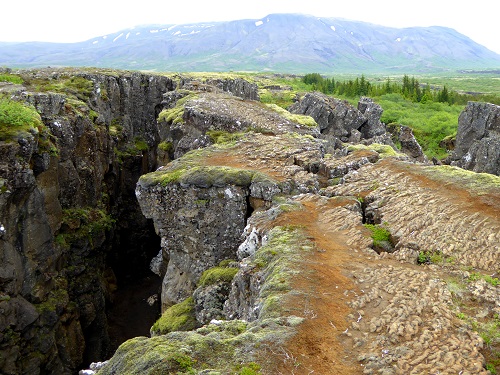
which seemed to have recently opened-up clefts on the lava mounds with their interesting patterns above it.
Another river, the Grimagilsklækur, flowed on the higher ground, rich in waterside flora,
and we took the road route down to the National Park Centre for lunch with other fauna (the jovial bikers were a small part of Iceland at leisure on its National Day).
Having established that the friendly girl behind the counter would drive us back to Reykjavik, I found I had enough time to follow the only path over the neighbouring lava field, Sleða
àshraun. This was the quietest and in many ways the strangest route of all, familiar to me from wading around the
Berserkjahraun on the Snæfelsnes peninsula. The moss grows thick on boulders and in crevasses
while on the trees which punctuate this otherwise moonlike landscape
sat the Redwings, calling to each other (or warning each other, or me, off).
Landscape and birdsighting on my four-mile Fife coastal path walk may have been less other to my perception, but the skies between showers and storm cast a clear and beautiful light over sea and land.
The noisy bird on a shrub this time I reckon must be either a Marsh or a Willow Tit (difficult to differentiate).
Eiders were bobbing in convoy close to the shore, just as I'd seen them on another stretch two years earlier
while the heron remained solitary, as usual,
and a lone cormorant perched on the edge of another rockline.
All this was worth lingering over, but by the time I reached some deserted huts with Crail just over the hill, black clouds had begun to mass inland and at around this point I heard a massive clap of thunder.
For all the speed with which I hoofed it into Crail, I didn't escape a hailstorm and, one minute away from the cottage where I was staying, got drenched to the skin. Looked forward to a nice cup of tea once I'd been picked up with no time to change and driven to Cambo House, only to find that the cafe had been closed due to flooding. The rest of the day remained unsettled, but Sunday morning dawned clear and bright, and I end not with birds - I heard some but saw none this time - but with rocks on the Crail beach, some substitute for not finding a suitable spot to swim there (I got my obligatory annual Fife bathe later in the day).
I leave you with a taste of things to come, courtesy of top Estonian photographer
Kaupo Kikkas. This wonderful colony, the Estonian Festival Orchestra which gathers ever year with Paavo Järvi (in the centre below) in the summer capital of Pärnu, would fly if they could. They certainly gave us wings in their two magnificent concerts.
I can hardly wait to write about another remarkable time with the best of orchestral players - and indeed all else that the Pärnu Festival has to offer. This is one event in the calendar that I hope never to miss so long as the enterprise continues to flourish.There will be a full report on The Arts Desk on Sunday week, and more here eventually, but in the meantime
here's my eulogy to the 2015 experience.




 Posts
Posts



