No apologies needed for lingering in 2020. As we head towards the first anniversary of lockdown, a full year in London nature needs chronicling, if only for my own satisfaction. This post shines a special light on the London Wetlands Centre, my then -new escape but now closed until further notice now that we're in Tier 4 (Kew Gardens has been the weekly excursion of choice on big-day-out Fridays in January).
First, though, one of the rare escapes, and of course that isn't London at all but country-house opera with an umbilical cord to the capital. First time I've been to Glyndebourne for ages to find it wet and grey and deepest Sussex, but there was still something beautiful about it. As I gave myself lots of time to get to Lewes owing to rail disruption and bus replacements, I was able to stroll up and down the hill, have a coffee and late lunch in a super new cafe on the high street, and see a few things I'd never noticed before, like the 15th century gateway which is all that survives of the Grey Friars Monastery near All Saints Church (it seems to have been relocated, but it leads to some planting which complements it beautifully.
At Glyndebourne, where I was to see a superbly-cast 90-minute version of Mozart's The Magic Flute (worth the trip), the grey was offset by autumn colours and a few floral survivors, dahlias included.
Purple-flowering sage is another late-autumn survivor, and there was plenty of it on the sides of the walk alongside the house.
The lake is always magical, come rain or shine,
and some of the lilies were still thriving.
So to the LWC, and a first acquaintance with the 'Wetlands of the World' zone, taking the path straight ahead once through the entrance rather than to the right which leads to the biggest of the two 'wild sides'. So happy to see the Barnacle geese I met everywhere in Svalbard - I gather they were a starting point for Peter Scott's big project. They share the tundra zone with the beautifully variegated Red-breasted geese and high-couture Emperor geese (though I haven't seen those there recently).
Further on are sea-ducks stranded inland: unquestionably the most fascinating are the hooded mergansers, which also makes comical noises as distinctive as the eider ducks.
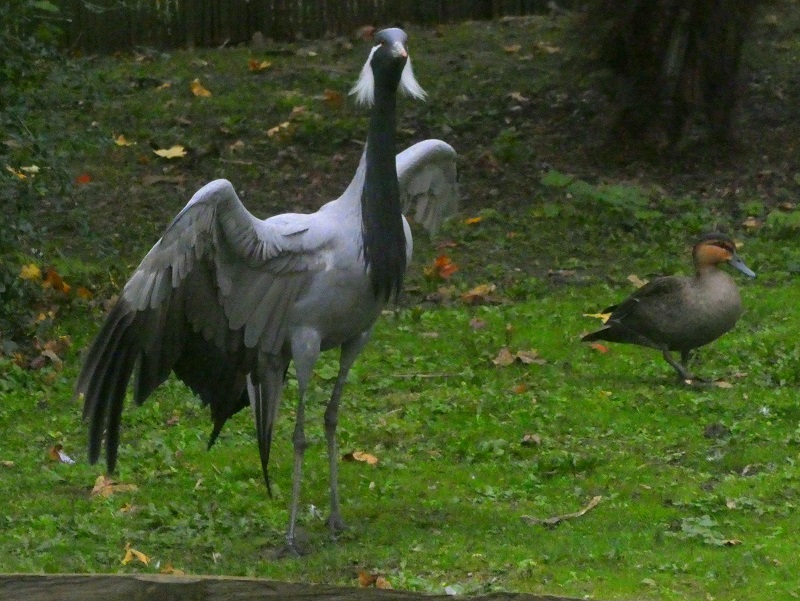
The demoiselle crane I saw out on the marshes in October seems to be a denizen of the next zone - wonder how it got so far, since I think all these 'zoo' birds have their wings clipped.
The ones with whom I like most to converse - yes, I'm becoming a weird old twitcher, or so people must think as they pass me at the LWC - are the whistlers in the Brazilian Pantanal zone, appropriately planted.
The fulvous whistlers tend to hang out in threes and come close to inspect
and they also whistle to the most adorable of all, the white-faced whistling ducks
whose back plumage is so intricate
and who hang around in packs, coming up to you whistling and eventually waddling away. The albino-ish one seems to be tolerated, but not much associated with.
Potentially more formidable a noise-maker is the southern screamer, but I've not heard it resound; still fascinating to look at, though,
and especially so in autumnal reflection.
Out on the 'wild side', wigeon have arrived to graze and swim in large numbers
The landscape here, all planted (with the exception of the larger trees, I'm guessing) from 1995 onwards, looks like parts of Norfolk and Suffolk; only the high-rises in the distance, not visible in these shots, give the game away.
At this point the hides were still open. I was lucky to share one - at a good distance and masked. of course - with an expert observer, all set up with better camera equipment than mine, and he pointed out a bittern among the reeds opposite. This is as good as I could do, mere proof that I could see it (to the right of the mallard duck).
And then the first of many great sunsets caught here over two months began, and it was time to leave.
On 5 November London went into a one-month lockdown. So lucky, then, that the previous day offered two live musical events, both wonderful. Sophie, former Queen of Djenne, joined me for another City of London Sinfonia special in Southwark Cathedral in the afternoon.
The idea, and you can read more about it in the review linked to above, was to build towards a bracing performance of Haydn's Symphony No. 104, and it began with a walkabout to hear various CLS musicians playing their music.
Afterwards we even found a well-distanced table just inside the door at the Borough Market branch of Brindisa, and then parted company as the late afternoon sun shone on the cathedral tower.
I had hours to pass before the evening event - a predictably outstanding performance by Imogen Cooper of Beethoven's Diabelli Variations, the last before the Fidelio Orchestra Cafe had to shut (heavenly Imogen is due back in April). Headed first east along the river, with pink clouds above the Tower opposite
as well as Tower Bridge further along.
Spent a happy time reading - what? I forget now - in the spacious depths of Fuckoffee (!), BoBo (Bohemian Bourgeois) hang out in trendy Bermondsey High Street, which I love nevertheless,
especially for the branches of my favourite commercial gallery, Eames Fine Art, which keeps up a good online show while currently closed.
Then back along the river, past Shakespeare's Globe, which I missed so much last year, and which has the nice quotation 'if we meet again, why, we shall smile' with the 'if' crossed out and replaced by 'when',
and across the 'wobbly bridge' to make my way up to the Fidelio Orchestra Cafe in Farringdon.
Nature soon compensated for the new shutdown. Friday 6 was a mackerel sky day - outside the bedroom window in the morning
and persisting above Old Brompton Cemetery's imitation of St Peter's Piazza as I cycled south.
The light was perfect for autumn colours: copper beech above my favourite 'patience on a monument'
and, down by the embankment at Cheyne Walk, casting floral shadows on one-time resident Vaughan Williams.
Battersea Park, my most consistent new attachment of 2020, was shown at its autumnal best.
The English Garden, closed during the first lockdown, also shone and glowed, the gingko in the centre its star attraction,
while roses still bloomed in the shadows,
papyrus enhanced reflections in the pond
and spent artichoke flowers foregrounded autumnal yellows
I've found my way around the paths that cross the various outlets of the main lake, which must be the biggest in any London park. Each seeming creek has its own identity. Deciduous conifers, easily seen in the main central spaces looking across to Battersea Power Station
inform this one
while a greener shade persisted here.
At last I found my way round to the rockery which you can see from the main cycle path round the edge of the park. A chimney of the former industrial cathedral reflected in the water:
and one of two great crested grebes gliding gracefully back and forth (and not diving as frequently as the one I kept trying to capture on the Serpentine.
Feeding frenzy with young swans and seagulls round the corner
while other birds were more aloof. Here's an alternating pattern in a tribe of mandarin ducks (they like trees, apparently, and this group emerged from one, colourful men and their less brilliant but still nicely marked ladies waiting to take the plunge)
and the irresistible plumage on one handsome chap
contrasting with the ever-still and aloof heron
I made my way back via the Peace Pagoda at sunset
across Albert Bridge
to home on the north side of the Thames. Back to Chiswick House and Gardens the following day - still beautiful, though it's more a spring and summer place. The house near the next sunset
and still-vivid planting, entirely of purple-flowering sage, either side of the central avenue leading to the camellia glasshouse.
The Ionic Temple of 1726 from the pathway (part of my usual circuit - I walk around with the bike in an anti-clockwise direction)
and, crossing the humpbacked bridge,
from the other side of the lake,
The route back: roses still blooming in one of the gardens separated from the houses of Chiswick Mall, recently subject to the highest waters I've seen.
Return to the wetlands, 13 November: just one shot of the channel that leads to the mere. With all the hides shut, the main lakes couldn't be seen unless you stood on a bench near the Peacock Tower. But still a walk on the wild side without much spectacular birdlife was a joy.
And that takes us just over the 60-day mark, which means I still have the rest of the year to cover. But maybe I'll go easier on that, and select a few aspects both of the wetlands in winter and Kew over three January Fridays.






 #
#


 Re
Re


 Posts
Posts



