Showing posts with label Dalkey. Show all posts

Thursday, 5 September 2024

'Another good one': more bathing in Dublin Bay


The quoted remark was made by Dublin's oldest bather - as far as anyone knew - after every daily dip up to his death at the age of 93. I heard it from two senior folk while changing for a swim in Sandycove. One of the beauties of these swimming locations is the friendliness and ease all around, and the fact that you meet all ages, sizes, shapes...a far cry from the time when the Forty Foot was men-only (nude bathing early in the morning), though the jumping from the rocks remains the same.

This was the Dublin fortnight in which I found the value of the immersion reaching an almost metaphysical level. It was a big thing for me since, apart from a trial run in the Estonia Resort Hotel's spa back in July, I hadn't really taken the plunge since the consequences of my big op a year ago: namely could I, should I, swim with a stoma? Reassurances didn't banish nagging doubts. And so on my first day back at the Forty Foot, trunks hoiked up over the bag, I stayed in very cold water for a short time, anxious about the aftermath though having already enjoyed the social scene before immersion.

But it was fine: no change needed (though I'd brought supplies), and time for a snack and a coffee just up the hill at an old furniture salesroom turned into a wacky cafe. 

It was important that I did this with my wonderful bathing pal in Dublin, Catherine Bunyan, a convert to daily sea swimming, and also with one of our recent guests, dear friend Ashley from Australia (on the left in the selfie she took above). Not every visitor would want to indulge in so-called 'wild swimming' - the wild bit about it, I'd say, would be the sea temperature - but both Ashley and our next arrival, Cally, were delighted to do so. Both swam around for longer than I did. 

The options at Sandycove are the Forty Foot itself - still no clarity on the naming, since the Fortieth Foot Brigade turns out NOT to have been stationed at the Martello Tower here, though the rumour may have stuck - or, if the sea is too turbulent, in the sheltered bay, where the white wall is lovely to lean against in full sun. Swim Two was another good one at the Forty Foot

and in fact Sandycove was more blustery, with a wind from the west. 

Do look at the names given to the jellyfish on the noticeboard. We actually met a friend of Catherine's here who'd been stung the previous week, but was happy to get back in the water.

The sun didn't properly materialise until my big day out with Cally (swimming below at a highish tide when the colour of the water shows that Joyce's 'snot-green' wasn't necessarily a negative).

We repeated part of the route on which I'd taken Ashley, walking from Dalkey Station to Coliemore Harbour, scene of my near-fatal swim out into the straits. Here are shots from two days - one blustery and sea-swelly but exhilarating, with seals swimming and fish to be caught, the other on a golden Saturday).

Then up to the panorama in Sorrento Point (wider view taken by Cally - you'd best click to enlarge),

in this case back round down Sorrento Road to catch the lobster festival in town (though not to eat there, since 3pm lunch called at the fabulous Andhra Bhavan), 

then on to Sandycove for the swim, enhanced by the pleasant company of two turnstones,

 and back to Dun Laoghaire for the DART back into town. That was livelier on the previous Saturday, when a zumba class taking place where the much-missed sea baths used to be enlivened the scene. Casement's statue (another bathing-place) beyond.

Sadly our excursion south to the coastal cottage of mutual friends Rosanna and Anthony found the sea too rough. But paddling proved good enough, especially on this lovely, deserted bay which may be sandy one year and shingly the next.

My last discovery has embedded the top image deep in my heart. Seapoint is closest, from home in central Dublin via the DART, and as time was limited I used the train - Catherine so often drives - to enjoy two last swims with her. 

The first day was grey but with fascinating lights, especially looking over to the Poolbeg Towers with cormorant-surmounted rocks (a small group of terns were further along),

 the second a dream late afternoon after a morning of rain. 

At last it was possible to swim with the sun on one's face, and to walk back to Seapoint DART station looking at the sun on the rocks and Howth magical behind. 

It's given rise to so many images, not just in the first chapter of Ulysses but also in another Irish masterpiece, Jamie O'Neill's At Swim, Two Boys. I haven't finished it yet; when I do, I hope I'll return to enlarge on its infinite richness here.

Sunday, 17 April 2022

Flann O'Brien: mortality, metaphysics and bicycles


It was our friend Paul Ryan who, when J said we were briefly renting a place in Dalkey by the sea, c.12km south of Dublin city centre, handed over his copy of Flann O’Brien’s The Dalkey Archive as essential reading. Thus began a strange journey which has so far taken me deeper into a singular kind of Wonderland, a dreamscape with nightmarish elements and so many parallels with the successful realisations of Neveux’s play and Martinů's opera Juliette, or The Key to Dreams, much on my waking and sleeping mind when we studied the musical masterpiece last year. And more than dreams, in all cases; for what can be more boring than when someone divulges the randomness of sleep images? 

Beyond the first chapter, where the Vico Road and the bathing spot beneath it figure significantly, neither Dalkey nor any of the other Dublin settings loom very large (though that opening page IS pertinent to our immediate vicinity).

The oddities are initially parcelled out between the opinionated and possibly dangerous/insane de Selby and two potential acolytes, brusque drinker Hackett and confused truth-seeker Mick, who turns out to be the main character. The girlfriend to whom he's none too committed, Mary, is the only sane person in the novel (and I’m assuming from his difficult character that the misogyny is Mick’s, not FO’B’s). The comic coup is saved for the arrival on the scene of the loquacious and fantastical Sergeant Fottrell. An underwater interview with St Augustine is counterbalanced by several more with James Joyce, who’s turned up alive and well working as a barman in another seaside resort, Skerries, this time north of Dublin.

The reading was addictive, and as I neared the end I was hungry for more O’Brien (real name Brian O’Nolan, born 1911, died on April Fools’ Day 1966); the Lord be praised that The Gutter Bookshop in Dalkey had a copy of The Third Policeman, Which is altogether more nightmarish, more hallucinatory and much more preoccupied with landscapes, and what man may or may not have injected of him (or her, but mostly him) self into them. The metaphysical aspect is even more pronounced, the sudden swathes of melancholia and self-doubt similarly lending gravity. Yet there’s a whole chunk I’d already read, the policeman’s disquisition on the interchange of human and velocipedal attributes due to the exchange of molecules.

Why? The answer is quite simple, but fascinating. O’Brien’s first novel, At Swim-Two-Birds, was published in 1939 at Graham Greene’s recommendation, and praised by both Joyce and Beckett. The Third Policeman was rejected on the grounds that ‘we realize the author’s ability but think that he should become less fantastic and in this new novel he is more so’. His third novel, The Poor Mouth, came out in Gaelic and then there were the daily columns of wit and fantasy in The Irish Times as ‘Myles na Gopaleen’ – as a secretarial civil servant O’Nolan could never use his own name in print – but no more novels until The Hard Life in 1962 and The Dalkey Archive in 1964. In true Mylesish fashion he spun various stories about the fate of The Third Policeman but it only came back to the surface after his death. 

I’m sure there have been scholarly articles on the complex relationship between The Third Policeman and The Dalkey Archive; but, that central velocipedal episode excepted, the witty exchange of non-appearing 'classic' (or prolific lunatic?) De Selbey with lower-case maverick de Selbey and the theft of a black box from a big house, the correspondences are more subtle. The later work is the one which will have wider appeal; the earlier is one I want to re-read almost immediately, because so much becomes clear at the very end. I’m glad he didn’t give it the alternative title he proposed to the Americans – I won’t mention it here – because that’s a real spoiler. But the book is bigger than that – just in Juliette, crucial questions of memory and what happens when we lose it, the proximity of dreams and death, the search for something that may not even exist, are vital. I’m hooked.

As for our Dalkey fastness, Dublin suburbia – some of it pretty – continues south until, essentially, Sorrento Point, from which we had a terrific early evening view of the island with its chapel and Martello Tower

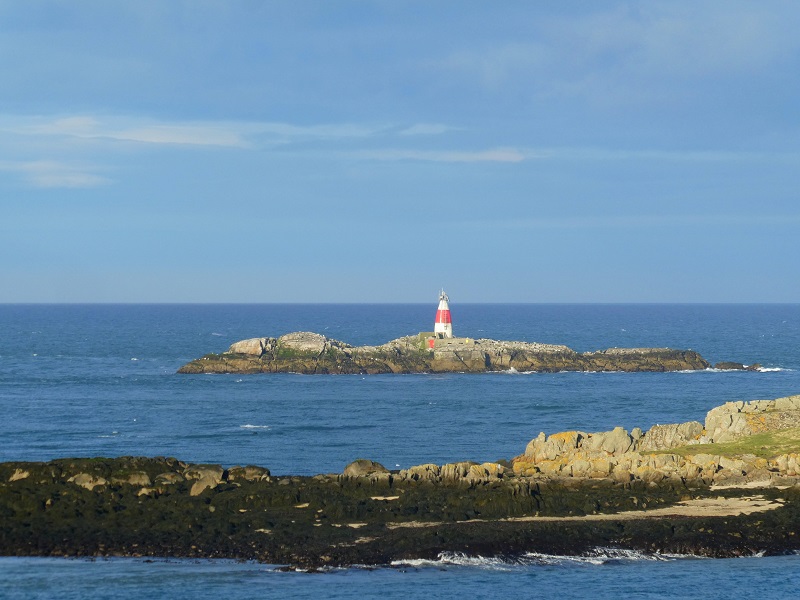
and the lighthouse beyond,

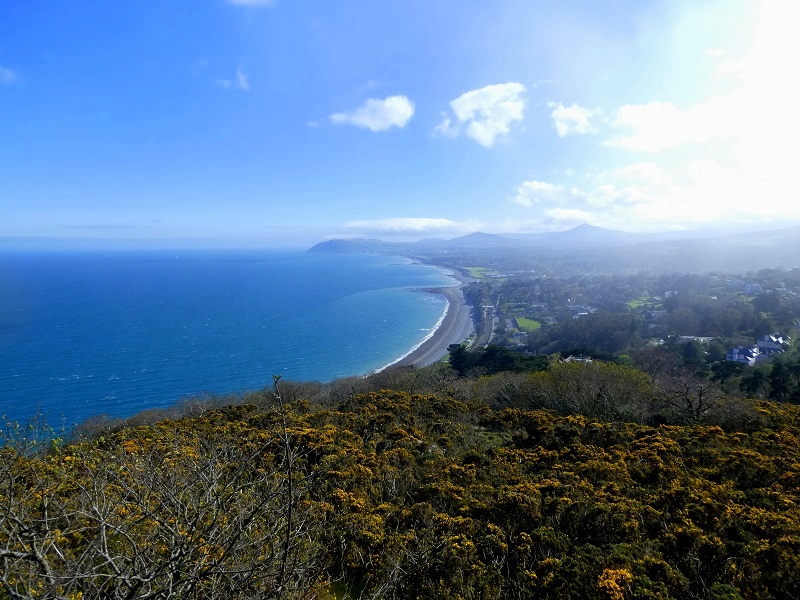
and – on our first full day, which offered a sunny afternoon, views from wonderful Dalkey Hill south along Killiney Bay to the Wicklow Mountains

and back to Sorrento Point and the island. 


An easy walk north the next day took us to Sandycove and the Martello Tower where ‘Ulysses’ begins. But I’ll save the already overwhelming Joyceana for another entry.