What would I like to be in another life (not that I can really imagine being anyone else, but it's fun to fantasise occasionally)? At the moment, in the wake of my Darwin phase - which partly turns out to be something of a father-fixation - either a geologist or a botanist. Reading about the great man has brought about a realisation that classification doesn't diminish a sense of wonder about the natural world. And though my knowledge about plants has focused on a mere handful of species, I'm getting to know what I like. So, after our many Apennine walking holidays, and above all last year's excursions to the Julian Alps and the Valais, Alpine plants are my current craze.
Dipping into Jim Jermyn's Alpine Plants of Europe - helpful because it covers the zones from the Pyrenees to the Carpathians and tells you what's unique to each - coincided with an article on the Pulsatilla family in the Kew magazine. That's pasque flowers to the average punter, and being fascinated by their hairy leaves and their early appearance - though the flowering is staggered according to subspecies from the eastertime suggested by the nickame through to early summer - off I went along the river on my bike to the Royal Botanic Gardens. In fact the bloomers in the rock garden were few but splendid, chiefly Pulsatilla halleri subsp. slavica, a Carpathian spring visitor pictured above in one small but noteworthy group and below in a bigger cluster.

I think I snapped the Pulsatilla vernalis - or alba or alpina or even Anemone baldensis, to which the pulsatillas have always been related, and how's an amateur to tell the difference? - on that extraordinarily rich floral trail around the Lago del Predil in the Julian alps (see last year's entries on the place and about the flowers). Here's the putative Pulsatilla

and a reminder of the location, just over the border from Slovenia - which we walked in to, very exciting - with the monstrous dolomitic Cinque Punte in the distance.

One of the most heavenly places on earth, and the south end of the lake has no road, only tracks, hence the abundance of plants.
Anyway, the rock garden at Kew is very bald at the moment, which makes its few flourishings all the more impressive. Here are a crop of Balkan tulips

and can this really be a type of Galanthus, as the label by it indicated? I know they come in more shapes and sizes than just the plain white snowdrop.

Inside the Alpine House, there were a few bright treasures, mostly in pots: the Chilean Tecophilaea cyanocrocus

and the Scoliopus bigelovii or Californian fetid adderstongue (no bad smell detected here), a damp-loving member of the lily family which nestles under redwoods.

Spring is still only half-formed at Kew now, though I get more excited at the early buds and shoots than I once did. The healthily lichened magnolias are all furry and incipient

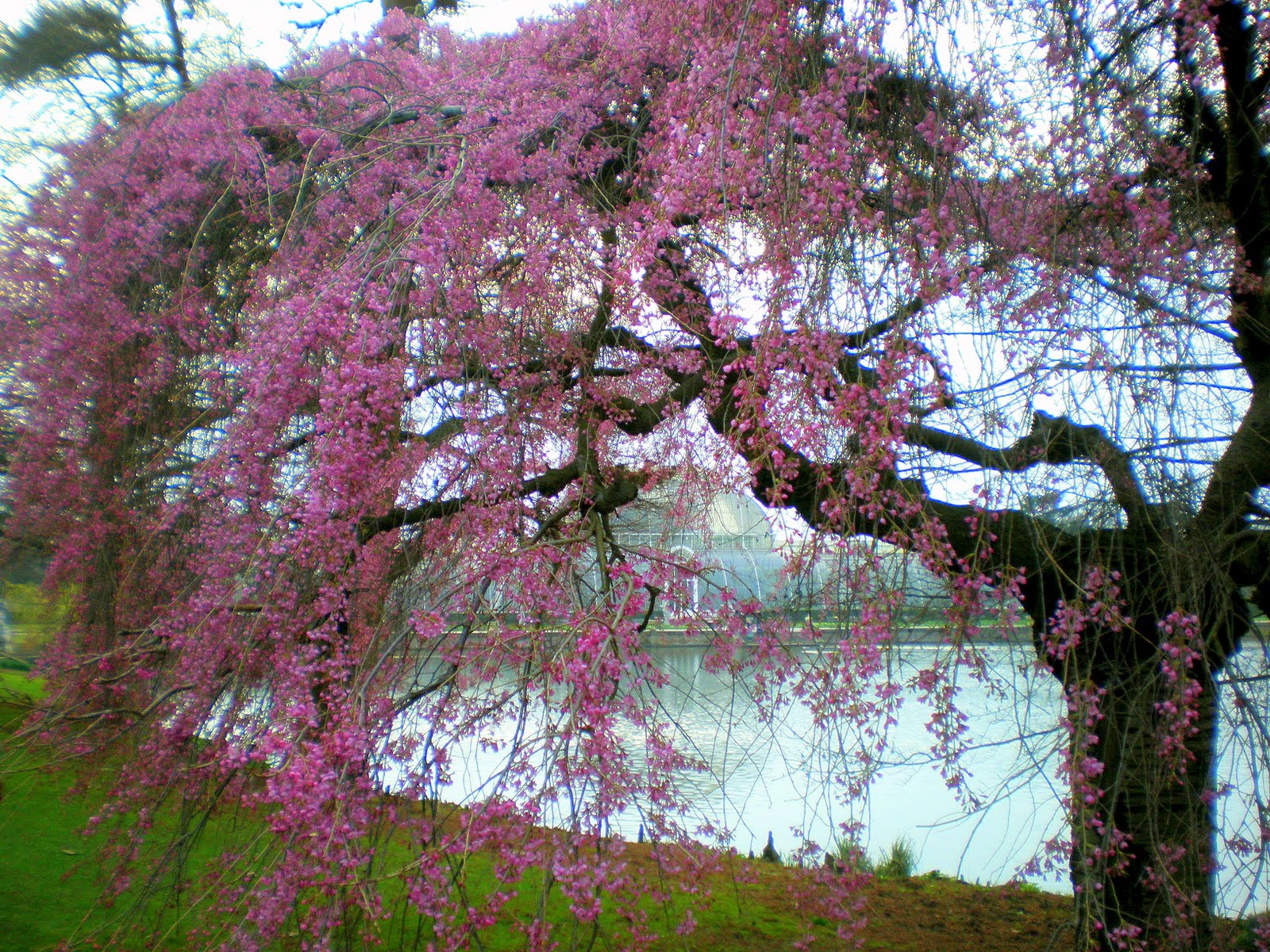
and there are some spectacular blossoms, not least a rare type of prunus by the lake.
Naturally the daffodils host the way along the main north-south path

and the trees are mostly budding but not yet in leaf; again, I find much more poetry in the bare outlines than I used to. Perhaps I'll return to them for comparison in a month or so's time. Anyhow, I left well satisfied with a couple of Pulsatilla purchases, white and red, along with a Primula denticulata, though I'd actually been on the lookout for Sempervivens. Here's a final reminder of one such kissed by the bee high above Verbier

part of a precipitous clump, which I can't resist including with a look forward to the months when the snow clears and we can go a-wandering again in the heights.


 Posts
Posts