Showing posts with label Paris. Show all posts

Thursday, 7 April 2022

Kiefer and Baselitz in Paris

Top of the list when we stopped over in Paris before the last leg of the train journey to Siena and back over Christmas and New Year was Anselm Kiefer's 'Pour Paul Celan' at the Grand Palais Éphémère.


It didn't disappoint, but Paris excelled expectations this time - and we had two days longer there than planned, which was the very opposite of hardship. Ads for exhibitions on the Metro are sparse, so it was only when we found ourselve in front of the Centre Pompidou on the last full day that I realised there was a big Georg Baselitz exhibition.

These were spectacular bookends to a time in the city as happy as I've ever experienced, and unexpectedly up there with the discovery of Turin and reacquaintances with Florence, Siena and Venice. We were especially lucky to catch the Kiefer, which ended on 11 January before any other Brits could get across to Paris to see it (we had been lucky to travel through France before Christmas on the day before the borders were closed to us). I'd read the review by my colleague Mark Kidel on theartsdesk but needed no encouragement after the Royal Academy retrospective and the two big shows in White Cube Bermondsey. 

The new Parisian space is at one end of the Champ de Mars opposite the Eiffel Tower - the clods of earth here and the perspective could be straight out of a Kiefer painting -

and the hangar-like interior with its wooden struts is absolutely necessary for the space of Kiefer's monumental works, around which there was, as before, so much space to walk around and view them from every angle.
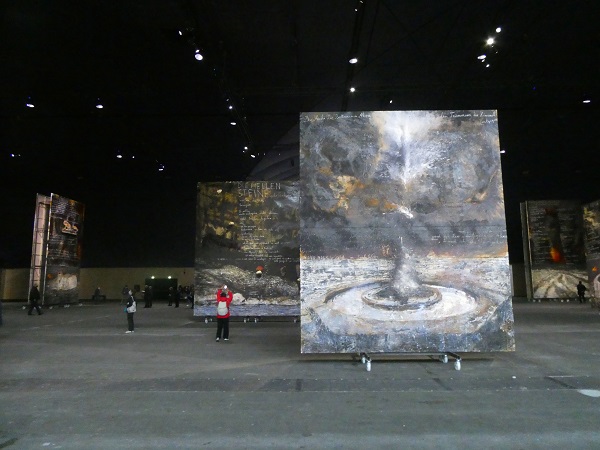
Tellingly Mark wrote that 'there is something beguilingly time-less about a show that reminds us that human violence and frailty are not time-bound. Genocide is not limited to the Holocaust. If history teaches us anything, it is that humanity is rooted (or perhaps stuck) in cycles of repetition. Images of perfectibility and progress are an illusion.' So looking back on this and across to the hideous images of war-scarred Ukraine has special resonance right now. The poet, born Paul Antschel, a name he changed to Ancel then anagramatically to Celan, grew up in Czernowitz (now Ukrainian Chernovtsy) in Bukovina. His parents died - his father of typhus, his mother from a bullet in the neck - in a Transnistrian internment camp, and he escaped forced labour under the Nazis until 1944 .

'Todesfuge' ('Death Fugue'), Celan's most famous poem, from which he later tried to distance himself, is one response to that horrific time, It appeared in his first collection of poems, Mohn and Gedächtnis (Poppy and Memory). Immediately there's a connection with Kiefer's regular use of poppy seedheads on stalks among the materials he attaches to his paintings
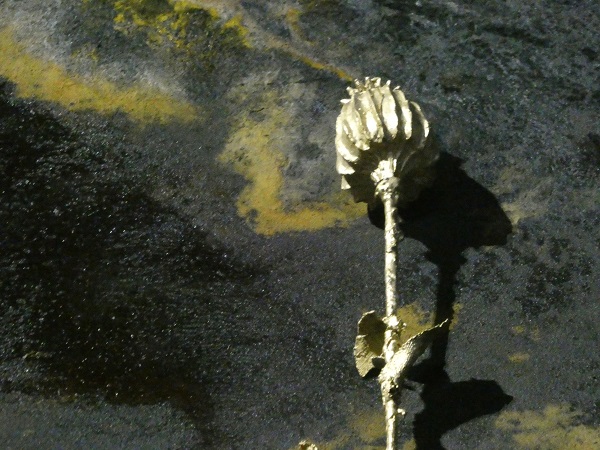
and in the attempt to recreate his storerooms in the space between the exhibition and the cafe/library zone, we see these as part of his stocks in trade.


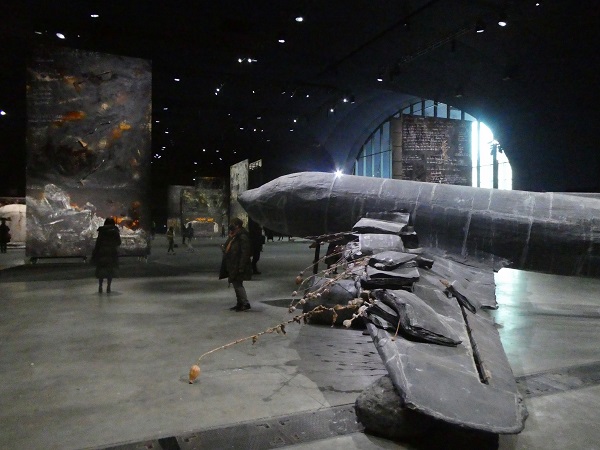
Unlike the red poppy which for us is a symbol of remembrance - we encounter these living flowers often in Kiefer's fields - the seedhead suggests opium, and forgetfulness. Yet the application of these stalks and heads rising from a round concrete bunker, or sprouting from huge lead books on the wing of a full-sized decaying aeroplane of the same material, turn it all back into memory and a hint of hope, or at least of humanity.
The two leading figures whose names are repeated in 'Death Fugue', Margarethe and Sulamith, are the subjects of two of Kiefer's large canvases from the early 1980s with straw applied to oil, acrylic, emulsion and woodcut. and featured in the Royal Academy exhibition (scroll down this blog entry for reflections on that). It was there, too, that I first saw Celan poems inscribed on Stalks of the Night and one of his Rhine series of woodcuts. Needless to say they're prevalent, too, in this latest exhibition, including one canvas which takes its title from Celan's 'Zuversicht' ('Confidence'), though the use of natural material here is more suggestive of 'Das Geheimnis der Farne' ('The Secret of the Ferns'). It's a long-established theme of Kiefer that a tank should be lurking in the half-natural surroundings.


There is word-music in Celan's poetry but the sense is very elusive. Kiefer, who declares that not a day has passed when he hasn't thought of Celan - who committed suicide in Paris by drowning in the Seine in 1970, aged only 49 - points out (hope my French is good enough to render translation from the handout) that 'the language of Paul Celan comes from so far away, from another world with which we haven't yet been confronted, it appears extraterrestrial. We understand it poorly. We seize upon a fragment here and there.  We cling to it without ever being able to discern the whole. I have humbly tried, throught sixty years.' And a vision of the whole is so often what we get in these vast canvases, even if it is so often contradictory or ambivalent one. The correspondence between text and painted vision isn't always clear - Denk dir - die Moorsoldaten must be related to the poem 'Think of it - the bog soldier of Massada/teaches himself home', but I can't see how, beyond a visionary optimism common to both. But it's an overwhelmingly impressive work. The apocalyptic Auf der Klippe (On the Cliff): für Paul Celan stands in front of it in the second image.


The most striking canvas of all, to me, at any rate, because I hadn't encountered some of its elements in a Kiefer painting before, is enigmatically called Madame de Staël: de l'Allemagne


What do the mushrooms sprouting from the floor of Tempelhof Airport, many with labels of famous German artists, composers and writers, have to do with this? The work stands by itself, but we're told that Mme de Staël wrote admiringly of Germany to her compatriots in 1813; German history since has turned so much upside down. Kiefer, of course, embraces the whole.

Between the Kiefer and the Baselitz we walked for miles in ever-brightening weather, and stayed for the first time (it's always been a bit of a dream of mine) on the Île Saint-Louis; absolutely worth it. I've covered some of the interim in an earlier blog post here

And so to Hans Georg Kern, born on 23 January 1938 in Deutschbaselitz near Dresden, Seven years the senior of Kiefer, who grew up playing in the ruins of Donaueschingen. He writes: 'I was born into a destroyed order, a destroyed landscape, a destroyed people, a destroyed society. And I didn't want to re-establish an order; I'd seen enough of so-called order. I was forced to question everything, to be "naive", to start again'. Kern took the name of Baselitz in 1961, then shocked the world with a giant erect penis in The Big Night Down the Drain, apparently masking his hatred of Hitler; when he revisited the work in 2005, the resemblance to the dictator was even stronger. 


 His next gambit, in 1964, was to present himself as Oberon, king of the fairies, in four duplicate heads - 'not heads', he writes, 'in the sense of portraits, but something like an image which has in the centre. in the thick of a soup of colours, a head which became more and more distinct from one painting to the next'.


A sense of dislocation in a divided Germany reared its head in the series of 'fracture paintings' (1966).

Then, in 1969. Baselitz declared he had found 'the philosopher's stone./Painting lives on through the inversion of motifs./It is possible to create an abstract painting using this method'.


The tumbling eagle and the naked man (Triangle Between Arm and Trunk) are among his finger-paintings.

The Model for a Sculpture, carved with axe and chisel and then sprayed with red and black paint, and so well placed in a room with two of the most vibrant upside-down paintings (see up top), derives from Baselitz's collecting of African art. He denied that the raised arm was intended to represent a Nazi salute, but of course it caused a scandal.

In 1989, following the fall of the Berlin Wall, Baselitz recalled the rebuilding of Dresden, and homaged the 'Trümmerfrauen', the women who clear the rubble, in the yellow heads of Dresdner Frauen

Late bronzes and a striking image of his wife Elke in a hospital bed take us one step further in the last big room.

How fresh and lively the Pompidou Centre felt again; I remembered those days discovering Paris on the way back from an Easter party in Rome in 1983 when I watched Syberberg's freaky film of Wagner's Parsifal in the cinema there for free (over three visits) and was so struck by Delaunay's statement that 'colour itself is form and subject'. Wandered the galleries of great 20th century art, and of course the escalator ascents were as magical as ever given the light.


Paris, I fell in love with you all over again on that trip. So close to London, and yet so utterly different.

Saturday, 8 January 2022

Heureuse après-épiphanie de Paris

We were in the city of day- and night-light for two days longer than planned; seek not to know further, other than that we're back home now. Let's just say that it was total joy to walk for miles, discover more, eat well, and see two stunning exhibitions (Anselm Kiefer's Pour Paul Celan at the Grand Palais Ephémère, a new structure at the foot of the Champs de Mars, and a big Georg Baselitz retrospective at the Pompidou Centre, a serendipitous stumbling-upon - since I hadn't seen it advertised - to balance the other monumental, post-war German genius).

There were other surprises. I've always wanted to stay in a hotel on the Île Saint-Louis, and we did, very happily, at the lovely Hotel du Jeu de Paume, strolling out along the back and side of the building-site that is currently Notre-Dame, very well informed by the board-exhibition as to what's going on. We had taken a dear friend who's confined on a virtual WhatsApp walk around the Duomo in Florence, and decided to do the same here. So we all gasped when we rounded to the west front and found it lit up in blue


as are all the major landmarks of Paris right now to celebrate France's taking up the Presidency of the EU. I'd wanted to see the stars on the Eiffel Tower, but had to be content with blue in the distance with the dome of Les Invalides in front

and the following night, after a day of brilliance and blue skies, a crescent moon hovered above the Panthéon


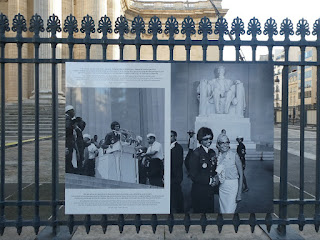
where we'd hoped to see the homage to its latest incumbent, Josephine Baker, but the building was closed for three days so we simply enjoyed another exhibition around the periphery, offering so many images like La Baker in her prime with pet leopard

and her role as the only woman to speak at the March on Washington (she's with Lena Horne on the right). What a life she led, and what a great human being.

For this it wasn't a wasted visit. I also got to show J my favourite church in Paris, Saint-Étienne-du-Mont opposite the Panthéon, with its stunning choir screen.

Hadn't previously appreciated its  abundance of 15th and 16th century stained glass, either.


More serendipity came in the Montparnasse cemetrery where, having duly admired the outlandish monuments of Niki de Saint Phalle to two dear friends and the Baudelaire cenotaph,


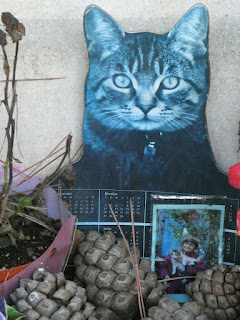
I was just remarking on how prosaic the place mostly seemed when we suddenly discovered, not knowing it was there, the grave of Jacques Demy and adored Agnès Varda - the headstone covered with lipstick kisses,

a cat homage


and several potatoes left among the offerings - mine was a 3D 'lucky' card of Buddha which I placed between the stones and the middle potato, all I could think of but it somehow felt right -


just as there are metro tickets on the joint grave of Jean-Paul Sartre and Simone de Beauvoir. 

Had to look this one up, and found that Saint Agnès was known as 'Dame Patate' and dressed up as one for her 2003 Venice Biennale installation Patatutopia, which used 700 pounds of tubers. This is a still from a documentary fim of hers I must see, The Gleaners and I. No wonder she's the film director who inspires the most love and affection of all.

After our Montparnasse wander, we finally visited the Catacombs, which was not quite what I'd expected but not uninteresting. Kiefer and Baselitz must wait on another blog instalment, but I must mention two last wonders which framed our visit - on the metro from the Gare de Lyon, a fellow singing melancholy French songs perfectly in pitch and sweet tone, not for money, and to balance it on the metro to the Gare du Nord yesterday afternoon, a chap with a murine companion, daintily ribboned. 

Paris can still surprise; this time it was not an anticlimax after Italy.

Tuesday, 25 April 2017

Parisian Snow Maiden: into the Bastille woods


Dyed Moroz, Old Man Frost, had released his icy grip - but not his cold east wind - when we arrived in Paris for six days which grew progressively warmer and then decreasingly sunnier over the weekend (Friday was the zenith, a day I'll never forget). And this was the year in which I got to see Rimsky-Korsakov's Snegurochka, The Snow Maiden, La fille de neige, call it what you will where you will, on stage not just for the first but also the second time - after Opera North, the Opéra National de Paris mounted it in more lavish style, and with world-class singers, but not necessarily more truthfully. Gergiev brought a Kirov concert performance to London, what, two decades ago now, from which I remember chiefly the shepherd-boy Lel of the young Yekaterina Semenchuk. She was down to sing Spring Beauty at the Bastille, while a strong counter-tenor many may remember as runner-up in the 2009 Cardiff Singer of the World competition, Ukrainian Yuriy Mynenko, was cast in the trousers role.


He appeared (pictured above in the second of five images for the Opéra by Elisa Haberer); Semenchuk didn't - though it would be hard to imagine a more authoritative bouffanted grande dame than Elena Manistina - and nor did Ramón Vargas, whose role of the aged and here ineffectual Tsar Berendey was taken by another stalwart Ukrainian, Maxin Paster, who cranked up well but didn't get his second aria. Director Dmitry Tcherniakov went for more of the score than John Fulljames in the Opera North production earlier this year, but made some odder cuts: chiefly the best-known number in the score, the Dance of the Tumblers/Skomorokhi, which at least appeared as an Entr'acte in Leeds (as some compensation, we did get the quirky little march of the Berendeyans, and I loved the 'heralds' singing through megaphones).

The imaginative Russian usually ends up bending the scenario to his will in a way that ultimately doesn't always serve the music best. His idea here was that the thuggish merchant Mizgir is incapable of being enchanted, so no magic spell cast on him when he first claps eyes on Snegurochka. Nor can she succumb to his passion in the end, so the great love duet of capitulation becomes a struggle, which deprives the singing of its conviction (Snegurochka and Mizgir pictured below, in the second of four images for the Opéra by Elisa Haberer).


No, this Snow Maiden loves Lel to the end and is seen slowly dying through the second half of the opera (Acts Two, Three and Four). A sacrificial victim like Stravinsky/Roerich/Nijinsky's Chosen Maiden, she doesn't melt with love and the first rays of the sun but drops down dead, lying there at the front of the stage while everyone ignores her in a stomping dance with a fake fire sun rather than a real one at the end.

That didn't work for me, and as a whole, to my surprise, I'd rate Fulljames' balance of magic - those video projections, exquisite - and realism higher. But in every respect the vitally beautiful Aida Garifullina was Snegurochka incarnate; our hearts went out to her from the start. She was, of course, one of my two work-related pretexts for spending nearly a week in Paris; the interview, a total delight, will appear soon on The Arts Desk. That crystalline lyric voice carried even in the horrid vasts of the Bastille Opera (not all the choruses crossed the proscenium arch, though the soloists were mostly clear). And at least Tcherniakov forsook his beloved grim, realistic interiors, which always look good in the director-designer's work but aren't always apt. We entered the auditorium to witness a forest community complete with caravans and dacha-houses, dwarfed by enormous pine trees which rose to the full height of the stage and went back as far as the eye could see. That kept us happy while the Prologue unfolded in a smart (stage?) school where Madame Spring put her proteges delightfully through their paces as a chorus of birds (pictured below).


Veteran Vladimir Ognovenko - whom I think I last saw at the Bastille as a gruff Kutuzov in Prokofiev's War and Peace - is as easy on stage as Manistina, plausibly an old couple whose late-flowering love-affair went awry. Mynenko sings as artistically as any counter-tenor could as long-haired, slightly repulsive Lel, but I'd still prefer a fruity mezzo; Heather Lowe for Opera North looked just like a teenage boy, but didn't have the dark Slavic colour). There was luxury casting for the 'other' soprano, sensuous, experienced village girl Kupava, in the shape of dramatic soprano Martina Serafin, whose Marschallin in Vienna was Crespinesque and who totally redeemed an otherwise dreadful production of a dreadful opera, Giordano's Andrea Chénier, in Zurich (I've not seen her Tosca and wonder whether she really still has the top for Turandot). Neither as youthful nor as hilariously crazy as Elin Pritchard in Leeds, she still produced beautiful sounds and relaxed, intelligent acting. That's her in the middle of the ensemble scene pictured below. The real let-down was baritone Thomas Johannes Meyer's Mizgir, brutal and constricted beyond the call of duty.


I wasn't entirely convinced by the conducting of the Mikhailovsky Theatre's Mikhail Tatarnikov; as with Leo McFall in Leeds, there were times when the score could afford to expand more opulently, and the last duet felt rushed - didn't help that it was cut in half. The first oboe was having a bad night, too, with many notes not coming out. But perhaps the most bewitching scene in the entire score, the desperate Snegurochka's summoning of her vernal mamma, really glowed, and it produced the most beautiful tableau, too, as the forest constantly revolved. For symmetry's sake, it might have been better to return to the school room, and the forest was stuck there for the scene in Berendey's court, too; but this was the highlight for most of the audience, and it's the scene that Garifullina loves best, too.

Anyway, I'm glad Tcherniakov is making a case for the best Rimsky-Korsakov in Paris, rekindling earlier glory days at the beginning of the 20th century, and we need it at the Royal Opera too. High time they engaged Garifullina before she's booked up entirely; and in earlier days a complete Decca recording would have been built around such perfect casting, She told me in our wonderful interview on Sunday that her next wish is to sing Manon in Vienna, but I'd be even more delighted if somewhere like Glyndebourne would stage Strauss's Daphne for her; I'm sure she could manage that lighter soprano role among his operas already. So, exciting times ahead, and they couldn't happen to a lovelier person. I'll put in a link here when the interview's up and running; and needless to say much remains to be written here about Paris in the springtime, even if I haven't finished with Oslo, Amsterdam, Gloucester or Tallinn yet...