Showing posts with label Riccardo Muti. Show all posts

Sunday, 31 December 2023

I'm still here

...as Bonnie Langford is the most recent show singer to tell us, and so well (yes, really), in Stephen Sondheim's Old Friends, which I'm glad my old friend Simon encouraged me to go and see before Xmas. Actually the odds were very low on my not being still here, since the diagnosis of bowel cancer in November 2022 yielded a verdict of Stage 1/cuspal 2 and no metastatizing.

Nevertheless it's been quite a year, full of inspiring people like the heroic folk of Charing Cross Hospital - I can never get tired of seeing this pic -  


and I choose the top image, at one of my happiest places in the world, S. Apollinare in Classe outside Ravenna, since between my six weeks of radio and chemotherapy back in February, which coshed the tumour but not all cancer cells, and the big op to remove my lower bowel in July, I cycled to this glorious place just before temperatures went berserk in Italy. And here I was 10 days ago with my best beloved, cycling not an option for the foreseeable future but slow walking with stick always possible. finding it similarly deserted a few days before Xmas, though about to host a big wedding with a sumptuous reception set out on the upstairs level of the nearly-new Classis Museum, converted sugar-beet factory, nearby.

I'm having too full and rich a time to blog much right now, but let's have a token shot from each of our cities. A first night in Bologna revitalised my love of the place (any city which has a naked god in its main square, courtesy of Giambolgna, can't be bad),
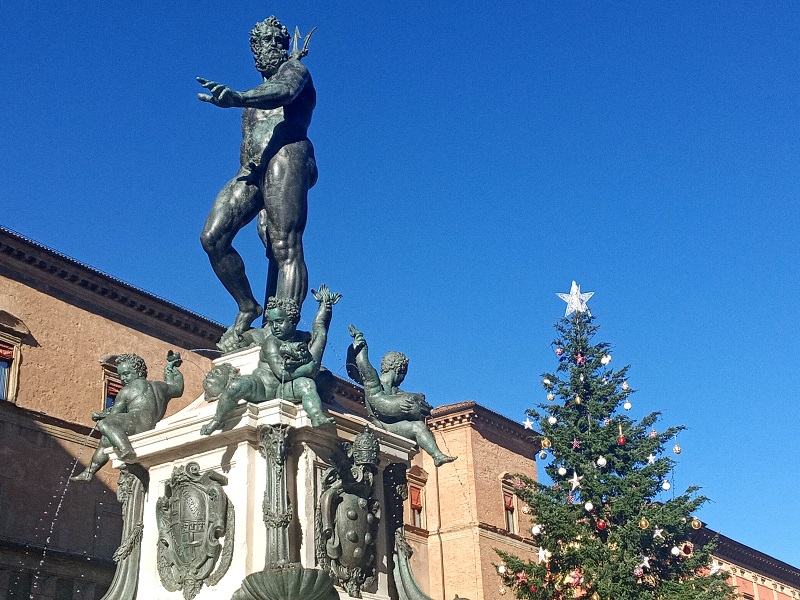
while adored Ravenna yielded the best three nights of Italian opera, courtesy of honorary Ravenato Riccardo Muti, and allowed a day trip to Rimini, which was more fun than I'd imagined, 

with one of the greatest Renaissance interiors ever in the Tempio Malatestiano (must spend more time on that), and plenty of homages to native Fellini. Then it was on to Ferrara for Xmas itself: we ate well and saw much, met some charming people, but a certain grimness takes it cue from the fortress-become- palace (no wonder the Estes sought out cosier retreats in the suburbs), and the two main exhibitions were of 20th century Italian artists admired by the Fascists (no prizes for guessing who's in power here). Plenty of green on the 12 mile circuit of the walls, though.

Vicenza awed us with its theatricality - it helped that we turned out to be staying in Palladio's Palazzo Valmarana Braga, a huge bargain, right in the heart of things - and the Basilica in its square simply gobsmacking.

I'm happy we did a seven-mile country walk to take in villas and a giant Veronese - climbing steps on a wooded hillside was a major achievement. And now we're in the bosom of Siena again, in Sophie's stunningly designed top-floor guest house with views one dreams of - she can see this from her bedroom and bathroom.

And so, buon'anno, buon comincio, auguri, whatever takes your fancy. I have the task of leading Italians in "Auld Lang Syne", which has very different words in its best known Italian form, but Milva carries it off:

Italian retreats gave me time to labour love-wise over the best of 2023 on The Arts Desk. Opera is here; classical music concerts here.  May 2024 be as good, musically speaking; and may the world give us a bit less need to seek optimism in arts alone.

Tuesday, 28 June 2011

Three Macbeths


O speak not his name, if theatrical lore sayeth sooth, but there's no getting round it: I could have used 'Macbetto' for two of the three in question, Verdi's radically different operas of 1847 and 1865 which have been the subject of my last seven opera appreciation classes at the City Lit, but the Shakespeare is what it is (and we saw quite a bit of that, too, in the very curate's eggy Orson Welles movie, and the unmissable McKellen/Dench partnership of Trevor Nunn's intimately filmed production).


Actually I must just record that a funny thing happened during our City Lit screening of the banquet scene in the play. McKellen stares fixedly at Banquo's empty place in front of him - there's nothing there - and our DVD chose precisely that moment to freeze, only to leap to a ghostly image of one of the three witches. You can imagine that freaked me out a bit and I didn't want to go back and see if it would work properly a second time.


Amazement still sits on me at how much perfect music-theatre Verdi managed in the midst of his early operas (especially when you think of Attila, which I'd rather not, and I Masnadieri, graced at least by some excellent moments of darkness, either side of it). As apt, albeit in a less sophisticated way, as anything in Otello and Falstaff, are his genius, free-form telescoping of the 'Is this a dagger' speech as well as the duet which follows, recast a little for Paris (how Fuseli matches Verdi here)


and the concentrated mix of eeriness with unexpected pathos in the Gran Scena di Sonnambulismo.

Still, the greatest fascination rests with three of the four numbers Verdi completely replaced in 1864-5. First, he removed what he called 'an awful aria of the Prima Donna'. 'Trionfai!', Lady Macbeth's response to the short Act 2 exchange, isn't so very bad; though generic, it continues to characterise her vaunting ambition - but that's superfluous, since we've already had it twice in 'Vieni! T'affretta!' closely followed by 'Or tutti sorgete'. See what you think in the best performance I could find on YouTube (we used Rita Hunter in the BBC radio recording of the original version, not on great form either). Do I put myself beyond the pale with voice queens if I say I'd never heard of Olivia Stapp?


Performance regardless, there's no doubt that the replacement, 'La luce langue', is not only an improvement but one of the glories of the score in the orchestral colour which accompanies the paraphrase on Macbeth's 'Light thickens...Good things of Day begin to droop and drowse' and the, once again free, cabaletta section, with its pre-echoes of Eboli's determination and the mezzo's music in the Requiem. I thought Cossotto, on the extraordinary Muti set, carries out all the detailed injunctions in the score even better than Callas.


Passing over the Paris ballet for the supernatural hokum in Act 3 - which I love, especially as choreographed in Richard Jones's werewolfs-gimps-and-cooker version - the tweaks to Macbeth's scene with the seven kings and the duet which replaces his 'Vada in fiamme', perhaps even more extraordinary is what happens at the start of Act Four: the replacement of one rousing chorus for an oppressed country, which would have had extraordinary significance in 1847, with another still more profound yet written by the time Italy was a free nation. The original has those unisons blossoming into harmony which we recognise from Nabucco's famous Chorus of the Hebrew Slaves, but with Macbeth's all-important minor seconds jabbing desolation into the music. We heard a wonderful performance from the Welsh National Opera Orchestra and Chorus, but this pale imitation is the best I could find on YouTube.


The major-key resolution is just too easy. Note how in the formally more complex, orchestrally richer replacement of 1865, Verdi postpones a possibly ray of light until the very final bars. Yes, this is great, deep music, a fine prophecy of the 'Lacrimosa' in the Requiem but standing with head held high in its own right.


That's probably enough for now, and extracting the complications of the rewrites to the final scene is beyond me here. But it's probably right that Macbeth's original death scene, 'Mal per me', should be stitched back into the revised, quicker resolution as it was at Covent Garden. There, incidentally, it provided Simon Keenlyside's one moment of glory, though recent news suggests we should never be too quick to judge when a singer's off form: the generous baritone has cancelled tonight's Wigmore recital owing to the death of a family member. So a tinge of guilt at a harsh judgment and my thoughts to him.


Anyway, I rather like the crude one-note trumpetings of the original battle, but the fugue as followed by the stirring final chorus is, as one of my students said, perhaps the most exciting curtain to any Verdi opera. The composer was as amused as anyone at possible responses to the news that he had used an academic form: 'A Fugue?...I, who detest everything that smells of school, and it has been nearly 30 years since I wrote one!!!'. And of course he wrote another right at the end of his musical life, in a contrasting spirit of huge good humour.


Well, I for one am sorry to leave Macbeth, even though I ran over on it by two weeks - which means there's less time for Massenet's Cendrillon, but that's probably as it should be. And it's not goodbye to the Scottish play yet as I have a DVD review copy of Rupert Goold's production with Patrick Stewart to watch for the Arts Desk*, and we're all gathering together for a free extra City Lit class so we can watch the film of Tcherniakov's Paris Opera production. And next year's six operas will be Weinberg's The Passenger, Puccini's Tosca, Adams's The Death of Klinghoffer, Dvorak's Rusalka, Gershwin's Porgy and Bess and Britten's Billy Budd. Today is probably the last for getting in, as booking has just opened and we always fill the 32 spaces in double quick time. At least I hope that's the case for 2011-12 too. Download a course guide from the City Lit's website here.

*Now I have - the review is here - and it's imaginative but all over the place. No guarantee that a good theatre director will make the transition to cinema. Clodhoppers like Brook's Lear - would-be Russian style - and Lloyd's Mamma Mia prove the point, and I hear similar reports about Sam Mendes. Shame, because Goold's Turandot was a triumph in my books, and this is full of striking ideas.
