Showing posts with label Snæfellsjökull. Show all posts

Friday, 30 December 2011

Happy endings


Very well, Hans Sachs and Fairy Edna may have nothing else in common, but they do both help an outsider and a merchant's daughter in difficulties towards a wedding. And to be honest, the panto in Wimbledon spoke more often to my depths - or my shallows, though what's as profound as Homeric laughter? - than the Royal Opera's Meistersinger revival (the final scene of which is pictured above by Clive Barda). There were passing pleasures, all the same, in the second of the two comedies which rounded off a year rich in events.

I tried to unpluck the best from its varied tapestry in my Arts Desk 2011 choice, but even then I found I'd missed a few (how could I not have squeezed in Kazushi Ono's CBSO Mahler Resurrection Symphony?) I needn't repeat the results here except for the crème de la crème: in terms of Gesamtkunstwerk, it was a tough choice between Christopher Alden's production of Britten's A Midsummer Night's Dream and Sasha Regan's riotous but also very moving all male G&S Iolanthe, full of attractive strangers and responding well to Wilton's Music Hall magic (and there's another special event I left out - Alina Ibragimova's recital-happening at Wilton's in colloboration with the Brothers Quay. I think Sussie Ahlburg's photo was taken at the concert's first, Manchester venue, but never mind).


Thought I ought to do a quick coast back over the 2011 blog, too, for other signifiers. Nothing new about the most entertaining book I read all year, Simon Winder's Germania - others rail against its flippancy, but he makes no bones about it - or the most revelatory author, Halldor Laxness, though after Under the Glacier and Independent People, I'm getting stuck with the disconsolate whimsy of World Light. Nothing new either about all seven series of The West Wing, after which everything on telly comes across as flat and unprofitable (dipping into BBC drama, it always seems well acted but poorly scripted. And could you believe the direness of Ab Fab? I couldn't).


The places I fell in love with, either for the first time or again, are too numerous to mention, but I'll try - from Darwin's Down House, the treasures within Cologne's churches and the unpickled German small-town perfection of Göttingen to the wilds of Connemara and the Burren in Ireland, the monastery of Tioumliline, the medina of Meknes and the beautifully-sited Roman town of Volubilis (pictured above again, why not? )in Morocco and - of course, the highlight - the top of Iceland's Snæfellsjökull and its lavafields/slopes running down to a blue, blue sea. Of course the whole place would tell a different story in wind and rain, but that's not how we saw it.


Here's hoping that we do head back to Iceland's south coast in 2012. And may your year be as adventurous as you want it to be.

Monday, 12 September 2011

Sub-glacial fiction


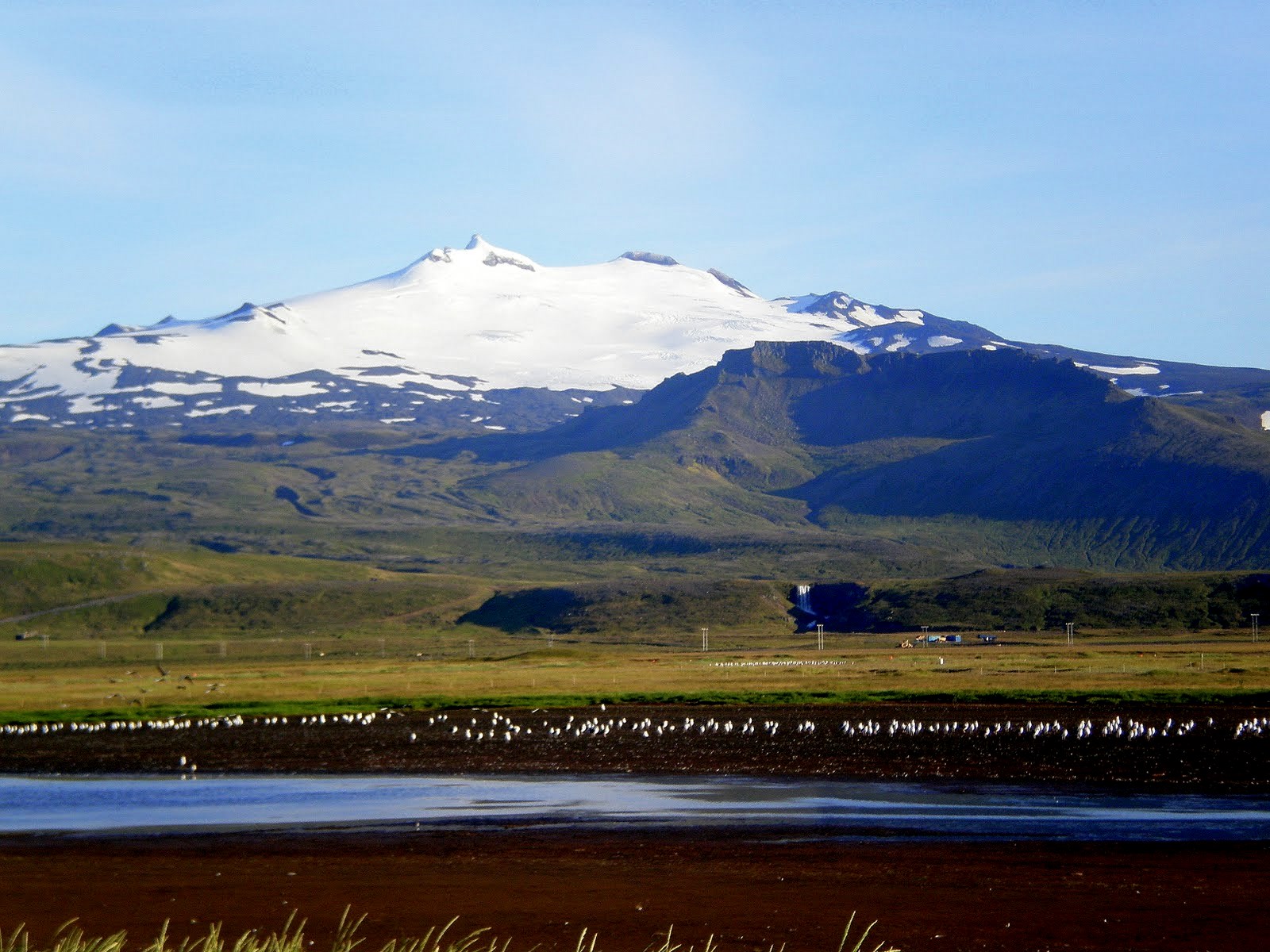
Iceland's Snæfellsjökull, still haunting my dreams since we saw it loom so large in fair if cold weather, is your ultimate powerful fictional backdrop. I'm sure it must have produced more novels than the two I've come across, as recommended by Hilary Finch: a disposable but human detective story by Yrsa Sigurðardóttir, My Soul to Take, and an undisputable mini-masterpiece, Nobel Prize winner Halldór Laxness's Under the Glacier.

How to describe Laxness's metaphysical comedy? Susan Sontag does a better job of it than I can in the introduction to the Vintage edition, laying out categories of novel that defy the 'artificial norm' of 'so-called real life' - 'Science fiction. Tale, fable, allegory. Philosophical novel. Dream novel. Visionary novel. Literature of fantasy. Wisdom lit. Spoof. Sexual turn-on' - before adding that Under the Glacier (in Icelandic the title is the less sellable 'Religion Under the Glacier') is the only novel she knows which fits into all those categories.


There's a church, of course, but unlike the beautifully kept one at Hellnar, it's been boarded up and a new home owned by a mysterious magnate who only appears past the novel's halfway mark has been jammed right up against it. The protagonist, emissary of the Bishop of Reykjavik who abbreviates himself 'Embi'and starts out, in Sontag's words, as 'the generic Naive Young Man', has to investigate a pastor who seems to have given up his religious duties to fix Primus stoves, a mysterious absent wife called Ua - the noise, the 'resurrected' woman later tells us, eider ducks make - as well as a casket and a possible corpse up on the glacier, which every local acknowledges to be the centre of the universe.


From mordantly witty 'reporting', the novel unfolds to include all sorts of weird interviewees and New Agers - even in 1968, it seems, hippies were finding their way to Snæfellsjökull in search of spiritual enlightenment - within a dissolution of time and space which, Sontag rightly points out, allies it with Ibsen's more supernatural works and Strindberg's A Dream Play. I love its musical refrains: the wry references to Verne's Journey to the Centre of the Earth, the local poet's ode to Palisander wood, the mittens Ua knits for Peruvian fishermen, the shrunken-head ritual - well, that will give you enough of a taste of how weird it all is. But I can't convey the style, which seems to me brilliantly rendered by none other than Magnus Magnusson.


Sigurðardóttir - or rather plain 'Yrsa' as I should call her in Icelandic form - is surprisingly reluctant in her often nailbiting thriller, or perhaps unable, to convey much of a sense of place, beyond the first murder on a foggy basalt beach. One thing I do know: the above cover is completely wrong, since the action, apart from the creepy prologue, takes place in June, in other words in a capricious Icelandic early summer; no snow, despite the elegiac gravestone disquisitions.


Yrsa does have a warm and witty way with characters, and it's refreshing to have an amiable, slightly prudish and only mildly dysfunctional heroine with a level-headed boyfriend. And here the swipes at new spiritualism are unequivocally incredulous. Was there an implied point-scoring against the slightly alternative hotel at Hellnar which was fully booked when we tried to get a room? Hilary thinks possibly so. On, now, to the Auden/MacNeice Letters from Iceland, which I bought in a handsome first edition for the diplo-mate's birthday: perfect late night reading-aloud material. Then a pile of other Laxnesses, which I've ordered up.

Quick church walk report, before I eventually get round to downloading the pictures and writing it up: 16 churches and 19 miles covered on Saturday in humid, windy and intermittently sunny weather, with a spectacular sunset to round it off. More anon.

Tuesday, 23 August 2011

Journey to the centre of Snæfellsnes


One of the many things Jules Verne forgot to mention about Iceland in his really not that great Journey to the Centre of the Earth, which properly begins there in a land he never visited, is that there's a spectacular glacier on the top of the dormant (not extinct, please note) Snæfell volcano. And nothing in his novella, which can't make up its mind whether to mangle geological facts or go all-out for fantasy (I wish he had - the underground sky and sea are the most imaginatively described things in the book), can touch the wonders of this extraordinary country as we experienced it in mostly clear, coldish and always sharp-focused weather.

It might have been the sunlight and the relative ease of access, but I couldn't find it in myself to fear these powers of nature or use the terms 'horrid', 'dire', terrifying' - awesome it all certainly is. And I really don't know where to begin. The motivation for visiting a country I've always wanted to see in the summer was the little weekend jamboree in Reykjavik centred around festivities in the spectacular new Harpa concert hall/arts centre, about which I'll be writing for The Arts Desk on Sunday.

As it was the diplo-mate's Big Birthday, I thought I'd treat him (and myself too, of course) to four days on and around the Snæfellsnes, the peninsula on the west coast north of Reykjavik which is supposed to have a little bit of everything in the geological makeup. Icelandomane Hilary - Hilla to her northern friends - Finch told me I'd chosen well over coffee in a Prom interval the week before last, and was delighted to give plenty of helpful tips.


We based ourselves in the beautifully located harbour of Stykkishólmur, the furthest point north in the top right hand corner of the map. That and its archipelago are going to need an entry to themselves. Otherwise I just couldn't decide where to start and stop today. So, reluctantly passing over our bracing journey in the hire-car from Keflavik airport, I'll confine myself to the momentous 11 hours - making use of a sun that didn't set until after 10pm - we spent driving and walking around Snæfellsnes.


First stop was a lavafield with flora and mountain backdrops very much its own, the 4000 year old Berserkjahraun named after the path through it forged by two doughty warriors of that name. These lavafields look alarming at first, and you could describe them as old stony bones covered in mould, which essentially is what the moss is. But look closer and all manner of flowers grow on them and in the cracks. That, I reckon, is going to have to be a separate entry too, once I get to identify which plant/flower is which.


The road goes west across the water and mountains of the Kolgrafarfjordur


before hitting the first settlement after Stykkisholmur, Grundarfjordur, an 18th century commercial centre monopolised by the Danes. A good place to base oneself, I reckon, with all the waterfalls around it


and the shape of Kirkjufell, dominating the harbour and rising to 469 metres, across the water.


You catch a first, heart-in-mouth sight of Snæfellsjökull as the road bends to descend towards Olafvik.


We turned off before the village to take (with great care and speed of 5mph, I hasten to add) the track up towards the eastern side of the glacier. Parked where the moraine looked grimmest, the winds keenest and the view along the south coast first apparent and then trekked upwards as far as we could go before the glacier takes over (even with full mountaineering gear you're advised not to go on it, though apparently there are moon-vehicles that do, occasionally). Occasionally we caught sight of the two 'horns' which from certain angles crown the cone with devilry, but mist and cloud swirling against the blue kept disappearing them.


Up here, you'd expect the colours to be lava/basalt black, but the lichen is still with us and the range of tufas stupendous (I won't pretend, as Verne does, that I know what I'm talking about, but I'm taking up volcano studies with the expert who's set up the handsome little Eldfjallasafn Volcano Museum in Stykkisholmur, Haraldur Sigurðsson).


The track then winds down past Stapafell to the south coast.


I guess we should have driven down to the curious harbour of Arnarstapi, but we had several objectives for late-afternoon walking so we pressed on, first to the long-defunct fishing village of Hellnar with its excellent visitors' centre run by a very helpful warden and its tiny church which forms such a homely foreground both to Snæfellsjökull


and to pointy-headed Stapafell, which rises to a mere 521 metres (compared to the summit of the big 'un at 1446).


Dates on the tombstones in the graveyard make it clear that the fishermen and their wives tended to live to grand old ages - most died aged 90 plus.

Snæfellsnes's green and peaceful coastline, shining in a relatively warm August sun, put me in mind of Cornwall's West Penwith peninsula, round which of course we walked on our long-term coastal trek; but then you look inland and there's the volcano.


The rock formations here, too, are not dissimilar to Cornwall's granite outcrops, but again on a bigger scale. We carried out our desired expedition to the Londrangar rock pillars, the tallest of which rise to 75 metres.


The description on the edge of my big map tells me that 'these are remnants of a long-vanished volcano: eruption vents filled up with volcanic material, which formed a hard "plug". The plug, of much harder rock than the surrounding volcano, remains as a pillar when the rest of the volcano has been eroded away.'

Well, we really did feel like we were in Cornwall, taking half an hour's kip on the grassy cliffs before retracing our steps. Back in the car, missed the turning to the harbour of Dritvik and found we'd got further round the coast road than expected, so instead of driving back to Buðir, we pressed on. The wide open spaces of the far west made it feel like an American road movie. And Snæfellsjökull kept revealing its different faces - from Kothraun


and from the bird-rich wetlands around the glacier-water plant at Rif.


So, at 9pm, it was back to base for sunset over the harbour and the best fresh haddock I've ever tasted. And now, heck, I must get back to a mountain of work. Next blogstop: Stykissholmur.