Showing posts with label Westminster Abbey. Show all posts

Sunday, 18 February 2018

Beulah: perfection of the life, and of the work


It may have been the best funeral I've ever been to, and if that sounds weird, my dear friend and opera course student of 20 years, Dame Beulah Bewley, had planned that it should be so before dementia took over. I always loved visiting her and Thomas, her totally devoted psychiatrist husband of 62 years (they were essentially together for 65), in their Grosvenor Gardens Mews home (oh, those bookshelves, and Thomas's collection of Irish masters). His favourite photograph of her hung on the bedroom wall and presumably has pride of place in the Wimbledon care home to which they moved, and where he still lives.


On the first occasion when the illness was some way advanced - Beulah had already survived multiple heart attacks - she described J and I as 'the musical side of the family,' which made us feel very honoured (we get on so well with the four surviving 'children', Susan, Louisa, Henry and Emma; Sarah, who was born with Down's Syndrome and a congenital heart syndrome, lived contrary to all expectations to the age of 44). On the last visit, I arrived after J to find Beulah sleeping, as she did increasingly, but she woke up, gave me the most beautiful smile and hug before turning to look at J and say 'you've lost weight' (which he markedly had). Those were the only words on that visit, but they made it all worthwhile; as it always was anyway, seeing Thomas and her sitting together.


Susan took a great many recordings of her mother talking about her remarkable life, which became this finely edited, proofed and presented book. I finally read it in its entirety in the week of the funeral. 'My Life as a Woman and Doctor' is apt, since I don't know anyone who has ever kept a more remarkable balance between life and work. I can hear Beulah's voice - direct, warm but unsentimental, wry and surprisingly flinty at times - in every sentence.

She describes her comfortable upbringing both sides of the Irish border, her determination to become a doctor from the age of five - an uncle who told her 'dentistry would be more suitable for a nice young girl like you' gets very short shrift - her studies at Trinity College Dublin, the early days from which the below photo in their home within Tooting Bec Hospital was taken, balancing part-time work in pediatrics and family planning (in which she was something of a pioneer, later finding her sensible views on abortion echoed in David Steel's pioneering bill*) before academic retraining in research into public health (starting with a major study in smoking among schoolchildren). She was made a Dame in 2000 for her services to women doctors, explaining the possible reasons with typical directness.


I personally treasure the friendship of Beulah and Thomas especially because they were among the few people I wanted to go out and have supper with at the time of my depressive illness (and they asked us a lot). There was never any pressure to 'perform', even if they also invited guests I didn't know, because boy, could they talk - usually at the same time. They also came to various events including our civil partnership lunch party - the below photo I don't have in electronic form, so it will have to do with the rather odd bleaching effect from the flash -


and to hear J singing. It was after a splendid concert to celebrate the work of 'Ireland's Minstrel', Thomas Moore, that Beulah decided she wanted J to sing 'Believe me, if all those endearing young charms' at her funeral. So he did, very wonderfully though I say so myself, between Henry reading Yeats's 'The Lake Isle of Innisfree' and Emma giving the most evocative tribute.


I think we all admired Rev Ralph Godsall's sermon for reinforcing the 'woman and doctor' aspect, the sense of a life supremely well lived, and I'm grateful to him for referring to a memorable line and a half from Edith Sitwell's Eurydice:

                             Love is not changed by death,
And nothing is lost and all in the end is harvest.

Hannah, Beulah and Thomas's only grandchild, daughter of Susan and her partner Barbara, read Revelation 21: 1-7, and the professional choir sang superbly. I blush to say I didn't know either Tennyson's 'Crossing the Bar' - the poem he always wanted placed last in any collection of his work - or Parry's eloquent setting of it (one to set alongside the Songs of Farewell which are among the glories of a cappella choral writing).


Here's the only decent performance of it I could find on YouTube.


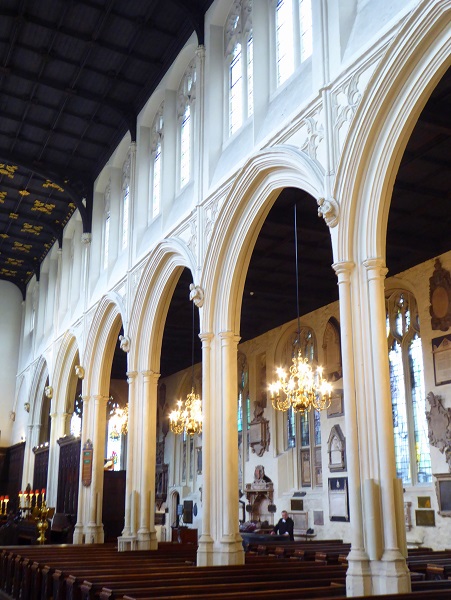
I felt that the music, including three of the hymns to which towards the end she could still sing along with, was like Beulah, too - unpretentious, seemingly simple but with a very singular lucidity. Despite a bitterly cold, wet day, St Margaret's Church also seemed so bright; I took this photo after the service more or less from where I'd been sitting.

At the refreshments in Church Hall, in addition to warm words with most of the family, I also saw a student I'd really liked who'd come along at good friend Beulah's behest, Kate Broadfoot, looking very stylish despite the fact that her legs won't do what she wants them to (at 87, she's like my mother, almost the same age, in that respect - indignant that her body isn't in as good a shape as her mind). I then had hours to spend in town before what turned out to be just the tonic, Iolanthe at ENO, so first I went to meditate, as I recently did very regularly, in Westminster Abbey's Chapel of St Faith, taking a look on a circuitous way out at the tomb of Mary Queen of Scots (this is the only shot I snuck in before I realised I wasn't supposed to, honest),


and then walking across St James's Park, where the pelicans didn't seem to mind a cormorant (or seagulls) sharing their rock,


to the National Gallery, which has a marvellous free exhibition of Degas pastels and drawings from the Burrell Collection, not all of which I'd seen up there - though 'Jockeys in the Rain' is still a highlight for me, such a singular composition -


and on to tea at Maison Bertaux, a rare treat these days (it's very pricey, but Michele - only just found out it's only one 'l' - keeps it as it always was). And there I read a substantial amount of the wonderful autobiography, which I finished this morning. Susan now has her work cut out piecing together Thomas's memoirs.


*I modified this sentence slightly following Susan's comment thus: 'I think her views were probably formed well before 1967. As part of my own thinking about this as an Obstetrician/Gynaecologist, I remember the stories she told me as a medical student seeing a woman die of septic illegal abortion, and knowing that the safer option for rich women was to come over to the UK if they got pregnant even in 1940s/50s.'

Thursday, 15 February 2018

Lights in the dark, cold and wet


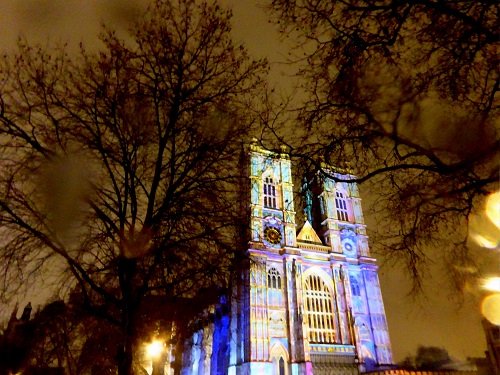
Lumiere came to London for a second time to brighten a January weekend, and though what I saw only had a couple of highlights to equal the more widespread success of 2016, I'm glad I made it out on a beastly Sunday evening to see them. Westminster Abbey was again the classy zenith, with another contribution from Patrice Warriner lighting up new aspects. Then it was the 20th century saints above the west door; this time their surroundings, in a constantly shifting light-show,


and the triple north porch, a very convincing Gothic pastiche by Giles Gilbert Scott.


Possibly the best view of Hawksmoor's west facade is coming from St James's tube, and crossing the road which leads to Victoria,


though fine details without a zoom were best seen from standing right in front of the towers,


and there was another good viewpoint further away, between London planes, from the terrace of the QEII Centre.


Scott's door, completed after his death by his son, has all the right Gothic ingredients for the same sort of illumination that 'painted' the west end saints.


Over the main entrance are figures carved by Messrs Farmer and Brindley. Christ in Majesty blessing the Church and the World is surrounded by angels.


Below them are seated figures of the Apostles and underneath are figures in procession which represent the science and the arts alongside the royal builders of the Abbey. On the central pillar the Blessed Virgin Mary holds the Crowned Christ in her arms.


The pillars to the side are fine, too.


The rain stopped as I walked up a (nothing doing) Whitehall. The illuminated balloons by Collectif Coin in Trafalgar Square would have been fine without the soundtrack - a problem of quite a few installations; less son, more lumière, please.


It was quiet in St James's Square, though well peopled as I walked through the centre admiring the multihued cords hung from tree to tree - Spectral by Polish artists Katarzyna Malejka & Joachim Sługocki.


I'm glad I walked through the passage of St James Piccadilly to reach the thoroughfare, because I had forgotten that Arabella Dorman had followed up her first response to the humanitarian refugee crisis, Flight, with a second, Suspended - a harrowing explosion (I think she called it a bomb) made out of hundreds of items of clothing discarded by refugees arriving on the beaches of Lesbos.


It hangs like our bad conscience above the heads of the congregation. How could one not be moved by this, especially by such details as the bib with 'My 1st Christmas Ever!' on it. 


Some Christmas that would have been. Sadly the installation has now been taken down, having run its due time, but St James is such an impressive institution for commissioning work like this.

Here seems as good a place as any to put up some long-withheld pictures of another striking illumination, from a year back (there was another before Xmas, but we didn't make it).


I came across the Chinese-lantern illumination of Chiswick Park and House by chance, on one of my regular cycle rides down there via the riverside. There was an admission charge to the display proper, but the tree-lined avenue was free and had some pretty blooms along the way like this one behind snowdrops,


and this,


as well as an even more impressive gateway the other end.


I walked back, wheeling my bike, and snuck into the garden in front of the greenhouses which accommodate a major camellia collection.


The sounds of the distant fun-ground blended with the chatter of multiple blackbirds at sunset.


The illuminations made a fine foreground to the Palladian villa


and created another, forbidden-city palace to rival it.


As the last of the natural light began to fade, I walked back, catching a reflection in the greenhouse window


and one more general vista.

Saturday, 15 April 2017

Easter interstitial


So here we are still in London, and not in Norfolk as planned - J has a cold. No matter; it's good to be at home after a week of rushing around Europe. And I always love the reflective period before Easter itself. Very happy, in looking for images to accompany my review of the Dvořák Requiem on Thursday, to have rediscovered a masterpiece which stunned me when we spent Christmas in Prague back in 1990, the altarpiece from the Vyšší Brod Monastery. My Czech friend Jan reminded me of it in sending a postcard of the above, taken from the depiction of Christ in the garden of Gethsemane.


The mourners at the cross are expressive, too.


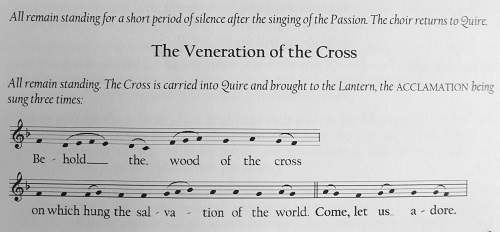
We spent an hour and a half of contemplation on that theme yesterday afternoon in Westminster Abbey. Our dear Spanish friend María Jesús wanted to meet up, and though I fear we let her in for a longer ritual than any of us had expected, I hope she found it a treat. Anyway, we did get to chat over tea afterwards. That's Giotto's great crucifixion on the order of service cover, of course.


Certainly it was surprising to find that the congregation queueing and then packed in around the central tower didn't consist of casual tourists, but a plethora of believers (among which I do not count myself, however much I take from the Passion narrative). Indeed, the number of folk wanting to venerate the cross meant the whole service took much longer than expected (the Communion was more streamlined, with priests serving both aisles). Never come across this business before - nor has J, with his Catholic upbringing - and found it all a bit mumbo-jumbo-y, but then I guess so are the rituals which I've grown up with since I was a choirboy, and I say the Creed without a second thought.


The order of service cannily embraced a diversity of styles and nations - plainsong, Lutheran and Anglican hymns, and composers Spanish (Victoria - the central St John Passion, in which 'composition' is not much present, but it was splendidly delivered by two tenors, bass and choir), Italian (Lotti) and Austrian (Bruckner). Much as I love anthems like Locus iste, which we sang at Stephen Johnson's and Kate Jones's wedding, I blush to say I didn't know the latter's Christus factus est, and it's a masterpiece, covering so much of the composer's mature style in such a short span. The Westminster Abbey Choir sang it with magnificent fervour in the climaxes. Here it is performed by, of all things, a Japanese high school choir, and very well, though you need to look away from the gurning individual among the boy-men...


Some of the details in John 18 and 19 took me by surprise. Hadn't realised, for instance, that Pontius Pilate did what he could to avert the sacrifice. And this I love: 'When Jesus saw his mother and the disciple whom he loved standing beside her, he said to his mother: "Woman, here is your son." Then he said to the disciple: "Here is your mother". And from that hour the disciple took her into his own home.'

On which note, there's a marvellous poem on the Stabat Mater theme by Joseph Brodsky in his Nature morte. I came across it as the third of Estonian-based, Ukrainian-born composer Galina Grigorjeva's settings gathered together under the same name. It was high time I listened to the disc by the Estonian Philharmonic Chamber Choir which had been sitting here for too long. Grigorjeva calls the poem 'Who are you,' and here it is.

Mary now speaks to Christ:
'Are you my son? - or God?
You are nailed to the cross.
Where lies my homeward road?

'Can I pass through my gate
not having understood:
Are you dead? - or alive?
Are you my son? - or God?'

Christ speaks to her in turn:

'Whether dead or alive,
woman, it's all the same - 
son or God, I am thine.'

Alas, this setting isn't available on YouTube, but there's a marvellous film there which includes the second setting, 'The Butterfly,' remarkable especially for capturing Grigorjeva's spirit as she talks to the choir about it. I'm waiting for her score of the new and remarkable Vespers I heard premiered in the Niguliste (Church-)Museum last week by the stupendous Vox Clamantis choir. She sent me a very polite email saying she couldn't send it or hand it over just yet because she'd noticed some mistakes. A composer of obvious and rare integrity.


Finally, a few more seasonal flora shots from the cycle home after the service yesterday - tulips in the meadow arrangement in front of Clarence House


and wisteria backed by white lilac - both out already - in Launceston Place, the magical street which runs parallel to Gloucester Road.


Sunday, 31 January 2016

High lights in the West End


Highlights, too, of Lumiere London 2016 (reported over on The Arts Desk, but with photos by others), one of Cédric Le Borgne's Les Voyageurs flying high above St James's Square, and the jellyfish by Janet Echelman called 1.8 London floating over Oxford Circus.


The palm for the light spectacular, at least monumentally speaking, has to go to Patrice Warrener's The Light of the Spirit on the west front of Westminster Abbey.


With 31 installations shared between Mayfair, the West End and Kings Cross, the experience was bound to be hit and miss. Our own trail on the Friday night took some time to yield wonders - proceeding from Lumiere's VIP HQ, we hit the light fantastic at Keyframes figures climbing up a Regent Street facade. Good to see the thoroughfare closed to traffic, but was there enough going on here? 1.8 London looked nothing from a distance - I was to find out how wrong that impression proved on Sunday evening - and there were modest pickings around Carnaby Street. J told me Elephantastic worked better on a bridge in Durham than it did above the arch near the Regent Street curve.


Then, however, we hit Porté par le vent's barrage-balloon fish Les Luminéoles swimming above Piccadilly like some sort of phantasmagorical celebration of Chinese New Year. Kids gaped in wonderment and so did we - this time the pedestrianisation proved a triumph. Shame about the blaring Harry Potteresque music.


Having taken an unimpressed look at NOVAK's 195 Piccadilly, we followed the Voyageurs trail from St James Piccadilly


downwards to the Square I hardly ever walk through (not a member of the now-exorbitant London Library, you can tell). A cold, clear night with a half moon gave the figures a goal to reach


and I also wondered if the buildings were normally illuminated as well as this. Certainly the Theatre Royal Haymarket glowed in its rightful perspective from one of the Square's exits. Trafalgar Square was underwhelming, Centre Point's neon sign taken down and squatting in front of the National Gallery, but Leicester Square's garishness was well served, as I've already pointed out in an earlier blog entry, by TILT's Garden of Light.


No harm in reproducing the giant ?peony? blooms again, this time by flashlight.


That was our early evening stroll done before going up to supper in Primrose Hill. The couch potato would not acquire legs for a Sunday evening attempt to catch up on the rest, but I was glad I went, and phoned from Westminster Abbey to say he had to come and see this.


For the first time I looked properly at the 'martyrs' placed in the previously empty niches above the west door back in 1998.


They are, left to right, Maximilian Kolbe, Manche Masemola, Janani Luwum, Grand Duchess Elizabeth of Russia, Martin Luther King, Óscar Romero, Dietrich Bonhoeffer, Esther John, Lucian Tapiedi, and Wang Zhiming.

Nice, also, to bump into three people I knew, have the admiration compounded and be told what was worth seeing of the rest.


I took the Victoria Line up to Kings Cross, where a whole procession of lightshows was to be seen on the walkway up to Central St Martins, but there was such a static queue in the tube tunnel that I turned turtle and took the southbound train to Oxford Circus. Which turned out to be the right thing to do, since 1.8 London proved a wonder close up.


Green-jacketed stewards were yelling through megaphones that no-one should stop on the pavements - a reasonable enough request, as it turned out, since you could do what you liked in the roads and on the Circus itself.


I thought the Grosvenor Square zone would be less crowded than the rest. I was wrong, so I did a quick whizz around the neon birdboxes of Sarah Blood's Sanctuary and avoided the throng in the Square itself, which was fine since Ron Haselden's Brothers and Sisters could be seen perfectly well from the other side of the railings outside the American Embassy.


And in a last bout of mad indulgence, I let myself get hemmed in by the crowd pressing forward to see Aquarium in a phone box by Benedetto Bufaino and Benoit Deseille. Very good-natured it all was, with children refusing to believe there were real fish in the booth until they got closer, and one Scouser on his mobile phone saying 'I don't know exactly where I am, but I'm standing near a phone box with fish in it'.


So I squeezed along and got a close-up glimpse before taking the No. 10 bus home. And that's not quite the end of it, because there will be a Lumierisation of the Guildhall on Shakespeare's birthday.