Showing posts with label Zurich. Show all posts
Monday, 21 April 2014
Zurich Opera: mixed hand
It was a happy coincidence that ever-stylish director/designer Robert Carsen's new production of Tchaikovsky's Pikovaya Dama happened to be running at our old haunt the Zurich Opera following on from the not-too-hard-work Basel stint of my latest Swiss trip (which you can read all about over on The Arts Desk - though I have more to add on the city and the dreamlike Fondation Beyeler). Andrea Chénier was an optional extra, one to tick off as I've not seen it on stage before. Trouble is, it put me off Giordano's very sub-sub Puccini manner so badly that I probably won't want to see even Jonas Kaufmann in the title role this coming Royal Opera season.
Both evenings offered outstanding and not so good in equal measure. Carsen's concept was very austere and a little hard-worked in its insistence on keeping the whole thing green, black and white in entirely indoor settings. It's also the first Queen of Spades I've seen to shed some of the dramatically peripheral but musically accomplished Imperial padding - not least the opening chorus with the delightful post-Carmen boys'-army routine and the long divertissement of the faithful shepherdess which Richard Jones made work so brilliantly as sinister puppet-show in his Welsh National Opera production.
We see the final tableau at the start, as if it were inevitable fate (all Queen of Spades images by Monika Rittershaus) - the same happened on Saturday in Yoshi Oida's also very mixed Lyon Opera production of Peter Grimes - and Carsen exchanges a sunny day overshadowed by storm in St Petersburg's Summer Gardens for the gambling tables. The stage is cleared for Lisa's bedroom - the ladies simply take off their shoes and frolic in petticoats - while the Countess's chamber has an enormous green bed and a dressing table, though this crucial scene lacked most of its tension given Doris Soffel's still too-young and anything but pathos-filled Countess. Perhaps the point was that Hermann woos the older woman in the same key as he does her ward, and sometimes confuses the two.
Best was the funeral/barracks sequel: the variable Zurich Chorus, overworked at present, sounded magnificent and mysterious with their backs to the audience, while Hermann wheels the Countess's coffin forward for the conflict with the ghost.
We drew the wrong card with our Hermann, it seems. Misha Didyk had been off sick, replaced at first by the vocally resplendent Latvian heroic tenor Aleksandrs Antonenko (one of the best Otellos I've heard, if not seen). But Didyk, it seems, insisted on coming back for several performances, and so we got a tenor who certainly couldn't act and who was so vocally in trouble that he didn't even try some of the top notes. Lucky I worked this out and checked, because there was nothing in the programme to suggest we weren't getting Antonenko.
Forcibly raising Didyk's game in the 'canal scene' was Tatiana Monogarova's Lisa. A wonderful, truthful and heart-rending actress, she's one soprano size too small for this treacherous role, but went for bust in the aria and duet, making both the most lacerating I've ever witnessed on stage. There were a typically stiff, vocally secure Yeletsky from Brian Mulligan, and an excellent Tomsky from Alexey Markov, secure and vivid throughout the range. Good though it was to see Jiří Bělohlávek in action again, he got variable results from the resident Philharmonia Zurich, not up to scratch in brass and wind departments; some scenes burned, others seemed too middle-of-the-road. Happy to have seen it again, as if I needed reminding of Tchaikovsky's genius in every sphere of the extended drama.
Genius Giordano was not: I'm amazed Andréa Chenier and the even tawdrier Fedora remain in the rep, but I suppose it's a singers' market. Well, the composer got the vulgarity he deserved from the revived production of Zurich regular Grischa Asagaroff, whose Cav and Pag I saw here back in 2009: very conventional direction in a would-be-regie casing, hideously designed by Reinhard von der Thannen (production image by Suzanne Schwiertz).
As far as I'm concerned, there are only two things worth reviving about the score: heroine Maddalena's 'La mamma morta', immortalised not only by Callas's stunning recording but also by how Tom Hanks reacts to it in the film Philadelphia, and the final duet as she and poet Chénier go to the guillotine. Without a doubt we had a touch of the Corellis from Korean tenor Yonghoon Lee, who makes an amazingly idiomatic heavyweight-Italian-tenor sound even if it wasn't a pretty sight to watch him brace for the high notes. I've not seen so total a stand-and-deliver performance ever before: Didyk looked like Olivier compared to this.
But then, ah, then there was the sublime Martina Serafin, whose Marschallin in Vienna had seemed Crespin-worthy to me some years back. Such bearing, such handsomeness, and more colour in the middle range than I think I've ever heard from any other soprano. I kick myself for missing her Tosca at Covent Garden but hope we'll see more of her in the great Verdi and Puccini roles, for only the slightly lighter Harteros is a match for her in such Italian repertoire. Alas, there are no production images of the revival, so I've stuck to portrait shots.
The rest was good to poor: a stalwart Gérard from Lucio Gallo, no-one else really able to make anything out of the excessive number of characterless smaller parts, and veteran (85 year old) Nello Santi in the pit, conducting with expected style but perhaps not able to hear too well since the orchestra was relentlessly loud. Anyway, we certainly had our share of A grade stars in those two performances, so that's one respect in which respect I feel blessed.
Friday, 3 September 2010
Protestant Zurich, Catholic Lucerne


The Swiss, don't you know (I didn't until recently), are a lot more interesting than The Third Man's cuckoo-clock jibe would have us believe. As Jan Morris, whose Europe: An Intimate Journey accompanied me along with Ulysses on our little rest-cure, puts it, his fellow officers in 1945 would have welcomed the comment. It came, of course, four years later. For them, though, it would have expressed perfectly 'the sour judgment of a battle-scarred, impoverished imperial kingdom of epic suffering and performance upon an comfortable, well-heeled, chocolatey republic which hadn't done a damned thing to save civilization as we know it.'
Morris's own view doesn't stretch to the more recently uncovered extent of Switzerland's compromises in the First and Second World Wars, compromises which seem to have sprung all too easily from the ambiguous nature of its safe-haven status. The recent minaret debacle has done nothing to endear Switzerland to the rest of Europe. But in the long term, I think I share Morris's fundamental stance:
The Swiss are the one people who have given dignity to the idea of the Nation-State by turning it into a State of Nations, to my mind a model for us all. They have not compromised either their Statehood or their nationhoods. Their four languages [French, German-ish, Italian, Romansh] remain more or less unviolate, but in all their autonomous cantons the Swiss are the Swiss.
Having spent time in the Valais and central Switzerland in close succession this summer, I can appreciate a few of the differences (though we still need to go walking in the Romansh valleys further south-east). I also find it intriguing that after quite a few nasty conflicts, the more powerful Protestant cities established a modus vivendi with the Catholics, holding the fragile Nation-State together. After 1874, in fact, it was race rather than religion which threatened to tear things apart.
The gulf hadn't occurred to me until I spent more time in several different churches in democratic Zurich and patrician (but Habsburg-resistant) Lucerne. St Peter's (first picture up top) dates from the 13th century and its 16th century clock face is the largest in Europe, overlooking a very pretty square

but the greater part of the interior was remodelled in 1705. You can just about see the Hebrew lettering above the gospel text, 'legacy of the Reformers' desire to reclaim the fundamental sources of Christianity' as my guidebook says.And the plasterwork is very lovely. Then you find yourself in a Romanesque choir with some rather attractive wall painting.

Along with the equally light and airy Predigerkirche, it's my favourite of the Zurich churches. The Grossmunster and Fraumunster have distinctive towers/spires to grace the wonderful skyline, and famous glass (I prefer the Giacomettis to the Chagalls, at least closer to) but rather gloomy interiors.
Lucerne's three big churches all have their glories. You may remember from an earlier entry that I visited the Hofkirche just before Easter. This time I managed to catch up with the other two. The Jesuit effect (second picture up top, 1673) could be predicted from the big 'uns in Rome and a regular haunt in Vienna. That extravagance lines the Reuss

and its neighbour is very different, the Italianate Renaissance Rittersche Palace, still the seat of the cantonal government

while the bigger and older number, the Franziskanerkirche, has its own grounds - formerly those of a large 13th century monastery - tucked away behind the Jesuitenkirche. It's much more of a jumble of styles, all intriguing.

Flags were painted on the nave walls in 1625 after the original battle-snatched standards had been removed. The painted images were twice restored, at the ends of the 19th and 20th centuries.

The outlandish mannerist pulpit is by Niklaus Geisler of Schweinfurt and dates from 1628.

A final flourish comes from the late 17th century plasterwork angels of the north chapels.

It was an exhilarating if exhausting afternoon, temperatures rising fast: the grey, humid pall hanging over the start of the holiday had lifted by noon as the four-day heatwave began. So we found it a bit of a sweat doing the circuit of the town walls

but worth it for the views over city (including the KKL, home to our stupendous Lucerne Festival Orchestra/Abbado experiences) and lake from the top of the Schirmerturm.

Labels:
Franziskanerkirche,
Jan Morris,
Jesuitenkirche,
Lucerne,
Switzerland,
Zurich
Monday, 30 August 2010
Sisters of the Villa Wesendonck
It's not so much the building, constructed in 1857 by Leonhard Zeugheer along the exact lines of the Villa Albani in Rome for Otto and Mathilde Wesendonck, as the so-called Rietpark of the Villa Wesendonck in Zurich's Enge district which I love so much. The Wagner connection, of course, is inescapable - he worked on Tristan in a now-defunct building on the other side of the cobbled street which leads up and over the hill, down to the Zurichsee on one side and the residential district where Lottie and our goddaughters now reside on the other.
But I've written about that before, and all I need to reiterate here is that the park has proved the perfect summer retreat over two years for reading, writing, napping or just enjoying the excellent produce of the Rietberg Ethnographical Museum's cafe at various tables dotted around under the old trees.
The neoclassical fancies and Pompeiian reds have been freshened up a bit in the latest stage of restoration. But I'm still not sure what to make of the building. It's one of many luxury villas dotted around Enge, and their greenery can accompany you all the way down the hill to the lake if you walk through the Rietpark
and across the road to the grounds of the Villa Belvedere. Then you can manage it so that you reach the Sukkulentenhaus by the lake, another of my favourite Zurich sites with its phenomenal collection of cacti and its Madagasque centrepiece.
At the Belvedere, it's not so much the main building as the double-villas flanking the main entrance which prove of interest. Seestrasse 127/9 was constructed in 1895 by Hermann Stadler and Emil Usteri in the new-baroque style

and is remarkable chiefly for its ironwork.
Quite different is the huge block down the other side of the Rietberg, Zum Wolfsberg, built by Jakob Habler and Carl Schindler in 1910 as a living-space with workshops for the owner, lithographer Johann Edwin Wolfensberger. In 1911 he opened an art gallery here which was to display for the first time many works by Dix and Beckmann. The Jugendstil ornamentations to the rather severe facade are by Wilhelm Schwerzmann.
Clearly the wolves are a play on the proprietor's name, but what to make of the vulpine-headed nudes which adorn the main doorway?
Round the corner, the wolf-theme vanishes and the designs between windows vary from bees
to - what? Monkeys? Putti?
So much for uniformity in Zurich. It doesn't yield up all its secrets on a first visit, but the artistic hotchpotch continues to fascinate.
Sunday, 22 August 2010
Joyce meets Mahler


In my currently overheated imagination, that is. Despite failing the eminent Dr Senn in missing the James Joyce Centre of Zurich's weekly Thursday reading of Finnegans Wake and losing out on a repeat of last year's experience, I did finally kickstart my long-delayed second attempt to re-read Ulysses on the train to Lucerne, and haven't looked back since.
How little it meant to me on my first cavortings around European railways back in the early 1980s. I think I did read two-thirds, but without absorbing or understanding much - and retracing those steps now I wonder why on earth not. Anyway, the point here is that Joyce's cornucopia of reference, his sublime mix of the ordinary and the sublime, his easy snatches of popular song in amidst life-and-death reflections, all seemed to connect with the Mahler Ninth I was so privileged (again I use the only possible word) to hear Abbado conduct in Lucerne.
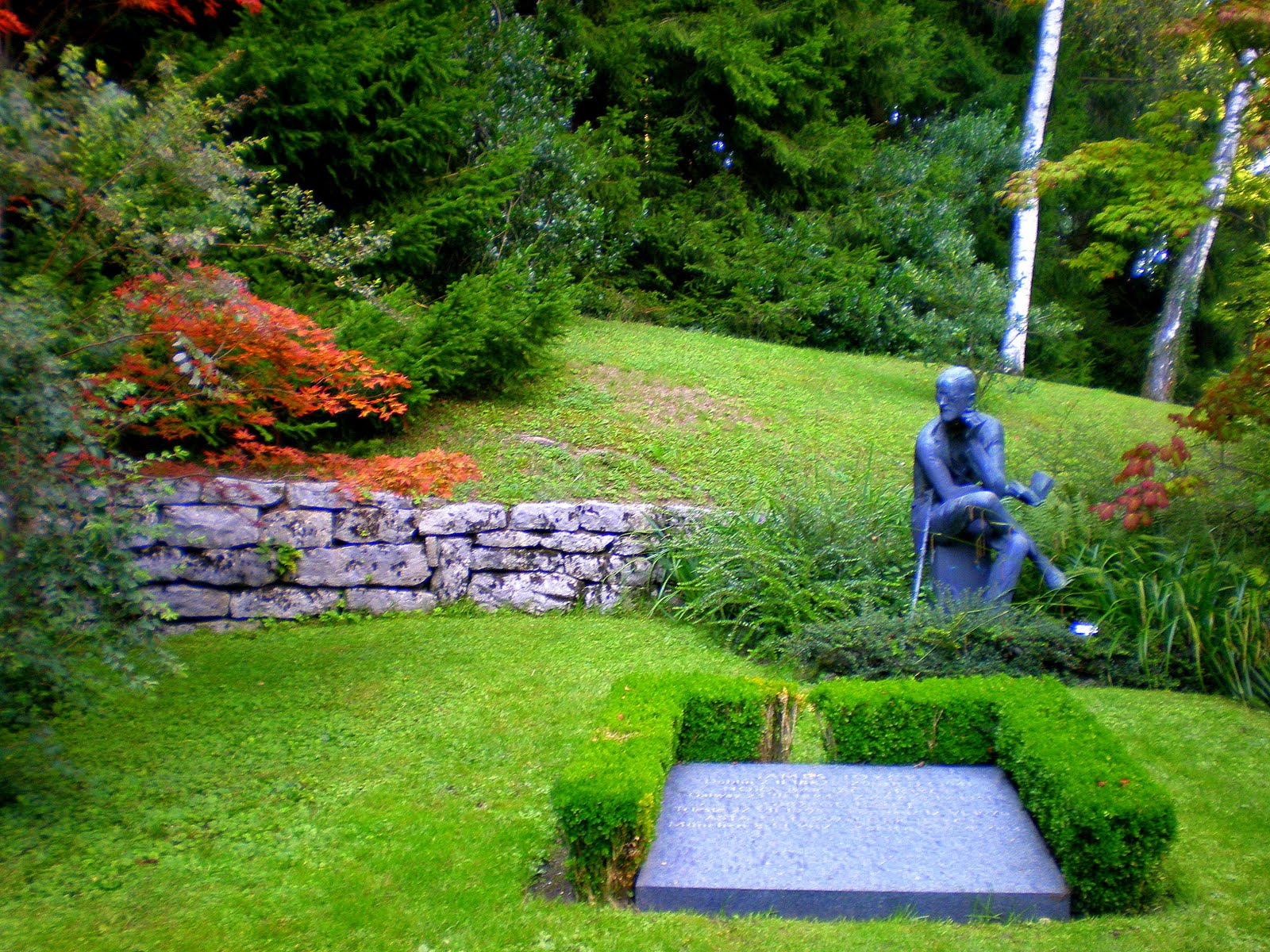
Still gathering my thoughts about that, but in the meantime, it's been an oddly connected time, filtered through our many reflections in the Rietberg Park of the Villa Wesendonck, now my most familiar numinous site in any city. Yesterday I braved the latest heatwave to make a pilgrimage from Enge to Fluntern and Joyce's grave. Again, the strands along the way seemed so diverse, so Joyce-Mahler and so contradictory of the order and uniformity which are supposed to reign in Zurich. A balafonist in the Saturday flea-market, a Siberian throat/overtone singer in the crypt of the Grossmunster - neither indigenous, both consummate - and a colourful, ululating protest favouring a united Kurdistan complete with Ocalan posters and national flags, crossing the bridge from the Fraumunster with police cars at either end revealed the city's multikulti side.
I was also out and about to complete my collection of Giacometti's breathtaking stained glass on both sides of the Limmat. Then I doffed my cap again as I walked up through the garden of the Thomas Mann residence and wove my way to the Zurichberg past psychiatric clinics, resthomes and grotesquely overornamented villas. The final haul took me through a field of sunflowers, the forest flanking Fluntern Cemetery, and a first glimpse of Joyce's statue through the fence.
Though seemingly all too close to the local hospitals like many of its kind, the cemetery actually has a less grim neighbour than most, the zoo, so the shouts of children and the continuation of other species resonate next door. The plots are a little over-ordered for my taste, but it made another nice symmetry with last year's hunt for the grave of Joseph Schmidt on the opposite hill. Not to mention Mahler's last resting place (pictured above) in Vienna's Grinzing, well away from the touristic heurigen.


I sat in the shade, replaced the fluids lost through excess perspiration with gallons of water and finally settled down to the 'Aeolus' chapter I'd just reached in Ulysses. And the hour or so's sweat uphill was offset by a straight number 5 tram ride all the way back to Enge. Mission accomplished.
Subscribe to:
Posts (Atom)