

We did very well without the fake snow and the weird filming at what was clearly the wrong time of year in the two slightly disappointing episodes following up the best of telly's classic series. Lacock in Wiltshire is the perfect fastness of our friends the Van der Beeks whose National Trust-owned home played host - most famously, in my life - to the diplo-mate's stupendous 50th birthday party. More people will know Lacock's ideal village as a suitable location for the Midlands setting of Elizabeth Gaskell's cosy women-rule-the-roost Cranford tales when they came to be adapted and interwoven by the Beeb (our hosts' residence, Cantax House, has also featured in the Harry Potter films, though don't ask me where as I've only ever half-watched one of them).
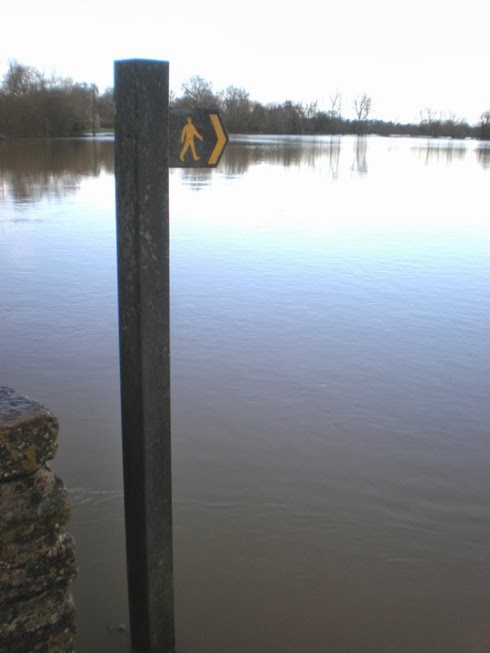
What we did have to negotiate on our Christmas Day walk was the fallout from the previous few days' floods. Fortunately there's been no building on the floodplain of the Avon and I understand the only badly affected house was an old mill. The water meadows did what they're supposed to do, looking quite a pretty sight both from Bowden Hill (up top) and as we approached Raybridge.

Down at the bridge pedestrians had the edge over cars, since the road was impassable. Not so the raised route for feet (and bicyles) only.

In the summer J and I went straight up the road, but Andrew led us on his preferred route along the banks of the local canal via a field that looks more northern France post-1914 than Wiltshire.

The Wilts and Berks Canal is a fascinating case of a disused waterway being brought back to life by active locals in recent decades.

It opened in 1810 to bring coal from south of Bath to the area, but with swift exhaustion of that resource fell into disuse and was abandoned in 1914, the final death-blow having been dealt by the collapse of an aqueduct 13 years earlier. Some of it still remains filled in, but our stretch was vigorously restored and includes the handsome Double Bridge (re)launched by Camilla, the canal trust's patron, in 2009.

Of course an ivy-covered ruin is more picturesque than this, but hopefully it will regain a weathered appearance within a few years. We were grateful for it, anyway, because a walker going in the opposite direction told us that the flooding meant we wouldn't be able to cross further up where Andrew had intended. We headed up a field with views of the rather ugly house in which Michael Tippett lived with Meirion Bowen for so many years. Half the field was in shade, and the night's frosts meant more pleasurable walking than the saturated ground we'd so far covered.

We crossed Nocketts Hill to Bowden Park, with views of Wyatt's 1796 house to our left and the floodplain below straight ahead. The high beeches on the top of the hill looked especially splendid in their skeletal outline.

Down to Bewley Court, and a wood full of birdsong (the mild winter so far means they're all out scrummaging), and then to the more famous of the two bridges near the Abbey, also closed to traffic. No walking across the meadows here for obvious reasons.


Sunset, and home to (eventually) a splendid goose

with sprouts and cavolo nero inter alia


to accompany.
Deborah's decorations were as original as you might expect from a true artist (scroll down this blog entry for shots of her exquisite bathroom muralling).

The hall collection of animal skulls was suitably feathered

or clementined, in which company our marzipan pig from the splendid new Swedish cafe Bagariet in Covent Garden seemed naturally at home.

The garden is still looking splendid in the dead of winter, especially as the mists began to burn away and steam rose from the bourne at 8.30 on Boxing Day morning.


The yew lady stands proud by the green castle.


Soon there was activity in the village which I hadn't bargained for - what else but the Boxing Day meet for the hunt.


My first experience of such a thing, and purely as pageantry it's handsome enough with the black and red ('pink'*) jackets, the horses' banded manes and tails and the occasional top-hatted, veiled, side-saddle dame. But investigate further and you unearth the social divide it represents.


They'll tell you that all sorts join the hunt, which of course under the ban means following a fake fox (or that's the idea). But the gulf became apparent when the Master of the Hunt exhorted us to give generously to the helpers' fund 'because we can't afford to pay them properly'. 'Rubbish', my now-lost-in-the-crowd companion tells me she shouted. And apparently there was a bit of aggression when one of the riders deliberately backed his horse into the group of erstwhile protesters.
Well, I don't like the idea of the fox torn to pieces, but I have to say there are far more important things to protest about. And the trouble with the more obsessive and violent objectors is that they care more about animals than human beings. On the other hand, the Countryside Alliance is made up mostly of self-interested conservatives. Never mind, it was fun to see, once at least.
Leaning against the wall of the great barn, it was warm in the sun. And the light was even more brilliant than on Christmas day, so J and I whiled away a pleasant hour around the (closed) Abbey.


We've visited several times, not least when my godson was six and gratifyingly identified a mortar and pestle as Baba-Yaga's flying machine in the Russian stories we'd been reading (still among his favourites). This time restricted to the walkways around the south and east facades, rounding the corner by the Renaissance tower of unscrupulous Sir William Sharington who bought the 13th century nunnery in 1540, a year after its dissolution.

The rather splendid oriel windows date from the time of the early 19th century Talbots, into whose family Sharington's niece had married (W H Fox Talbot famously pioneered the art of photography here). We sat on the bench beneath the biggest and basked in the sun.

After lunch, we were roused to join the family on a last walk close to dusk in a valley near Box.

Lichen on a beech stump contrasted with the fallen leaves of that fascinating-in-all-seasons tree.

An ascent brought us to a field of alpacas

and then on past a very fine group of farm buildings

to the park of a slightly sinister mock-Lacock Abbey (I didn't note the name), home to a charitable Lebanese foundation, with plenty of fine trees in its ground.


New Year we spent in the bosom of friends Jill, Susie and Michael back in North Norfolk. The weather was not, to put it mildly, amenable to any but the shortest walks this time, but apart from visits to more churches, including the extraordinary Binham Abbey which I need to cover here anon, we had one big compensation. As we were driving from Binham towards Hindringham on New Year's Eve, the pall lifted in the west for an unexpected sunset

and then to our left - a rainbow lit by the glow. Not just a strip, but a whole arch - and then a second: a full double rainbow.

I curse the fact that my camera battery needed recharging, but Jill and J rushed to get their iPads out of the boot, so these three treasurable pics courtesy of our valiant driver and Norfolk churches walks doyenne record the moment. Let it stand as a symbol at least of a really wonderful 2013, whatever this year has in store.

*see comments below for the reason why.


 Posts
Posts



