Tuesday, 18 October 2011

Depressive apocalypse


Anything Lars von Trier makes is worth seeing - anything (and I know, all that nonsense he spouted at Cannes, which is so crucifying to watch, led a lot people to turn their backs on him, and in a sense who can blame them?) I couldn't steel myself to see Antichrist, though one day I shall, and I can well believe those who say it's not as sensationalist in its horrors as others make it out to be. It was even a bit of a task to get to Melancholia, as I'll admit it rings true to the not so distant past, but I knew we had to go, and to see it on the big screen which, by and large, we've all but abandoned other than for special events in recent years.

Funny, that, how certain modes of being feel right at one time and not another. We used to make a regular Monday thing of it after my classes - tea in Bertaux, a film at the Curzon Soho (at least since the Metro and the Lumiere gave up the ghost), a Chinese meal afterwards in the New World. Maybe cinemas are noisier, less pleasurable to visit than they used to be; I know the Empire Leicester Square is a no-go zone because of the shattering volume which even destroyed our pleasure in The Incredibles and The Life Aquatic, which shows how far back we're talking. As for the audience, I'm kinda glad I wasn't there (J was) when our friend Hen challenged the chatterers throughout a Whiteley's screening of Malcolm X with 'shut the fuck up and you might learn something'. She would like you all to know that it worked.


But there were very few folk the last time I went to the commercial cinema, to see Of Gods and Men in Mayfair - our popcorning neighbours were soon stunned into silence - and even fewer at the Curzon Chelsea on Sunday evening. I was glad we saw both in the right circumstances. What to say about the extraordinary collision of two themes in Melancholia without regurgitating the little plot there is? Kirsten Dunst rings frighteningly true as Justine, a pretty girl first sinking into, then deeply sunk in, a depression that may or may not give her oracular knowledge of the impending world's end (Dunst admits to having been there, like von Trier; everything she does feels authentic). There's a second, pivotal contribution from the strange, mumbly but compelling Charlotte Gainsbourg (pictured up top with Dunst in the first of Christan Gesnaes' images). There are also good flanking performances, not least from the very lovely Alexander of the hugely talented Skarsgård tribe - I barely recognised Papa Stellan - as the new husband Justine apparently loves.


But it's von Trier's personal trajectory which amazes. Yes, the opening sequence is one of the most spellbinding in cinematic history; yes, the dysfunctional wedding does go on, but certainly every time the Tristan Prelude - the only music in the film other than incidental stuff at the reception - resurfaces, expect staggering imagery. Could von Trier have handled the Bayreuth Ring after all, or is his own imagination too big for other people's fantasies? It was a bit worrying, of course, that he snips bars out of Wagner here and there, not least for the denouement, where he leaps so quickly to the climax of all that unquenchable yearning that I laughed when I shouldn't (nervously? Not sure). But the music, and the sounds of near-silence, certainly add to the metaphysical dimension, and the concentration on this hermetically sealed world of the big house by the sea is harrowing.


Unique, unrepeatable, probably indescribable. I see in any case that I haven't made a good job, but I'm a bit wonky anyway from three and a half hours moving between the dentist's chair and waiting room as the poor woman tried to deaden an inflamed nerve to get a tooth out. I am, apparently, the most intractable case she's ever had, though at least she finally believed me that the nerve in question was causing all the trouble, when she at last got through to tackle it head on. Seems to tie in well with all this, somehow, especially as Durer's allegorical depressive seems to have a bad case of toothache and as I sat through Melancholia worriting about the pain in the lower right corner of my mouth. That, of course, added to the edginess of the viewing experience.

Sunday, 16 October 2011

Lord Henry of Chiswick Park


It’s only his aristocratic bearing that prompts me to give the famous – or so I learned – heron of Chiswick House’s fabulously restored gardens his title; to several folk passing over James Wyatt's beautiful 1788 central bridge, he’s well known as plain ‘Henry’: celebrated for sensing the arrival of his most regular feeder from the other end of the park, and for being fed by a Chinese lady with chopsticks. It was an unexpected bonus to an afternoon off; Friday was such a blue-sky day – and more autumnal than our recent heatwavy Indian summer – that I took a couple of hours out and cycled along the river, which usually means either to Chiswick or to Kew. This time I rolled up the drive of Lord Burlington's Palladian villa to be greeted by the guardian sphinxes and the facade shining in the sunlight.


Anyway, here’s Henry at closer quarters perched elegantly but somewhat perilously on a delicate branch of a fir tree overhanging the lake, intermittently and not so elegantly dropping his load into the water.


His local fame is only possible thanks to the fact that the grounds are open to all; the domesticated canine life was almost as interesting as the birds on the lake.

I can’t have walked around the grounds properly since the extensive English Heritage-advised restoration was completed in June of last year. I seem to remember the Inigo Jones gateway Burlington bought from that collector of collectors Hans Sloane and had transported to Chiswick under wraps; not so now.


And here, at last, after long fencing-off, is the completely renovated Victorian conservatory with its legendary collection of camellias. Joseph Paxton started here before going on to bigger things. Again, it all feels like part of a limited-admission stately ‘ome set-up, whereas it’s a facility for everyone who lives locally to drop in and use. They even have several of the original vases of coade stone.


I've only just learned about Eleanor Coade (1733–1821), who made her living flogging architectural decorations and garden ornaments to stately homes made from an artificial stone which was subsequently named after her. There's a fine river god at Ham House, and the above vase is the real thing, too; the replicas in the early 19th century Italian garden look equally splendid.


It remains dotted with heavily-scented roses still blooming in mid-October.


In another recently-renovated formal garden stands a replica of the Venus de'Medici on an intricately carved Doric column which I find a bit more interesting.


Lord Burlington's model was Hadrian's villa at Tivoli, from which he seems to have liberated several of his statues.


Burlington’s Ionic temple was one of the first buildings to be renovated, and even without its original surrounding orange trees it still looks handsome from several perspectives


not least those of the nearby spiders.


And so via the bridge, Henry and the south alleys back to the house


and bike. I must say the whole renovation has lifted the gardens to a new acme of free-to-all perfection. Some of the planting seems a bit questionable and virginal, but give it time. And the café, since it’s run by the impeccable Company of Cooks, livener-up of institutional fare from the Southbank Centre to the Royal Opera House, may be many folk’s first reason for coming here; and why not?

Friday, 14 October 2011

Munk's Passenger


Weinberg's opera The Passenger is, as we've seen for ourselves, an admirable, honourable attempt to grapple with the human issues of Auschwitz: what keeps the soul alive in an inmate, how strong are the instincts both for freedom and to forget (especially in the oppressor). It has, as I've insisted - and some won't even grant it that - masterly scenes, but overall still seems to me too unwieldy for anything like masterpiece status. Whereas I'd be far more inclined to bandy that phrase about with respect to the (absolutely non-operatic) film by Andrzej Munk now available on Second Run DVD. It's much closer - as the author said to me when we met at the London Coliseum on the opera's opening night - to Sofia Posmysz's original autobiographical novel. Its unfinished status raises more questions than answers; Munk was killed in a car crash on his way to Lodz to look at film designs on 21 September 1961, shortly before what would have been his 40th birthday. To complete a necessary memorial, Andrzej Borowski filmed extra scenes in Auschwitz, while the portion of the drama set on the liner Batory, where former SS overseer Liese Alexandra Slaska, pictured below) comes face to face with her spiritually indomitable one-time charge Marta, had been shot but not to Munk's satisfaction; so stills alone were used - incredibly effectively - against a commentary written by two Polish School acolytes. The result is that it's the present which seems unreal, while the mundane brutality of the camp comes across in all its chilling casualness, heightened by the almost unbearable use of the site 15 or so years after its abandonment. Chinks in the guards' armour are briefly evoked with the subtlety that only cinema can convey: Liese's expression suddenly changes from hard to worried as she looks through the fence at people on their way to the gas chambers; later, in a close-up on one such processional, a young soldier lets a little girl stroke his Alsatian dog, and again for a moment his face softens before he realises what he's supposed to be doing. Marta, who of course has such a strong and radiant voice in the opera, hardly speaks. Yet when, processing past a woman being ritually humiliated to stand semi-naked, she says 'head up!', it's all we need to know about her sense of pride and refusal to bow to Liese's 'help'. Marta is superbly played, with nearly all expression in the eyes, by Ewa Mazierska. Liese's account of their relationship, in the present editing, seems to unfold in two narrative flashbacks: once as soft-pedalled economy with the truth, the second time to reveal the sadism which develops from her own sense of not being loved, as Marta is by Tadeusz. This, too, is summed up in a single moment - when she enviously takes the flowers sent to Marta on her birthday, and walks away along the fence with them. It's all accountable only moment by moment, and I'm still left wondering exactly what the trajectory of Posmysz's book might be. Which means that we have to fight all the harder to get it translated into English, as we discussed with her interpreter at the reception before the ENO premiere. Anyway, here the lady is, so elegantly dressed and gracious, in much-needed colour after all that harsh black and white. And you can hear Weinberg's The Passenger in a recording from the Bregenz Festival (which means, in German, Russian, French, English, which all serve it well) on BBC Radio 3 tomorrow at 6pm. I mull over opera and film with Andrew McGregor before and between the acts. Curiously, tonight BBC 4 also screens Terry Gilliam's much more questionable, but fitfully brilliant, holocaust-related ENO production of Berlioz's The Damnation of Faust.

Thursday, 13 October 2011

Reykjavík: little big city


It could so easily have been an Icelandic anticlimax. After a voyage around the glacier-topped volcano of Snæfellsjökull, one of the most impact-ful things I've ever done, and a glimpse into the interior, at least as far as the Hraunfossar waterfalls, might not the capital - previously only driven around in a nightmarish hire-car starter experience - be a bit of a disappointment?

That it turned out anything but was partly due to insights into musical life and people gleaned from the doyenne of the new Harpa Concert Hall, Steinunn Birna Ragnarsdóttir (that's to say, simply 'Steinunn' to all), and partly because our big full day there saw half the extra-Reykjavik population of Iceland - not large, about 300,000 - flood into the city for the annual giant open house, which included the official inauguration of Harpa (the reason I was invited in the first place). Plus the fact that this really does feel like a friendly small town with domestic architecture to reflect that, but also offering food and museums of world-class city standard.

Why now, by the way? Because a colleague has been writing up Harpa's Björk extravaganza, running at the moment (wouldn't have minded seeing that); and because I hadn't intended to let the Iceland experience - the biggest impression of the year - slip without amplifying what I've already written about the musicfest on The Arts Desk.

I reckon that even if you only had the conventional package weekend, you'd get a sense of this extraordinary country. The very fact that the journey from Keflavik airport lands you straight in one of the various lavafields is a good start. And even the Blue Lagoon, our only obligatory experience of mass tourism on the way back and a monstrously overpriced if well maintained set-up, is still quite something if you haven't experienced better. Though the current Mayor of Reykjavik, comedian Jón Gnarr, promised - and took pleasure in breaking that promise, I heard him laconically say on the World Service - to make all hired towels at thermal baths free of charge, which would save you over £10 for a start (no doubt this wouldn't have applied to tourist traps anyway).


The location itself in 'smoky bay' - like all place names in Iceland, the city's means something - would also give a flitting visitor intimations of what's beyond. We even saw our beloved Snæfellsjökull glowing in the sunset from the swish Harpa restaurant on the first night.


The big day began with the 29th annual Reykjavik marathon, caught as we strolled towards Harpa for a morning meeting with Olafur Eliasson and the acousticians.


All the work-y stuff I'll leave you to read about on The Arts Desk, but we ought to see a few more shots of this incredible building with its basalt-imitating 3D glass front and sweeping staircases


with the windows offsetting a couple of new premieres open to all in the foyer, featuring Iceland's flotilla of harps


a couple of carefully-placed trombonists


and, outside, the campest Chinese acrobats I'm ever likely to see.


The whole arts-centre experience is on the kind of scale any city would be proud of (and indeed a group of Manhattan architects were there to see if they could achieve a similar, viable riverside project). Yet Reykjavik's choicest central living-spaces are intimate indeed, rather like village London (but nowhere near as expensive, relatively speaking, or so I'm imagining). Take the street in which our splendid Hotel Holt was situated, Bergstaðastræti. It really merits a blog entry of its own, but since I can't say more about the little corrugated-iron, wooden and stone houses along it other than to draw your attention to Reykjavikaners' love of little things in the windows - Moomintrolls from Finland seem especially popular - there's nothing to do except to show and contrast.


On open day, the street was out in bring-and-buy sales. In some little pockets you'd find music thrown in too, though perhaps I should use inverted commas since the likes of the incredible amplified screaming and drumming which broke a quick afternoon rest wasn't exactly that. No matter; it was all offered up with love, and the likes of Pollianna ('Let me sing and I'm happy' it says on the front of her card) karaoki-ing 'I am what I am' while pancakes were served had undeniable charm.


Elsewhere games of giant and portable chess were rife


and don't ask me what these mummers intended.


There was, in short, too much to catch on festival day. Would have loved a hug from a policeman in the main drag and a dance to an accordion band, less sure about 'Surface Appearances' in which 'a well-dressed couple panhandles and collects bottles to recycle'. But I did think I ought to see at least one museum in 24 hours - a tour of medieval manuscripts in the Þjóðmenningarhusið had to bite the dust - and so I crossed the fields of cars and negotiated endless barriers to reach the Þjóðminjasafn Íslands - that's National Museum of Iceland to us - which in addition to medieval and Renaissance treasures was hosting an exhibition of carved drinking horns


and then past another residential district with odd taste in door plaques


to the compelling horrors of the Einar Jónsson Museum next to the big church on the hill.


What was going on in the mind of Iceland's best-known sculptor (1874-1954) I know not, and perhaps you don't need to grasp the meaning of his allegories; but 'Rest' this isn't.


Jónsson designed the ugly but striking building to house his giants with Einar Erlendsson. It's a fine situation on the hilltop, with an intriguing, narrow spiral staircase the only link between the different levels, and the sculptures in the garden seem happiest; here a crowd of international students were busy pavement-chalking (again, oh, don't ask why). In the even more imposing white concrete Hallgrimskirkja, congregation and choir were well in to a six-hour marathon of psalms. I do like the building both without and within, which reminds me a bit of Guildford Cathedral, though less hospital-clinical.


The chaos of Icelandic organisation turned our evening somewhat pear-shaped, though we forged our own itinerary by making sure not to spend too long at the reception hosted by comedian-mayor Gnarr in the 1909 Höfði on the harbour, famous for the Reagan-Gorbachev summit of 1986.


Our little function was less ambitious, though there was a rather charming ceremony in which native American Indians from Seattle presented the mayor (pictured below) with something significant in wood.


Whereupon we swiftly retired to eat in Harpa, and watched the sun finally sink below the horizon at about 9.30pm.


Happy memories of a near-Utopian city, or so it seemed on a day everyone seemed to enjoy in late summer. I can't wait to go back and see the volcanoes of the south coast.

Tuesday, 11 October 2011

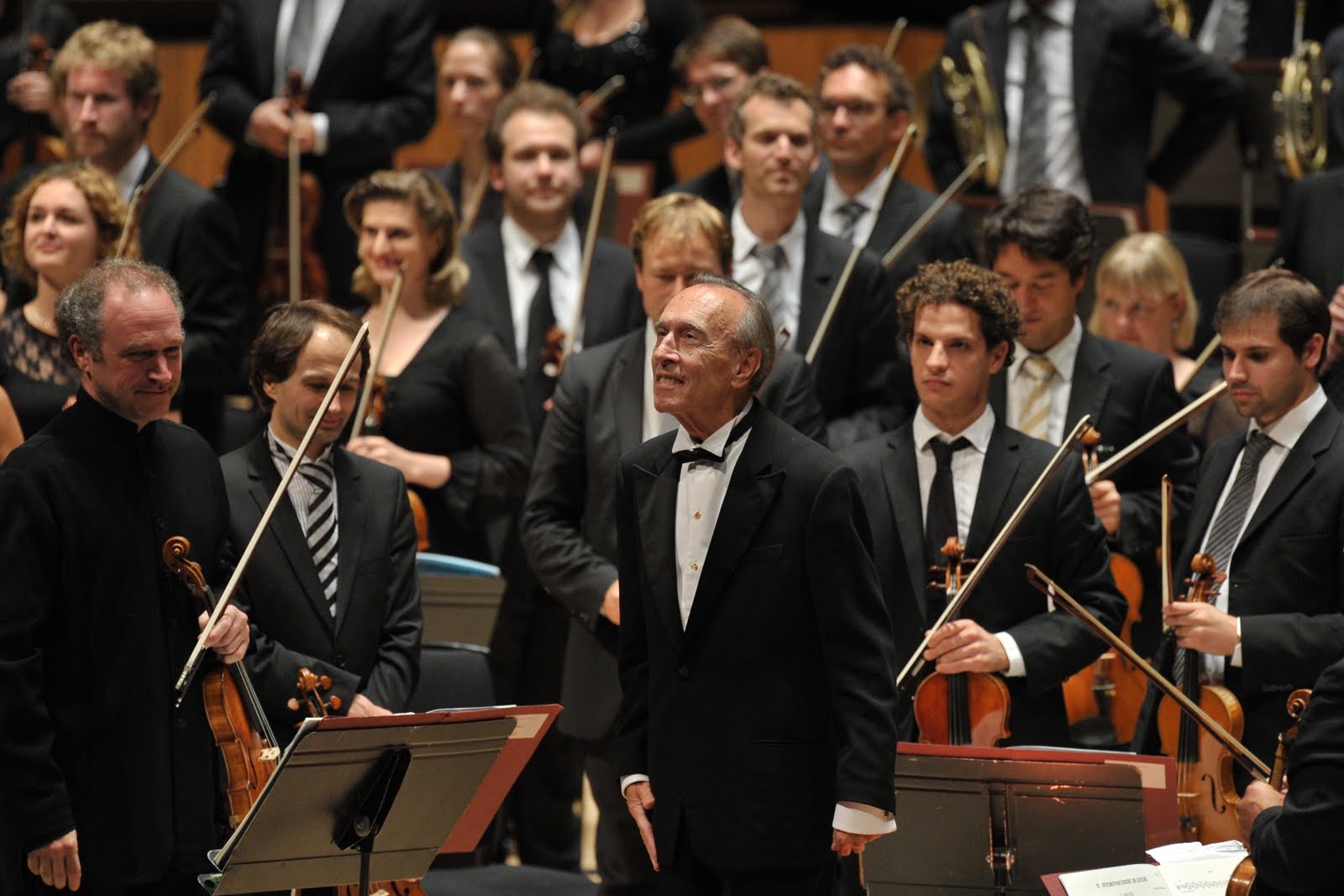
Maestrissimo Claudio and crazy Anton


Here he is at the Festival Hall rehearsal, in one of four characteristically superb shots by Chris Christodoulou: Claudio Abbado, the greatest, with the score of one of the 19th century's weirdest symphonies, Bruckner's Fifth. Its wackiness can only seem the more pronounced in a performance of such freedom, suppleness and colour-consciousness as the one we got last night from Abbado's ever-flexible Lucerne Festival Orchestra on the Southbank: indeed, that made me wonder if there wasn't a case for going even further, totally over the top, because I nearly laughed out loud at several spots in the outer movements.

Just as well, anyway, because I can't take solemn, ponderous Bruckner interpretations. His individuality seems to me to lie in his riven quality, the way religious assurances always crumple. In the Fifth, the usually problematic (for me, again, I stress) Bruckner finale is replaced by a brilliant solution: first the clarinet's cheeky broom sweeping the old ideas away, then the tear-jerking brass chorale at the point when everything seems to have run out of steam. Abbado made no attempt to paper over the cracks, but he did pursue the chamber-musical quality that had been the chief virtue of the Schumann Piano Concerto in the first half.


As in a late Mozart concerto, Schumann's woodwind have as much of the glory as the soloist, and Mitsuko Uchida is too good a listener and collaborator not to let the fabulous Jacques Zoon and his fellow-flautist shine. The Lucerne Festival Orchestra has certainly got through first oboists - first Albrecht Mayer, then Kai Frombgen, now Lucas Marcias Navarro (wasn't there a Berlin veto thing which led to the calling upon the Concergebouw principal?) - but they're all the world's best and Marcias Navarro led the way with incredible projection last night.

If Mitsuko occasionally charged with just a hint of panic at the thicker flurries, her sensitivity and clarity of phrase-turn made it all worthwhile. And it was surely a lucky escape that Abbado had fallen out with the unmusical Helene Grimaud before the festival performances - what a substitute!


I'm coming to love most in Bruckner those twilight zones where only a handful of woodwind play. Again, Zoon had the dove's share of the best, supported only by two clarinets and bassoon at one point in the slow movement, sharing a chuckle with first violins where you really couldn't see the joins. That came in the Scherzo's trio, a Landlerish miracle as it dewily came across last night which I'd rather hear repeated than the whole damned outer portion: it's at points like this that I cry out inwardly for Mahler's constant evolution.

But Bruckner is what he is, and as Sibelius - another true original - pointed out, it may be messy, but it's always authentic. As was this interpretation (authentic, that is, never messy) from the greatest conductor-orchestra team of our time. Look at the photogenic players, who glowed and hugged each other with genuine warmth as they always do after every performance with Abbado.


Wish I could go again tonight, when Mozart's 'Haffner' Symphony replaces the Schumann, but, alas, I'm teaching - Bruckner 4, as it happens, in preparation for Belohlavek's BBC Symphony performance next week*. Less of a rush, deo gratias, than yesterday, where I biked in to meet the players of the Pacifica Quartet (more on them anon) in the Wigmore at 3, taught my Passenger class at the City Lit, whizzed back to the Wigmore to do the pre-performance talk with the Pacificas, then pedalled off to the Southbank. Only Abbado could have made me miss the first instalment of the PQ's Shostakovich cycle, but I'll catch the second on Thursday.

*later - ouch: my students reminded me it's tomorrow (Wednesday 12). Just as well they did as I'm supposed to be giving the pre-performance talk...Fortunately there's just enough time to prepare.