Saturday, 7 December 2013

Three Emils


Erich Kästner's 1928 masterpiece for juniors Emil and the Detectives wastn't on the radar in my own childhood, though so many contemporaries remember reading it and wanting to be one of the 100 Berlin boys who pursue crook Grundeis through the city streets (in much the same way, I imagine, as I so wanted to be one of Fagin's boys after seeing the musical film Oliver! and dreaming about that sequence where they cross the rickety 'bridge' singing 'We'll be back soon'). I think I'd heard the title, but it was only reading John Bridcut's Britten's Children and especially the nine pages he devotes to the 19-year-old composer's obsession that made me curious to see the 1931 film directed by Gerhard Lamprecht, with a screenplay by Billy (then still Billie) Wilder and an uncredited contribution by Emeric Pressburger.


Even that had to wait until I ordered up the BFI special edition and we watched it yesterday night, two days after going to see the joyous National Theatre adaptation by Carl Miller and directed by Bijan Sheibani. I was lucky enough to be allocated that to review by The Arts Desk, and felt a good deal more generously disposed towards it than some of the carpers.

Two write from lack of knowledge of the book (which I was sure to buy a copy of while I was there and read it later that evening). No, Michael Coveney, Kästner's original has no dark undertow (though the film certainly has in Fritz Rasp's rather alarming portrayal of the villainous Grundeis, The Man in the Bowler Hat). And it's no surprise to find the odiously opinionated Quentin Letts - whose one-star reviews always guarantee an adventurous show worth seeing, though he grudged this one three - vilifying the social commentary. 'The show's programme drones on about how Emil's single-parent mum is poor' (a reference to the excellent article by Miller on Kästner's relationship with his own troubled mother). 'Oh poverty, woe, alack. Yet all I remember from boyhood is that this was a ripping yarn'. NT production photo, like the third of the leads, by Marc Brenner - this one featuring Naomi Frederick as Ida and one of the three Emils, Daniel Patten.


Would it have hurt Letts to read again? One of the most charming things about the book is that some of Walter Trier's classic, indispensible illustrations have extra texts by Kästner underneath. The one below the drawing of Emil's mum Ida Tischbein washing a neighbour's hair runs:

Emil's father was a master plumber, but he died when Emil was five. So his mother became a hairdresser, trimming, washing and setting the hair of all the mothers and girls in her neighbourhood. She has to do all the housework as well, of course, and the washing and cooking. She is very fond of Emil and glad she can earn enough money for them both. Sometimes she sings lively songs. Sometimes she's ill. Then Emil does the cooking. He can fry eggs, and steak and onions too.

Kästner has a light touch with the social commentary, and usually lets actions speak louder than explanations, but here's one more observation he makes in the story proper:

You may possibly be thinking that this is a lot of fuss to make about seven pounds [140 marks in the original; the NT programme helpfully tells us that this would be about £360 today]. Well, perhaps it is, and people who earn a hundred or a thousand pounds a month certainly would not think twice about spending that amount. But, believe me, most people earn a great deal less than that, and to anyone who earns, say, thirty-five shillings a week, seven pounds seems a great deal of money to have saved. Plenty of people would think themselves millionaires if they had five pounds to spend, and in their wildest dreams could not imagine anyone actually possessing a million pounds.

It seems that for Mr Letts, the reverse is true: he simply thinks that poverty is the stuff of fiction (you ask what on earth I was doing reading the Daily Mail. The answer is that I was at my ma's for a night and a day on her emerging from hospital - praise be - and now that she's not dependent on me taking that loathsome rag to her - I flatly refuse to buy it - she's back to it again. And what a horror yesterday's edition was, with Jan Moir telling the woman who wants her dead husband's child that she shouldn't, an 'open letter' from the film critic to Daniel Radcliffe advising him to stop seeking out 'sordid' roles and a 'before and after' picture nonsense about the beauteous Nigella Lawson, making out that on day two of the admittedly rather compelling trial she's stressed and tired because she's caught with eyes and mouth downcast).

Anyway, enough of all that rubbish. I'd say that the play version is simply a third telling very different from the book and the film - which of course are already different from each other. The film creeps us out with Grundeis' leering, sinister behaviour on the train - no wonder Rolf Wenkhaus's Emil looks so stricken.


As he is right to be - good gracious, drugged sweets inducing a trippy dream (with brilliant special effects for 1931, which, remember, is very early on in the history of the Talkies). But the Berlin in which Emil wakes up is a lively rather than a scary place. Lamprecht was an experienced recorder of street life, and it shows. And of course all this has both charm and horror, when you think of how this everyday life was so shortly to be decimated. Other books by Kästner, a pacifist and freedom fighter, were burned in 1933, and though proscribed by the Nazis he stayed on in Berlin until the end of the war, moved to Munich and died in 1974. Clearly many more are in need of translation, above all his childhood autobiography and the ecologically-minded Animals' Conference outlined in this blog entry.
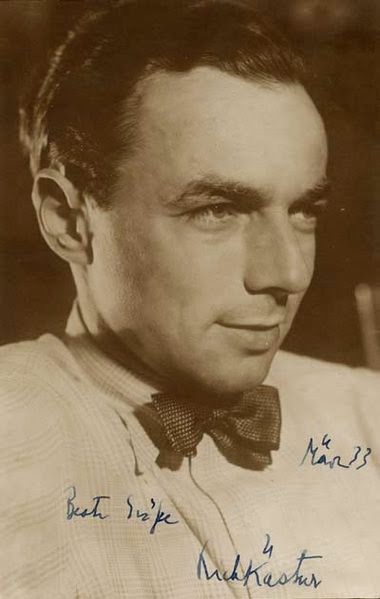

Young Wenkhaus was shot down on a German bomber expedition off the coast of Donegal in 1942. It's also heartbreaking to learn that Hans Albrecht Löhr, the nine-year-old playing 'little Tuesday', a character so many kids identified with during rehearsals for the play, died that same year on the Eastern Front at Saplatino. His mother Lotte went to see the first post-war performance of Emil at Berlin's Metropol - her son had been in the 1930 stage premiere, too - and wrote a rather moving letter to Kästner on his 64th birthday.


Lotte Löhr was, happily, incorrect in her assumption in the letter that all the other children had been killed in the war. Just a few weathered the storm.  Hans Richter, the funniest kid of the lot, 'The Flying Stag' (the freckly one on the right below) who delivers his message to Emil's granny with the utmost sense of self-mportance, appeared in more than 130 films before his retirement in 1984.


Inga Landgut, charming Pony Hütchen (also pictured above with Emil and Olga Engl's Granny) - who, alas, seems destined for the housewife's kitchen rather than the emancipated life promised in the National Theatre's much more girl-friendly version  - had as long a career as Richter if a less prolific one.

Ultimately, the film's tone and touch remain light (I'm not sure I'd read much other than suspense into the scene where Emil hides under the villain's hotel bed, though Bridcut does). Amazingly, it was copied action for action, with the same musical soundtrack but a Kent/London setting, in the 1935 English film, which I've yet to see on the BFI DVD - let's give it another week before making too much of a good thing. Meanwhile, long may the NT Emil run. It's a perfect seasonal treat for kids of all ages.

Friday, 29 November 2013

Parsifal: crystal bells, magic garden


Those great bells which sound four notes so solemn-jubilant in Act One and so doomy-despairing in Act Three of Wagner's Parsifal are making a discreetly joyful sound in my head now that I've sent over the script for Radio 3's Building a Library. It's by no means the end of the quest, which will happen once I've declaimed the holy text in the studio on Tuesday morning. But three months of listening and watching which have never been anything but revelatory, though very tiring, have now come to an end. The grail among recordings seemed to me quite obvious once I'd heard them all, though more than that I can't say before broadcast on Saturday 14 December's Christmas edition of CD Review.

Anyway, the cumulative Parsifal week, which began so delightfully with the wonderful Mark Wigglesworth's visit to the ninth of my City Lit classes on the subject, isn't over yet: tomorrow is the first night of the new Royal Opera production, which I'm lucky enough to be reviewing for The Arts Desk*. I'll write up the Wigglesworth chat in due course, but I'm a bit behind and still haven't sifted the transcription of Richard Jones's Gloriana talk back in June.


Above is where I'd like to be instantly transported now that I've earned a holiday - the garden of the Villa Rufolo in heavenly Ravello, a quarter of a mile above the Mediterranean near Amalfi. The postcard I saved and had scanned for reproduction up top offers a musical quotation from Gurnemanz's Act 1 monologue:  'there he [Klingsor] awaits the knights [of the grail] to lure them to sinful joys and hell's damnation'. Give me more of that, which I so enjoyed - or nearly did - back in 1984 in the company of a beautiful young Los Angelene and fellow InterRailer called Marc.

That's quite a curious story in itself: we shared a room in Atrani; he told me how he liked to look at women but not to touch, much as they pursued him; after two days of our walking everywhere together he disappeared with a German girl for a night and then I heard him outside the door at 1 in the morning telling his tearful, beseeching young Kundry how coming back was 'like crossing the Red Sea'. I affected sleep and didn't ask him what he meant - the unanswered question I soon regretted I hadn't posed.

Next morning Marc was off on a train to Brindisi and Greece, and I to Sicily, before we could meet and talk (I thought we'd catch the same bus to Salerno together but he was nowhere to be seen). Truth to tell, he was probably a bit of an unholy fool himself, but cut quite a Parsifal figure standing under the arch of the Bar Klingsor in Ravello's main square (it's still there, I'm told) and wandering shirtless around the even lovelier Villa Cimbrone where Walton composed his Violin Concerto. Anyway, that's certainly not the only tale of unrequited desire on the Amalfi coast.

The gardens, as you can see, are beautifully situated but rather tamely planted as they were when the Wagners visited in May 1880: not quite the luxuriance one expects of the magician's enchanted domain; if anything the cloister with Moorish touches on the capitals is more redolent of the outer acts' Monsalvat.


The Russian artist Paul von Joukowsky met Richard and Cosima in Naples that January, and was there sketching away at the Villa Rufolo; he later designed the sets and costumes for Parsifal. I was looking for his vision of the garden and found it, serendipitously, on my dear friend Jonny Brown's Villa Parasol website, so I hope that given that link he'll be happy with me reproducing the much more luxurious imagining of Joukowsky here.


How to present the magic garden's inhabitants, the fair Flowermaidens with their curious mixture of playfulness and threat, innocence and debauchery, remains a perennial problem for directors. Perhaps the best solution is Harry Kupfer's: in his Staatskapelle Berlin production they all appear soft-porn style on a multitude of television screens. That at least lets Kundry - in that staging on DVD, an incredibly sensual Waltraud Meier - upstage them in her entrance. I've never found the voice alone that impressive, but you tend to forget it when you watch her. This clip gives a last glimpse of the TV Blumenmädchen and plenty of Meier.


You'd have thought it was easier to get the Monsalvat castle bells right. But Bayreuth had problems during Wagner's life and after it. For much of the following, I'm indebted to a page on the Monsalvat - Parsifal website, though we had both turned to Selected Letters of  Richard Wagner translated and edited by Stewart Spencer and my good, loyal friend Barry Millington for the first source. There you'll find the request sent by Wagner to Edward Dannreuther, the British Wagner Society founder who'd discovered a dragon in London to be shipped out for the Bayreuth Siegfried and whom he now requested to obtain a set of Chinese tamtams, which I assume to be the same as this sort of temple gong.


So the effect was clearly never going to be the 'gentle ringing, as of crystal bells' mentioned in Wagner's 1865 prose draft. Evidently the tamtams fell short of the ideal  and were succeeded by metal drums and then a 24-string piano with four keys. From the late 1880s until 1929 these metal canisters were used, pictued below as on the Monsalvat - Parsifal site courtesy of the Richard-Wagner-Gedenkstätte. You can hear them on one recording only, and a very splendid one: the set of extracts recorded - in a big venture for the time - by HMV in Bayreuth shortly after the advent of electrical recording, and conducted by the great heir to a tradition Karl Muck. His company was the first to introduce the Ring to Russia in the 1880s (a visit which had a huge impact on the composing style of Rimsky-Korsakov, chief among awestruck musicians).


The conducting is grand but masterful, setting the trend for the Knappertsbusch style which I sometimes find de trop in my quest for the golden mean, and it sounds amazing for the time. The bells were clearly a bit flat by 1927, but their resonance is never in doubt. Here's the Grail Scene from Act 1 minus Gurnemanz's interjections, Amfortas's tormented monologue and the final scene of Gurnemanz's reproach to Parsifal. The bells emerge loud and clear at 5'58.


The bells were silent, then, from 1929 until the Second World War, when they were melted down for obvious reasons. I wondered what on earth I was hearing on the 1962 Knappertsbusch-conducted Bayreuth recording. It sounded like a weird kind of synthesizer, and it was, the very first, namely the: Mixtur-Trautonium invented in Berlin in the late 1920s. You hear it on all three of Knappertsbusch's recordings (1951, 1962 and 1964) so I wonder when it was phased out - none too soon, as the results bear witness. You'll be able to hear them, followed by the 'Muck originals', on the programme.

I could easily have devoted an entire Building a Library to the question of the 'Parsifal bells'. But that's quite enough here. What we really ought to end with is Alexander Kipnis's magnificent role as Gurnemanz in the Act Three Good Friday Music. I was going to reference here the excerpt conducted by Siegfried Wagner, but then I discovered that the inexhaustible treasure-trove of YouTube had Kipnis with a sadly rather flat Max Lorenz and - this is the heilig hehrstes Wunder - Strauss conducting in 1933** (the infamous year in which he perhaps too readily stepped in for the much more admirable Toscanini). Did Gurnemanzes ever get any better than this? Tune in Saturday week - at the end of Radio 3's seven-days Wagnerfest, which also includes my excellent and incredibly hard-working producer Clive Portbury's Sunday Feature: The Invisible Theatre - to find out.


30/11 My colleague Jasper Rees just sent me a link to the interview he conducted with me - one of many, the others featuring much more distinguished figures like Waltraud Meier, Robert Carsen and Sir John Tomlinson - for the K T Wong Foundation in association with the Beijing Festival, which has had what I can only call the misfortune to share Michael Schulz's Salzburg production. It's on YouTube but it seems there's no means of embedding it as yet, so here's the link.


*1/12 It turned out to be repulsive and disappointing, with fitful musical treasures in the mud: read my Arts Desk review of the Royal Opera Parsifal here. Image above by Clive Barda, who makes the production look better than it was.

**7/12 That great Wagner expert Mike Ashman kindly emailed to tell me it most likely ISN'T Strauss conducting here: 'As far as I know (and Ray Holden the Strauss conductor expert also thinks) what's in circulation, although it is those named singers, is not from the performances actually conducted by Strauss. It apparently existed once but was lost, like many Bayreuth things, in the war'.

Thursday, 21 November 2013

Pitch-perfect protest


I'll admit I was wary of joining a demonstration after so long; even years ago I only ever went on Pride marches, which I stopped attending when the whistles got too much and a BBC producer told me how he'd got tinnitus from an ex blowing one in his ear. J thinks I was on the Section 28 protest when they shut us in a garden, but I have no memory of that.

Anyway, the reason I went this time was simple. After three months of silence, having been targeted for lending his name to Putin's re-election campaign and failing to make any sort of comment on the murderous  new anti-gay laws in Russia, Valery Gergiev had finally produced a statement to prove he was gay-friendly. It was amusingly summarised in a tweet by Philip Hensher: 'Some of my best friends are gay. I don't support institutional homophobia. I leave that up to my friend Putin.'

Weak or not, the statement would have been enough for me had he not, in the time between the Met, Carnegie Hall and San Francisco Opera protests and this one, gone and put his foot in it about the anti-gay laws in Russia, which anyone who cares about human rights must abhor. He was quoted in the Dutch newspaper Volkskrant as saying 'In Russia we protect our children. These laws are not about homosexuality, they concern paedophilia'.

Now if he misunderstood, or was misquoted, he's had plenty of time to put the record straight. But he hasn't. And having reeled at a casually-muttered remark about 'child molesting' by an older relative of my now-godson when I was bouncing the baby A on my knee, I have a personal reason for seeing red at such equations.


So, in spite of having had so many amiable and fascinating meetings with Gergiev over the years, I still went along to the Silk Street entrance of the Barbican before his second performance of Berlioz's The Damnation of Faust (I was speeding off at 7, the time the concert was due to start, to the first night of the dismal Magic Flute at ENO). I'd feared they might get it wrong: it would have been totally misleading to have banners saying Gergiev was homophobic, because I don't believe for a minute that he is.

As it turned out, what needed to be said was said. The orchestrator was the slightly scary but admirable Peter Tatchell, and he'd pitched it, I think, just right. It was peaceful and - as this very fair Guardian report points out*- 'civilised' but 'loud' as the African contingent, aptly there to protest similarly appalling human rights records in Uganda inter alia, backed up Tatchell in chanting 'Gergiev! Stop supporting Putin!' - some coaching occasionally needed on pronunciation - and the stress-curious 'SOME people ARE gay! GET over IT!'.

Chanting isn't really my thing, so I joined in a little less than lustily. But I was happy to accede to Peter's request to hand out leaflets, which again were correctly worded, and it rekindled memories of what it's like to be rejected, in this case by a fair few haughty concertgoers.


Anyway, the sparklers and the huge diversity of the protesters (the three above in a photo from the Tatchell Foundation) added to the festive, non-aggressive air. Unfortunately the whole thing was grievously misreported by Melanie McDonagh in a feeble Spectator blog as being inside the hall where she could barely make out cries of 'shame' (the hall event had taken place a week earlier, when Tatchell courageously held the platform for a minute before, not during or after, the concert). The pretence of being there, which she has not retracted?  Journalists lose their jobs for less. But I'm not even going to link to her invective; that would only help to give the right-wing rag the clicks it so badly needs.

As for my own 'open letter' to Gergiev's response on The Arts Desk, it felt strange and initially rather lonely. None of my musical colleagues was willing to lend support, with two against - the usual argument, 'why this and not x' - and three not wanting to go public; not a single contributor showed any solidarity. But then, as I could see from the bottom right column of the main page, there were plenty of supportive tweets from the likes of Jessica Duchen, Petroc Trelawny, Richard Bratby and - proudest of this - a lovely short eulogy from my oboist hero Nicholas Daniel. So it was clearly the right thing to have done. I don't blame the silent majority, but 'Halldor', commenting on the TAD latest, put it all rather beautifully. I select a few choice sentences:

The all-smiles, "you were marvellous" culture of the classical music world is deeply ingrained in all of us. And so many well-meaning, liberal people are deeply invested in Gergiev's prestige. So responses to real stand-up-and-be-counted moments like this are awkward, embarrassed; people wish it'd just go away, they lose patience, and don't think matters through.

Curiously but unsurprisingly even as I was turning the article's screw on what the consequences of the 'anti-paedophilia' law had been, Queer Nation New York reported the latest hate crime from Moscow with appropriately angry artwork.


Will this specific issue go away? Not until our conductor retracts or qualifies that awful statement. No-one's asking him to renounce Putin; that's just not possible in the present climate. But as to one PR's frenzied declaration that Tatchell is trying to ruin Gergiev's career, no chance, and that's not what any of us wants.

Rather more productive relations with musical Russians came thick and fast in the weeks around the protest. I loved interviewing Michail Jurowski, Vlad's dad, before what I think must go down for me as the most extraordinary concert of the year so far. I hope the LPO releases the recording of our talk, because he was fascinating about the distinguished visitors to the  intellectual household in which he grew up - Vladimir Senior was a respected Soviet composer - and on how as a teenager he played piano duets with Shostakovich. Michail Vladimirovich's wife took this photo in his dressing room, where he nearly talked himself out before the half-hour under the public eye. It gives some idea of how many staves the score of Schnittke's First Symphony often has to encompass.


As for the work in action, what a jaw-dropping masterpiece. I knew as I listened to Rozhdestvensky's outlandish recording with the score that morning that, unless the performance were to go badly wrong, there'd be an instant standing ovation, as there had been from the young in VJ's LPO performance of the Third Symphony.  And there was. Read about it on the Arts Desk review.

I was trembling with emotion even before we heard it: in the interval my companion for the evening Roger Neill introduced me to the vivacious, brilliant and hugely talented Alissa Firsova, and she introduced me in turn to her mother, Elena and the great Dmitri Smirnov. Elena was at both the world premiere of Schnittke's First in the 'closed' city of Gorky (Nizhny Novgorod, sadly in the news again recently owing to the awful plane crash there) and then, after the work's 12-year ban was lifted, at its second performance in Moscow - not nearly as good, she thought. Dmitri enlightened me as to why, though we found it extraordinary, the performance of Lutoslawski's Cello Concerto wasn't quite right in the light of Rostropovich's premiere performance (I heard Slava play it with the LSO; neither then nor in Truls Mork's interpretation earlier this did it have anything like the impact we got from Johannes Moser's piece of music-theatre). Here are all three in the foyer.


After  my Wigmore Hall talk in the Bechstein Room on quartets by Haydn, Britten and Shostakovich to be played by the dazzling Belcea Quartet, I realised that I'd been standing in front of the anniversary hero whose First String Quartet knocked me for six, so I got one of the punters to take a snap. Afraid I asked him to cut out Elliott Carter, not an idol of mine..


Fourth talk in a row was an introduction to Sakari Oramo's first official concert as new chief conductor of the BBC Symphony Orchestra: part setting-up of Shostakovich's First Piano Concerto and Mahler's First Symphony, with good links between the popular ditties in both, part conversation with Tristan Murail, whose two new pieces going under the collective title Reflections/Reflets were being given their world premiere. I was slightly apprehensive of talking to a composer with whom I wasn't sure I'd be in total sympathy, but the deep sound the minute the work began in rehearsal that morning captivated me. In our chat TM soon relaxed and became surprisingly bonhomous dealing with an charming old gent in the front row who asked about tunes. Murail's the one to look apprehensive in this picture, and I set  myself up as a candidate for another episode in 'great British dentistry' by the webtroll I've been ignoring, but it's the only one, so it will have to do.


The DDS trail has continued with two talks to the Friends of the Jerusalem Quartet (photo below by Marco Borggreve) around that amazing foursome's Shostakovich cycle. I only managed to hear the third concert in the first series, of quartets 4, 5 and 6, but from the very first bars it was obvious that these are the natural successors to the old Borodin Quartet in the powerful reserves they can draw on and their unique flexibility and tonal quick-changes. Five was, of course, the stunner, and the Sixth brought the redemption of romance just as I'd anticipated.


I have to say that cellist Kyril Zlotnikov's my favourite, not just for his handsome profile but also for the infinitely cultured sound he makes and the aristocratic, readable expressions which match the mood of the music in question.

And on the Friday I got to talk to the wonderful Boris Giltburg the morning after his stunning Queen Elizabeth Hall recital. He's a real Renaissance man, currently translating Rilke into Hebrew, and his command of English was astounding in his ability to articulate complex thoughts on space and silence in the previous evening's performance of Prokofiev Eighth Sonata. More on that anon. Here's Boris in the lobby of the St Pancras Hotel, which I also need to eulogise in due course.


One concert I wasn't sorry to miss was the five-hour epic of the Philip Glass Ensemble. A very treasured new student of mine who did go knows what I think of Glass, and drew this image of how he imagined I'd have been at the event. I've taken the liberty of setting it on the computer alongside a photo of the composer from that concert.


Only six days to go now before I hand in the script for the Radio 3 Building a Library on Parsifal, which explains why I've done so little blogging over the past couple of weeks.  That and visiting my poor old mum in hospital: she broke her hip en route to tests for a heart operation which should have taken place last week. Came out on Tuesday night, was in appalling pain at home and is now back in St Helier, which is where I'm heading now before further doses of Parsifal and Kundry.  And still loving every minute of this infinitely fascinating work - 'the greatest opera by the greatest composer' declares Mark Wigglesworth, who comes to talk to my City Lit opera class on Monday. Rich times indeed. And something to celebrate - many of Greenpeace's Arctic 30 who've spent far too long in jail in Murmansk and St Petersburg already, were released on (exorbitant) bail. Here's Ana Paula Alminhana Maciel from Brazil at the time of her liberation yesterday.


Yet fellow activist Australian Colin Russell is being held captive at least until February. Why him? No-knows. And like he says,


Sign Greenpeace's latest petition to keep the pressure up on urging Colin's release and the abolition of charges here.

29/11 update: Colin was released on bail today. The regular Greenpeace bulletin showed a joyous picture of him outside the St Petersburg prison embracing fellow activist Faiza Ouhlasen.


The 30's troubles are far from over, though. They've still only been bailed and could yet be sentenced. Remember the fate of their fellow 'hooligans', the girls of Pussy Riot. I'm sure, though, that the pressure will be maintained on Russia from the rest of the world.

*'One well-dressed man apologised for leaving early because he had to get to The Magic Flute across town at the Coliseum.' Guess who? I was wearing the same psychedelic flowery tie which always comes out on special occasions, like our civil partnership party, because it was the nearest thing I own to anything rainbowy. I also wore it last Friday to Dame Edna's gala launch at the London Palladium. Gladdie pix pending; in the meantime you'll have to read my Arts Desk review, possums.

Sunday, 10 November 2013

Two Norwegian moods


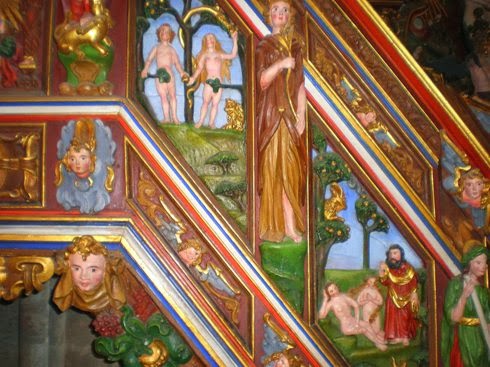
The one in St Swithun's Cathedral Stavanger was essentially as celebratory as its gaudy pulpit, completed in 1658 by Scot Andrew Lawrenceson (aka Anders Lauritzen after he settled in Bergen and married a Norwegian) Smith and running the Bible story from Adam and Eve to Christ in triumph: this was the first home for the great events of the fabulous Stavanger International Chamber Music Festival, my invitation to which kicked off an unforgettable Scandinavian holiday.


No doubt there would have been a party mood out on the island of Mosterøy when the festival celebrates the end of a busy week with a picnic and a concert at Utstein Abbey. Alas, we were only around for the first three days. Since an expedition to the famous Pulpit Rock up the fjord would have taken too long between the festival events, I pleaded with our obliging hostess to take a trip out to Utstein on a brilliant sunny summer morning. Bathing in the inlet was also an attraction (though only for me, as it turned out).


Of course there was no-one there except the girl in the ticket office, so we probably got a better sense of why the monastic community which existed there until the Reformation loved it so. Records for the Abbey actually go back to the 9th century when its site seems to have been some sort of royal farm or fortress for Harald Fairhair. The Augustinian monks settled there, and the Abbey was built, around 1260. Now it's almost concealed by the beeches and other trees which have grown up around it.


Post-Reformation it became the parish church, which accounts for the handsome early 17th century fittings by Gottfried Hentschel and the Lauritz Workshop (online information is very hard to come by; I should have bought the guide book at the time). In the Gothic east end, this includes the altar surmounted by trumpeting angels and the pulpit.


The font, modern as it looks, is Romanesque


as is the nave, separated from the chancel by the bell tower. Here the Stavanger Chamber Festival concerts take place.


 Attractive whitewash in the cloister occasionally lets the original details shine through


while the rooms occupied by Christopher Garmann in the 18th century are handsomely if simply furnished and on a sunny morning the windows frame trees and water in a halo of light.


Everyone loves a bit of the supernatural to be appended to a sober monastery. The story goes that Garmann's first wife made him swear on her deathbed that he wouldn't marry again. 20 years later he did; his death followed in a matter of weeks. Copies of the first Garmann couple's portraits - pretty terrible, it has to be said - hang in their dining room.


After that air was needed, so the others sat on the jetty while I swam around - the only holiday bathe in salt rather than fresh water, though it still felt like a lake.


Back in Stavanger, the cathedral was always evocatively lit for the concerts, the purple of which I'm so fond bathing another Gothic chancel behind the players and Victor Sparre's rather attractive 1957 east window glowing until nightfall.  First of two images by the excellent official festival photographer Nikolaj Lund.


St Swithun's has an older history than the monastery. The bishopric was established around the time of Stavanger's founding in 1125, its first encumbent none other than Reinald of Winchester, who arrived one of Swithun's arms (!) and other relics - removed after the Reformation, when the building became Lutheran, to Denmark. Norman nave, second of Lund's photos during a festival event.


All the pulpits we saw in Norway and Sweden were handsome in either simple painted or extravagantly carved ways (or both), but Andrew Smith's was the garish jewel.


Braco-born Smith also designed some equally handsome memorials in the north and south aisles.


Externally, the cathedral was stripped back in the 1960s to something of its original look after a heavy handed Victorian restoration. Festival crowds outside the west end.


Some of the 19th century work, chiefly on the east end exterior, isn't bad at all.

And the setting is lovely, sloping down to Stavanger's central park and lake.


Fond memories from the perspective of rainy, strife torn November. Barbican protest report next. I wanted to finish by redeeming the half-promise of the title with Stravinsky's very pretty Four Norwegian Moods, salvaged from his unused film score to Columbia's 1941 The Commandos Strike at Dawn. The only full version available on YouTube, an excellent performance conducted by Chailly, isn't for some reason postable here, so just click on this link and enjoy.