Just a quick one so I don't let the big day pass unrecorded here. I had the good luck to be in a studio of beloved Broadcasting House, Portland Place on Tuesday morning, recording the script for my Building a Library on Elgar's Falstaff (due for broadcast on Saturday 8 October). Before I lifted on to the table the ancient script rack of which I'm so fond, which seems to have made its way upstairs from the old days in Studio B14, I found pages left by the estimable Rob Cowan, Mensch and stalwart, whose seat I was occupying. You probably can't see the name on the top of the page, but it's his.
Having got everything 'in the can', I had a quick chat with my vivacious producer Olwen Fisher and sound engineer Michael Bacon about the status quo. It's just such a joy that recording BaL is exactly the same as it ever was - that's to say, you discuss the script and any tweaks needed with the producer, then go through recording it with all the music examples in place as you devised them. So in reading it you still get something of the right tempo and inspiring snippets to give your voice the necessary reactive kick.
That hasn't always been the case elsewhere; some years back on the World Service, for instance, I had a discussion with Patrick Harrild, principal tuba player of the LSO, about our favourite recordings from the orchestra's first 100 years; we never got to listen to the chosen snippets of each other's choices, so we couldn't react properly. There have been moves to economise here too by trying to stop the full playthrough, but so far the Record (formerly CD) Review team have staved it off (and they don't think it would save much time anyway).
I rejoice, because that means studio work for RecordReview is as it always was, with a civilized timeframe and knowledgeable folk as editors. It changed for the worse during the Gambaccini era, but they realised they were losing their core listeners and not gaining any of Classic FM's, so back it went to the old format and we non-celebrities came back in from the cold.
Which means it's been 29 happy years for me, starting with a review of Sawallisch's recording of Strauss's Die Frau ohne Schatten, with a few bumpy interludes thereafter, and some wonderful studio meetings, like the one above with the late, great Bob Tear - then aged 71 - and Elaine Padmore, Petroc Trelawny chairing. Topically, one of the three books we discussed was Susie Gilbert's excellent Opera for Everybody: The Story of the English National Opera. Once past the last two productions to be conducted by ENO's adored but honourably departing Music Director - Don Giovanni opening tomorrow night, can't wait, and Lulu - that particular story may go downhill rapidly.
Which is a way of advertising six classes of the new Opera in Depth season on Mozart's Don Giovanni and my forthcoming BBC Radio 3 Building a Library on Elgar's Falstaff (broadcast date 8 October). Let's get the basic info down for the first, since it starts on Monday 26 September. Runs for ten weeks, Mondays 2.30-4.30pm, at the wonderful Frontline Club in Paddington. We devote the first five weeks to Don G before moving on to Shostakovich's The Nose (covering two or three weeks) and Ligeti's Le Grand Macabre (one or two).
Mark Wigglesworth is down to return on 14 November, having by then moved on to Berg's Lulu at ENO. If you're interested in joining, try this email: david.nice@theartsdesk.com
While it's hard to love the Don Juan of Tirso de Molina and the Don Giovanni of Mozart, who could not have more complex feelings about Shakespeare's greatest (semi)comic creation? Elgar understood his dualities and wrote the most perceptive 'analytical essay' for the Musical Times of September 1913. Novello helpfully reprinted it as a little booklet, which I treasure.
As this most magnificent of tone-poems illustrates, Elgar had no time for what he saw as the 'caricature' of The Merry Wives of Windsor but couldn't praise too highly the creation of Henry IV Parts One and Two, whose death is described so vividly by Mistress Quickly in Henry V. Thus part of Elgar's second paragraph, using Professor Dowden and Maurice Morgann to speak for him:
The real 'Sir John Falstaff is a conception hardly less wonderful than that of Hamlet.' This complexity has been summed up by Morgann as follows: 'He is a character made up by Shakespeare wholly of incongruities; - a man at once young and old, enterprizing [sic] and fat [not sure what the duality is there, mind you], a dupe and a wit, harmless and wicked, weak in principle and resolute by constitution, cowardly by appearance and brave in reality; a knave without malice, a lyar without deceit; and a knight, a gentleman and a soldier, without either dignity, decency, or honour.'
Dare I say the opposing qualities would have appealed to a typical Geminian like Elgar? They account for why in part Falstaff is also a self-portrait (cue this surprising photo which Graham Rickson sent me today).
Everything is in perfect balance - the humour and extroversion versus the introspection of the dreamer, darkness and light, programme music and pure symphonism. The climaxes of the Gadshill exploit, battle and aggressive coronation march sit well around and between the heartbreaking dream interludes - and if those don't have the right degree of inwardness, any recording is going to fail. That helped me to make distinctions and to jettison half-good performances at key points. But more I cannot say, of course, until the programme's aired.
Some years ago I was asked to give a talk comparing Falstaff with Strauss's Don Quixote. There are so many points of correspondence between the man Strauss hailed as 'the first English progressivist' and the Bavarian tragicomedian (another Gemini, of course). I had a wonderful time on Wednesday evening hearing the English Concert in two Quixote-related works; should have got to know Telemann's Le Burlesque de Quichotte long ago, but what a light-footed charmer it is, made all the richer by Danann McAleer's reading of what turned out to be the poetically archaic Victorian translation of Cervantes by John Ormsby. Maybe that's the version I should turn to next - for like War and Peace, Don Quixote should be revisited at least every 10 years.
It's in fact been nine years since I last covered Mozart's Don Giovanni in what was then my Opera in Focus class. Now we coincide with the first and last fling of what ought to be a perfect partnership, Mark Wigglesworth conducting and Richard Jones directing a new production at English National Opera (oh, what wouldn't we all have given for the original plan that the duo should share The Gondoliers, a work Carlos Kleiber in all seriousness would have conducted at ENO if they'd taken him at his word). I look forward to all the film references Richard revealed in a special-preview ENO talk with Christine Rice and myself, bearing in mind that he had given each of the cast members a special DVD. Clive Bayley, the Leporello, got The King of Comedy.
Which made me buy a copy and watch it for the first time. What a masterpiece of discomfiture and a prophecy of the insane pitch celebrity culture has already reached. Astonishing performances from De Niro as the man who won't let go, Jerry Lewis as the man without humour - and Sandra Bernhard as the fan from hell, getting her big break from Scorsese.
Hoping that Richard will come along again to the Opera in Depth course. Looks likely, but he's usually elusive until closer to the time, and of course totally preoccupied with Don G at the moment.
Recorded my Building a Library script Tuesday last for broadcast on BBC Radio 3's Record Review (as CD Review has now been re-named), 9.30am this coming Saturday morning. Obviously I'm not going to give anything away about interpretations, but it's the first time I've found myself with a neat set of examples that didn't need editing down and down - in fact the total came to several minutes under the three-quarters-of-an-hour mark, but I felt I'd communicated what I wanted with all the right connections. The only drawback, as on previous occasions, was that several respectable middle-of-the-road versions didn't make the script.
How did I feel at the end of two months with this most curious of Ninth Symphonies, having suggested it in the first place? Surprisingly churned up, with the darkest portions of the work running round in my head. Never believe anything the public Shostakovich said about his works. He knew he was going to get stick for not producing a triumphal ode to the end of the war after the externalised tragedy of the Seventh and the much deeper soul-searchings of the Eighth. Even so, to describe the Ninth as being 'dominated by an airy, serene mood' is absurd.
Amazing how the fallacy has clung to so many of the liner notes for the 28 recordings I listened to. Doing a Building a Library on those alone would be fascinating in itself.I jotted down some of the plums, won't shame the writers by naming them in just a few examples: 'unquestionably the wittiest and most cheerful of all his symphonies'; 'tiny, undramatic and transparent'; 'the composer really is celebrating the end of the past years of war'; 'a pronouncedly classical piece full of enchanting cheerfulness and bright colours...innocuous traditional symphonic close'. Pictured below: the nearest portrait of Shostakovich I could find to the year of the Ninth: the composer at Bach celebrations in Leipzig, 1950.
If you tot up the passages of unequivocal cheerfulness, they total less than three minutes out of an average 23. And even that's doubtful: note the sarcastic trill in the opening, Mozart-Haydn theme. Outer movement developments are fierce, even violent; the transformation of the finale's neutral main theme into a goosestepping parade should be terrifying. I'm not proposing any Ian MacDonald-style 'Stalin subtexts' here - he goes too far in suggesting that the slow movement sheds 'crocodile tears of mourning'. The clarinet melody is a sad, limping waltz, no two ways about it, preferably taken at a moderato pace sufficient to show that, not as an Adagio, but there are persuasive examples at the much slower pace.
As for the bassoon solo, as tragic and lamentatory as its cor anglais equivalent in the Eighth Symphony? One proponent of 'happy symphony' concedes it could be 'a homage to the dead on a day of general rejoicing'. But, in the words of the dubious Shostakovich in Testimony, they are beating the symphony to rejoice. That's not my fancy, it's there in the dissonances and the chromatic twists added to initially straightforward material. Below: Monty with Marshals Zhukov and Rokossovsky and General Sokolovsky of the Red Army leaving the Brandenburg Gate in 1945.
One should never forget that Shostakovich's aim is to entertain as well as to chasten, to give the orchestra its rewards - and all the woodwind have their moments in the sun (though the oboe's is very brief). It's a wonderful, a perfect work, especially in dialogue with its vast(ly different) but similarly five-movement predecessor - in both the last three movements run without a break - and I hope something of that perfect originality comes through on Saturday. Any Building a Library worth its salt should be as much about the subject as the performances, taking you through the piece and pointing out its treasures, and a short symphony is in many ways the perfect candidate for that.
Top image: Shostakovich's greeting to Sibelius on his 80th birthday, inscribed with formal congratulations and a quotation of the finale's main theme. Snapped during my heavenly five hours at Ainola; discussed in context here
Here's one I prepared earlier, now let out of its cage. Look no further if you haven't listened to my Building a Library on Parsifal, just broadcast, and you're postponing revelation until you catch it on iPlayer for the week, or whatever this clip facility now up and running might be (17/!2: my producer tells me it should be 'up there until the end of days', or of the BBC, whichever comes first. There's also a podcast, which you can download here). I'll even stick in a further grail image, 'the one', ho hum, in Valencia Cathedral, to delay a glimpse of the winning cover.
The choice, for the first time in my 20-odd years of doing the programme, was totally obvious. So many folk have said to me over the past few months, 'of course you'll go for Knappertsbusch '62'. I thought I would when I listened again to Hans Hotter as Gurnemanz in Act One. But it became ever clearer to me as I listened to the three 'Kna' Bayreuth Parsifals currently doing the rounds - also including his first, from 1951, and his last of 1964, not long before his death - that I didn't want this kind of hard-hitting so often.
Kna's style does make for magnificent pinnacles - Hotter's 'O wunden-wundervoller heilige Speer' ('62) and George London's 'Erbarmen' in Act 1 ('51), Jon Vickers' 'Amfortas! Die Wunde!' in Act 2 ('64) - but what I've always sought since Haitink showed me the light at Covent Garden, conducting Bill Bryden's mostly intelligent production, is a naturalness that doesn't need to reiterate the spirituality and grandeur. As Mark Wigglesworth remarked when he came to talk to my Opera in Focus class the other week, Parsifal gives and gives while Tristan simply takes and leaves you exhausted. A great conductor needs to guide and give space where necessary, of course, but not to impose his (I await a 'her') will.
Which the great Rafael Kubelik never does. A few clever folk knew of this 1980 studio recording's existence but I certainly didn't before I came to listen and nor did my Parsifal-crazy producer Clive Portbury. He agrees that it's incomparably the best of what we have.
Runners-up I don't need to mention again here, but I do urge you to see the DVD of Hans Hollman's Zurich production. It would qualify alone as the only document of Haitink's conducting, but it's also the most quietly moving staging I've seen, trusting to the singers' stillness in the outer acts and - most important of all - respecting the transcendence of the grail ritual for all the suffering that surrounds it. The vital antidote, in short, to Stephen Langridge's Royal Opera horror. The students all thought so when I screeened Act Three in an extra class on Monday, and many wiped away the tears that simply hadn't flowed at Covent Garden.
I have a feeling that might happen when the Met production with Jonas Kaufmann comes out on DVD in February; from the images I've seen it appears much more in the right region than the one we're enduring in London. In the meantime, snap this up while you can; Gatti's conducting won't surpass Haitink's, and probably won't come anywhere near.
Alas, there are no clips on YouTube so I'll move sideways to seasonal seriousness. On the same Tuesday when my preparation schedule had been eaten up by the flying visit to 'do a telly', I took the BBC Symphony Orchestra class through two very different responses to the Flight into Egypt story, tied in with the chance to hear the two works in question tonight and tomorrow afternoon. Berlioz's painfully beautiful, intimate L'Enfance du Christ located the narrative close to the centre in the hands of the tenor 'Evangelist'. We had Anthony Rolfe-Johnson returning to life so scrupulously for John Eliot Gardiner, but all I could find on YouTube was Alain Vanzo not at his considerable best for Jean Martinon. So let's make do with that.
Like Britten's best poetry compilations, John Adams's El Niño would be admirable just as a sequence of magical words tellingly juxtaposed, without even taking into account the extraordinary music which of course layers it still further. I look forward to experiencing it tonight without Peter Sellars' stage 'realisation', so enervating when the 2000 Paris original came to London. Adams for his supernatural epilogue turns to the charming and naive Gospel According to Pseudo-Matthew for a rest beneath a rather unusual palm tree, and juxtaposes it with the last of the stunning Mexican poems by Rosario Castellanos, a revelation to me.
As the soundclip doesn't offer a translation of the Castellanos poem, I take the liberty of reproducing it here:
Lady of the winds, heron of the plains, when you sway your waist sings. Gesture of prayer or prelude of wings, you are the cup into which the skies pour one by one. From the dark land of men I've come kneeling to behold you, Tall, naked, alone. A poem.
So the text resounds and melts into a single repeated word in the mouths of children - 'poesía'.
15/12 What a weekend it's been. My Arts Desk reviews are now up of El Niño here and of L'Enfance du Christ here. Don't whatever you do miss the Radio 3 broadcast of the ineffably moving Berlioz performance on the iPlayer herefor the next week.
Those great bells which sound four notes so solemn-jubilant in Act One and so doomy-despairing in Act Three of Wagner's Parsifal are making a discreetly joyful sound in my head now that I've sent over the script for Radio 3's Building a Library. It's by no means the end of the quest, which will happen once I've declaimed the holy text in the studio on Tuesday morning. But three months of listening and watching which have never been anything but revelatory, though very tiring, have now come to an end. The grail among recordings seemed to me quite obvious once I'd heard them all, though more than that I can't say before broadcast on Saturday 14 December's Christmas edition of CD Review.
Anyway, the cumulative Parsifal week, which began so delightfully with the wonderful Mark Wigglesworth's visit to the ninth of my City Lit classes on the subject, isn't over yet: tomorrow is the first night of the new Royal Opera production, which I'm lucky enough to be reviewing for The Arts Desk*. I'll write up the Wigglesworth chat in due course, but I'm a bit behind and still haven't sifted the transcription of Richard Jones's Gloriana talk back in June.
Above is where I'd like to be instantly transported now that I've earned a holiday - the garden of the Villa Rufolo in heavenly Ravello, a quarter of a mile above the Mediterranean near Amalfi. The postcard I saved and had scanned for reproduction up top offers a musical quotation from Gurnemanz's Act 1 monologue: 'there he [Klingsor] awaits the knights [of the grail] to lure them to sinful joys and hell's damnation'. Give me more of that, which I so enjoyed - or nearly did - back in 1984 in the company of a beautiful young Los Angelene and fellow InterRailer called Marc.
That's quite a curious story in itself: we shared a room in Atrani; he told me how he liked to look at women but not to touch, much as they pursued him; after two days of our walking everywhere together he disappeared with a German girl for a night and then I heard him outside the door at 1 in the morning telling his tearful, beseeching young Kundry how coming back was 'like crossing the Red Sea'. I affected sleep and didn't ask him what he meant - the unanswered question I soon regretted I hadn't posed.
Next morning Marc was off on a train to Brindisi and Greece, and I to Sicily, before we could meet and talk (I thought we'd catch the same bus to Salerno together but he was nowhere to be seen). Truth to tell, he was probably a bit of an unholy fool himself, but cut quite a Parsifal figure standing under the arch of the Bar Klingsor in Ravello's main square (it's still there, I'm told) and wandering shirtless around the even lovelier Villa Cimbrone where Walton composed his Violin Concerto. Anyway, that's certainly not the only tale of unrequited desire on the Amalfi coast.
The gardens, as you can see, are beautifully situated but rather tamely planted as they were when the Wagners visited in May 1880: not quite the luxuriance one expects of the magician's enchanted domain; if anything the cloister with Moorish touches on the capitals is more redolent of the outer acts' Monsalvat.
The Russian artist Paul von Joukowsky met Richard and Cosima in Naples that January, and was there sketching away at the Villa Rufolo; he later designed the sets and costumes for Parsifal. I was looking for his vision of the garden and found it, serendipitously, on my dear friend Jonny Brown's Villa Parasol website, so I hope that given that link he'll be happy with me reproducing the much more luxurious imagining of Joukowsky here.
How to present the magic garden's inhabitants, the fair Flowermaidens with their curious mixture of playfulness and threat, innocence and debauchery, remains a perennial problem for directors. Perhaps the best solution is Harry Kupfer's: in his Staatskapelle Berlin production they all appear soft-porn style on a multitude of television screens. That at least lets Kundry - in that staging on DVD, an incredibly sensual Waltraud Meier - upstage them in her entrance. I've never found the voice alone that impressive, but you tend to forget it when you watch her. This clip gives a last glimpse of the TV Blumenmädchen and plenty of Meier.
You'd have thought it was easier to get the Monsalvat castle bells right. But Bayreuth had problems during Wagner's life and after it. For much of the following, I'm indebted to a page on the Monsalvat - Parsifal website, though we had both turned to Selected Letters of Richard Wagner translated and edited by Stewart Spencer and my good, loyal friend Barry Millington for the first source. There you'll find the request sent by Wagner to Edward Dannreuther, the British Wagner Society founder who'd discovered a dragon in London to be shipped out for the Bayreuth Siegfried and whom he now requested to obtain a set of Chinese tamtams, which I assume to be the same as this sort of temple gong.
So the effect was clearly never going to be the 'gentle ringing, as of crystal bells' mentioned in Wagner's 1865 prose draft. Evidently the tamtams fell short of the ideal and were succeeded by metal drums and then a 24-string piano with four keys. From the late 1880s until 1929 these metal canisters were used, pictued below as on the Monsalvat - Parsifal site courtesy of the Richard-Wagner-Gedenkstätte. You can hear them on one recording only, and a very splendid one: the set of extracts recorded - in a big venture for the time - by HMV in Bayreuth shortly after the advent of electrical recording, and conducted by the great heir to a tradition Karl Muck. His company was the first to introduce the Ring to Russia in the 1880s (a visit which had a huge impact on the composing style of Rimsky-Korsakov, chief among awestruck musicians).
The conducting is grand but masterful, setting the trend for the Knappertsbusch style which I sometimes find de trop in my quest for the golden mean, and it sounds amazing for the time. The bells were clearly a bit flat by 1927, but their resonance is never in doubt. Here's the Grail Scene from Act 1 minus Gurnemanz's interjections, Amfortas's tormented monologue and the final scene of Gurnemanz's reproach to Parsifal. The bells emerge loud and clear at 5'58.
The bells were silent, then, from 1929 until the Second World War, when they were melted down for obvious reasons. I wondered what on earth I was hearing on the 1962 Knappertsbusch-conducted Bayreuth recording. It sounded like a weird kind of synthesizer, and it was, the very first, namely the: Mixtur-Trautonium invented in Berlin in the late 1920s. You hear it on all three of Knappertsbusch's recordings (1951, 1962 and 1964) so I wonder when it was phased out - none too soon, as the results bear witness. You'll be able to hear them, followed by the 'Muck originals', on the programme.
I could easily have devoted an entire Building a Library to the question of the 'Parsifal bells'. But that's quite enough here. What we really ought to end with is Alexander Kipnis's magnificent role as Gurnemanz in the Act Three Good Friday Music. I was going to reference here the excerpt conducted by Siegfried Wagner, but then I discovered that the inexhaustible treasure-trove of YouTube had Kipnis with a sadly rather flat Max Lorenz and - this is the heilig hehrstes Wunder - Strauss conducting in 1933** (the infamous year in which he perhaps too readily stepped in for the much more admirable Toscanini). Did Gurnemanzes ever get any better than this? Tune in Saturday week - at the end of Radio 3's seven-days Wagnerfest, which also includes my excellent and incredibly hard-working producer Clive Portbury'sSunday Feature: The Invisible Theatre - to find out.
30/11 My colleague Jasper Rees just sent me a link to the interview he conducted with me - one of many, the others featuring much more distinguished figures like Waltraud Meier, Robert Carsen and Sir John Tomlinson - for the K T Wong Foundation in association with the Beijing Festival, which has had what I can only call the misfortune to share Michael Schulz's Salzburg production. It's on YouTube but it seems there's no means of embedding it as yet, so here's the link.
*1/12 It turned out to be repulsive and disappointing, with fitful musical treasures in the mud: read my Arts Desk review of the Royal Opera Parsifal here. Image above by Clive Barda, who makes the production look better than it was.
**7/12 That great Wagner expert Mike Ashman kindly emailed to tell me it most likely ISN'T Strauss conducting here: 'As far as I know (and Ray Holden the Strauss conductor expert also thinks) what's in circulation, although it is
those named singers, is not from the performances actually conducted by Strauss. It apparently existed once but was lost, like many Bayreuth things, in the war'.
So I am now leading my not-so-secret band of 30 acolytes at the City Lit through ten classes on what Mark Wigglesworth recently declared in an email to be 'the greatest opera by the greatest composer' (he has promised us a visit). Well, it depends what you want, but after three decades' acquaintance I'm certainly more open than I used to be to the possibility that Wagner's Parsifal is the most spiritual. And I had better keep liking it because in early December I record a Building a Library for Radio 3's CD Review on this of all works. Not my choice, and a very surprising offer, but under the circumstances - and soulfully primed by the incredible Proms performance - I can only rejoice.
Ask me if I still do by 14 December, the broadcast date. But I welcome the journey ahead, be it strewn with thorns as well as roses. With the third class looming next Monday, we've still only got to the end of the Prelude after so much setting up, so many glances back at Tannhäuser, Lohengrin and Tristan. Preparing ahead to Gurnemanz's long opening narrative, I was surprised - using René Pape with Gergiev conducting Mariinsky forces in glorious sound - to discover that what had felt like the first ten minutes of the opera proper had lasted nearly half an hour.
The famous 'time becomes space' syndrome is largely due, I realised, to the special setting-up effect of the Prelude's vasts. I liked what I heard of the Mariinsky recording - past achievements of the increasingly alarming Ossetian are permitted here, live events are not - and of Marek Janowski's performance. But I stick unyieldingly, for sound and sense, to Bruno Walter's concert version with the Columbia Symphony Orchestra. It isn't on YouTube, and I know that background silence should really be an integral part of the experience, but I'm fascinated by Walter's 1927 version with the Royal Philharmonic, not least for the strings' extraordinary use of portamento.
Now we at last tackle the sources. My Penguin copy of Wolfram von Eschenbach's Parzival is full of significant markers sticking out of the book, yet I have no memory of having read the whole. It's so funny and quaint and ungainly, reminding me why Cervantes made fun of such romances with their silly names and aims in one of my two favourite books of all time, War and Peace being the other (Pope Francis, whose demi-Tutuesque promise I must reflect in another post, also cites Don Quixote as his No. 1 and among films he loves La Strada, Roma, città aperta and The Leopard. No poker-faced prelate he).
I've also ordered up the Chrétien de Troyes version which inspired Wolfram, so bathing in chivalry will be obligatory from now on. As to interpretations of the opera, we've only just begun.
After unhappy experiences with Calixto Bieito's productions of Don Giovanni and Un ballo in maschera at English National Operas, his Parsifal was not one I thought I wanted to see. But then last season's Carmen, for all its flaws, changed my mind. And in the same way his Fidelio is touched with genuine vision as it gathers weight.
Three things drove me to want to see the ENO takeover of the Bavarian State Opera production despite warnings: Ed Gardner's conducting, especially in the Leonore No. 3 Overture which I haven't heard live for so long, Emma Bell's Leonora and the intelligence that a string quartet descends in cages to play the slow movement from Beethoven's Op. 132 Quartet - shorn of the bouncy bits; no one ever seems to jump for genuine joy in Bieito's world - after 'O namenlose Freude'. All production photos for ENO by Tristram Kenton.
This last was more compelling that I'd anticipated - indeed, moving to tears as a symbol not just of the quiet intimacy between husband and wife which the noisy duet can't achieve but also of freedom in chains: physically the players are contained, but the incredible sounds the Heath Quartet achieve reach out as the music of the spheres. It's actually the first time I've ever wept in a late Beethoven quartet movement, and the intimacy of the couple who haven't been able to express themselves properly in song alone, at least while it holds, adds to the sense of painfully private emotion.
At first the variously lit glass and steel labyrinth of Rebecca Ringst's design seems like an overwhelming concept that dwarfs the singers. Bieito seems to have no idea what to do with the unwanted characters of Marzelline and Jaquino (poor Sarah Tynan is just left to despair all over the place, with, what is it, red lipstick or blood smeared around her mouth for no intelligible reason). James Cresswell's Rocco animates the space with a well-projected bass, Philip Horst deflates it again as a woofy, self-harming Pizarro. David Pountney's English translation is banal and sounds so old-fashioned.
Yet as usual in the work, if you've got a great Leonora, everything soars upwards from 'Abscheulicher!' onwards. Emma Bell has an odd technique, a rather hollow choral-mezzo-ish sound at times, a little like Kathryn Harries used to sound with a similar mixture of hits and frays in the totally different voice of the upper register, but she projects the text with such urgency that you're won over. At times it truly is heroic. And the Prisoners' Chorus works with the voices coming at you from all levels at the front of stage, Leonora distributing photographs of her disappeared husband. This I liked.
Everything comes down to ground level for the dungeon scene. The labyrinth flips to suggest that we're heading into the depths of the earth. Perhaps it was this that allegedly prompted Gardner to throw in the towel, only to be held to his contract (a ruckus confirmed by him, again allegedly, in a pre-performance talk). Maybe a compromise was reached, for the creaking happens before the Act 2 Prelude, not during it. Last night we had a second Florestan in the absence of Stuart Skelton (pictured here), Bryan Register, a bright but genuine heroic tenor who just made the ridiculously strenuous vision music. Lovely line in the trio; not much of an actor.
Still, it all flowed, despite inept attempts at applause. A weakness, Bieito's attempt to get the singers to declaim portions of eloquent texts by Borges and Cormac McCarthy when these would have been better amplified or video-projected, had dwindled; the music took over, Gardner always lucid and keenly springing. Leonora's acid attack on Pizarro got round the usual awkwardness of a too-long freeze at the trumpet call.
The 'Heilige Dankgesang' remained the höhepunkt for me: why can't we hear the Heath Quartet's Tippett/Bartok series in the UK? Nor was the ambiguous parade-ground scene the mess I'd read about: Roland Wood's Joker-Fernando had his moment, the open-ended suggestion of government-forged manacles of a different sort after supposed liberation worked well. The blank cards with 'free' scrawled on some of them offered a symmetry to the 'disappeared' photos of the First Act, just as the quiet of the quartet echoed the only still point of Act One, the celebrated chorus. This is the kind of joining-up I always love about a more consistent genius of the stage, Richard Jones.
How often have I seen this opera fail - at Covent Garden, here at ENO under Graham Vick - and yet Bieito really had something to say at times, and said it unforgettably. Kudos. And who knows, I may end up enjoying the Christopher Alden Fledermaus more than expected, though I'm not going to see it until after my pre-performance chat with Christopher Cook next Wednesday; much as I love the froth on CD, at least the Boskovsky and Carlos Kleiber sets, it has NEVER worked on stage for me and I don't want to slam the prison door decisively shut before I speak.
STOP PRESS (5/10) or rather something that slipped my mind: I'm talking on Mahler and Opera tomorrow (Sunday 6 October) for the Gustav Mahler Society of the UK at the airy, attractive Austrian Cultural Forum in Knightsbridge, 11-4. I'm interesting myself in unexpected areas of the subject, so I hope I can communicate that. Full details on the Mahler Society website here.
It's a good few years since I've tackled a complete opera for Radio 3's Building a Library. Yet having handled two Russian greats already - Eugene Onegin, headlined with the old Khaikin version, and Boris Godunov, crowned by Abbado - I jumped at the chance to run a relatively small gamut of available recordings of Tchaikovsky's 'masterpiece of horror' (as Janacek called it) The Queen of Spades. Pikovaya Dama is, of course, the proper alternative title; I make no bones about redisplaying the frontispiece of the precious old vocal score I brought back from Petersburg.
It's such a baggy operatic monster, at close on three hours, and yet I've come to love every jot and tittle of the Mozartian laciness Tchaikovsky weaves in between the musical-theatrical fibre true to Pushkin's short story. Yet that makes it devilish hard to illustrate. I must have had examples and script at about the hour-long mark, and never did quite whittle them down to the requisite 45 minutes (normally, you'll have to believe me, orchestral works fit the formula very well by the time I arrive in the studio). With the trusted help of that most collegial producer Kevin Bee, I think we've got it down to 48.
But what casualties! I can't tell you anything about the trajectory until the broadcast's aired on Saturday morning - now available (9/10) on the iplayer 'listen again' facility for the next six days, but I can publicly lament the passing of snippets featuring Olga Borodina (Paulina is just TOO incidental a character), Alexey Ivanov's Tomsky and Pavel Lisitsian's Yeletsky. Inevitable we had to let pass all but a sliver of the Mozartian divertissement in Act 2, and I couldn't really show much of what Tchaikovsky so fabulously does, proto-Stravinsky-wise, with selective wind ensembles for his recitatives.
Here's a bit of side-tracking atonement, then. First, that deliberately rather frigid party chorus launching the ball scene in Act 2, and set to a Derzhavin text, simply because it gives you a chance to see Richard Hudson's set - curiously, the masterly scene of Hermann's scaring the Countess to death doesn't seem to be on YouTube - and also because the diplo-mate is, ahem, rather prominent going through the dance motions (clearly Graham Vick WANTED him to be at the front of the stage, and he does look dashing in his uniform, though the moustache doesn't inflame my desire). Even so, what an odd number for Arthaus to choose as the trailer for their DVD.
Though Building a Library is essentially about sound rather than sound-and-vision, Yuri Marusin and Felicity Palmer DO get a look-in on Saturday.
I lamented the absence of any film of Richard Jones's superlative vision, originally staged for Welsh National Opera. Yet there on YouTube are little one-minute snippets of when it resurfaced at Houston Grand Opera in 2010. Jones's greatest feat was to make ALL of the party creepy-interesting (I'll never forget the way Hermann puppet-masters Lisa while she's trying to listen to Yeletsky's aria). His solution to the Mozartian interlude-pastoral of the faithful shepherdess - which CDs reveal as interminable only if the conductor doesn't keep it lively - was pure genius:
So off with you to watch the Glyndebourne DVD - or indeed the superb film of the original story with Anton Walbrook and Edith Evans.
Alternatively you could always book a weekend in Leeds to catch Neil Bartlett's Opera North production that's opening soon (I found his Snape Maltings shoestring approach to Stravinsky's The Rake's Progress, which I caught a few years ago because I was giving a talk before it, really inventive). Worth seeing especially, I'm guessing, for a rare chance to see the glorious Orla Boylan as Lisa; when did we last see her in London - as Tatyana or Sieglinde at ENO, it must have been, and how long ago was that?
Some years since we met at Glyndebourne to record an interview about The Bartered Bride - Orla remembered the year exactly - I was delighted to chat to her again as we quaffed champagne in the Cologne Philharmonie after Markus Stenz's superb Mahler 8 the other Saturday, in which she'd played so regal a part. Little did I know, when I took this picture in the Philharmonie's recording studio, that Orla was celebrating a Significant Birthday the next day (she was hardly coy about it, but I'm supposed to be gentlemanly, I guess).
Anyway, after Saturday, I also hope you'll want to hear the leading sound version of Pikovaya Dama, too. But more of that anon.
By the way, I've yet to hear from my pals in Radio 3 exactly how the BBC cuts announced today, with nearly 2,000 jobs to go, will affect them. UPDATE: Roger Wright clarifies a bit here. It did appal me that the axing has been graced with the fair, oh-so-imaginative title of 'Delivering Quality First' (= 'Ditching Quality Fast'). And of course the sort of person who gets paid vast sums to think crap like that up should be the first to go. But middle management usually survives intact; s'ist Lauf der Welt.
No, we supposedly civilized people don't USE such terms, do we (vide that splendid movie Little Miss Sunshine), least of all in the hallowed halls of Radio 3's CD Review, where the word 'winner' is out of bounds. Nevertheless, as they say, a sop is needed to the public at the end of Building a Library, and usually I end up saying, this is my personal choice but I would have been equally happy with x, y and z. Not so for the suites-incarnation of Bizet's L'Arlesienne, I have to say, where the sophisticated beauty of Abbado's LSO left everyone else - Beecham included - some way behind.
And you may have found it odd that I made so much of Tommy's failure to use a Provencal side drum instead of a mimsy tambourine in the middle of the Pastorale. QED: hope the Cluytens alternative made the point. Is anyone going to complain that I didn't spend long enough on the complete incidental music? Well, combining suites and original was always going to be problematic - though nowhere near as bad as the first time I 'did' Prokofiev's Romeo and Juliet and was supposed to jump between ballet and concert-hall versions, very different - but made a lot simpler by the fact that the best of the two available had a German text, and that the alternative, Plasson, was as usual a bit sleepy and out of focus.
In the world of the play, the melodrama metamorphoses on Frederi's and L'Innocent's themes enrich our understanding of Bizet's subtlety but are too snippety to work in anything other than a semi-staged version with actors. Still, I'm very glad to have got to know them, and to love Bizet's incomparable woodwind writing even more. The complete Building a Library is here on the Radio 3 iPlayer for the next week; go to about the 34 minute mark to hear Andrew McGregor's introduction (with apologies for the spoiler above if you hadn't wanted to know the no. 1 choice)
Have you noticed how journalists spend far too much time accentuating the negative? 'What's your worst/Which composer do you really hate/What would you NOT take with you on a Desert Island?' are the most frequently asked questions. At best it's a bit of fun, but usually all it serves to do is to emphasise the blind spots of the writer. And never more so than in the BBC Music Magazine's latest attempt to get the critics to say what bores them. The disclaimer 'one man's meat is another man's poison' doesn't fail to conceal the fact that in nine cases out of ten the last laugh is on the disliker, unless he or she expresses that aversion in golden prose. Good grief, many of these pet hates are among my biggest loves: Tristan, Butterfly, Cenerentola, Strauss's Don Quixote, Britten's A Midsummer Night's Dream, Mahler 8, Bruckner 7 (though admittedly the Britten and the Bruckner, like the Brahms German Requiem also cited, can sound awful in ponderous or frigid hands, but that's not the fault of the music)...
The only one I half agree with is Fiona Maddocks in her insistence that Purcell's Dido and Aeneas needs to cut to the chase and 'When I am laid in earth' which is, of course, one of the supreme laments of all time. Let's hear it for La Connolly at the 2009 Last Night of the Proms.
My other problem pieces? Quite a few, from Monteverdi's Return of Ulysses via Beethoven's Violin, Third Piano and Emperor Concertos (torpid slow movements especially) to Glass's Satyagraha. But I freely admit that, with the possible exception of glassy Phil, whose bland experiment I'd argue as tied to its time and place (move on, Mr Glass, evolve), blind spots they remain.
Last Tuesday I went into BBC Broadcasting House to record this coming Saturday's Building a Library for Radio 3's CD Review: by my own choice, following on from the sunny time spent with Delibes' Coppelia, the subject was Bizet's incidental music for Alphonse Daudet's Provencal tragedy L'Arlesienne. It was actually a chance remark by my friend and unofficial former mentor Dr. Roger Savage that Bizet's Adagietto must be behind Elgar's most introspective moments that led me to listen again, and fall in love.
Of course I can't give even a hint of the 'winner' among the 20 or so recordings. But I would like to sing the praises a little more of the work itself. As I've discovered, all of Bizet's 27 numbers for Daudet's play are worth doing, though they need some kind of dramatic context - and only one of the three contenders there gives that, though unhelpfully it uses German actors (excellent all) rather than French. So it boiled down to a choice between various versions of the famous Suites: the first put together and re-orchestrated by Bizet himself, the second assembled by his friend Guiraud after his death (with a not exactly appropriate borrowing, the Minuet from La Jolie Fille de Perth).
Beyond the striking sax-solo portrait of L'Innocent, the hero of the drama's slow-witted brother who 'comes to his senses' just as Frederi, the protagonist, is abandoning his, and the tragic lovesickness of Frederi himself, there's not much here to tell you what a predominantly dark work this is. You need to hear all the melodramas for the play proper to know that it all ends badly, with a dramatic defenestration. As in Carmen, the merrymaking of the crowd - in the opera, for the bullfight, in the play, for a celebration of the feast of St. Eligius - serves as background to the tragic denouement.
And what a strange play it is, beyond the evocation of Provence which has so much in common with the later images of Van Gogh I've reproduced here. The 'girl from Arles' who gives the hero so much grief never appears: is she a Carmen-like vamp or just an ordinary woman with a history? There's a morbidity about our Frederi which apparently casts back to Daudet's unfortunate experience in his youth: one in which he contracted the syphilis which was to lead to a slow, lingering death (I've just picked up a copy of his sketches on the subject). Like Don Jose, his passion is unquenchable, but the violence is turned against himself. And there's also a Micaela, the village girl Vivette who loves him unquestioningly. Her music provides the real raison d'etre of the Second Suite, apart from its brilliantly effective orchestral combination of Farandole and old Provencal marching song, which we used to sing in Christmas carol services as 'De bon matin, j'ai recontre le train de trois grands rois'.
What did I take away from repeated hearings of the music? That Bizet's woodwind scoring, like Glinka's, is simple but perfect and goes straight to the heart. That the Menuetto's quiet ending may have influenced the Gavotte of Prokofiev's Classical Symphony; that the four-part string writing of the incredibly brief but profound Adagietto, which really ought to be played in the original by a string quartet, undoubtedly made its mark on Elgar, Mahler and Strauss.
This is potent writing on a miniature scale which finds it hard these days to carve out a niche in the concert hall, just as the fastidiously wrought, discreetly sensuous operas of Bizet's devoted friend Massenet no longer play a major role in the repertoire. And I doubt if that will change with the Royal Opera's production of Cendrillon, much as I love the piece and enjoyed most of the production. Read all about it on The Arts Desk, where I've also briefly commented on the Opera North vs Lee Hall presumed-homophobia kerfuffle (fellow blogger Jon Dryden Taylor wrote the response Opera North should have given). In the meantime, enjoy this striking production shot by Bill Cooper of simpatica if surprisingly pale-voiced Joyce DiDonato as Cinders with the stunning mezzo Prince of the real star, Alice Coote.
And don't forget to tune in to Radio 3 on Saturday morning, or go to the iPlayer for a week thereafter. I hope you come to love Bizet's music as much as I do. Next season it's back to the Russians, and I intend to give Prokofiev Vol. 2 a much-needed kick this summer, but I've enjoyed my Gallic interlude beyond measure.
That alien visitor the sun shone yesterday, but not on Wednesday when I essayed a grand walkabout in town, from BBC Broadcasting House at midday to the Barbican at night. I felt the liberation was justified because recording the Building a Library on my now-adored Berlioz Romeo et Juliette - listen on Saturday morning at 9.30am or on the iPlayer for the following week - meant it was properly done; I can't relax the weeks of adrenalin-fuelled work until I can be sure that the voice has held out long enough to record the script.
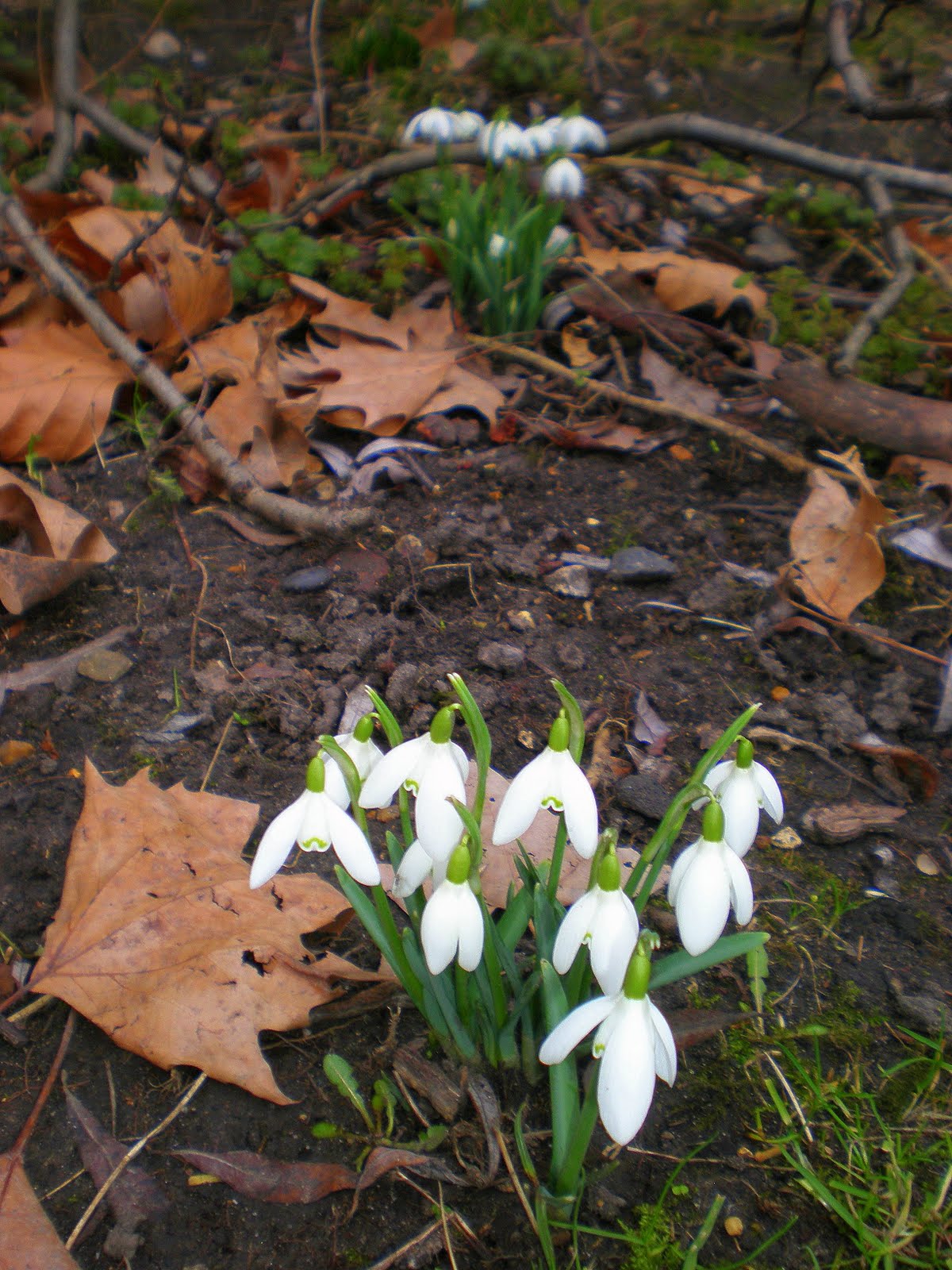
It did, I had fun, so after a bite to eat at Leon's and a necessary purchase of Bronnley's lemon soaps from Liberty's (Leopold Bloom did the same at Sweny's of Dublin in the 'Lotus Eaters' episode of Ulysses, I learnt long after taking a fancy to them) I took the Nash way to St James's Park. Where the first snowdrops were finally out.
A park worker asked me if it was true that a snowdrop had fetched £300 on eBay. I said I had no doubt, because galanthophiles will pay that much for a rare species - though I feared these were not in that category. Saluted a black swan
the pelicans on the island
and the first blossom
and went to meet the diplo-mate at Europe House where a new Slovenian exhibition requring 3D specs had just gone up. Through the park by the Houses of Parliament, peppered with grotesque Mexican statues
and then via Southwark to Borough Market, where I did my favourite shop - beans from the Monmouth Coffee Company, salami from the Piedmontese stall and crabmeat from the fish stand, where Whitby is queen of the seas.
And so eventually to the Barbican to be exhausted by Belohlavek's Mahler 6, where there were two divas (at least) in the audience - Linda Esther Gray (my guest, and now dear friend) and Anja Silja (Jiri's guest). The one thing I didn't manage to enlarge upon in the Arts Desk review was why I think the Allegro energico should always be followed by the scherzo, which it wasn't that evening:
1) It's a 3/8 replay of the opening march, in the same instrumentation; 2) The second subjects, Alma and the children respectively if you believe what she says, appear in the same keys - first F major, then D major; 3) The Andante is really only won when you've been through the two ordeals, and if you buy the children-in-the-sand image of the Scherzo, then the quotation from the Kindertotenlieder in the slow movement can only come after their Grimm-like annihilation; 4) The half-hour finale is too much after the grim scherzo.
Belohlavek - pictured above by Chris Christodoulou - made the best possible reasons (2 versus my 4, see the review) for the reverse order, but I'm still not convinced. But no matter, it was a shattering evening. What with that and the Jacobi Lear screened live on Thursday, I've been reeling. Which I can't exactly say about Weinberg's The Portrait at Opera North in Leeds tonight. But I'm jumping ahead of myself - more anon.
All observations, questions and challenges are welcome: resistant to tweeting and Facebook (though long converted to LinkedIn), I still like to exchange ideas. You don't have to be signed up, and you can be anonymous, but comments are moderated.
Copyright
If you wish to use any of my own photographs featured in the blog, or any of the text, just let me know in the comments. Acknowledgment and a link are all it takes.


+BARDA.jpg)




 Posts
Posts



