Dante's Divina Commedia was Puccini's model for the trajectory of his most comprehensive masterpiece, even if the subject-matter is quite different for the most part. You can, of course, take Il tabarro, Suor Angelica and Gianni Schicchi separately, or put the individual operas alongside other one-acters, but it's reassuring to see the trilogy most often presented these days as the composer intended (and no, IMO it is NOT acceptable to reverse the orders of the convent drama and the Florentine comedy).
The beauty of it is that each is a supreme masterpiece of timing and atmosphere on its own terms. Each makes use of finely observed vignettes in the first third of the drama before the screw begins to turn. There is something hellish about the barge couple's existence in Il tabarro, but it's offset by an almost Debussyan impressionism and gently comic vignettes. Puccini surely drew some of the details of cloistered life from meeting with his sister in her monastic community. And the better I know my Dante - THE big revelation of recent years since the free course with Alessandro Scafi and John Took at the Warburg Institute - the more pleasure I can take from the passing references to so many Dantean names and places in Schicchi, even though its source is a mere line and a bit in Inferno.
Then each opera packs its punch (and never more so than in Richard Jones' Royal Opera production - we'll be referring to the above regularly). Suor Angelica is the most heartbreaking, on a level with Madama Butterfly; Gianni Schicchi is laugh-out-loud funny tinged with youthful romantic love. It will always be a desert island opera for me since it was on an Edinburgh Fringe week of performing it with the Rehearsal Orchestra that my so far 35-year-old relationship with other half, later civil partner and husband, began.
I'm hoping the infinitely generous and warm Ermonela Jaho can be persuaded to join us after her unforgettable visit to the Butterfly course (when we also had two hours of Antonio Pappano, but I guess he's even busier now. Just got a proof copy of his autobiography and there's wisdom on every page). Meanwhile, here's the flyer for the forthcoming term with full details of how to join - click to enlarge.
For the last four Mondays I can't wait to revisit John Adams's Nixon in China - for me, the best opera of the last 40 years, though there are comic rivals to Schicchi in Gerald Barry's The Importance of Being Earnest and Alice's Adventures Under Ground). One plus since the last time is that other productions have appeared since Peter Sellars' initial hit toured the world (partner and I saw its UK premiere in the Edinburgh Festival at the aformentioned time). To return to operas I'd studied in live classes is never to repeat; I don't look at the old notes. Picture below by Ken Howard from the Met staging of the Sellars production.
How fresh and wondrous we all found Salome and Carmen this past term. The most rainbow-hued of Strauss's operatic scores is surely also his most perfectly structured. And seeing it a week after the last class in Bruno Ravella's so richly-layered Irish National Opera production in Dublin was a wonder (image below by Patricio Cassinoni for INO).
Hpw delighted I am that it will be appearing on the superlative free OperaVision website (YouTube connected) later this month, with Ravella's unsurpassably well-cast Garsington Ariadne auf Naxos). How lucky we were, too, with tie visit of Bruno and conductor Fergus Sheil just before the production opened.
Bizet's instrumental and harmonic felicities in Carmen seem limitless: surely this has to be the opera to take a newcomer to if the performances nail it. And I don't think we'll ever see or hear surpassed the duo of Elīna Garanča and Roberto Alagna in Richard Eyre's Metropolitan Opera production*.
I used scenes from other productions, but no central relationship goes to the edge in its visceral quality as this one does. I've previously state that the DVD of Glyndebourne's Janáček Jenůfa should be the first port of call for anyone who comes to opera from the world of theatre; for the perfect mix of aria, duet and ensemble form with high drama, the 2010 Met Carmen should be the one.
*UPDATE: Damiano Michieletto's new Royal Opera production comes nowhere near, alas, or certainly not with its first cast, marvellous though Aighul Akhmetshina is. And of course I wanted it to succeed, but the review has to tell the truth.
I'm actually referring to one-off classes from the past two weeks of my Opera in Depth course, but Adams' Christmas oratorio/opera and Shostakovich's Gogol extravaganza are both unique even in their composers' outputs (top images: Mujer de Mucha Enagua, PA'TI XICANA, 1999, as it appears on the cover of El Niño's indispensible first recording, and the 2012 tapestry The Nose, with Strawberries, executed by the Stephens Tapestry Studio, Diepsloot, Johannesburg, to a design by William Kentridge - part of the wonderful exhibition Thick Time at the Whitechapel Gallery, which I have yet to write about).
Adams was to go on and enrich the biblical-mythic aspect of his music in an even more complex work, The Gospel According to the Other Mary, while Shostakovich had another shot at Gogol in the 1940s, trying to set his play The Gamblers word for word, but gave up (there are Gogolian touches in Lady Macbeth of Mtsensk, too). Before I pass over what we talked about Shostakovich-wise the week before last - the Adams experience has rather eclipsed it - I must at least put up one more image taken by Bill Cooper of the best thing about Barrie Kosky's Royal Opera production, the multiple dancing noses.
Curiously I felt that the single class on The Nose was actually enough - I'd started by intending three - while I wanted at least another two-hour session on El Niño. All the students who spoke up seemed to fall in love with Adams' piece on the spot. None had seen the overloaded UK premiere with Sellars overegging an already elaborate pudding with a film that hadn't been timed to fit the music; Adams admits the many shortcomings of that first production when it opened at the Chatelet in his indispensible autobiography Hallelujah Junction, which I wrote about on the blog back here).
I started where Adams does in Chapter 12 of that beautifully written confessional, with what he calls 'the ecstatic shuddering and quivering of violins and jubilantly exclaiming voices' of Handel's 'For unto us a son is born' from Messiah. He goes on to write about the WASPy images of Christ and his disciples from his childhood, his mother's move from the Episcopalian to the Unitarian Church, and how its 'moral and intellectual training', though fine, seemed too close to Plato, Voltaire and Bertrand Russell and didn't feed his need for the 'spiritual truths' of religious mystery and miracles (the latter my own sticking-point with the New Testament). Elsewhere, to Michael Steinberg he confided 'I envy people with strong religious backgrounds. Mine is shaky and unformed. I don't know what I'm saying, and one reason for writing El Niño was to find out.'
It almost goes without saying that, as in so many of Adams' works, the light and the dark are in constant tension. That's best summed up, perhaps, in Mary's response from the St James Gospel when Joseph asks why she is weeping one moment, laughing the next, and she replies: 'It is because I see two peoples with my eyes, the one weeping and mourning, the other rejoicing and glad'. Only the simplicity of the final children's chorus, a setting of Rosario Castellanos' A Palm Tree, offers any kind of resolution to the two-edged use of the title, 'El Niño' as both 'the child' and that phenomenon of capricious weather - though this too, one feels, is provisional: the naive leading us back towards innocence and away from the sentimental.
Like Steinberg. I'm indebted to Adams for introducing me to the poetry of Castellanos (1925-74), one of the world's greats, it would seem - and which of us, in the UK at least, knew her work before? On the original recording, it's the incandescent Lorraine Hunt Lieberson who intones the sinuous, Spanish-faithful setting of Castellanos's childbirth chronicle, 'The Annunciation'. The interplay of poems by Castellanos and other Spanish-language writers with Biblical texts and their curious offshoots is as masterly as Britten's interweaving of the Latin mass for the dead with Wilfred Owen in War Requiem, and sometimes more ambivalent. The choruses are shattering, the writing for Dawn Upshaw stunning - more than the pure-voiced Mary of Part One, it's her anguished delivery of 'Memorial for Tlatelolco', the most hard-hitting of the Castellanos poems included, which packs the biggest punch, along with music of breathtaking complexity. This, of course, is the work's 'massacre of the innocents', the flipside of the radiant birth. More on the 1968 horror here.
But Adams also has the gift to be simple: I prefaced it with the mixture of St James' and the Latin Infancy Gospel depicting Joseph's amazement at how the whole scene stands still for the birth, sustained strings and pinprick piccolos backing up Willard White's superb natural declamation. And of course we had to end where Adams does, with the finale genius interweaving of the Pseudo-Matthew narrative where the Holy Family is fed and watered by a palm tree obedient to the Christ Child alongside the final Castellanos poem. And naturally the Flight into Egypt becomes the part of the Christmas tale which perhaps has most resonance today given the plight of those millions of refugees fleeing death and destruction.
All this makes us anticipate Adams' own performance with the LSO on Sunday all the more, even though it's only two years since I was blown away by the first performance I heard to present the music in its unadorned glory. Meanwhile, only a couple of hours after I'd finished Monday's class, quite a few of us had moved on to the Barbican for something completely different - the European premiere of Gerald Barry's Alice's Adventures Under Ground. Read all about it on The Arts Desk. The magnificent seven singers are pictured below with Thomas Adès conducting the Britten Sinfonia; image by Mark Allan.
Gerald had promised to follow up his first visit to the class earlier this year with another, but a final rehearsal yesterday afternoon meant that wasn't possible. Never mind, he'll be back soon, not least - I'm certain - for the first UK staging of his new opera.
Here's one I prepared earlier, now let out of its cage. Look no further if you haven't listened to my Building a Library on Parsifal, just broadcast, and you're postponing revelation until you catch it on iPlayer for the week, or whatever this clip facility now up and running might be (17/!2: my producer tells me it should be 'up there until the end of days', or of the BBC, whichever comes first. There's also a podcast, which you can download here). I'll even stick in a further grail image, 'the one', ho hum, in Valencia Cathedral, to delay a glimpse of the winning cover.
The choice, for the first time in my 20-odd years of doing the programme, was totally obvious. So many folk have said to me over the past few months, 'of course you'll go for Knappertsbusch '62'. I thought I would when I listened again to Hans Hotter as Gurnemanz in Act One. But it became ever clearer to me as I listened to the three 'Kna' Bayreuth Parsifals currently doing the rounds - also including his first, from 1951, and his last of 1964, not long before his death - that I didn't want this kind of hard-hitting so often.
Kna's style does make for magnificent pinnacles - Hotter's 'O wunden-wundervoller heilige Speer' ('62) and George London's 'Erbarmen' in Act 1 ('51), Jon Vickers' 'Amfortas! Die Wunde!' in Act 2 ('64) - but what I've always sought since Haitink showed me the light at Covent Garden, conducting Bill Bryden's mostly intelligent production, is a naturalness that doesn't need to reiterate the spirituality and grandeur. As Mark Wigglesworth remarked when he came to talk to my Opera in Focus class the other week, Parsifal gives and gives while Tristan simply takes and leaves you exhausted. A great conductor needs to guide and give space where necessary, of course, but not to impose his (I await a 'her') will.
Which the great Rafael Kubelik never does. A few clever folk knew of this 1980 studio recording's existence but I certainly didn't before I came to listen and nor did my Parsifal-crazy producer Clive Portbury. He agrees that it's incomparably the best of what we have.
Runners-up I don't need to mention again here, but I do urge you to see the DVD of Hans Hollman's Zurich production. It would qualify alone as the only document of Haitink's conducting, but it's also the most quietly moving staging I've seen, trusting to the singers' stillness in the outer acts and - most important of all - respecting the transcendence of the grail ritual for all the suffering that surrounds it. The vital antidote, in short, to Stephen Langridge's Royal Opera horror. The students all thought so when I screeened Act Three in an extra class on Monday, and many wiped away the tears that simply hadn't flowed at Covent Garden.
I have a feeling that might happen when the Met production with Jonas Kaufmann comes out on DVD in February; from the images I've seen it appears much more in the right region than the one we're enduring in London. In the meantime, snap this up while you can; Gatti's conducting won't surpass Haitink's, and probably won't come anywhere near.
Alas, there are no clips on YouTube so I'll move sideways to seasonal seriousness. On the same Tuesday when my preparation schedule had been eaten up by the flying visit to 'do a telly', I took the BBC Symphony Orchestra class through two very different responses to the Flight into Egypt story, tied in with the chance to hear the two works in question tonight and tomorrow afternoon. Berlioz's painfully beautiful, intimate L'Enfance du Christ located the narrative close to the centre in the hands of the tenor 'Evangelist'. We had Anthony Rolfe-Johnson returning to life so scrupulously for John Eliot Gardiner, but all I could find on YouTube was Alain Vanzo not at his considerable best for Jean Martinon. So let's make do with that.
Like Britten's best poetry compilations, John Adams's El Niño would be admirable just as a sequence of magical words tellingly juxtaposed, without even taking into account the extraordinary music which of course layers it still further. I look forward to experiencing it tonight without Peter Sellars' stage 'realisation', so enervating when the 2000 Paris original came to London. Adams for his supernatural epilogue turns to the charming and naive Gospel According to Pseudo-Matthew for a rest beneath a rather unusual palm tree, and juxtaposes it with the last of the stunning Mexican poems by Rosario Castellanos, a revelation to me.
As the soundclip doesn't offer a translation of the Castellanos poem, I take the liberty of reproducing it here:
Lady of the winds, heron of the plains, when you sway your waist sings. Gesture of prayer or prelude of wings, you are the cup into which the skies pour one by one. From the dark land of men I've come kneeling to behold you, Tall, naked, alone. A poem.
So the text resounds and melts into a single repeated word in the mouths of children - 'poesía'.
15/12 What a weekend it's been. My Arts Desk reviews are now up of El Niño here and of L'Enfance du Christ here. Don't whatever you do miss the Radio 3 broadcast of the ineffably moving Berlioz performance on the iPlayer herefor the next week.
'Desert' is probably the wrong word to describe early Minimalism: at the time it must have seemed more like a rainforest after the aridity of Darmstadt's iron rule. So in writing my Arts Desk review of the BBC Singers' and Endymion's reduced-forces version of Steve Reich's 1984 masterpiece The Desert Music, I fumbled for a compromise, 'savannah', in trying to describe the terrain from which it, and earlier (in 1980-1) John Adams's equally individual chorus-and-orchestra spectacular Harmonium, took off. Curiously, and incidentally, that same day I read a passage in Richard Mabey's bewitching Nature Cure where another of my heroes used the term 'savannah' for an image in a different context.
As ever, in trying to sum up what Minimalism was for the students in a 20-minute lecture-room whizz before the Milton Court concert began, and where these two composers departed from its basics, I found my Adams bible, Hallelujah Junction, indispensible. Mighty John is writing about the work in which he first found his voice, Phrygian Gates, having turned 30 by the time Mack McCray gave its premiere in 1977. Forgive me for reproducing such a large chunk of text, but it conveys everything I want to say, and more, from an insider-practitioner's perspective.
I had first heard Terry Riley's epochal In C while still living in Cambridge, probably in 1971. A friend, another composition student, invited me back to his flat with the promise of introducing me to something 'like you've never heard before.' And he was right. What he played for me was the famous Columbia Masterworks LP of the landmark piece that announced a new style in contemporary music. Terry's In C may have been to contemporary American music what Ginsberg's Howl or Kerouac's On the Road were to literature. With its insistent, unyielding high pulse on the high C of a piano and the sunny, upbeat fragments of melodies recirculating over and over in a loose polyphony, In C captured the congenial hippie spirit of the West Coast while at the same time proposing a new, slowly evolving approach to musical form. It was also marvelously provocative, giving an R. Crumb [who? I only know, and love, George*] middle finger to the crabbed, pedantic world of academic modernism.
I later heard more organized, more elegant versions of the Minimalist aesthetic when Steve Reich brought his ensemble to town in 1974. Their performance of Drumming revealed a different but equally novel take on pulsation as the guiding principle of the music - the main event, so to speak - but compared to In C, Reich's materials were more fastidiously organized and the gradual process of melodic, harmonic and timbral evolution more methodical. What also impressed me about Reich's music-making was that it was done at a high level of expertise and preparation. In contrast to the free, anarchic avant-garde happenings I'd been involved with, Reich's music used precision and balanced counterpoint to create a sound world that was carefully organized, musically engaging and sensually appealing.
...What appealed to me about these early works of Minimalism was that they did not deconstruct or obliterate the fundamental elements of musical discourse such as regular pulsation, tonal harmony or motivic repetition. Indeed they did the opposite: they embraced pulsation and repetition with an almost childlike glee. To me, it felt like the pleasure principle had been invited back into the listening experience.
And what of Glass? I have foresworn his company, which means that if I can avoid it I hope never to sit through one of his symphonies or operas again. Adams is brutally frank on the historical limitations.
...But much as they enchanted me, these Minimalist compositions felt like latter-day descendants of Baroque compositions from the 18th century. As musical organisms, the pieces were largely monolithic, their expressive worlds more often than not confined to a single affect. One spoke of trances or hypnotic states. That was both the brilliance of the style's originality and the conundrum of how to make it evolve into a language of greater subtlety...Much of his [Glass's] symphonic music, such as the 1996 'Heroes' Symphony, based on songs by David Bowie and Brian Eno, moves among simple, familiar harmonies in regular symmetrical units of two and four bars, while the orchestration, once established for a movement, remains more or less unchanged.
Those are shortcomings you won't find in The Desert Music or Harmonium. Which is why I'm still startled when someone else labels Reich and Adams (pictured above, much more recently than Reich, by his superb photographer partner Deborah O'Grady) American Minimalists. I've just read an annoying interview in the latest BBC Music Magazine with John Tavener, who says he hates that 'school' on the whole: 'John Adams bores me to tears'. Tavener's longer rituals bore me to tears, as it happens. Adams bores me never, even if I respond to some works more enthusiastically than to others.
The Desert Music certainly isn't for trance states; as Reich says in an interview on the original LP, 'I actually prefer the music to be heard by somebody who's totally wide awake, hearing more than he or she usually does, rather than by someone who's just spaced out and receiving a lot of ephemeral impressions.' As the poetry of William Carlos Williams, a real revelation to me, has it as set in the fourth movement, 'I am wide/awake. The mind/is listening.' The below is a fine performance, even if the choir doesn't 'get' the text in the same way American or British forces seem to.
The opening is anything but Minimalist-diatonic basic: in fact so much of the piece lives in a state of suspension, like Tristan und Isolde, or anxiety (specifically about the nuclear threat) that the hint of an F major resolution, still ambiguous, makes the ending especially luminous.
In that context, I proposed to my great blogging friend Susan Scheid over on Prufrock's Dilemma that we each give a list of 20th century works offering affirmative capability, even if that only comes at the end of the masterpiece in question, one per decade. Here are mine today (they could of course change tomorrow). The Desert Music slotted into the 1980s only by postponing Adams for the 1990s
1900s: Schoenberg's Verklärte Nacht. It was actually composed in 1899, but the Rosé Quartet and two players from the Vienna Philharmonic gave the original sextet premiere in 1902.
1910s: Strauss's Der Rosenkavalier. Especially apt since Salome and Elektra had preceded it.
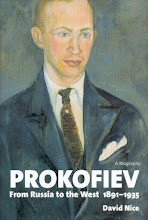
1920s: tricky - Prokofiev's The Prodigal Son is suitable because of the beautiful homecoming, but Nielsen's Fifth Symphony is the greater work.
1930s Britten's Paul Bunyan. Such optimism, such a libretto (Auden). Having recently been faced with the possibility that several of the 'mature' operas, one especially, might not be as great as I thought they were, I love it the more.
1940s: should really be dividied into war and post-war years, but this is a celebration that manages to be rooted and iconoclastic at the same time: Messiaen's Turangalîla Symphony with its crazy final blaze of a chord out-Scriabining Scriabin.
1950s: Shostakovich's Tenth Symphony. That finale really is raucously celebratory, not hollow, I fancy, with the rampaging of the composer's personal signature. And Stalin really was dead, even if the composer had no great optimism about his successors.
1960s: Poulenc's Gloria. Hits the heights more surely than the earlier Stabat Mater, which I heard on Wednesday and found it eclipsed by Prokofiev's painfully beautiful Seventh Symphony.
1970s: Bernstein's Mass. I see I've gone to the New World for later 20th century optimism from this point on.
1980s: Reich's The Desert Music
1990s: Adams's El Niño. Cheating in quite the opposite way to my choice of Verklärte Nacht: I assume work began at least a couple of years before the Paris premiere in December 2000. Looking forward to hearing it shorn of its Peter Sellars production overload when Jurowski conducts it towards the end of The Rest is Noise festival.
*Howard Lane clarified below: 'R. Crumb is the signature of the cartoonist Robert Crumb of Fritz the Cat, The Fabulous Furry Freak Brothers and Mr Natural fame.'
UPDATE (28/10) Notice board for pre-performance talks I'm involved with this week - four on the trot:
Wednesday 30 October: talking to Michail (father of Vladimir) Jurowski in the Royal Festival Hall about his LPO performance of Schnittke's First Symphony. Sorry to hear that Sasha Ivashkin, who knew Schnittke well, has written and/or put together two marvellous books about him and interprets the great man's cello works as well as anyone, is ill and had to cancel his play-and-talk event: hence this different combination.
Saturday 2 November: back to the BBC Symphony Orchestra at the Barbican to chat with Tristan Murail and say a bit about Shostakovich's First Piano Concerto and Mahler's First Symphony before Sakari Oramo's first official concert as the BBCSO's chief conductor.
I hadn't intended to go to the third concert in John Adams's mini-residency with the London Symphony Orchestra, though I'd certainly been bowled over by the first two (review of no.1 here on The Arts Desk). Rare as the programming looked, Copland's Appalachian Spring is one of those pieces to whose charm I'm deaf - diatonicism taken to artificial extremes? - and Elliott Carter remains anathema to me ('how can you be so hard-hearted?' said my concert companion Hen, 'the poor guy died last year'. That was before she heard his Variations for Orchestra).
It was the Adams piece on the programme that I knew I had to hear after the St Lawrence String Quartet's absolutely stunning performance of his String Quartet on Thursday at LSO St Luke's, where the above photo was taken by Kevin Leighton. I need much more time to get to grips with that complex work, probably a masterpiece.
They were very much at the centre of Absolute Jest, first performed last year with Adams's buddy of 30 years Michael Tilson Thomas conducting the San Francisco Symphony Orchestra. I think, then, this must have been the UK or even the European premiere, but there was no fanfare about it.
I'm not sure what connection the title has with the novel Infinite Jest by David Foster Wallace - though I'm attracted to the book from what I've just read about it, to be sure. What's certain is that this has to be one of music's biggest ever scherzos at around 25 minutes. It begins with the pounding dactyls of Beethoven's Scherzo in his Ninth Symphony, which the orchestra takes to semi-minimalist extremes. But the real subjects are the scherzos of late quartets Op. 131 - that weirdest of chatterboxes - and 135, with its manic repetitions.
It was Adams's idea, presumably, to preface his performance by getting the St Lawrences to play the passages in question, along with the slow fugal introduction to Op. 131 which finds itself interlaced with snatches of the Grosse Fuge in a much-needed if hardly easy slackening of all the frantic activity.
Others like my colleague Alexandra on The Arts Desk have raised the question of whether it's a good idea to submit to your own style the music of a giant. After all, most of Stravinsky's stylisations including Pulcinella, a performance of which was one of Adams's inspirations, are based on lesser composers or lesser music. And co-opting one of the supreme masters is different from finding your own music lined up in a concert programme with Beethoven or Brahms (what Adams charmingly calls 'sharing a bed with the big boys'). Well, I bought Absolute Jest for as long as it lasted, in colour and motion the work of a master. The wind-up from the central section was as accomplished as any of Adams's great transitions, and there was a sequence for the quartet players just before the end that absolutely knocked me for six.
This may be where, I later learnt from Tom May's SFSO note as reproduced on JA's compelling if fitful blog Hell Mouth, the composer references the 'Waldstein' Sonata's opening - you can see how exciting that must have been for Adams in his early almost-minimalist phase. One good result is that Adams has turned me back to the late Beethoven quartets, with which I've always struggled, and I begin to hear them more clearly.
More details about Absolute Jest in Adams's four-minute talk filmed by the San Francisco Symphony Orchestra last year. Good to see he didn't repeat much of this on Sunday.
I can't see that Absolute Jest strikes out for deeper waters and more poignant climes as the first concert persuaded me again that Harmonielehre does, at least in its first movement.
But it is, after all, a scherzo, and Adams's concert sequence had given us a much less approachable Big Boy earlier. As Carter's Variations began their perplexing journey, I could admire the remarkable orchestration even as I resigned myself to not being able to detect the theme the variations were supposed to be tracing. But, like the composer himself in a grisly evening I once experienced of his string quartets where he talked and talked, the piece does go on. And the Neo-Gothic, brass-heavy peroration suffers from a bad case of elephantiasis. Adams writes superbly about his ambivalence towards Carter, and his acquaintance with Copland, too, on the above-mentioned blog, Hell Mouth.
Appalachian Spring passed swiftly and with lively string playing, but the real dazzler was Ives's Country Band March later incorporated into Three Places in New England, a knockout curtain-raiser if ever there was one. And three cheers once again to Adams for three superbly designed concerts. I'm now looking forward to The Gospel According to the Other Mary at the Barbican in March, though reports from the Los Angeles premiere have been very mixed.
Back to Bach as promised, and a cantata for Septuagesima which has nothing to do with either of the Gospel readings for the day, one of which is the parable of the workers in the vineyard (as supposedly depicted by Rembrandt above). 'Ich hab in Gottes Herz und Sinn', BWV 92 (1725, Leipzig again) is more preoccupied with the rough seas, winds and eathquakes God sends to test mankind. It's another of those 'total submission to God's will' texts which don't bear too much examination by agnostics like me. But what invention there is here, as usual.
The chorale that runs through the cantata begins in the sopranos against independent lines from strings and two oboes d'amore, especially winsome in thirds that take some unexpected turns. It punctuates the bass's recitative, where the continuo goes darting and plunging off to imitate the 'cracking and fearful crashing' of mountains and the 'great waters' (an excuse for introducing a stormy seascape by Ludolf Bakhuizen below). The turbulence is sustained in whiplash strings forcing an equally strenuous line from the tenor in his aria.
The bass's comparable number dealing with rough winds, this time in the shape of continuo only, sounded unduly blustery in bass Dominik Wörner's singing for Masaaki Suzuki; I'm sure there are more convincing ways of performing it. But the soprano's calm pastoral after all these elemental surges is a winner, and quite unlike any other Bach aria I know, the vocal line dancing with a solo oboe d'amore against the most delicate pizzicato strings. After the plain sailing of BWV 72 on Sunday, this was a total treat - and rather militates against the 'short cantatas to help choir beat winter cold' theory since it's half an hour long. 13/3 I'm replacing my original YouTube Leonhardt with the superb Koopman, above all because on it is our (re)New(ed) Best Friend Debbie York, who's been to stay as a result of Facebook re-contact with J, her old fellow Glyndebourne chorus pal (and Queen of Spades dance partner). And magic she makes indeed of one of Bach's loveliest arias (around 24'20).
Unthinkable, isn’t it? And yet that would certainly have
happened if the Islamist extremists, having taken Konna the other Thursday, had
been able to plough on to Bamako.
There have been well-reported programmes on the World Service filling us in on
the situation in Timbuktu
and elsewhere in the north: no sounds of music allowed, not even on the mobile
phone. The Festival in the Desert has, of course, been a fatality, though by
the sounds of it that had been corrupted from its original Tuareg base to an
international event for very well-heeled tourists featuring a lot of crap bands
from abroad who wouldn’t have been tolerated anywhere else. Sophie tells me
that part of the set-up now reassembles at Segou between Bamako and Djenné.
Just how relaxed the music scene in free Mali is can be
seen from these photos, which I apologise to those with a long enough memory
for repeating from 2009. Yes, women singing, playing and dancing: something not
tolerated in Iran
or any of the more extreme Muslim states. It only goes to show the easy-going
nature of Mali’s
sufi-based religion. We caught the good women of Diabolo (not to be confused
with Diabaly, much in the news of late) performing for their village when we took a horse-driven excursion with Sophie from nearby Djenné, and they were quite
unfazed by our presence, OKd by the local headman. True, they were performing
for tourists the following week, but the crust-earning seemed well deserved.
I’ve been listening to the great, late Ali Farka Touré, guitarist-vocalist
‘king of the desert blues’. The booklet for his last solo album, recorded at
Bamako’s famous Hotel Mandé by World Circuit , is exemplary (and unusual in the
so-called world music scene) in giving us notes by The Man with translations of
the songs. I’ve chosen this one about Beto, the river god of neighbouring Niger, because
the text is appropriate: ‘Beto, will you share with us this special day of the
new year? Yes, Beto, indescribable Beto, Beto, speak, we are listening.
Beto, tell us…are the ancients angry?’
The special sound on the next track, Savane, is that of two ngonis,
unusual west African stringed instruments.
The famous Basseko Kouyaté is
one of the players, and (27/1) was playing at the Barbican last night when I was duty bound to hear Elgar's The Dream of Gerontius over at the Royal Festival Hall; see Howard Male's review on The Arts Desk. The rest of the photos, by the way, obviously aren't mine.
Ali Farka Touré also recorded a Hotel Mandé session with Mali’s
most celebrated exponent of the lovely 21-string harp called the kora, Toumani
Diabaté.
It was, as AFT explained, an unusual conjunction ‘since I am
from the Songra/Peul culture in the north and he is a Mande from the south.
It’s rare that musicians meet like this from different cultures’.All too
familiar contrasts between music’s hand of friendship and more common daily
hostilities has just been strikingly illustrated by intelligence well
documented by Amnesty and in the Guardian that the Malian army, whose fighters are
mostly from the south, has been committing atrocities against the Fulani people
of the north.
Anyway, the result of the meeting between guitarist and
kora-player is, to our ears, pretty basic – improvisations on two chords in
each number – but beguiling thanks to the sonorities of the two instruments. This is 'Monsieur le Maire de Niafunké'*.
Meanwhile the Bach cantata for the week is ‘Meine Seufzer, meiner
Tränen’, BWV 13, composed for Leipzig
performance in January 1726. The Gospel reading for this second Sunday after Epiphany treats of the
Marriage at Cana where Christ miracled water
into wine (detail below from Veronese’s vast canvas of the scene; the musician
on the left is believed to be a self-portrait).
The subject-matter and the prevailing musical mood of Bach's
cantata, however, could hardly be further removed from the expected. Only two
lines deal with the happening – ‘God can with ease/Turn bitterness into joyful
wine’ – and the rest is numberless tears, groaning, the sickness of sorrow, in
other words the earthly misery to be transfigured. John Eliot Gardiner writes
that in the opening aria only the tone of the oboe da caccia we met two weeks ago, intermediary here between the tenor and the two recorders, softens the
dissonances.
The bass lament at the heart of the piece has to be one of
the bleakest numbers ever composed (the Germans have a word for it I found
applied by Hofmannsthal to Elektra: ‘lichtlösigkeit’ or ‘light-less-ness’). This
time the recorders double the violin obbligato at the octave, wraith-like; the
soloist only partly fills the chasm between them and the bass line. Even when
the central portion of the text speaks of solace and joy, there is hardly a
sliver of light. Detail below from Rogier van der Weyden's Deposition.
On the other hand, the alto’s earlier chorale, crying out to
God in vein, is wreathed in joyful strings, as if to contradict the
hopelessness with a promise of better things. Otherwise, this is a stark revelation of the human condition, and
I marvelled at Gerald Finley’s restrained performance of the big number in the
Gardiner Bach Pilgrimage performance. Once again, there's a slightly less special alternative on YouTube, part of Masaaki Suzuki's Bach Collegium series:
We had extremes of joy and despair in last night’s bumper LPO/Jurowski Strauss concert launching the Southbank’s much-touted The Rest is Noise festival,
including a revelation of mighty Richard's death haunted symphonic poem for voice,
violin and orchestra Notturno. Read all about it on The Arts Desk - a long review for a very densely packed programme. Ambitious
though it was, I got more consistent enjoyment out of the execution in John
Adams’s LSO spectacular three days earlier, as recounted here. Much more to come now that the concert season is back on the boil.
*STOP PRESS The ever vigilant Sue Scheid has alerted me to a wonderful video of Mali's great musicians uniting to plead for peace. I can't say I know them all, but if anyone can tell me who's who among the terrific lady vocalists, I'd be grateful. Though Sue has the links below, I'm posting it here for easy access. I believe it's our kora-ist, Toumani
Diabaté, kicking off.
I'm certainly not referring to their creators pictured above in the first of Richard Hubert Smith's ENO production shots: knowing treble Joseph Beesley and more-than-promising tenor Nicky Spence, unrecognisable in the transition from feckless twentysomething Baron Lummer in the Scottish Opera Intermezzo to tortured teenager. Both were part of an excellent team at ENO, all of whom handled their not ungrateful vocal lines - that's something, for a start - with aplomb. And I hate to pour cold water over the bubbling score of the orchestrally adept Nico Muhly, who knows how to orchestrate and provides more shifts in instrumental colour and texture as well as harmony than I was expecting from Glassian premises.
Yet the whole thing is so turgid and lumpy as music-drama that half way through the first act I wanted to run screaming from the theatre. That's a response, I guess, though it's not even the purer loathing I had for Glass's Satyagraha. At least Glass had the courage of his back-to-basics convictions - an anti-theatrical four chords in forty-five minutes which serve as something of a trademark (that he simply hasn't evolved like Adams or Reich is another matter). Muhly, though, always sounds like someone else - mostly Adams in early, Nixon in China mode, without that score's flying dynamism.
And how did Muhly botch that most operatic of opportunities - the chance to haunt us all with a choral, overlapping representation of the internet's humming 'netherworld of cheerless cheer'? When so-so librettist Craig Lucas says that 'opera isn't about beautiful music, it's about dramatic tension', he sounds Two Boys' knell - though he seems to believe that his composer can do the nodal-point stuff. Really? Only consider the stabbing and its aftermath, which despite being set up by some fine growly tuba-and-basses writing go for nothing (is that the point?) The overall result is portentous, very far from the humanity Lucas half-etches and as moralistic as the Royal Opera's Anna Nicole without the fun, the musical invention or the staging of genius.
I liked two things in the score: the shifting support for the first solo of Sue Bickley's Detective Inspector Anne Strawson on curtain-rise, and the way her vocal line takes up the orchestral line at the start of the second. Yet ultimately even Bickley doesn't have a chance to engage as she should.
There's still a chance that the real Nico Muhly will stand up, but I have a feeling he may carry on being the Korngold to John Adams's Richard Strauss (which is hardly a huge insult if you revere Erich Wolfgang more than I do, and besides, Korngold even at his most precocious had a better sense of where to press the dramatic buttons than Muhly does). Let's also remember that by the age of 30 Shostakovich had written both The Nose and Lady Macbeth of Mtsensk, Prokofiev The Gambler and The Love for Three Oranges. All I can see at the moment, though, is that in terms of sharpness, subcutaneous horror and sheer fecundity of ideas, ENO's latest show is left standing by its Midsummer Night's Dream - and that goes for Bartlett Sher's fidgety production, too, with its now-generic video projection.
Well, not everyone agrees: for an alternative view, see my colleague Igor's review on The Arts Desk. Do go and make up your own mind(s): just because a new work fizzles, that doesn't mean enterprising companies like ENO shouldn't keep on trying to find the operas of our time, the ones that really engage our hearts and minds.
For many folk I've spoken to, Alex Ross's The Rest is Noise has become a bible of information about 20th (and 21st) century music. It's extremely well-written if necessarily biased towards what the author likes, to judge from what I've dipped in to (what, not a word about Jimmy MacMillan?), but for authenticity it can't beat John Adams's autobiographical journey through the thickets of what he calls 'the partisan orthodoxies and prejudices that dominated my generation'.
Yes, he was there when Boulez ruled with his dogma, 'a technocrat bristling with all the gleaming armaments of his specialized field'. He was bewitched by the freer experimentation of Cage and company: was it any more than 'Dadaist doodling'? Much more, he fairly concedes, but judiciously lists its limitations. He was engaged by the promise of minimalism, describing Reich's early work as 'a sound world that was carefully organized, musically engaging and sensually appealing...To me, it felt like the pleasure principle had been invited back into the listening experience'. The cabin'd aspect of minimalism, Glass's static brand especially, is then tactfully touched upon.
But Adams was also beguiled by the best of the popular music of his time, by the revelation and the long-term promise of Wagner when driving along listening to Act 1 of Götterdämmerung, and later by Peter Sellars's eclectic knowledge of musics outside the 'western hegemony'. The book also offers lucid clarification of the issues behind his operas, from Nixon and Mao in '72 through the Palestinian problem to a terrific exposition of nuclear power and the diverse branches to the basic Indian spiritual fairy-tale of A Flowering Tree.
If you don't think you have time to read the entire book, the short last chapter, 'Garage Sale of the Mind', is the best ever precis I've read of the crossroads at which we now stand, the notion that complexity isn't necessarily progress but that easy promise isn't the solution either. This fits with the swivels of his own all-embracing musical language: the other week I reeled again at the daring, gnarly counterpoint of his Chamber Symphony in a dazzling performance by the Aurora Orchestra under Nicholas Collon, and loved going back and listening to the CD again.
It was looking up what Adams had to say about the Chamber Symphony as a result that finally led me to read the book from cover to cover.
I realise how many of the scores I still need to catch up with: being a bit of a sucker for stylish CD presentation - which in this case sometimes features wonderful nature studies by the composer's photographer wife, Deborah O'Grady - I have to update with the Nonesuch releases following on from the Earbox, including Son of Chamber Symphony. I'm not saying every work is a masterpiece, but it's always engaging, never dull. The world is a much better place for Adams's music.And the wordsmith continues to do good with an inspirational speech to students, reproduced in full on his blog.
Anyway, I'm proud of my Earbox, which I got the great, easygoing man to sign along with my '88 Edinburgh Nixon in China programme after we'd done a fun talk before one of his BBCSO concerts. And I'm proud, too, that he said to the admin as we came off stage: 'he's really good, you should ask us to do this again'. But that's blowing my own trumpet in the manner of some of my esteemed but not very modest fellow-bloggers...
I'd have guessed an all-in-the-schoolroom reinterpretation of Britten's The Turn of the Screw. In fact Alastair Muir's ENO production photo is from Christopher Alden's even more radical re-think of A Midsummer Night's Dream, next in the Britten operatic canon: Iestyn Davies, whose throat infection meant he did a perfect mime job to William Towers singing very well from a box on the first night, is Oberon/Quint, with Dominic Williams as changeling boy/Miles and Anna Christy as Tytania/Governess. I've thought and thought about this superb realisation, which like Rupert Goold's vision of Turandot set in a Chinese restaurant oughtn't to work right across the board but somehow does, since I saw it on Thursday: read the Arts Desk review here.
To coincide with the new production, the latest in a series of new ENO-related series of opera guides has just been published. Building on the old ones, but even handsomer, they take me back to a more innocent time doing humble proofing for still much-missed Nick John alongside Henry Bredin, and happy days are here again with the very friendly Gary Kahn in charge. He asked me to write a piece on the production history of MND - haven't seen a copy yet, so can't tell you what else is in it - and I realise I've seen rather a lot, from luminously trad (the Peter Hall at Glyndebourne, three times) to luminously mod (Robert Carsen plus a short-lived Opera London version conducted by Hickox at Sadlers Wells) via one by Christopher Renshaw which made the score seem stiff and contrived at Covent Garden (saving grace: fledgling Mark Rylance as Puck) and one in a semi-staged performance at Snape (the diplo-mate sang Theseus).
The one I still wish I'd seen, apart of course from Aldeburgh days before I was born, is Baz Luhrmann's Raj-versus-protoBollywood Opera Australia production. I put up this YouTube trailer on the Arts Desk, but no harm in repeating it here. I've heard better performances of "Now until the break of day", not least last Thursday's, so bewitchingly as well as brutally conducted by Leo Hussain, but none - again, apart from ENO's latest departure from the norm - which looks more enticing.
ENO, of course, is on a roll. Though it's more hit and miss, Terry Gilliam's approach to Berlioz's already problematic Damnation of Faust has at least three visual scenes to compare with the coups of the C Alden Dream and continues the Bury regime's mostly successful incorporation of other media (the Dream is austerely straightforward in that respect, though the visuals - especially in an Act 2 sequence which I won't spoil - are no less amazing). Here's another blackboard shot for ENO, this time by Tristram Kenton - Peter Hoare as coxcombed, C D Friedrich Faust and Christopher Purves as Mephistopheles.
Next season has two surefire talking points which I hope will be great hits, and which I've taken the risk of including among the six operas we'll study at the City Lit. At the ENO's 2011-12 core is what I believe will be the London, though not the UK, stage premiere of Adams's The Death of Klinghoffer, which still hits idiotic pro-Israeli lobby reefs in the States (I've just read what Adams so eloquently and carefully has to say about the balance of sympathies in his superb book Hallelujah Junction). And the season kicks off with Mieczyslaw Weinberg's The Passenger in the David Pountney production, the Bregenz world premiere of which I've just waxed lyrical over for the BBC Music Magazine.
A more of-the-essence piece of work than Weinberg's The Portrait - don't miss the Radio 3 broadcast this coming Saturday at 18:00, with Christopher Cook chatting to me in one of the Leeds Grand Theatre boxes - it deserves its right to deal with Auschwitz; the author of the novel, Zofia Posmysz, was interred there and based her tale on the premise of what would happen if she came face to face in later life with her tormenting Kapo, and Weinberg escaped Poland and the fate of the rest of his family only to end up a near-victim of Stalin's antisemitic drive in the early 1950s. But none of this would figure if the score wasn't extremely strong, and I think it is, though haven't made up my mind pending the live experience whether it's a masterpiece or not.
My, these are culturally exhausting times. I've been to big events five nights on the trot, and I'm holding my breath about tonight's special-invitation Chamber Orchestra of Europe 30th birthday concert, on a hunch as to why the conductor isn't named on the invite. Wasn't looking forward hugely to the Glyndebourne Meistersinger on Saturday, given unquenchable loyalties to the WNO experience of Richard Jones's superlative production with Bryn Terfel last June, but it did its own thing and, while not surpassing the Welsh event, came close to it at times. Again, I tried to be as fair as I could to Gerald Finley, who did a good job and won a not undeserved standing ovation but still isn't Bryn or Norman Bailey, on the Arts Desk. And it was sheer bliss to be at Glyndebourne again on a perfect day.
I was lured away from my favourite picnic spot by the lake since we critics had only a ticket apiece, I wanted company, Ed Seckerson hadn't wanted to risk (wrongly) anticipated cold and discomfort, and so I joined him and a friend in one of the Wallops. Where the food was much better than I'd anticipated, even if service was in a bit of chaos on the first night. Anyway, I then got another little wander just as the sun had gone off the gardens.
At least one aspect of the new garden regime is redeeming recent misdemeanours: the abundance of papaver orientalis both in the beds on the lawn and in the formal garden was spectacular.
All observations, questions and challenges are welcome: resistant to tweeting and Facebook (though long converted to LinkedIn), I still like to exchange ideas. You don't have to be signed up, and you can be anonymous, but comments are moderated.
Copyright
If you wish to use any of my own photographs featured in the blog, or any of the text, just let me know in the comments. Acknowledgment and a link are all it takes.


 Posts
Posts