I've always loved Scotland's rainy city, though I know we students were in danger of romanticising it as a livelier alternative to our more outwardly beautiful stronghold of Edinburgh in the 1980s. Now my beloved godson Alexander is studying at Glasgow University, so a trip like this, to give another talk before one of the BBC Scottish Symphony Orchestra's thoughtfully planned programmes in the beautifully restored City Halls, is also an excellent opportunity to catch up with him in person.
Everything, for once, went smoothly, not least the train journeys either end through hillier territory than the East Coast line (and in my view far more beautiful). A rainbow hovered over one of the city's remaining giant tower blocks as we drew near Central Station.

Then I made straight up the hill for the ABode Hotel on Bath Street, which I've come to welcome for its quiet and comfort as well as for its fairly stylish adaptation of the original building constructed in 1829 by Sir James Campbell. Most of the remaining fittings must belong to the time when it became the family home of British Prime Minister Sir Henry Campbell-Bannerman, including, I'm guessing, this stained-glass panel in my room.

Just as good was a new discovery as I walked around the streets of the Merchant Quarter where the City Halls are situated, looking for a restaurant to have a pre-talk-and-concert supper with Alexander. I settled on the Italian Caffè because its list of Italian tapas-size dishes looked unusual and authentic. We had two dishes each - pasta, chicken livers in marsala, sea-bass in a mussel sauce, superb Italian grilled vegetables - and, most important, a great talk about Glasgow and family life. How times have changed since the two-year-old Alexander used to make a daily early morning visit to our room at Edinburgh when we were there for a seasonal stay, sit on the chair and ask "shall we have a chat about Christmas?" Here he is now, with his permission because even he agrees it's not a bad photo of him, at the end of the concert.

I very much like the room where the talks take place - huge contrast to the Barbican's Fountain Room with its low ceiling and poor lighting. While the City Halls bar is too pink, the pretty colours across the hallway are kept to an acceptable level. Here it is before the punters arrived.

The theme I'd decided on with the BBCSSO's Andrew Trinick and Douglas Templeton was on the legacy of Beethoven's Fifth, part of an extraordinary Viennese programme to be conducted by the great Donald Runnicles. I started with the strangeness of its opening gesture, harking back to a BBC Symphony Orchestra/Robertson concert which had connected Wagner's Tristan Prelude and Schoenberg's Erwartung - a much tougher work to talk about - in its first half. I found that there was a reason for putting those three works together. Look at it carefully, and the world's most famous musical gesture has a lot more to it than meets the ear. I'm only summing up here, so no more on that for now.
The middle section was on composers who'd taken the gesture, and how differently they'd interpreted it. Rachmaninov in his 1900 song 'Fate' (Sudba) for Chaliapin clearly followed the romantic cue of Beethoven's secretary Anton Schindler who claims the composer declared "Thus Fate knocks at the door!" (though I prefer Carl Czerny's notion that it's a joke amplification of a yellowhammer's song in the Prater). I had Boris Christoff and Alexander Labinsky to demonstrate the first stanza; I'm guessing, though a different CD set is suggested, that this is much-missed Elisabeth Söderström with Vladimir Ashkenazy. Especially valuable since Apukhtin's poem is given in English translation:
At the other end of interpreting the "knock" is ever-kooky Charles Ives, who heard in Beethoven's theme "the Soul of humanity knocking at the door of the Divine mysteries, radiant in the faith that it will be opened - and the human becomes the Divine". Here's that amazing third movement of his Concord Sonata (1909-15) which Alexander liked so much. The rhythm's beautiful transformation at the start commemorates the Alcott family, most famous of whom, to us at least, is Louisa May. Of it Ives wrote: "And there sits the little old spinet piano Sophia Thoreau gave to the Alcott children, on which Beth played the old Scotch airs, and played at the Fifth Symphony." On Thursday I chose a pianist I adore, Jeremy Denk, but the Hamelin performance below comes with the score, always a welcome YouTube touch:
Mahler, who conducted Beethoven's Fifth quite a bit in his earlier days, gave up because he lost confidence in how to conduct the fermatas in the phrase. He thought the 'tremendous meaning' of it could more fittingly be summed up as 'Here I am!' ("Das bin ich!"). Which cued me on to symphonies which follow the symphony's trajectory of darkness to light in very different ways - Tchaikovsky's Fourth, Mahler's Fifth (progressive tonality, of course, C sharp minor to D major), Shostakovich's Fifth and all the rhetoric of Beethoven's Sovietization, and finally, richest and rarest in my view, Martinu's Third of 1944. But needless to say 25 minutes proved all too short and I had to cut out quite a few of those examples.
As for the concert, it made excellent sense of its extreme Viennese contrasts, and the afterconcert bonus, a Schubert Violin Sonata from the soloist in the Berg Violin Concerto, Julian Rachlin, with Runnicles at the piano, was such a wonderful way to end that I wish the London orchestras would adopt the practice where appropriate. All about that in my Arts Desk review.
Morning-after plans went slightly but not unpleasantly awry, as usual. I always plan to head back to my favourite gallery, the Kelvingrove, or make another expedition out to Helensburgh to find the Mackintosh house open (as it wasn't when I went before). But time and rain interfered, so I was happy to go and see Alexander's student flat further up Bath Street, with a dozen or so pairs of trainers in the hall seemingly multiplying but good coffee from an espresso machine his dad had given him for Christmas.
Then I headed for a nearish retreat, the Glasgow Gallery of Modern Art in the 18th century building touched up by David Hamilton in the late 1830s. It took up less time than I'd expected on my second visit, because the whole point of the ground floor space - to show off new works in neoclassical surroundings - was obscured by the installation of two large screens in a darkened room. Anyway, in the gift shop I found gifts for our evening hosts back in London and noted for the first time the way Carlo Marochetti's 1844 statue of the Duke of Wellington outside is adorned by Glasgow's celebrated sense of humour, a long-standing tradition:


The mosaic on the architrave is by Niki de Saint Phalle, who has an object in the otherwise not very colourful GoMA collection currently on display in Gallery Two.
A quick look inside the grandiose late 19th century City Chambers was enough to see the Carrara marble and alabaster staircase.

It seemed too soon for lunch, so I wandered to the southern bit of the shopping zone I've never walked around before. Rather surprised by the Victorian Argyll Arcade full of jewellers


and delighted by the earthy pipes and drums of a very hairy street band, Big Peat, which seemed to be very much for local shoppers, though - equally surprisingly - there were quite a few tourists around.

Then along Argyle Street with its fine ironwork

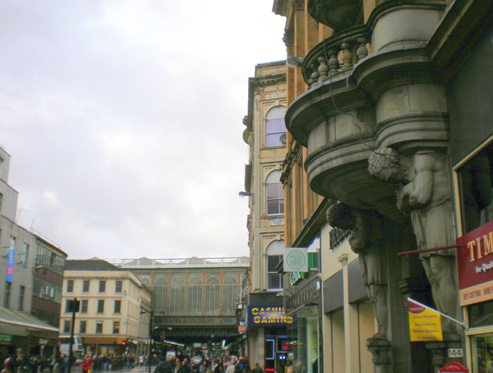
where I passed the Atlantes pictured up top, sculpted by the firm of William Vickers on one doorway of Horatio Kelson Bromhead's vast Stewart and MacDonald Warehouse. Glaswegian wit quickly named the figures Stewart and MacDonald, while the handsome extension of Central Station under which Argyle Street continues to run on its way to the West End - I'm assuming that's the bit added by James Miller in 1901-5 - and which you can see in the distance is known as the Hielenman's Umbrella.
After re-acquainting myself with the famed Glesca friendliness* in a couple of shops and an eatery, I headed back for the train and an utterly restful journey finishing a very gruesome Icelandic thriller and relishing the sharpness of the late afternoon light on the hills that fringe the Lake District (a slightly out of focus shot, this, from the carriage window, but we need a bit of sunshine after all that typical Glaswegian rain).

Two cheers today, anyway, for the passing of the law in the House of Commons to enshrine gay marriage as an equal right. I don't want it for myself - being civilly partnered since that institution first arrived in the UK is good enough for us - but I think it should be there for those who do. The two cheers, of course, are for the fact that 175 voted against, but is that surprising? And anything that splits the already fractured Tory party still further has to be a good thing.
*which can just as easily be replaced by an equally entertaining rudeness, as I discovered from the programme seller in the City Halls...


 Posts
Posts