Showing posts with label BBC Scottish Symphony Orchestra. Show all posts

Friday, 6 March 2015

Runnicles: best after Berglund


In Sibelius’s Seventh Symphony, that is (and only connect: Paavo was left-handed and so is Donald). I flew up to Inverness for a mere 20 minutes’ talk on this and Sibelius’s links with Beethoven, very much interconnected in the BBC Scottish Symphony Orchestra’s programme with mighty Donald (how lucky they are in the commitment to his homeland of one of the world’s best conductors).

The flight passed over snowy Cairngorms and flights of geese beneath before a taxi sped me to the town on the river Ness, rushing at high level past my hotel and the Eden Court Theatre on the other side where the concert was held. The place enchanted me in the bright, cold weather with only the occasional snowstorm, enhanced by the knowledge of those mountains to the south and no major settlements to the north.

I last came here with dearest Lottie in 1983 to join the Scottish Chamber Orchestra on its steam-train trip to the Kyle of Lochalsh (the best perk of being the SCO’s ‘student publicity officer’). We stayed in the youth hostel which, my taxi driver told me, has since burnt down, leaving enough of a shell to save and within which, perhaps, to rehouse the museum, currently stuck in a concrete box. His lilting accent reminded me of the Invernessian charm. News of my business there, and mention of Sibelius, led him to tell me of a Scot he knew called Greig who lived in Norway and reversed the e and i.

We could live here, I foolishly thought, enticed by the nearness of wild nature and the fact that on the Saturday morning before my early afternoon flight I walked half way to Loch Ness along river and canal, greeting lots of locals – cheery at the sun, no doubt – with their dogs: any town where the country is so imminent has my vote. Lewes would probably be a more practical suggestion but heck, a castle here wouldn’t cost half our flat thanks to the insanity of the London market.

Alas, I left my camera behind and my mobile phone was in transit from Aix-en-Provence, where it had fallen out in a taxi, so no shots of the fast-flowing river or the thousands of snowdrops and crocuses along the way. Here’s a generic photo of the Eden Court – no architectural masterpiece, but you get a sense of its riverside setting.


As for talk and concert, I thought I’d better draw the threads suggested by the programme together: Sibelius and Beethoven, the painstaking path both took to the final results (Beethoven 9 finale, Sibelius 5 versions 1 and 3). Runnicles’ coup, after a first half balancing a Sibelius Finlandia which was never overbearing even from my second-row seat with an intonation-perfect, meaningful-in-every –note Alina Pogostkina as soloist in the Beethoven Violin Concerto (still boring to me despite that), was to follow the end of Sibelius 7 with Beethoven’s Leonora Overture No. 3 (the same C major). My blind spot for so many Beethoven scores meant I still didn’t find it as meaningful as the Sibelius symphony, but that was a beauty of a performance, every tricky tempo change seamlessly negotiated and the climaxes falling where they should. Delighted to find this sketch on sibelius.fi.


Predicting success from what I knew of Runnicles' flexible style, I’d made an unfavourable comparison in the talk with Rattle’s Sibelius cycle so fresh in my head: this is a work that Donald knows how to negotiate, on a first attempt by the way, and Sir Si, for all his strengths in Sibelius 1, 2 and 4, doesn’t. A lady in the interval ticked me off for setting one above the other, and she did it with typical Scots abruptness, not prepared to hear me out. But against that, there were five folk with whom I had really lovely conversations, including the local worthy who remembered Neeme Järvi unveiling the plaque to the new theatre. That wasn’t all to the good: the theatre had lost several hundred seats in the revamp, meaning that they couldn’t afford many visiting orchestras because they couldn’t sell as many tickets as they had before.


Still, this event was packed. A fine crowd; they deserve more music up there. And I loved meeting the very thoughtful and friendly Donald as well as Alina (pictured above) afterwards, thanks to the kind offices of the excellent Andrew Trinick. I mentioned the superb performance she gave of Widmann's Violin Concerto in Bamberg and our conductor was keen to hear a recording of it.

Now I’m in Glasgow after another talk, another great concert, enjoyed with the adored godchildren studying here, Evi and Alexander. I hadn’t intended to write about it but was so impressed by the sound coming from the orchestra under Mexican conductor Carlos Miguel Prieto that I just have, with a disclaimer, for The Arts Desk.

Work proceeds inspiringly on listening to all the Sibelius 4s for Radio 3’s Building a Library: halfway through I’ve found one which will be hard to beat, a real surprise to me at any rate. But I can’t say more about the performances; suffice it to say that being immersed in this dark, if not black, work has not been depressing – past an early dip, extrovert performances raised my spirits and the perfect construction amazes me more and more.


Another seminal work of  around the same time, Schoenberg’s Three Pieces for Piano Op. 11, was beautifully argued in word and performance by young Jordanian-born, British-trained pianist Karim Said (pictured above) the other week. The circumstances were remarkable: an evening at Lady Valerie Solti’s house, organized by Norman Rosenthal. Said was promoting his new album on Opus Arte, hence my invitation from the recording company.

What artistic treasures – one never knows if it’s legit to list them or not – and what unshowy good taste, much like the lady herself. She came to the rescue when I asked where Strauss, at whose funeral Solti conducted the Trio from Der Rosenkavalier where the ladies famously broke down one by one and came back in again to reach the end -  was among the pictures in the music room. The photograph in question – the old composer on his 85th birthday celebrations working with young Georg (Valerie referred to him throughout as ‘Solti) – seemed to have disappeared. She found me an unsigned copy, wonderful to see. Naturally it's not available, but I think - I may be wrong - that this photo of Strauss conducting also dates from the time of the celebrations.


A portrait of Thomas Mann led to a conversation about Joseph and his Brothers, which I’ve just begun and, contrary to fearful expectations, am bathing in its serene mythic re-interpretation. ‘Solti’ read one of its four books every summer holiday, and when he finished, went straight back to the beginning. I can already understand why.

Said’s concerts will always be a success if he presents them as revealingly as he did this one, explaining why the Schoenberg shouldn’t be seen as difficult music: how it should waltz and entertain. In that small space, the resonance of the Steinway could be overwhelming, and it is perhaps a little too often on the CD too; a few more genuine pianos wouldn’t go amiss. But there’s no doubt about Ashkar’s lively intelligence, re-creative art and knack of good programming. The Berg Sonata actually made sense and flew by for once rather than sounding like an improvisation, though the improvisatory quality was still there and the becalmed ending seemed like the goal of all its labours. Fabulous neoclassical Enescu, too. The promotion did its work: I’ll be seeking Said out from now onwards.

Wednesday, 22 May 2013

Talkabout: Strauss, Prokofiev, Stravinsky


Put a week's silence here down to busy talk scheduling - crazy, in fact, but the subjects were desert island pieces (original 1912 design for the domain of Strauss and Hofmannsthal's Ariadne above by Ernst Stern), so I wanted to do them all. Sunday was the first mad day. Having to be at Glyndebourne for a 10.30am talk, with a sound test well in advance, meant it was worth staying over on Saturday night to avoid a very early start from London. I was also able to fit in an interview the previous lunchtime with Katharina Thoma, director of the Ariadne auf Naxos which has just opened, and Kate Lindsey, the mezzo singing the Composer. Delightful company, as you can glean from the way-too-long but I hope interesting Arts Desk Q&A. I get to see the show when I talk again at Glyndebourne on 2 June.

Thoma took her central production idea from the fact that Glyndebourne was used as a wartime home for evacuee children. It looks idyllic as they run gay through green meadows, but no doubt the trauma always lurked.


Though it seems from another archive photo that there was no lake in the 1940s, and of course no new opera house, otherwise not a great deal has changed. Of course a smooth lawn now takes the place of the meadow, but the goalposts suggested that fun and games were still to be had before the season opened last Saturday.


The relatively new garden regime takes time to have its full effect: there aren't nearly as many varieties of exotic tulips as there used to be, but enough to make a pre-season May visit special.


The tree peony in the formal garden used to be in full spate on study days, but this year's slow progress means it's only budding, ready to burst.


Notoriously variable in its featured artists - remember the dreadful 'portraits' by Adam 'Son of Harry' Birtwistle? - Glyndebourne has made an odd choice this year. You'll be taken aback by Sean Henry's standing or sitting lifesize figures in polychrome/bronze dotted about the place (Bryn as Wanderer is the one I didn't see), and generally I don't mind them, but I'm not at all sure about 'Catafalque', the recumbent man out on the lawn. He certainly changes perspectives like this one from the Ebert Room where the talks take place.


So I took the audience on a whistlestop tour of Strauss and Hofmannsthal's three Molière projects, starting with Le Bourgeois Gentilhomme as Der Bürger als Edelmann in 1912. On the downloadable Glyndebourne podcast the plot's the thing, shorn of the Sunday talk's background complexities. It's very likeably presented by Margaret (aka Peggy) Reynolds and has been well edited by the delightful Mair Bosworth. I talk on it alongside an expert on commedia dell'arte and that great gentleman Michael Kennedy, whose Master Musicians book led my teenage self deeper into Strauss.

On Sunday, playing Pavarotti as the Rosenkavalier tenor singing 'Di rigori armato il seno' seemed like a good place to start alongside the same text delivered by an Italian Singer(ess, so it's armata) in Lully/Molière's Ballet des Nations. Hopping between Strauss and Hofmannsthal's Version 1 and the more familiar 1916 all-operatic Ariadne meant some fun in comparing Zerbinetta's whole-tone-higher, longer original crazy coloratura aria with the one we usually get.


There wasn't time to feature the cod-Turkish ceremony of Hofmannsthal's 1917 Bürger-minus-Ariadne (I'll never forget the late Peter Allen's take on it in his Edinburgh University staging of Le Bourgeois Gentilhomme for Les Escogriffes, which involved a swimming pool and actors in Kermit and Fozzy Bear masks: genius, it seemed at the time). But the first musical programme which Glyndebourne dramaturg Cori Ellison had devised, under the aegis of the lovely people in the Education Department, made amends with the Madrigal alongside two numbers from the 1912 incidental music - Monsieur Jourdain's little doggerel song, which I'd played in sequence with the original composer's aria 'Du, Venus' Sohn', and the pretty neoclassical duet for shepherd and shepherdess - as well as, from the opera, Harlequin's serenade and, from the Prologue, the Composer's ode to music.


As always with the young singers involved, you think, if the covers are this good, can the artists they're covering be better? That was true of all three singers, accompanied by repetiteur Helen Collyer: soprano Lucy Hall, mezzo Carla Dirlikov (pictured above by John Myers) - who pulled out all the stops for her big number, acting and all - and a fine young baritone, Daniel Shelvey.

I'd have loved to stay and hear Hall and Collyer in two Zemlinsky songs with Hofmannsthal texts, as well as Margaret/Peggy's 'mythical sisters' talks - the afternoon was devoted to the other new production, Rameau's Hippolyte et Aricie - but a taxi was waiting at 11.55 to whisk me to Lewes station and the train back to London for a 3pm event.

This one was unmissable: Denis Kozhukhin playing all three of Prokofiev's titanic so-called 'War' Sonatas (6-8, composed between 1938 and 1944). Because the feat required a bigger rest-up time during the interval between the Seventh and Eighth Sonatas, the Southbank's The Rest is Noise team, having liked what they heard of my Paris 1910-1930 taster, enlisted me to talk for about 15 minutes while Denis prepared for the final hurdle. Classical Music Programme Manager Ben Larpent took the following photos; obviously the pianist could only be snapped after his performances.


Kozhukhin's interpretations were much as I'd found them when I reviewed his Onyx CD for the BBC Music Magazine's May issue: fabulously nuanced and with an uncanny skill in bringing out the tone-colours of different simultaneous lines. For me there was too much sustaining pedal in developments - not at all Prokofiev the pianist's style - and something reined in about the outer movements of the Sixth and Seventh Sonatas, though the latter's central Andante caloroso moved me to tears.

Just as well, perhaps, because my talk started - with credit to friend and so-collegial fellow Prokofievian Daniel Jaffé, whose singing-teacher then-wife Frith spotted the correspondence - with its obvious-when-you-hear-it resemblance to Schumann's 'Wehmut' from the Op. 39 Liederkreis. And of course this is one of those coded references to suffering which we used to think were exclusive to Shostakovich. Eichendorff's text begins 'I can sometimes sing/As if I were happy,/But secretly tears well up/Which free my heart', and ends 'no one can truly feel the anguish of my song's deep sorrow'. I don't need to add any more about the context except to repeat what I've written elsewhere, that according to his older son Sviatoslav, Prokofiev never talked about the terrible years 1936 and '37 to anyone, at least in the children's hearing.


Anyway, having a captive audience in the middle of a concert opened me up to a taste of my own reviewing medicine, so it was a relief to find that Colin Clarke on MusicWeb's Seen and Heard International approved. Quite a few enthusiastic listeners were unusually willing to come up and chat at the end of the concert, perhaps because they could see where I was sitting. And I got to meet the ever so nice Roger Vignoles, who said he'd heard Schumann when Kozhukhin played the movement, but couldn't place what exactly until I did it for him.

The glory, of course, was the pianist's: the end crowned the mighty work with the best of the three performances, as on the disc, of the Eighth, with its huge tarantella-cum-march finale majestically tying up the pain with the biting humour. Here's Kozhukhin introducing the sonatas.


My desert island disc of that, by the way, is the incomparable Sviatoslav Richter's, but this interpretation was very fine indeed. And Kozhukhin's way of terracing the sound came across beautifully in the only possible encore - Bach, but arranged by Ziloti (the B minor Prelude). There's certainly no harm in featuring the pianist who gave the premiere of the Eighth Sonata, Emil Gilels, in this ineffable lowering of temperatures.


Actually Kozhukhin's own performance of this gem, also to be heard but not seen on YouTube, is just as magical in its way.

With only a couple of days in London - more talking, this time in the Gloriana class - I flew up to Glasgow on Wednesday afternoon and back on Thursday night, since I had to be off to my beloved Göttingen and its Handel Festival the following morning. This way I didn't get to stay for the concert in which Matthias Pintscher conducted the BBC Scottish Symphony Orchestra in Stravinsky's The Rite of Spring, which I was discussing earlier in the evening; another quick whizz after another talk was again the order of the day. But I did get to see Scottish Opera's new G&S, The Pirates of Penzance, to which I took godson Alexander on Wednesday night and which I reviewed for The Arts Desk. Here's the consummate Richard Suart's Major-General pirated, picture for Scottish Opera by KK Dundas.


In short, although the cast and orchestra were mostly excellent, the Savoy wit and wisdom drowned in a stream of gags by a director who didn't trust his material. I enjoyed rather more my haggis and chips sitting in warm sun on Sauciehall Street before the show. Ah well; Alexander got the point that the text is dazzlingly witty - who but Gilbert would rhyme 'Aristophanes' with 'Zoffanies'? - and the music stronger, quite often, than the Italian opera it spoofs.

Thursday was mostly spent indoors working on the Glyndebourne interview transcription and brushing up the material for the talk. But I did have an hour off walking from the ever-welcome aBode Hotel in Bath Street to City Halls. En route I had a plate of oysters fried in polenta


sitting outside at Glasgow's oldest established restaurant, Rogano, inspired design-wise by the art deco of the Queen Mary back in 1935.


The Duke of Wellington outside the Gallery of Modern Art, traditional target for Glaswegian malarkey, is no longer traffic-coned as he was in February but sports a rather sinister face mask (representing what I couldn't make out).


I took in some rather remarkable Victorian/Edwardian architecture around the City Halls in Candleriggs, all nicely tarted up for this fashionable zone. Again, I'd love to know more about what I was seeing, though I've just identified the eccentric turret in the middle as part of a former warehouse in Brunswick Street 'designed in the baronial style by architect RW Billings in 1854 for J and W Campbell'. The City Chambers are seen in the centre of the bottom picture.


Then I ensconced myself in a dressing room backstage at the City Halls to work, courtesy of Douglas Templeton and Andrew Trinick,


popping out for Pintscher's rehearsal of The Rite. Such efficient use of the time available, such professional dovetailing, such clarity and character; the firm basis would have allowed for any amount of extra intensity in the performance. Must set aside time to listen to the broadcast of the event proper available on the BBC Radio 3 iPlayer (a more than usually generous three weeks left to catch it).


In the talk, I tried to offset the perceived modernism of Stravinsky's score and Nijinsky's choreography at the premiere 100 years ago this month with the music's roots in folk music and Musorgsky (the opening piping - I love Saint-Saens's remark in 1913, 'if that's a bassoon, I'm a baboon' - is a reworking of shepherd Gritsko's reed-playing at the end of the Sorochintsy Fair version of Night on a Bare Mountain).

So, after the most stressy of the week's travels, on to a more relaxing ambience in Göttingen where I wasn't required to hold forth and concert treasures - if not this year's opera - offered plenty of soul food. More on that anon, but let's connect by having William IV less stylishly debunked by the students of the university he so splendidly enriched just before his death in 1837 than the Duke of Wellington is by the Glaswegians.

 
23/5 Oh yes, and Wagner was a nifty four times 50 on the day of posting. How could I have forgotten? Anyway, I'm not in the mood at the moment (and a concert conducted by Sir Andrew Davis, of all people, hardly seemed like the best way to celebrate). There will be nothing but Wagner for me at the end of the year, for reasons I'm still not at liberty to divulge.

Wednesday, 6 February 2013

24 hours in Glasgow


I've always loved Scotland's rainy city, though I know we students were in danger of romanticising it as a livelier alternative to our more outwardly beautiful stronghold of Edinburgh in the 1980s. Now my beloved godson Alexander is studying at Glasgow University, so a trip like this, to give another talk before one of the BBC Scottish Symphony Orchestra's thoughtfully planned programmes in the beautifully restored City Halls, is also an excellent opportunity to catch up with him in person.

Everything, for once, went smoothly, not least the train journeys either end through hillier territory than the East Coast line (and in my view far more beautiful). A rainbow hovered over one of the city's remaining giant tower blocks as we drew near Central Station.


Then I made straight up the hill for the ABode Hotel on Bath Street, which I've come to welcome for its quiet and comfort as well as for its fairly stylish adaptation of the original building constructed in 1829 by Sir James Campbell. Most of the remaining fittings must belong to the time when it became the family home of British Prime Minister Sir Henry Campbell-Bannerman, including, I'm guessing, this stained-glass panel in my room.


Just as good was a new discovery as I walked around the streets of the Merchant Quarter where the City Halls are situated, looking for a restaurant to have a pre-talk-and-concert supper with Alexander. I settled on the Italian Caffè because its list of Italian tapas-size dishes looked unusual and authentic. We had two dishes each - pasta, chicken livers in marsala, sea-bass in a mussel sauce, superb Italian grilled vegetables - and, most important, a great talk about Glasgow and family life. How times have changed since the two-year-old Alexander used to make a daily early morning visit to our room at Edinburgh when we were there for a seasonal stay, sit on the chair and ask "shall we have a chat about Christmas?" Here he is now, with his permission because even he agrees it's not a bad photo of him, at the end of the concert.


I very much like the room where the talks take place - huge contrast to the Barbican's Fountain Room with its low ceiling and poor lighting. While the City Halls bar is too pink, the pretty colours across the hallway are kept to an acceptable level.  Here it is before the punters arrived.


The theme I'd decided on with the BBCSSO's Andrew Trinick and Douglas Templeton was on the legacy of Beethoven's Fifth, part of an extraordinary Viennese programme to be conducted by the great Donald Runnicles. I started with the strangeness of its opening gesture, harking back to a BBC Symphony Orchestra/Robertson concert which had connected Wagner's Tristan Prelude and Schoenberg's Erwartung - a much tougher work to talk about - in its first half. I found that there was a reason for putting those three works together. Look at it carefully, and the world's most famous musical gesture has a lot more to it than meets the ear. I'm only summing up here, so no more on that for now.

The middle section was on composers who'd taken the gesture, and how differently they'd interpreted it. Rachmaninov in his 1900 song 'Fate' (Sudba) for Chaliapin clearly followed the romantic cue of Beethoven's secretary Anton Schindler who claims the composer declared "Thus Fate knocks at the door!" (though I prefer Carl Czerny's notion that it's a joke amplification of a yellowhammer's song in the Prater). I had Boris Christoff and Alexander Labinsky to demonstrate the first stanza; I'm guessing, though a different CD set is suggested, that this is much-missed Elisabeth Söderström with Vladimir Ashkenazy. Especially valuable since Apukhtin's poem is given in English translation:


At the other end of interpreting the "knock" is ever-kooky Charles Ives, who heard in Beethoven's theme "the Soul of humanity knocking at the door of the Divine mysteries, radiant in the faith that it will be opened - and the human becomes the Divine". Here's that amazing third movement of his Concord Sonata (1909-15) which Alexander liked so much. The rhythm's beautiful transformation at the start commemorates the Alcott family, most famous of whom, to us at least, is Louisa May. Of it Ives wrote: "And there sits the little old spinet piano Sophia Thoreau gave to the Alcott children, on which Beth played the old Scotch airs, and played at the Fifth Symphony." On Thursday I chose a pianist I adore, Jeremy Denk, but the Hamelin performance below comes with the score, always a welcome YouTube touch:


Mahler, who conducted Beethoven's Fifth quite a bit in his earlier days, gave up because he lost confidence in how to conduct the fermatas in the phrase. He thought the 'tremendous meaning' of it could more fittingly be summed up as 'Here I am!' ("Das bin ich!"). Which cued me on to symphonies which follow the symphony's trajectory of darkness to light in very different ways - Tchaikovsky's Fourth, Mahler's Fifth (progressive tonality, of course, C sharp minor to D major), Shostakovich's Fifth and all the rhetoric of Beethoven's Sovietization, and finally, richest and rarest in my view, Martinu's Third of 1944. But needless to say 25 minutes proved all too short and I had to cut out quite a few of those examples.

As for the concert, it made excellent sense of its extreme Viennese contrasts, and the afterconcert bonus, a Schubert Violin Sonata from the soloist in the Berg Violin Concerto, Julian Rachlin, with Runnicles at the piano, was such a wonderful way to end that I wish the London orchestras would adopt the practice where appropriate. All about that in my Arts Desk review.

Morning-after plans went slightly but not unpleasantly awry, as usual. I always plan to head back to my favourite gallery, the Kelvingrove, or make another expedition out to Helensburgh to find the Mackintosh house open (as it wasn't when I went before). But time and rain interfered, so I was happy to go and see Alexander's student flat further up Bath Street, with a dozen or so pairs of trainers in the hall seemingly multiplying but good coffee from an espresso machine his dad had given him for Christmas.

Then I headed for a nearish retreat, the Glasgow Gallery of Modern Art in the 18th century building touched up by David Hamilton in the late 1830s. It took up less time than I'd expected on my second visit, because the whole point of the ground floor space - to show off new works in neoclassical surroundings - was obscured by the installation of two large screens in a darkened room. Anyway, in the gift shop I found gifts for our evening hosts back in London and noted for the first time the way Carlo Marochetti's 1844 statue of the Duke of Wellington outside is adorned by Glasgow's celebrated sense of humour, a long-standing tradition:


The mosaic on the architrave is by Niki de Saint Phalle, who has an object in the otherwise not very colourful GoMA collection currently on display in Gallery Two.

A quick look inside the grandiose late 19th century City Chambers was enough to see the Carrara marble and alabaster staircase.


It seemed too soon for lunch, so I wandered to the southern bit of the shopping zone I've never walked around before. Rather surprised by the Victorian Argyll Arcade full of jewellers


and delighted by the earthy pipes and drums of a very hairy street band, Big Peat, which seemed to be very much for local shoppers, though - equally surprisingly -  there were quite a few tourists around.


Then along Argyle Street with its fine ironwork


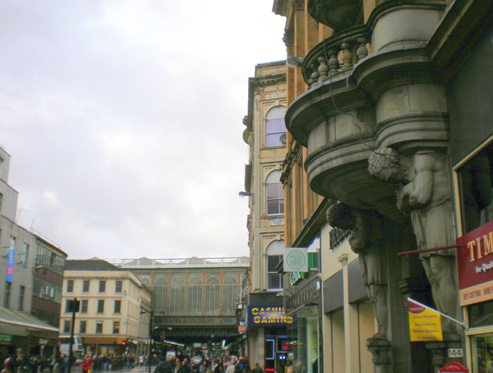
where I passed the Atlantes pictured up top, sculpted by the firm of William Vickers on one doorway of Horatio Kelson Bromhead's vast Stewart and MacDonald Warehouse. Glaswegian wit quickly named the figures Stewart and MacDonald, while the handsome extension of Central Station under which Argyle Street continues to run on its way to the West End - I'm assuming that's the bit added by James Miller in 1901-5 - and which you can see in the distance is known as the Hielenman's Umbrella.

After re-acquainting myself with the famed Glesca friendliness* in a couple of shops and an eatery, I headed back for the train and an utterly restful journey finishing a very gruesome Icelandic thriller and relishing the sharpness of the late afternoon light on the hills that fringe the Lake District (a slightly out of focus shot, this, from the carriage window, but we need a bit of sunshine after all that typical Glaswegian rain).


Two cheers today, anyway, for the passing of the law in the House of Commons to enshrine gay marriage as an equal right. I don't want it for myself - being civilly partnered since that institution first arrived in the UK is good enough for us - but I think it should be there for those who do. The two cheers, of course, are for the fact that 175 voted against, but is that surprising? And anything that splits the already fractured Tory party still further has to be a good thing.

*which can just as easily be replaced by an equally entertaining rudeness, as I discovered from the programme seller in the City Halls...

Monday, 7 November 2011

Old-new Glasgow


On recent visits to Glasgow, I’ve found myself confined to the more or less unchanging scene up on the hill, around the Theatre Royal, the Royal Scottish Academy of Music and Drama and the soulless, inadequately acoustic’ed Royal Concert Hall. It would have been so simple to stroll eastwards from Queen’s Street or Central Stations and examine the newly done-up Merchant City of the plain, but I haven’t done that since I was a student and it was still something of a no-man's-land.

My loss, as it turns out from this most recent trip. The nice folk at the BBC Scottish Symphony Orchestra spearheaded by Andrew Trinick - always the best of people to work with, so good to see him again after our BBC Symphony days together - must have thought I was overdoing the compliments about the City Halls. I was in fact genuinely amazed by what’s happened here since those (pre-Royal) Scottish National Orchestra concerts, Järvi blasting us with Shostakovich 4 while before it in the interval little old ladies in their tea-cosy hats sat by the windows of the 1950s-feeling cafeteria.


In effect, the main hall of 1841 has essentially been rebuilt and raised from scratch, with a lovely, airy feeling to its white walls and plastered balcony. Arup associates enhanced the acoustics by opening up the coffered ceiling (photos, by the way, since I forgot my camera, are from the BBCSSO and – further down – via GoMA and The Skinny). The audience, to judge from Thursday’s experience, is of all ages and hugely enthusiastic; there’s a buzz here I’ve never felt at Edinburgh’s Usher Hall. The folk at the RSNO, now consigned Glasgow-wise to acoustic hell up on Buchanan Street, can only look on enviously at the Musikverein-style shoebox perfection and point out that the 1100-seater hall, with room for a maximum of 90 musicians on the platform and no resident organ, is too small for what they do.

Which it nearly is for some of the BBCSSO’s noisier scores. But I loved the way the foundations shook with the thundering chorale at the end of Sibelius’s Second Symphony – a generally lithe, no-nonsense interpretation from Ilan Volkov (pictured below in the hall with the orchestra at an earlier concert), which nevertheless gathered quite some intensity through that strange slow movement. And connected, in the wrigglings of the coda there, to the death-throes of Berlioz’s Cleopatra – handsome of voice – true oaky mezzo - if monotonous, colour-wise and a bit pitch-dodgy in the shape of Ruxandra Donose; as usual, the orchestra had the lion’s share of Hector’s shock tactics – the thrummed accompaniments to the three-trombone funeral dirge, the incredible final shudders.


The Berlioz in turn made a muscly complement to the wispier trills and mysteries of Debussy’s Saint Sebastian fragments. And there was a generous bonus, too, in the shape of Julian Anderson’s Eden, starting and ending well with mesmerizing folky-ancient string solos, in between sounding well but not sense-wise adding up to much for me. Though I have to say my godson Alexander, whom it was such a treat to host for an evening now that he’s started a new life as a student at Glasgow University, was excited by it all and told me chapter and verse why.

He also enjoyed some of the sounds I dug out for the 1911 talk. And I loved the lecture-space, a room apparently rediscovered, Danny Pollitt of the RSNO told me the next day, during the renovation work on the building.


Down south at the Barbican’s Fountain Room – much as I prefer it to the hall for the ability to establish a rapport with the audience at pre-performance talks - I nearly hit my head on the low ceiling and remain unlit on the platform; here there’s space enough to accommodate another full house and lighting that is almost phosphorescent. And the streets around Candleriggs take on a light and elegance that felt to me, unless I was hallucinating, a bit Parisian.

With a couple of hours to spare the next morning before catching the train back to London, I was heading for the St Mungo Museum of Religious Art and Life but got unexpectedly waylaid by the delights of GoMA, Glasgow’s Gallery of Modern Art housed in a splendid neoclassical building in the same grid as the City Halls.


The ground-floor interior had been turned into what the brochure rightly describes as ‘a twenty-first century sculpture court’. My thanks to photographer Nick Milligan and his work in The Skinny for permission to reproduce the next two images.


The artists, all from Glasgow, have been yoked together under the aegis You, Me, Someone Else, and the blurb struggles to link artworks made from found objects with finished products in wood, metal and plaster, but never mind; all have the space they need and some complement the building in surprising ways, like Andrew Miller’s wood and rope chandelier


and his tower of lampshades seen in the wider shot. The most resonant object for me was Lorna Macintyre’s Apollo.


The mythic symbol of sun and music speaks through a disarmingly simple conjunction of a wooden bass, a lyre-like bent metal rod, a harp string and a ball covered in gold leaf. Stravinsky, I fancy, would have approved.

Downstairs at GoMA is a well-used library with coffee-shop attached, while in Gallery 2 Alasdair Gray’s impressions of Glasgow in 1977, when he was commissioned by Elspeth Gray of the People’s Palace to encapsulate the city as he saw it then, showed me a side of the writer-artist I didn’t know from his book illustrations to Lanark and the like.


There’s energy in the big four-part panorama of a single street, and I’d have been delighted to be one of the worthies and/or locals he portrayed. Shame so little of this seems to appear on the web. It can be found in a book that’s just come out which I’d rather like, A Life in Pictures, but it seemed a bit expensive at £35 – the price to pay for good book production, I guess. Anyway, the exhibition was well frequented by allsorts, just as I remember a Kelvingrove display of 19th century architectural designs back in the early 1980s being attended by a whole range of citizens, and the People’s Palace dotted with proud oldsters explaining to their grandchildren the significance of the ordinary objects lodged within. A city with plenty of spirit still, to be sure – as Alexander, one of its most recent citizens fresh from the sleepy comforts of the Borders, is happy to attest.

Saturday, 5 November 2011

1911


That was the theme upon which I had half an hour to expound before the second in the BBC Scottish Symphony Orchestra's 1911 series in Glasgow's glitteringly refurbished City Halls on Thursday evening (more on the revelation of this virtually new venue, and the concert, in the next post).

Of course it's a subject which throws up further astonishing links the longer you have to think about it, and even as I was putting the finishing touches to my dozen examples, the year of Alexander's Ragtime Band turned my thoughts to checking what Ives was up to. Sure enough, it was then he composed The Fourth of July, third movement in the Holidays Symphony and the trickiest polytonal melee of the lot ('I did what I wanted to, quite sure that the thing would never be played , and perhaps could never be played' - it finally was, for the first time, in Paris on 21 February 1932 - 'although the uneven measures that look so complicated in the score are mostly caused by missing a beat, which was often done in parades').

Even in terms of what DID get performed in 1911, the musical list is perhaps the most impressive of any year. I turned to the treasure-trove chronology of Slonimsky's Music Since 1900 to compare the premieres of the twelfth year with those of the first. In 1900, the lucky public got Tosca (a lively start in January), Finlandia, The Dream of Gerontius; in 1911, another start-of-year blast with Der Rosenkavalier, Scriabin's Prometheus, chunks of Ravel's Daphnis and Chloe as well as his L'heure Espagnole, Sibelius's Fourth Symphony, Elgar's Second, Mahler's Das Lied von der Erde, Debussy's Le Martyre de Saint Sebastien and Stravinsky's Petrushka (the latter two respectively graced by designs from Bakst and Benois below).


In terms of the as yet unperformed, you can add to the list Bartok's Bluebeard's Castle, from which I took the vision behind the Fifth Door and Judith's blank response as a paradigm of the splendour-and-misery dichotomy of music in 1911, and the fourth of Webern's Op. 10 pieces, composed on 19 July, 'scored', Slonimsky sums up, 'for clarinet, trumpet, trombone, mandolin, celesta, harp, small drum, violin and viola , containing 6 1/3 measures in 3/4 time lasting 19 seconds according to the metronome mark.' (Boulez takes 22).


That made a neat contrast to the Mozart-minuet-for-breakfast that turns into a sensuous 19th century waltz in Der Rosenkavalier (taking advantage here of one of the Roller designs the Austrian National Library in Vienna gave access to during its all too short Rosenkavalier centenary exhibition).


Other polarities I used - analogous, I hope, to the Somov/Schiele split up top (both portraits painted in 1911) - were Debussy's whole-tone versus diatonic in Le Martyre, the slightly unsatisfactory 'fragments' from which were being performed in the concert; Stravinsky's tritone-into-bitonal basis for riven puppet Petrushka versus the white-note-y Russian Dance in the ballet; Sibelius's tritonal obsession in the Fourth Symphony versus the light and airy 'Way of the Lover' in Rakastava; and the dissonant nine-note scream in Mahler's Tenth as contrasted with the great string leap leading to a final becalmed F sharp major at the end of the symphony - if only to prove that human love, in the shape of 'to live for you, to die for you, Almschi' as written beneath it, was the ultimate triumph for Mahler. Who of course died on 18 May that year and was buried in Grinzing cemetery as painted by Schoenberg (an image I've already evoked on this blog, but worth repeating).


The one issue I took was with the doomy nature of the BBCSSO's blurb: 'immense change was afoot...accelerating towards the cataclysmic events of 1914...the end of the empire...the angst-ridden music of middle Europe...a time of great foreboding'. True, the world was worried by Germany's rush to arms


but once more I take my new bible on the subject, Simon Winder's Germania, as gospel against the notion that everyone sensed the world as they knew it was about to crash and burn. Winder maintains that the Habsburg end of things needn't quite have shattered in the way it did had the Austrian Empire not been tied to 'the cretinous and wholly unrealistic aims of the Germans'. He points out Vienna's pioneering brand of 'luxury modernism' and argues it could, and should, have continued to carry on defining European style and idea:

It seems more rational to be angry than mournful that a war of such a peculiar kind would end all this. The final movement of Berg's extraordinary Three Orchestral Pieces, with its lurching, macabre military march, written in the spring and summer of 1914, is generally seen as a brilliant premonition of the conflict to come - but nobody could foresee such a thing. It would be as plausible to criticize Klimt because his paintings incorrectly presaged a future mostly filled with half-nude society hostesses.

The example I took from 1911 parallel to Winder's Berg was from the Rondo in Elgar's Second Symphony, namely that juggernaut of a summer-garden ghost resurrected AntiChrist-like from the first movement. David Pownall's play Elgar's Rondo posited it as a prophetic vision of soldiers marching to their doom on the battlefields of the First World War, which may have been justifiable dramatic licence; but to me it's a private nightmare of the riven, troubled Elgar. Below is the late lamented Sir Edward Downes's performance, posted on YouTube by someone who seems to find the movement happy and joyful (though one commenter contradicts that). The apocalypse I refer to starts at 4'44, though of course the Rondo is nearly all chromatically unsettling.


At any rate a month after the unsatisfactory premiere of that divided symphony, Elgar's splendid and far from harmonically placid Coronation March for George V and Queen Mary was performed. It was recorded in abridged form - it's awfully long, probably the only reason why it doesn't join the Pomp and Circumstance Marches on concert programmes - by Landon Ronald in 1935, a year after the composer's death, for the Silver Jubilee of the same couple. Which I would compute as being 1936. In which case, as J pointed out when I played him the black-white examples, here would be another case of a significant time three years away from a big cataclysm.