Showing posts with label The Turn of the Screw. Show all posts

Sunday, 12 January 2025

Opera in Depth on Zoom: Britten's dark heart


Prepare for fleshcreep if you've joined, or want to join, the spring term of my Opera in Depth Zoom course. Inspired afresh by the remarkable achievement of Isabella Bywater's remarkable production of Britten's The Turn of the Screw for English National Opera, with a groundbreaking central performance by Ailish Tynan (pictured above as the Governess with Jerry Louth's Miles by Bill Knight), I thought it was time to turn back to this masterpiece, the composer's most rigorous, which I first experienced as a Hesse student scene-changer at the Aldeburgh Festival in 1983. 

As I've never covered Owen Wingrave in class, and found it more fascinating than I'd previously thought in Neil Bartlett's Aldeburgh production, superbly cast from experienced and young singers and conducted by the great Mark Wigglesworth, I thought I'd do a Britten/Henry James double. That rather reduced the time I was intending to spend on Handel's Giulio Cesare, due a top line-up with Harry Bicket and the English Concert later in the year. But Handel can always be excerpted (heresy! But I do come to love his operas ever more).

Places still available - you can join from anywhere in the world and get the videos if you can't make the classes. The course starts tomorrow (Monday) at 2.30pm UK time. Full details here; click to enlarge.


Monday, 12 August 2013

Dream, Screw and Serenade in Norfolk - 1


Britten's two spookiest operas and his exquisite songs of sunset melting into night had the most poetic settings imaginable the other weekend. I was up in beloved north Norfolk to talk about the connections between The Turn of the Screw and A Midsummer Night's Dream - they turn out to be more legion than I thought - in the intimate little Granary Theatre of old-fashioned Wells-next-the-Sea, pictured in the middle above. Seastar Opera's all-women cast with piano had joined, by serendipity, with Yorke Trust Summer Opera's full-scale production of Dream in one of Norfolk's loveliest churches, St Mary's South Creake (above), players and singers from all over the world working mostly for free on a course with a very splendid end.

The bonus to those, and the events connected with them, was to discover that the Britten Sinfonia would be at the Theatre in the Woods of Britten's (and Auden's) old school, Gresham's of Holt, with its amphitheatre canopied by beautiful beech trees - third photo - and that we could squeeze it in between walks, bathes and other performances.

First of the major trio up was Susie Self's Screw; though there was a treasurable warm-up act. That great double-bass player Rodney Slatford, driving force of the Yorke Trust and seen here in the South Creake chapel where the smaller happenings took place,


had arranged a number of events to educate us all around the Dream. So King's Lynn-dwelling friend Jill and I hurtled to South Creake to hear Rodney in very, very lively conversation with that unstoppable but never boring or self-regarding anecdotalist, director John Copley, and the more quietly amusing violinist Nona Liddell, both of whom had participated in the 1960 Aldeburgh Jubilee Hall premiere of the Dream. Stories that made us laugh are too countless to record - all should have been mp3d but sadly weren't - but Copley had his own take on why Mackerras became a Britten ghost (I'd heard another, but this is choice). He was there when Mackerras was rehearsing Screw with the tenor who'd taken over from Pears on tour. Quint was out of synch offstage - 'miles out, miles out' as Charlie shouted - and apparently couldn't find the peephole in the drapes to see his conductor. 'I can't find Peter's hole' he wailed. 'Lucky for you', snapped back Mackerras.

Anyway, our Quint was very apparent over at Wells in the shape of Susie, singing the Prologue before heading to the conductor's stand, and her stage double, co-director Marina Sossi. Britten and Piper's very present ghosts can be a problem, especially in a smaller space;  I'd have liked more play with lights, and the valiant scene-shifters were just as distracting in the interludes as I, the great Bob Ling and a fellow Hesse student had been at Aldeburgh back in 1983 (Myfanwy Piper found us very irritating). But on a limited budget, Susie's wonderful Michael Christie did an excellent job as Lord High Everything Else. Here they are together outside the Granary.


And as you can hear in the Woman's Hour excerpt, Susie makes a very compelling Quint singing at tenor pitch.


Our Governess, of two, was Nazan Fikret, not so long ago the most frightening Flora anyone's seen at English National Opera. Her voice has a piercing sweetness and her innocence was touching, though the hysterical fixity needed a bit more playing up in a second half where everyone adopted bright colours. The church scene worked best as theatre, with the children at 'prayer' before turning gargoyles.


I suspect that just as you wouldn't have known Susie and Marina were women beneath that effective make up, you'd never know Eleanor Kramer wasn't a boy. Her 'Malo' was as touching as they come, her screams terrifying; again, only a bit more dramatic vividness as the screw turned wouldn't have gone amiss. The Flora (Alex Saunders, who took the two production photos) and Mrs Grose (Louise Mott) were impeccable, and we heard a big Wagnerian voice from Laura Wolk-Lewanowicz as Miss Jessel. Richard Black worked his socks off at the piano, but it only made you realise how specifically Britten, for all his wonderful pianistic skills, writes specifically for each of his 13 players.

Saturday morning was the talk, to a rather small but very participatory audience, followed by a round table in which I was specially impressed by the common sense and insights of Dream director Jennifer Hamilton. After our second F&C of the day, a later-arrived J went off to see the matinee while Jill and I walked out to the beach past the famous Wells huts/chalets (£60,000 a pop, can you believe).


The tide, alas, had retreated beyond reach of swimming, a pleasure to be postponed until the following day, and a haar was rolling in.

The Holt experience provided further confirmation - as guitarist Dario von Gammeran's Friday afternoon performance of the Nocturnal after John Dowland had suggested - that so much Britten would benefit from the al fresco treatment. Several of the works from Jackie Shave and her nearly all-women strings I'd loved at the Wigmore pre-centenary Brittenfest last year. But the works with tenor were fresh, and Irish-born Robin Tritschler is a new wonder on the scene. I'm indebted to Rodney Smith of the Photographers' Gallery at Holt for this picture.


Infinitely flexible, full of vocal colour, lightish but never forcing the sound, Tritschler was perfection in Finzi's Dies Natalis. And how wonderful that its newborn infant's-eye view of the world was paralleled by a gently mewling baby in the audience.


Inevitably, the Serenade crowned the glory of the late afternoon. Tritschler excelled in the difficult Dirge and flecked off the runs in Jonson's Sonnet to Diana. But an effect I'll never forget was fabulous horn player Stephen Bell's retreat to the woods for an offstage call to give us supernatural goosebumps. There were more of those in the Dream that evening, but I need to save it up for another day.

Friday, 19 July 2013

Talking Ben with Jenni


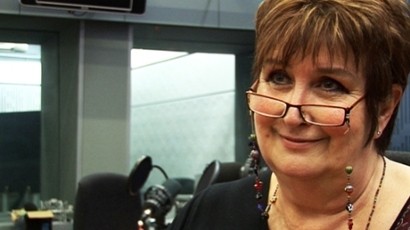
Fair, firm and often very funny, Jenni Murray has been steering BBC Radio 4's ever-fresh Woman's Hour since 1987. Though only in reality a mere Dame, she is indeed the uncrowned queen of broadcasting, so I was more than usually excited to learn that she'd be interviewing me, albeit down the line from Salford to Broadcasting House, along with Susie Self (pictured below outside Cley Church, Easter 2010) about Susie's forthcoming all-women production of Britten's The Turn of the Screw.


The results were aired live this morning at 10.20 after a very entertaining and light-of-touch take on Robin Thicke's catchy but almost parodically sexist No. 1 hit 'Blurred Lines' - 'unrated' video version with nearly-naked girls wearing only transparent thongs here - and a sweet slot on tandems; you can hear the results on the BBC iPlayer here, though I'm not sure for how long.

The Screw stretch starts at 20m16s before we roll up at about 22m50s, giving me a chance to hear the boy-treble tones of the soprano singing Miles and Susie's rather amazing delivery of Quint's Moorish melismas at the tenor pitch (she'll be conducting, too, so the voice should sound more than usually disembodied from the pit with her back to the audience). The quick-witted Dame followed the right lines of enquiry - following detailed research last week by producer Helen Lee - as intelligently as I knew she would, and our responses don't sound too bad, though the curse of live radio has me giving 'Queen Elizabeth the Second' as the protagonist of Gloriana; Freudian slip, perhaps? And in a sense true, though I'm not sure which young man Madge can be deemed guilty of destroying (Charles?)

What do I think of the idea? Well, never judge a production until you've seen it. There will be substantial new insights but I don't think you can ever quite replicate the queasy intensity of having a boy treble as Miles. On the other hand, the precedents for Susie's Quint are there in Britten's writing the 'role' of the boy in what I think is his deeply sick second canticle, Abraham and Isaac, for Kathleen Ferrier. And Yelena Obraztsova was the (usually counter-tenor) Oberon in the Soviet premiere of A Midsummer Night's Dream. So it depends on the artist(s).


I'm hugely looking forward to a long weekend by (and in) the sea - a distant Susie on the beach near Sheringham that same Easter, above - when we travel to North Norfolk next week for our multitalented friend's Seastar Opera Turn of the Screw at Wells-next-the-Sea and the Yorke Trust opera course production of A Midsummer Night's Dream in glorious St Mary's South Creake. I'll be giving a talk and chairing a discussion in Wells's Granary Theatre on the morning of Saturday 27. Full details here: come and make a beach weekend of it !


Though the culture-vulturing really ought to stop in this summery heat, I've had to say the least a varied week of it mostly thanks to The Arts Desk: song and dance from Paco Peña's flamenco dance troupe and musicians from Guinea and Senegal last Friday, orchestral ballet music at the Proms on Sunday, an eye-popping (mostly for the wrong reasons) D. W. Griffith silent epic on Monday, the best theatre with an all-black cast I've ever seen including a stunning impersonation of Patrice Lumumba by the phenomenal Chiwetel Ejiofor on Tuesday, a diva giving her all to an audience of 15 on Wednesday morning which can't be written about until the first concert performance of Strauss's Capriccio at the Royal Opera tonight, and a second visit to hear pianist Yevgeny Sudbin at the Wigmore last night.

Embarrassment of riches indeed; but if only the sea were at hand to clear the mind and relax the body.


Very Grimes, this parting shot from the same 2010 break, no? If that's Susie striding ahead as the doomed fisherman - next stop for the mezzo/contralto taking on the tenor world, don't you think? - then J and Michael must play Balstrode and Ellen. 'Sail out till you lose sight of the Moot Hall, then sink the boat. Do you hear? Sink her! Good-bye, Peter.'

Monday, 23 May 2011

Name that opera


I'd have guessed an all-in-the-schoolroom reinterpretation of Britten's The Turn of the Screw. In fact Alastair Muir's ENO production photo is from Christopher Alden's even more radical re-think of A Midsummer Night's Dream, next in the Britten operatic canon: Iestyn Davies, whose throat infection meant he did a perfect mime job to William Towers singing very well from a box on the first night, is Oberon/Quint, with Dominic Williams as changeling boy/Miles and Anna Christy as Tytania/Governess. I've thought and thought about this superb realisation, which like Rupert Goold's vision of Turandot set in a Chinese restaurant oughtn't to work right across the board but somehow does, since I saw it on Thursday: read the Arts Desk review here.


To coincide with the new production, the latest in a series of new ENO-related series of opera guides has just been published. Building on the old ones, but even handsomer, they take me back to a more innocent time doing humble proofing for still much-missed Nick John alongside Henry Bredin, and happy days are here again with the very friendly Gary Kahn in charge. He asked me to write a piece on the production history of MND - haven't seen a copy yet, so can't tell you what else is in it - and I realise I've seen rather a lot, from luminously trad (the Peter Hall at Glyndebourne, three times) to luminously mod (Robert Carsen plus a short-lived Opera London version conducted by Hickox at Sadlers Wells) via one by Christopher Renshaw which made the score seem stiff and contrived at Covent Garden (saving grace: fledgling Mark Rylance as Puck) and one in a semi-staged performance at Snape (the diplo-mate sang Theseus).

The one I still wish I'd seen, apart of course from Aldeburgh days before I was born, is Baz Luhrmann's Raj-versus-protoBollywood Opera Australia production. I put up this YouTube trailer on the Arts Desk, but no harm in repeating it here. I've heard better performances of "Now until the break of day", not least last Thursday's, so bewitchingly as well as brutally conducted by Leo Hussain, but none - again, apart from ENO's latest departure from the norm - which looks more enticing.


ENO, of course, is on a roll. Though it's more hit and miss, Terry Gilliam's approach to Berlioz's already problematic Damnation of Faust has at least three visual scenes to compare with the coups of the C Alden Dream and continues the Bury regime's mostly successful incorporation of other media (the Dream is austerely straightforward in that respect, though the visuals - especially in an Act 2 sequence which I won't spoil - are no less amazing). Here's another blackboard shot for ENO, this time by Tristram Kenton - Peter Hoare as coxcombed, C D Friedrich Faust and Christopher Purves as Mephistopheles.


Next season has two surefire talking points which I hope will be great hits, and which I've taken the risk of including among the six operas we'll study at the City Lit. At the ENO's 2011-12 core is what I believe will be the London, though not the UK, stage premiere of Adams's The Death of Klinghoffer, which still hits idiotic pro-Israeli lobby reefs in the States (I've just read what Adams so eloquently and carefully has to say about the balance of sympathies in his superb book Hallelujah Junction). And the season kicks off with Mieczyslaw Weinberg's The Passenger in the David Pountney production, the Bregenz world premiere of which I've just waxed lyrical over for the BBC Music Magazine.


A more of-the-essence piece of work than Weinberg's The Portrait - don't miss the Radio 3 broadcast this coming Saturday at 18:00, with Christopher Cook chatting to me in one of the Leeds Grand Theatre boxes - it deserves its right to deal with Auschwitz; the author of the novel, Zofia Posmysz, was interred there and based her tale on the premise of what would happen if she came face to face in later life with her tormenting Kapo, and Weinberg escaped Poland and the fate of the rest of his family only to end up a near-victim of Stalin's antisemitic drive in the early 1950s. But none of this would figure if the score wasn't extremely strong, and I think it is, though haven't made up my mind pending the live experience whether it's a masterpiece or not.

My, these are culturally exhausting times. I've been to big events five nights on the trot, and I'm holding my breath about tonight's special-invitation Chamber Orchestra of Europe 30th birthday concert, on a hunch as to why the conductor isn't named on the invite. Wasn't looking forward hugely to the Glyndebourne Meistersinger on Saturday, given unquenchable loyalties to the WNO experience of Richard Jones's superlative production with Bryn Terfel last June, but it did its own thing and, while not surpassing the Welsh event, came close to it at times. Again, I tried to be as fair as I could to Gerald Finley, who did a good job and won a not undeserved standing ovation but still isn't Bryn or Norman Bailey, on the Arts Desk. And it was sheer bliss to be at Glyndebourne again on a perfect day.


I was lured away from my favourite picnic spot by the lake since we critics had only a ticket apiece, I wanted company, Ed Seckerson hadn't wanted to risk (wrongly) anticipated cold and discomfort, and so I joined him and a friend in one of the Wallops. Where the food was much better than I'd anticipated, even if service was in a bit of chaos on the first night. Anyway, I then got another little wander just as the sun had gone off the gardens.


At least one aspect of the new garden regime is redeeming recent misdemeanours: the abundance of papaver orientalis both in the beds on the lawn and in the formal garden was spectacular.