Showing posts with label Fidelio. Show all posts

Sunday, 28 March 2021

Heavenly conversations in a year of Zoom classes

Ian Page, inspirational founder of what was originally Classical Opera and now goes by the collective vocal/orchestral heading of The Mozartists, wondered if his e-mail comment wouldn't look a bit pretentious out of context when I asked him if I might quote it. I'll still do so because it expressed what I've felt about those especially magical Zoom classes where musicians who haven't seen each other for some time - or even decades - find themselves together in the class and start conversing. Ian was referring to meetings with that wonderful mezzo Jean Rigby and her husband, the director Jamie Hayes, whom he hadn't seen for a quarter of a century, then with Mark Wigglesworth and Linda Esther Gray in the last Fidelio class, and added 'I've never been a particularly religious person, but it was almost like a vision of the afterlife, being able to chat about music with loved and respected friends and colleagues in a haven of timelessness!' Above, Mark (second from the right in the bottom row) is making us laugh. Ian is at the right next row up, Linda is on the left on the row above that and of course that's me second from left at the top (click if you want a bigger image).

The other three-way (four if you count myself as interlocutor) 'heavenly conversation' that brought us so much joy was between director Richard Jones and Wagnerian sopranos Sue Bullock and Dame Anne Evans. It was originally supposed to be spotlight on Richard, to talk about Act 2 of Götterdämmerung, but Sue and Anne had said they wanted to come along to see him. Sue was ready to speak, Anne had been wondering whether Zoom was for her and had asked to be a silent observer, but the other two shouted 'C'mon, Annie', so she did - and was still there at the very end as we were still shaking from emotion at her performance in Kupfer's Bayreuth Act 2. You can get a sense of the fun that was had from the below screen shot (Richard top left, Anne with a bit of husband and distinguished writer John Lucas top right, Sue centre of the second row).

So many connections made with the great and good in what now amounts to nearly a year of Zoom classes, starting out of pure necessity, have been serendipitous and charmed. I asked Ian to the Fidelio/Leonore classes because he's just released two superb CDs of 'Sturm und Drang' music familiar and obscure, and I wanted him to comment on Pizarro's raging. He then said that he'd been thinking the night before about scores he really wanted to conduct, which he was thinking about studying with a view to that, and Fidelio was at the forefront. So he came for the next four sessions. Similarly a New Best Friend made as a result of all this, the conductor (and top bassoonist) Catherine Larsen Maguire, based in Berlin, was recommended for my fourth class on the symphony, to talk about Schumann 2 and Brahms 1, and has been with us, on and off, ever since. Sometimes one of her cats, Lily, makes an appearance, though I confess the golden shot below isn't from one of our encounters.

It seems hard to believe that coming up to a year ago, I was grappling with the implications of taking my Opera in Depth class on to Zoom (we managed to reach the top of the mountain with Siegfried at Pushkin House on 9 March 2020). I was surprised and impressed by the number of students, especially the senior members, willing to give the format a try. The first class was bedevilled by poor sound quality for the excerpts, but I got some help before the second in finding how to do it perfectly. YouTube and DVD clips fell into place at a later date. The symphony course got more takers than I'd expected - after my 'Inside the BBC Symphony Orchestra' course at Morley college ended because the BBC doesn't support private classes, it had been difficult to drum up numbers for orchestral music. I'm eternally grateful to Dale Bilsland of the Wagner Society of Scotland for suggesting that, since the usual Gartmore House Ring adventure was out of the question in September, I should repeat Siegfried on Zoom. Many of the new visitors not only joined me for Götterdämmerung but have also signed up for other operas and the Russian music course which will enter its fourth term in mid-April. so we've been hitting the 60-students mark. A special debt of thanks to Kirk Davis of Southern California, who rises at 6am to join us at 2.30pm UK time: a born giver.

And so we've reached the Easter break, going out on a high with the second of my extra classes on Prokofiev's War and Peace, which ran to three hours and 40 minutes thanks to the unstinting and ceaselessly fascinating presence of Graham Vick (now a 'Sir', knighted in January) who stayed with us as I ran scenes from his 2014 Mariinsky production. He'd also been responsible for the 1991 Kirov experiment, again with Gergiev, and so was a witness to history - the new adventure beginning in the 1990s, which I also witnessed on my first visits to Leningrad as it transitioned back to St Petersburg, the shutdown well under way by 2014, when Putin invaded Crimea and an amazingly radical production had to jump through all sorts of hoops to reach the stage (I'm still surprised it did). Graham told us, among other things, that the manager of the Louis Vuitton shop below where he was staying told him that their prices were higher than any other store in the world. The Russian kleptocrats expected to pay more. Needless to see, this found its way into the 'Frenchified', corrupt world of Helene and Anatol. What I hadn't realised was that the 'retreat from Moscow' was supposed to represent the exit of western values in 2014.

It looks like boasting, but actually the below list is just a record for my own benefit of the astonishing number of visits we had from musical stars. All were happy to feel part of something at a time when isolation was the norm.

The Symphony

Class 1: Haydn with Jonathan Bloxham and Ian Page

Class 2: Mozart's 'Jupiter' and Beethoven's ‘Eroica’ with Mark Wigglesworth and Jonathan Bloxham

Class 3: Berlioz's Symphonie fantastique with Nicholas Collon

Class 4: Schumann's Second and Brahms's First with Catherine Larsen-Maguire

Class 5: Brahms's Fourth and Tchaikovsky's ‘Pathetique’ with Vladimir Jurowski

Class 6: Mahler's Third with Paavo Järvi

Class 7: Mahler's Ninth and Elgar's Second with Vasily Petrenko

Class 8: Sibelius's Fifth and Nielsen's Fifth with Kristiina Poska and Andres Kaljuste

Class 9: Martinů's Third, Prokofiev's Sixth and Vaughan Williams's Sixth with Mark Elder

Class 10: Shostakovich's Fifteenth with Elizabeth Wilson and Peter Manning

Class 11: Adams's Harmonielehre with Catherine Larsen-Maguire

Russian Music 1: Musorgsky’s Pictures at an Exhibition with Samson Tsoy; Tchaikovsky piano music with Pavel Kolesnikov

Russian Music 2: Stravinsky’s Petrushka with Gergely Madaras; Stravinsky’s The Rite of Spring with Andrew Litton; Scriabin with Alexander Melnikov and Peter Jablonski (Peter was driving to a recording session at the time but made a beautifully produced short film from his home in Sweden).

Russian Music 3: Shostakovich’s Fourth Symphony and Lady Macbeth of Mtsensk with Elizabeth Wilson; Prokofiev ‘War Sonatas’ and Shostakovich Second Piano Trio with Steven Osborne and Boris Giltburg; Prokofiev’s violin sonatas with Alina Ibragimova and Benjamin Baker.

Opera in Depth Summer term: Strauss’s Elektra with regular commentary from Susan Bullock, Puccini’s Madama Butterfly with three separate visits from Ermonela Jaho, Antonio Pappano and Mark Elder

Wagner’s Siegfried (Wagner Society of Scotland) with John Tomlinson

Opera in Depth Autumn term: Wagner's Götterdämmerung with Susan Bullock and Richard Berkeley-Steele, John Tomlinson, Anne Evans and Richard Jones

Opera in Depth Spring term: Beethoven's Fidelio/Leonore with Elizabeth Watts, Jay Hunter Morris, Ian Page, Linda Esther Gray and Mark Wigglesworth

Prokofiev's War and Peace, two extra classes: Graham Vick

These wonderful people have all come along for the love of music. I do like to send them various thanks, preferably books. My good Estonian friend Kaupo Kikkas could be called upon to supply the book of his Ansel exhibition to three contributors I knew would appreciate it. I won't mention the third yet because it needs to be a surprise, but the first two delighted recipients were Jay Hunter Morris, mighty Met Siegfried, whose YouTube film of the amazing Souper Jenny Kindness Tour he undertook with wife, son and friends around America showed me they'd visited the big natural wonders, and Boris Giltburg, who's a talented photographer as well as a great pianist. Kaupo sent me shots of the notes and dedication - this one to JMo.


And now, time to gather forces again, and enjoy what looks like it might be a rather clement Easter break. We return on 19 April to begin the summer term of Opera in Depth with Britten's Albert Herring and Mozart's La clemenza di Tito (coinciding with a new production at the Royal Opera: director Richard Jones and conductor Mark Wigglesworth have promised to visit us - hopefully together). Russian Music 4 begins with the shadow of the Zhdanov trials of 1948 on 22 April. If you'd like to join, drop me a message here with your email; I won't publish it but I shall respond.

Sunday, 3 January 2021

Fidelio/Leonore and more Russians: Zoom 2021

Zoom has been my salvation in 2020, and not just in terms of keeping financially afloat. To realise how much it's meant not just to an ever-expanding group of students but also to the great performers who so generously found the time to make special guest appearances has been (and I don't use the term lightly) humbling. We've had wonderful appearances from Sue Bullock, Anne Evans, Richard Jones and John Tomlinson (captured below, looking more Gurnemanz than Wotan - he was in fact talking Hagen - at the class by a student) over the 10 Mondays on Wagner's Götterdämmerung, completing our Ring survey over three and a half years. In the latest Russian music term covering 1910 to 1917 there's been enlightenment on Stravinsky's Petrushka from Gergely Madaras, on his Rite of Spring from Andrew Litton and Catherine Larsen-Maguire (extended to two whole classes), and on Scriabin from Alexander Melnikov and Peter Jablonski.

For all of us involved on a regular basis, it's given a shape to the week, and for many, an alternative to live performances (for which, of course, there's no real substitute, but needs and circumstances must). Take the two one-offs on the Tchaikovsky ballets - The Sleeping Beauty on 30 December and The Nutcracker on the 21st. They came about because one student lamented that she would no longer be able to go to any of the planned, socially distanced Nutcrackers given the third, and severest, lockdown of the year. We could at least share our pleasure in the beauties of these amazing masterpieces. I can't resist featuring again the late, much missed Maria Björnson's most ravishing design for the Royal Ballet Sleeping Beauty that came in for so much stick (I hymned the whole achievement on the blog here). Watched the entire DVD again yesterday and for me it's still the most magical Beauty. This is the Panorama from the second act, turned into a winter's tale.

These were also interludes between terms on Russian music - the first two have taken us from Glinka to Prokofiev's observations on the end of 1917, while the next covers 1917 to 1953, mainly but not exclusively Soviet (we have to follow the adventures of Prokofiev and Stravinsky in the west, too). I planned the Opera in Depth term to begin on 11 January with Beethoven's Fidelio (image up top, of the excellent Garsington Opera concert staging, by Johan Persson) and its original version, Leonore - on the special urging of Mark Wigglesworth, who's just conducted Fidelio for Opera North and wants most of all to 'do' Leonore at English National Opera - before moving on for the following five Mondays to Prokofiev's The Fiery Angel; as far as I can remember - and my records are still stored on the previous computer which went bust - I haven't covered it in over 30 years of Opera in Focus/Depth and it would tie in with what we're doing in the other course. It's also unclear what the main companies will be staging, so why not take advantage of an opera that's not appearing in any repertoires for the foreseeable future? By summer it should be clearer what the two last operas of the season should be.

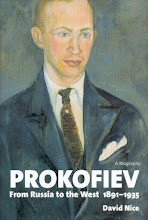
Here's my planned itinerary for Russian music 1918-1953, subject to change depending on circumstances and special visits. Pictured below: Nikolay Myaskovsky and Sergey Prokofiev, friends born 10 years apart, in 1927, detail of a photo taken from the first volume of my Prokofiev biography (sorry to link to Amazon, but my online seller of choice, hive.co.uk, reports it out of stock).


1: Adventures abroad, dark times at home  7 January

Prokofiev travels to America while Myaskovsky stays at home and remains true to his characteristic moods of gloom and pessimism. Myaskovsky's Fourth and Fifth Symphonies contrasted with Prokofiev's shorter works of 1918-19 and the exuberance of The Love for Three Oranges.

2: Stravinsky in Switzerland; the Ballets Russes transformed   14 January

Stravinsky's Russian trilogy begins with the small-scale experiments of Renard (Baika) and L'Histoire du soldat. Ever the seeker after novelty, Diaghilev engages a fresh range of artists to work with composers old and new. With special emphasis on Prokofiev's Chout (Larionov design pictured below) followed by Stravinsky's Pulcinella and Les noces (Svadebka).

3: Enter Shostakovich  21 January

With a prefatory look at Myaskovsky's biggest and darkest symphony, the Sixth, followed by the First Symphony with which the precocious teenage Shostakovich, Petrograd/Leningrad Conservatoire student, burst upon the scene. His first total masterpiece, the Prelude and Scherzo for string octet, is followed by a singular marking of the 10th anniversary of the October Revolution in what became known as his Second Symphony of 1927

4: 1927  28 January

The apogee of Soviet modernism, still strongly connected to developments in the west. We look at machine-age music by Prokofiev, Mossolov and Deshevov, and through Prokofiev's detailed diary entries for his first visit to the Soviet Union in 1927 look at the young musicians whose music he heard while he was there, chief among them Gavriil Popov with his remarkable Chamber Symphony.

5: A Gogol opera and two ballets  4 February

The young Shostakovich's reputation continued to grow with his wildly expressionistic opera The Nose and his two full-length ballets, The Golden Age and The Bolt - though proletarian musicians' organisations were now on the attack.

6: Two edicts, two masterpieces, 1932-6  11 February

The move to bring the querulous proletarian musicians' groups under one banner, the Association of Soviet Music, in 1932, looked like a good thing at the time, though it spelled trouble ahead. Shostakovich's Lady Macbeth of Mtsensk, completed at the end of that year, ran successfully in Moscow and Leningrad for two years before the blow fell with the Pravda attack on it in January 1936. Still he pressed ahead with his outlandish Fourth Symphony, but it was withdrawn before the scheduled public premiere at the end of the year. With special guest Elizabeth Wilson.

7: Soviet film scores, 1929-1938 - from New Babylon to Alexander Nevsky  18 February

Shostakovich worte his first film score for Kozintsev and Trauberg's New Babylon in 1929; Prokofiev worked on Feinzimmer's Lieutenant Kije four years later before becoming a true Soviet artist in 1938 with his music for Eisenstein's Alexander Nevsky. With clips from those films as well as Alone, Counterplan and Volga-Volga.

8: The 'Soviet' Symphony, 1935-1945  25 February

Picking up on the first Russian symphony to cause real controversy, Popov's First, performed in 1935, we see how Shostakovich followed a superficially safer trajectory in his Fifth before ringing the changes in the Sixth. We end with Prokofiev's own special circumventing of socialist-realist formulas in his Fifth, premiered at the beginning of 1945 and seen (wrongly) as a victory symphony. Pictured below; Prokofiev, Shostakovich and Khachaturian in 1940.

9: Chamber and instrumental 1938-45 4 March

Shostakovich's new journey in chamber music began with a kind of neoclassical purity, but Russia's dramatic entry into the Second World War opened up freedom in music again: the Second String Quartet and Second Piano Trio mark a dramatic change in course. Alongside them we also look at Prokofiev's so-called 'War' piano sonatas (6-8).With special guests Steven Osborne and Boris Giltburg.

10: The dangerous path to 1948   11 March

Two more towering symphonies, Shostakovich's Eighth and Prokofiev's Sixth, dare a naked sense of despair. After the war, it was time for the authorities to turn the screw again, which they did with Zhdanov's notorious trials of 'formalism in music', banishing the possibilities of dissonance and anguish expressed in music. Pictured below: Shostakovich in Leipzig, 1950.

I can see from this that I haven't managed to fit everything in: there will be two extra classes on Prokofiev's War and Peace. If anyone wants to join who isn't already on my list of students, just leave a message here with your email address. I won't publish it, but I shall certainly reply.

Friday, 4 October 2013

Parsifal all autumn, Fidelio anew


So I am now leading my not-so-secret band of 30 acolytes at the City Lit through ten classes on what Mark Wigglesworth recently declared in an email to be 'the greatest opera by the greatest composer' (he has promised us a visit). Well, it depends what you want, but after three decades' acquaintance I'm certainly more open than I used to be to the possibility that Wagner's Parsifal is the most spiritual. And I had better keep liking it because in early December I record a Building a Library for Radio 3's CD Review on this of all works. Not my choice, and a very surprising offer, but under the circumstances - and soulfully primed by the incredible Proms performance - I can only rejoice.

Ask me if I still do by 14 December, the broadcast date. But I welcome the journey ahead, be it strewn with thorns as well as roses. With the third class looming next Monday, we've still only got to the end of the Prelude after so much setting up, so many glances back at Tannhäuser, Lohengrin and Tristan. Preparing ahead to Gurnemanz's long opening narrative, I was surprised - using René Pape with Gergiev conducting Mariinsky forces in glorious sound - to discover that what had felt like the first ten minutes of the opera proper had lasted nearly half an hour.


The famous 'time becomes space' syndrome is largely due, I realised, to the special setting-up effect of the Prelude's vasts. I liked what I heard of the Mariinsky recording - past achievements of the increasingly alarming Ossetian are permitted here, live events are not - and of Marek Janowski's performance. But I stick unyieldingly, for sound and sense, to Bruno Walter's concert version with the Columbia Symphony Orchestra. It isn't on YouTube, and I know that background silence should really be an integral part of the experience, but I'm fascinated by Walter's 1927 version with the Royal Philharmonic, not least for the strings' extraordinary use of portamento.


Now we at last tackle the sources. My Penguin copy of Wolfram von Eschenbach's Parzival is full of significant markers sticking out of the book, yet I have no memory of having read the whole. It's so funny and quaint and ungainly, reminding me why Cervantes made fun of such romances with their silly names and aims in one of my two favourite books of all time, War and Peace being the other (Pope Francis, whose demi-Tutuesque promise I must reflect in another post, also cites Don Quixote as his No. 1 and among films he loves La Strada, Roma, città aperta and The Leopard. No poker-faced prelate he).


I've also ordered up the Chrétien de Troyes version which inspired Wolfram, so bathing in chivalry will be obligatory from now on. As to interpretations of the opera, we've only just begun.

After unhappy experiences with Calixto Bieito's productions of Don Giovanni and Un ballo in maschera at English National Operas, his Parsifal was not one I thought I wanted to see. But then last season's Carmen, for all its flaws, changed my mind. And in the same way his Fidelio is touched with genuine vision as it gathers weight.

Three things drove me to want to see the ENO takeover of the Bavarian State Opera production despite warnings: Ed Gardner's conducting, especially in the Leonore No. 3 Overture which I haven't heard live for so long, Emma Bell's Leonora and the intelligence that a string quartet descends in cages to play the slow movement from Beethoven's Op. 132 Quartet - shorn of the bouncy bits; no one ever seems to jump for genuine joy in Bieito's world - after 'O namenlose Freude'. All production photos for ENO by Tristram Kenton.


This last was more compelling that I'd anticipated - indeed, moving to tears as a symbol not just of the quiet intimacy between husband and wife which the noisy duet can't achieve but also of freedom in chains: physically the players are contained, but the incredible sounds the Heath Quartet achieve reach out as the music of the spheres. It's actually the first time I've ever wept in a late Beethoven quartet movement, and the intimacy of the couple who haven't been able to express themselves properly in song alone, at least while it holds, adds to the sense of painfully private emotion.


At first the variously lit glass and steel labyrinth of Rebecca Ringst's design seems like an overwhelming concept that dwarfs the singers. Bieito seems to have no idea what to do with the unwanted characters of Marzelline and Jaquino (poor Sarah Tynan is just left to despair all over the place, with, what is it, red lipstick or blood smeared around her mouth for no intelligible reason). James Cresswell's Rocco animates the space with a well-projected bass, Philip Horst deflates it again as a woofy, self-harming Pizarro. David Pountney's English translation is banal and sounds so old-fashioned.

Yet as usual in the work, if you've got a great Leonora, everything soars upwards from 'Abscheulicher!' onwards. Emma Bell has an odd technique, a rather hollow choral-mezzo-ish sound at times, a little like Kathryn Harries used to sound with a similar mixture of hits and frays in the totally different voice of the upper register, but she projects the text with such urgency that you're won over. At times it truly is heroic. And the Prisoners' Chorus works with the voices coming at you from all levels at the front of stage, Leonora distributing photographs of her disappeared husband. This I liked.


Everything comes down to ground level for the dungeon scene. The labyrinth flips to suggest that we're heading into the depths of the earth. Perhaps it was this that allegedly prompted Gardner to throw in the towel, only to be held to his contract (a ruckus confirmed by him, again allegedly, in a pre-performance talk). Maybe a compromise was reached, for the creaking happens before the Act 2 Prelude, not during it. Last night we had a second Florestan in the absence of Stuart Skelton (pictured here), Bryan Register, a bright but genuine heroic tenor who just made the ridiculously strenuous vision music. Lovely line in the trio; not much of an actor.

Still, it all flowed, despite inept attempts at applause. A weakness, Bieito's attempt to get the singers to declaim portions of eloquent texts by Borges and Cormac McCarthy when these would have been better amplified or video-projected, had dwindled; the music took over, Gardner always lucid and keenly springing. Leonora's acid attack on Pizarro got round the usual awkwardness of a too-long freeze at the trumpet call.


The 'Heilige Dankgesang' remained the höhepunkt for me: why can't we hear the Heath Quartet's Tippett/Bartok series in the UK? Nor was the ambiguous parade-ground scene the mess I'd read about: Roland Wood's Joker-Fernando had his moment, the open-ended suggestion of government-forged manacles of a different sort after supposed liberation worked well. The blank cards with 'free' scrawled on some of them offered a symmetry to the 'disappeared' photos of the First Act, just as the quiet of the quartet echoed the only still point of Act One, the celebrated chorus. This is the kind of joining-up I always love about a more consistent genius of the stage, Richard Jones.

How often have I seen this opera fail - at Covent Garden, here at ENO under Graham Vick - and yet Bieito really had something to say at times, and said it unforgettably. Kudos. And who knows,  I may end up enjoying the Christopher Alden Fledermaus more than expected, though I'm not going to see it until after my pre-performance chat with Christopher Cook next Wednesday; much as I love the froth on CD, at least the Boskovsky and Carlos Kleiber sets, it has NEVER worked on stage for me and I don't want to slam the prison door decisively shut before I speak.


STOP PRESS (5/10) or rather something that slipped my mind: I'm talking on Mahler and Opera tomorrow (Sunday 6 October) for the Gustav Mahler Society of the UK at the airy, attractive Austrian Cultural Forum in Knightsbridge, 11-4. I'm interesting myself in unexpected areas of the subject, so I hope I can communicate that. Full details on the Mahler Society website here.

Tuesday, 12 April 2011

Fidelio - liberated at last


Only professional reasons could have lured me back to sit through Jürgen Flimm's quarter-baked Royal Opera production of Beethoven's Fidelio a second time. Yet it turned out to be a whole different show, musically at any rate, from the one I had difficulties finding a good word to say about for The Arts Desk.

It may well be that Mark Elder got into his stride after an unco-ordinated first night. Yet while he had little time to step into back-troubled Kirill Petrenko's shoes, the Royal Opera's highly respected Head of Music David Syrus was also giving his first performance on little rehearsal last night.


And how he kept this tricky-to-start piece on its toes, with an ever-firm inner pulse, clear articulation and above all a buoyancy which, I suspect, is not Elder's ball-game (he seems to me to have succumbed to Goodallisation in his knighted middle years). While a couple of weeks ago I'd been inwardly screaming to get to Nina Stemme doing Leonore's 'Abscheulicher' - not quite right on either night, as it turned out, despite this fine soprano's inward energy - here I was delighted by every little woodwind nudge and nuance in those domestic ariettas, duets and trios. Not quite Mozart, I know, but Syrus made them seem almost so, and it helped to be hanging over the orchestra and to see what was going on in the pit when pitifully little happened on stage.

There were frisson-moments where I'd found none on the first night - above all in a flawlessly elevated shift back from the central solos of the Prisoners' Chorus to its recap, and in the little skipping violin triplets that lift the charge of the final joyburst. Again, it didn't pay to look at the chorus jigging aimlessly in a travesty of liberation, but they were at least crisp and together with the conductor, no easy task. This was a performance which I like to think our still so sorely-missed Charles Mackerras would have looked down on and heartily commended.


No real shifts of opinion on the production - its one moment of grace, so to speak, remains the darkness of Act Two's opening - or the singers: John Wegner remains a cipher; Stemme doesn't seem at her focused best, with the wide vibrato having some trouble getting round Leonore's more florid phrases; and despite some beautifully unfurled phrases from Elizabeth Watts as Marzelline (pictured above with Kurt Rydl's Rocco and Stemme), the most accomplished and technically secure performance remains Endrik Wottrich's Florestan; if only some people knew how impossibly written for the voice is the vision of 'ein Engel, Leonore', and how well he carried it off. The production photos here are by Catherine Ashmore for the Royal Opera.


Again for reasons yet to be divulged, I spent the afternoon listening to one of Beethoven's chief inspirations, Cherubini's 1791 'rescue opera' Lodoiska, and realised that it's not just the situation - here husband Floreski attempts to rescue wife Lodoiska from imprisonment by a wicked Pole - which gave the cue. The Sturm und Drang scenes of Act Two are very prophetic; so is the lovely woodwind scoring for a male trio and the Act Three quartet. Very fine music, and beautifully done on the Sony recording by Cherubini apostle Riccardo Muti with a cast including Mariella Devia, who I imagine would have made an excellent Leonore in her heyday.


It was fascinating to reflect, too, on Beethoven's Leonore of 1805, his Fidelio of 1814 and all the upheavals that had shaken Europe in its time of troubles since the idealism of 1789 went so badly wrong. It's worth remembering that the Bouilly libretto which inspired Beethoven was supposedly based on a true story of a wife freeing her husband from the Jacobins in Tours, and I was reminded of the compelling figure Hilary Mantel makes out of revolutionary Camille Desmoulins and his relationship with his feisty wife Lucile in A Place of Greater Safety. The real Camille did indeed write letters of a Florestanesque intensity to his wife from prison, though of course they both ended up on the guillotine.


So quite apart from Fidelio's endless resonances today, one trembles once again at the lessons of the French Revolution - how quickly liberators became oppressors, how betrayed were the libertarian ideals, and indeed how wonderful it was that, with Napoleon finally crushed, Beethoven could try and recapture the hopefulness of 1789 in the last great optimism of 1814.