Until this September, I'd never seen a photograph of my paternal grandfather, George Nice. I only knew that he was posted by the British army to Secunderabad, India, where my father was born in 1912, and after that he served throughout the First World War, where he suffered mustard gas poisoning and was something of an invalid for the rest of his life. Strange, isn't it, that my father had nothing to show my mother of his past life, not even a picture, and was so secretive that only after his death did we find out that he had an elder brother, George - the name he took despite being christened Cyril - who died of tuberculosis (when I was up for my BCG jab, Dad kept completely stumm).
My father was two decades older than my mother, of that more rigid and unrevealing generation, but even for a man of his age seems to have been remarkably unforthcoming. He became an invalid after a stroke when I was 10 and died five years later, so the longer chats that might have come with maturity never happened. I think I understand: that the fact he never talked about his work as a London fireman in the Second World War must have been to bury unimaginable horrors, while the death of his brother must have been so painful, and loaded him with responsibilities as the eldest son, the new 'George' to look after his by all accounts formidable mother. There was another brother, Harry, an older sister, Hilda and a younger, Edith, who kept the family heirlooms in boxes barely touched until this year.
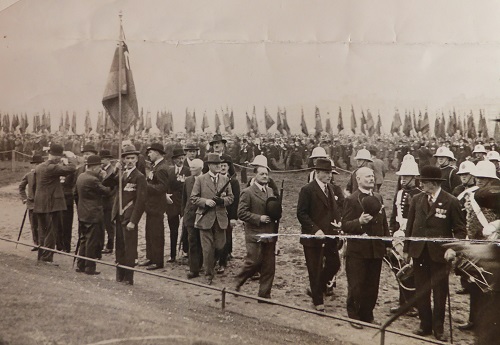
So it was to her daughter, my beloved cousin Diana in Reading, and Diana's husband Lee, who'd put together a kind of 'presentation' for me, that I went while my mother was staying there a couple of months ago. Lee first presented me with the photo from which the above detail is taken and asked me to guess the identity of my grandfather. The above standard-bearer wasn't my first choice.
He stands, if I've got it right, between Lord Jellicoe and General Gourand, at a Whitehall Remembrance Day ceremony. A second photo, less damaged, shows another scene from the same event.
From what I can make out, he served in the army until 1920 but maintained his duties with the British Legion until his death on 16 March 1944. There's a very touching and personal letter from Major Sir Brunel Cohen to his widow, my grandmother (whom I also never knew), which concludes thus:
I have known him for so long, 22 years, I think, and I would assure you that we shall miss him in the Legion more than I can say. He has been ill for so long and I have always admired his pluck in sticking to his job under such hardship and difficulty. A man of unimpeachable integrity!
I'm going to wind the clock back slowly. There are programmes from four Albert Hall ceremonies of remembrance, such large-scale events in the 1930s. This one took place on this day in 1937.
Here it looks as if my grandfather had gone to a commemoration on the battlefield itself, though there's no date or details.
He became a captain in 1920. He'd gone to France in December 1914 as a second lieutenant in the Fifth (formerly Seventh) Dragoon Guards, received one commendation for valour signed by Churchill and ended up with a special medal in addition to the three awarded to most soldiers who lasted the duration (known as 'Pip, Squeak and Wilfred'; if you got two, they were 'Mutt and Jeff').
The
History of the 5th Dragoon Guards published by Blackwood in 1924 gives the details of the action which led to the most prized of the medals, describing events on April 7 1918 in Fampoux Field to the east of Athies:
Second Lieutenant Nice of A Squadron was afterwards awarded the Croix de Guerre for his gallantry in reconnoitring under heavy rifle and machine gun fire to try and find a route for the regiment to make a further advance in the direction of Greenland Hill.
Here's the other side of the Croix de Guerre:
and, quite confoundingly, I also identified a fifth medal as a German iron cross. The mind whirls at this and so much else. How did he come by it? Who will ever know?
Around the war, my grandfather served in Cairo, Secunderabad and Palestine. Slightly curious that I've been to all three places, though I sought out Secunderabad, now a chaotic suburb of Hyderabad, because it always had a magic ring to it when I was a child, knowing that Dad was born there and looking it up in an atlas. Not surprisingly I jumped at this picture, which shows ever stern-looking Elizabeth and George with two of their offspring.
But the children must be Hilda and George Junior, and the location is probably Cairo, because we also came across George's birth certificate, D.O.B. 16 January 1910, Abbasiyeh Garrison.
My father, Cyril, followed two years later. And here he is, seated and serious in front of his Mama, with George the cheeky chappie, young Harry - who went on to serve in the Second World War with the Chindits in Burma, ending up in a prisoner of war camp, an event which scarred him for life - and Hilda (Edith was yet to be born).
Closing in, I have to admit he looks very much like a picture of me with teddy and model racing car aged five, though in my case the serious look may be unidentified myopia. You're spared that pic since I haven't scanned it, but here's Dad again.
Among the papers we also found a photo of Dad in his late teens, signed to Hilda, in which he looks so handsome and happy. But this is about Captain George, so back to the Dragoons. The all-important horse:
and George, third from right, in cod-medieval garb for I know not reason
on the back of which card he's written, which shows he must have had some sense of humour, this to his beloved:
Two more shots will do, a group photo of the Seventh Dragoon Guards in their Abbasiyeh Garrison, Cairo, before the First World War
amd another after it, of riding instructors, which clearly Captain George became, in 1920.
You can imagine the tumult of imagination this triggered in a grandson who now had some puzzle pieces to join together. I hope it's just the beginning of finding out more about my father's side of the family; it's only a shame I left it until this special year to embark on the discovery. Praise be to a blog, then, for enshrining the information. There isn't a lot about the Nices on the web - only a few 18th century American soldiers, and it's a common name out there, so tracing our Nices back, as we have done for the Parrises - earliest known ancestor a Huguenot refugee from the St Bartholomew's Day Massacre, Jean de Paris - is the next duty.



 Posts
Posts



