Showing posts with label Captain George Nice. Show all posts

Sunday, 11 November 2018

Captain George Nice, survivor


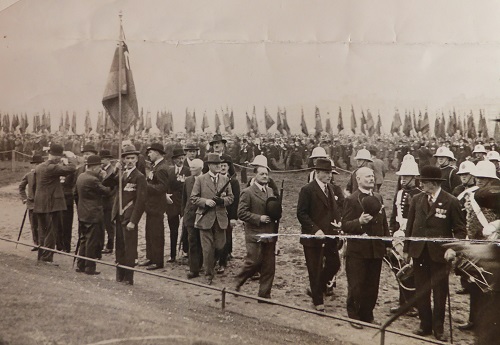
Nothing new to report about my paternal grandfather, George Nice born George King*, since the revelatory day at my cousin Diana's back in 2014 when I saw photographs of him for the first time, and the consequent revelations about his origins from a lady in Colchester. Yet every 11/11 I want to remember him, with some sadness at this proud, lonely figure standing to attention with a banner on many Armistice Day commemorations, as he is above in the front line towards the left. He fought throughout the War in the dragoon guards, and survived it. We know, albeit not in detail, that mustard gas poisoning left him an invalid, with who knows what impact on the adolescent years of my father, so often melancholy in my memories of him (though Diana and his goddaughter Sara remember him further back as a happy, laughing person).


Here, again, then, is the Croix de Guerre, the reverse side this time, which he was awarded (I repeat this ritually from The History of the 5th Dragoon Guards, remarking on the events of 7 April 1918 in Fampoux field to the east of Athies) 'for his gallantry in reconnoitring under heavy rifle and machine gun fire to try and find a route for the regiment to make a further advance in the direction of Greenland Hill.' I feel fortunate that ever since 2014 I have much of a more specific nature by which to remember him.

Other than Britten's War Requiem, I can't think of a more powerful commemoration in musical terms than his (pacifist) teacher Frank Bridge's Oration. After 1918, the gateway of international modernism was open to this underrated figure, a truly international British composer. Appropriate that the soloist should be a German of true Mensch status, Alban Gerhardt.


*Though the indefatigable Josie Holford - see comments - has now added this:

'His half brother Henry Thomas Nice died on July 27th 1917. He was serving as a private with the 15th Battalion of the Royal welsh Fusiliers – London Welsh – the same battalion as David Jones of In Parenthesis. This was just before the start of Passchendaele.

'He is memorialized on the Menin Gate'.

So there was loss there too. As I've mentioned before, my grandfather was actually a King, the illegitimate son of a chamber maid who married a Mr Nice several years later; the boy later chose to take his stepfather's name. So we are not in fact Nices at all.

Saturday, 21 April 2018

BBC Young Musicians at the Proms Launch


Here, in the pink thanks partly to the lighting, are two pianists from among past winners: Lara Melda (2010's victor, then known as Lara Ömeroğlu) and Martin James Bartlett, 17 when he took first prize along with saxophonist Alexander Bone in 2014. Perhaps the one significant step forward for the BBC Proms this summer is to bring together 21 Young Musicians of the Year (as they were formerly called) in a single concert, marking the event's 40th anniversary. Lara and Martin will be repeating their tour de force, featured first time round with the Aurora Orchestra, as specimens in the 'grand zoological fantasy' of Saint-Saëns' Carnival of the Animals, always a delight. Who'll play the Swan? Sheku Kanneh-Mason or one of the other three cellists represented, including Sheku's mentor Guy Johnston?


The reception had a special setting this year, after many sweltering gatherings in the Amaryllis Fleming Concert Hall of the Royal College of Music - the Imperial War Museum, looking less grim and Bedlamish than usual on a day of summer-in-spring. My photos of the gathering were taken before and after the great throng, from which you'll gather I lasted the duration.


The reason for the location was the Proms' commemorating the centenary of the last year of the First World War. The theme reminded me that my paternal grandfather's reconnaissance mission at the Front took place on 7 April 1918 in Fampoux Field to the east of Athies, 100 years ago this month. As related in the History of the 5th Dragoon Guards published by Blackwood in 1924 in my first entry on Captain George Nice - and it seems apt to repeat it here -

Second Lieutenant Nice of A Squadron was afterwards awarded the Croix de Guerre for his gallantry in reconnoitring under heavy rifle and machine gun fire to try and find a route for the regiment to make a further advance in the direction of Greenland Hill.

1918 was also the year in which Parry completed his richest choral music, the Songs of Farewell. At the launch the BBC Singers gave a very nuanced performance, stilling the party crowd, of 'My soul, there is a country,' the only one of the set I know, from All Saints Banstead days*; I came to marvel at the rest when working on a talk for Tim Reader and his Epiphoni Consort, who sang a selection. Sakari Oramo will conduct the entire set - and I think they do need to be heard in one concert, if not necessarily all together at once - in a Cadogan Hall Prom on 20 August.


Looking through the Proms prospectus - our usual pleasure in revelation at the pre-event gathering with David Pickard and Alan Davey was pre-empted by the untimely morning announcement of the whole lot - the Cadogan events strike me as much the most enticing in terms of repertoire. There aren't many great surprises in the rest, though DP made the very good point that what looks ordinary on paper can be transfigured by the unpredictable magic of the Albert Hall (conversely, it can let some pieces down). And there will be thousands who've never heard Shostakovich 4 before - it has to be worth it from Nelsons and the Boston Symphony.

To my surprise Bernstein's MASS isn't on the cards, a Proms piece if ever there was one - though I've had my vision to last the next five years. West Side Story (complete in concert for the first time) and On the Town are, under the peerless-in-that-rep baton of John Wilson.

Cue my chat with Martin and Lara (I knew the former a bit from his Southrepps recital and trio performance). MJB's quirky imagination revealed itself when we were chatting about Bernstein, I told him how, courtesy of my then editor at The Guardian Ted Greenfield, I shook the great man's hand at a recording session for Candide before he (MJB) was born, and he said that Lenny was the person he'd most like to have met. But then he thought about it and commented that probably you'd have the man's entire attention for five minutes and he would be charming, and then switch it off. Like Ripley.


I did a double-take. Yes, Patricia Highsmith's Talented Mr Ripley as immortalised cinematically in Plein Soleil, which MJB hadn't seen, and Minghella's beautifully filmed, scary and poignant masterpiece, which he had (Matt Damon's Ripley pictured above), and we talked about it, and told Lara she had to see it.

Well, it was a grand evening, and though I sometimes dread the thought of chit-chat, there were so many welcome faces, some of whom I asked along to the Europe Day Concert. Several key folk will be involved in that whom I met at the fabulous Pärnu Music Festival, which is a roundabout way for me to close in saying that the orchestra I'm most looking forward to seeing at the Proms, following the usual heavenly (we hope) week, will be the Estonian Festival Orchestra under Paavo Järvi (a chat with David Pickard at the Multi-Story Orchestra Prom last year encouraged that set-up, I'm told). Here the 2016 vintage is on the beach at Pärnu, a typically wonderful shot by the great Kaupo Kikkas.


 Only connect: they'll be opening with Arvo Pärt's Third Symphony, the UK premiere of which father Neeme conducted with the Gothenburg Symphony Orchestra at the Proms in 1989 - an event which led to my first ever visit to Estonia a few weeks later. Terviseks (Estonian for Cheers!) to all those Järvis!

*RIP Choirmaster DAH/David Harding. I can't say much more except that he was the most inspirational figure in my musical education.

Saturday, 11 November 2017

Remembering Captain George Nice


I did so for the first time on 11 November 2014, just after I'd learnt something about my paternal grandfather's history from my cousin Diana's collection of photos and medals; my father had never brought a single record of Captain George to his marriage with my mother. Exactly a year later I had more to post, not least the astonishing revelation that we are not really Nices at all; George Senior (my father, Cyril, took on that name after the death of a so-named brother from tuberculosis - another of dad's too-many secrets which we discovered only after his own death) was the son of a chambermaid who, several years after having given birth to him 'out of wedlock', as they used to say, father unknown, married a Nice and the boy took on his stepfather's name. We're really Kings - and who the real great-grandfather is, we'll probably never know.


Anyway, the point is briefly to commemorate on this day the grandfather I never know, who died 20 years before I was born. The photo on the booklet is of Captain George holding the flag on a Remembrance Day some time after the First World War, probably on a field in France, but again it's difficult to date. He seems to be wearing more medals than the ones my cousin had in the box, including the croix de guerre and an iron cross acquired we know not how (their story is recounted in the first entry).


And one last reminder of the Dragoon Guard with his wife, my paternal grandmother whom I also never knew, and two children, possibly the older one the little girl who died in Egypt since she doesn't look like either of my aunts.


With time, hopefully, even more will be revealed. In the meantime, we will remember them.

Wednesday, 11 November 2015

More on Captain George


Exactly a year ago, on Armistice Day 2014, I shared what I'd only recently found out about my paternal grandfather, Captain George Nice. As I wrote then, my father never brought so much as a picture of his dad when he married my mother, so my cousin's box of photos and medals revealed Cap'n George's face to me for the first time, as well as his Croix de Guerre and a mysteriously sourced iron cross.

Two people have been in touch as a result. One was medal collector Barney Mattingly, who has written several interesting articles on the Fifth Dragoon Guards.


Though I should, of course, have gone and looked at my grandfather's records in the National Archives, Barney's information was helpful to clarify that Captain George entered the "Great War" on 16 September 1914, served in France throughout - until 11 November 1918 - and served with his regiment, first the Seventh and later the Fifth Dragoon Guards, until 12 August 1921. He went to Palestine, as I knew already, and was a trainer in horsemanship, seen here in baggy white trousers in Colchester in 1919.


This is one of several more photos I'd never have seen had it not been for a surprise contact, Helen Barrull, director of the Jairo Barrull Flamenco Company, whose step-grandmother Brenda Elva Tomkins had died, leaving a legacy to a sister who unfortunately died just before her. Helen had been amazingly diligent in tracking down all known relatives - Brenda had 11 aunts and uncles on the Tomkins side, and 10 on the Nice side. My cousins have been elusive to find, but the legal process is underway.

Whether it yields anything or not legacy-wise is, so to speak, immaterial contained to the revelations with which Helen furnished me. And it probably won't, since my grandfather turned out to be first a King, and only a Nice when he took up his stepfather's name on joining the army some time in the late 1890s or early 1900s. His half-brothers and sisters assumed he was a full sibling.

He was born in Lexden, Colchester, in 1882, the illegitimate son of 18-year-old Esther King, a housemaid - so presumably his paternal name will never be known: could it have been a master or another servant? Impossible to say. Esther married George Nice in 1886. While serving in South Africa, her son tracked down his maternal grandfather in an internment camp during the Boer War; the man later died in a Salvation Army Hospital out there.

While my father was alive he never mentioned a brother, George, who died of tuberculosis as a young man. Now Helen had discovered the death certificate of another sibling, Phyllis, who was only eight months old when she died in Abbassia, India - not long before my father's birth in Secunderabad in 1912. Here's another extraordinary picture furnished by Helen of my grandmother Elizabeth, nee Wass, daughter of a mariner, holding my auntie Edith.


Other than that there's not much more to add so far, except one more picture of my grandad putting another dragoon through his horse-paces while in Egypt.


As I wrote a year ago, the mind runs riot when confronted with unexpected fragments of a family jigsaw. So I can well understand how Patrick Gale, a gripping story-teller, made a gay romance out of his great-grandfather's unexplained exile to the Canadian prairies in A Place Called Winter. I'm two-thirds of the way through, and while it may not have the deepest psychological depth, it certainly constructs a world.

Later: two pertinent photo footnotes. First, this amazing image of 650 officers and enlisted men from the cavalry in 1910 - could then Second Lieutenant George Nice be among them? - forming a horse's head.


With hindsight, it could be seen as a prescient memorial to all the horses who were killed in the First World War (of a million, 65,000 came back, and another figure suggests eight million horses were lost on all sides). I hope the source, the valuable educational side Hungry for History, approves me appropriation under the circumstances.

And as a sign that life goes on, here's a NASA satelllite image of India, the land where my father was born a child of Empire in 1912, all lit up for Diwali on the night of what we know as Armistice Day.