Showing posts with label First World War. Show all posts

Saturday, 19 August 2023

Bánffy's Transylvanian Trilogy: not found wanting

To call it 'the Hungarian War and Peace' doesn't do justice to Miklós Bánffy's three-volume chronicle about politics and the aristocracy in the decade leading up to the First World War: it is of equal fascination in the nuancing of its characters, that very Tolstoyan way in which we find sympathy even for those who start off as dislikable. It has a special value in that the Count lived through all this and, writing from the perspective of the 1930s, pours much of himself into the main character, Balint Abady. 

Like Abady, Bánffy had diplomatic experience before he became an independent member of the Hungarian House of Representatives, fighting for the rights of the Romanian-speaking population in his native Transylvania. At the time of the novel, 1904-14, Transylvania was part of Hungary; after it, part of Romania. Between the wars, Bánffy made a crucial contribution to his shattered country's reappearance on the world stage as Foreign Minister from 1921-2 and later resettled on his home estate, Bonczhida (Denestornya in the novel); in 1945 the retreating Germans trashed it. I understand that with the Bánffy family's assistance, it's being gradually restored, but even the shell is fascinating (Bonczhida Castle pictured below in 1893-4). Nearby Kolozsvár, now Cluj-Napoca, is also described in loving detail. 

With its three subtitles taken from the 'writing on the wall' episode in the Book of Daniel which ends with the downfall of sybaritic Belshazzar, the trilogy can seem forbidding before you start reading - and then, in the very first chapter,  Bánffy sweeps us straight into the world of the doomed aristocratic milieu as young Abady finds his carriage one among many heading for Var-Siklod, the country place of Count Lacock who's holding a house party following the Sunday races at Vasarhely. With incomparable vividness  Bánffy introduces us to many of the main characters, expanding upon their behaviour in the following chapters devoted to the house-party. The first two volumes especially teem with vivid descriptions of hunting meets (to shoot foxes and hares), balls and other social extravaganzas. Bánffy doesn't intrude too much with authorial judgment, but we know he's telling us that so much of this is TOO much. They're paralleled with sensitive evocations of the beautiful countryside and the mountains: time for a visit next spring. 

Parallel to this is the charting of Abady's growing social conscience, his observations of a parliament in Budapest obsessed with matters of local and national interest only. The wider European picture only really emerges when Balint learns of it from a cynical political operator, Hawlata, well in to the second volume: 'at that time [1907] no one believed in the possibility of war in Europe. Everyone accepted that the race for armaments was just a device of the great powers which was nothing more than a safety-valve used to save everyone's face'. A placid patriot up to this point, 'it hurt him to hear such a low opinion of his countrymen coming from a foreigner'. Part Two Chapter Six ends with a breathless Abady at the window of his room, wondering 'what price would be paid by his own country, by Hungary, and by his beloved Transylvania which had always stood as a proud fortress on the road from Rome to Constantinople?' He looks down on the distant light of a train passing through the Vag valley and realises

That would be the road down which would go so many of the flower of the nation's youth to the horrors of war, to their death in battle...and against such a vast enemy their sacrifice would surely be in vain...in vain...

The very last chapter of They Were Divided sees the nightmare come to pass in a nihilistic (or realistic) epilogue, as Abady, defeated in his personal as well as his public life, curses his generation and his people. Among others,

He saw before him the magnates and noble families, who thought only of social prominence, who forgot their European affiliations and threw the weight of their great fortunes and moral influence behind all that nationalistic nonsense of which they did not believe a word and which, in consequence, had poisoned the nation's politics...

Now this land would perish, and with it that deluded generation that had given importance only to theories, phrases and formulae, that had ignored all reality, that had chased like children after the fata morgana of mirage and illusion, that had turned away from everything on which their strength was based, that denied the vital importance of power and self-criticism and national unity.

One virtue alone remained: the will to fight.

And that too would prove in vain.

A truly great novel, though, stands not by the power of its rhetoric but by the living, breathing complexity of its characters, and here Bánffy yields nothing to Tolstoy in detail and shifts of register. The author makes us aware of his alter ego's weaknesses - we follow his early attempts at speechmaking with concern - while making sure that Abady holds the moral compass. The other main character is his cousin László Gyerőffy, a young man of potential genius as a musician who throws it all away on gambling and a dissolute life due to a fatal weakness of character stemming from his early orphaned state. Surely we all know someone like this, someone with friends who want to help him (or her) but ultimately prove powerless. In Book Two, there's a very moving and unexpected scene between László and the outwardly crabby 'Crookface' Kendy, who determines to help the dead-drunk young man because he remembers his irredeemable second cousin Daniel being in the same state.

The psychology of László's angry defensiveness and his surprise capitulation is masterly, but the most moving words belong to 'Crookface': 'There isn't enough love in the world for anyone to throw it carelessly away'. But László does, every time. And it's in connection with his capacity for destroying others that the two strongest women in the novel make their mark.  First is the ravishingly beautiful Countess Fanny Beredy, puma-like in her movements, who has musical talent to equal the man with whom she falls in love, resourcefulness and a fascinating personality. László's pride ruins both their lives; incapable of loving anyone else, Fanny's only realm of power remains in wielding what influence she can as the mistress of various powerful men - though Banffy makes it clear that she doesn't hold all the cards. Her disappearance half way through the saga is very troubling; we expect her to re-emerge, but she doesn't, and I wonder if the mysterious benefactor who keeps the destitute László going for as long as possible is supposed to be Fanny. But we never find out. This portrait by Jozsef Rippl-Ronai isn't quite how I imagine Fanny, but it has elements.

Another woman's Calvary, as Bánffy puts it, with even more of a 'don't do it' on our part when faced with László's ongoing self-destruction, is placed in the personage of handsome and independent Sara Lazar, farm manager and better at it than most men in the district. Bánffy's chronicle of how she comes to help the once again degraded youth out of practical sympathy, and falls in love with him, is infinitely nuanced and touching. We think it doesn't have to end badly. But Gyerőffy's character ensures there can be no happy ending.  

Alongside Fanny and Sara, the great love of Balint's life, Adrienne Miloth, cuts a less consistent picture. Banffy is frank about sex, and rape within wedlock, which makes the early stages of Adrienne's miserable married life very shocking. And her Mephistophelian, perverse husband Pal Uzdy doesn't always behave quite as one expects - this is another of those complex portraits at which Banffy excels. But even though she's modelled in part on a Bánffy muse, Carola Szilvássy (pictured below), Adrienne remains a frustrating and elusive figure - perhaps that's half the point. 

The big set-pieces tail off in They Were Divided, and this is no doubt deliberate: the rapid unfolding of events leading to war overshadows everything, though there are two brilliant narratives which bring a kind of light relief - the ridiculous circumstances of a duel challenge resulting from a spat between two comical Anglophiles at a reception for the French Prince Gaston d'Orleans promotion of his anti-duelling league, and the ridiculous Pityu Kendy's 'execution party' for Brandy, which amuses Balint and then disgusts him as the epitome of Hungarian fatuousness. The political disquisitions mount, making the final volume a different kind of book; but I'm sure Bánffy intended no less.

If the author was unlucky to be neglected under Communist rule, the endless hard work of his daughter Katalin Bánffy-Jelen and Patrick Thursfield in translating it all has to be acclaimed as a miracle - without them, so many Bánffy admirers would know nothing of his genius. It's fascinating to find references to his diplomatic and artistic lives which minimise the 'writer' aspect. But even Bánffy's surprising championship of Bartók's ballet The Wooden Prince and opera Bluebeard's Castle as Intendant of the Hungarian State Theatres is underdocumented, at least in English. Scenarist and librettist Béla Balázs has a very caustic style in his recollections of Bartók for the composer's 60th birthday,  but concedes that the Count was 'a talented and intelligent man, and painted lovely scenery'. I suspect you have to go to Budapest to look in the Raday Library for these designs; the only photos I could find were in a lively piece of Banffyana on the website of the tour company Reality & Beyond: I hope the link is enough to reproduce these two images, for what it isn't clear, but the landscape could well be for The Wooden Prince.


A biography of the great man in English is clearly overdue. Thanks to the indefatigable work of Bánffy-Jelen and Thursfield, though, we do have two substantial chunks of memoirs which take us beyond where the novels stop, From My Memories (1932) and Twenty-Five Years (1945). It seems cruel to have gathered them together under the title The Phoenix Land, because Bánffy makes it clear in his introduction to the latter how 'the annihilation that the second catastrophe Fate has brought down upon us is infinitely worst than the first'. He died in 1950, and would be horrified anew at the cynical manipulation of nationalism to feed prejudice that continues under Orbán's ever more disastrous 'Führerdemocracy'.

There's a queasy parallel between the two sets of memoirs. The first begins with Bánffy's imaginative role, as theatre intendant, in creating the spectacle of the last Habsburg coronation in 1916, right in the middle of the First World War. The second includes the comic-operetta haplessness of 'King' Carl's first attempted putsch within Hungary, and the potentially lethal consequences of his second, which could easily have seen Bánffy and others executed had it succeeded (fortunately the vanity and weakness of this impossible creature put fatal delays in the way of a proper Budapest siege, and as Bánffy points out, the Czechs and Romanians would have invaded immediately). I still see Habsburgists waxing lyrical over this coronation without any thought for what the pathetic Carl became. Anyway, it was Bánffy's theatrical instinct to swathe the entire Coronation Cathedral in deep red.

There is some comedy in Bánffy's descriptions, but Part Two of 'From My Memories' turns dark as revolutions threaten his country and he finds himself first trapped in Berlin just as the Spartacist uprising begins, then not too unpleasantly marooned in The Hague, where he turns his hand to portrait painting (plenty more humour here). His most important time as a politician, detailed in Twenty-Five Years, follows the fall of Béla Kun's communist regime, when he serves as Foreign Minister to the honourable István Bethlen, trying to minimise the damage done by the Treaty of Trianon. There's a totally dazzling character sketch of Bethlen adapted from an article originally in the Nouvelle Revue Française, comparing his political emergence to the evolution of life on earth from amphibians to four-legged mammals. I'd love to quote it in full, but I'll let you have the pleasure of seeking it out. At any rate Bánffy also turned out to be a first-rate caricaturist during his time at the 1922 Genoa Conference; it's frustrating not to find more than a couple of reproductions online, and no version of the book subsequently produced, but this is his Bethlen

and this Maxim Litvinov of the Russian Delegation, the arrival of which had all nations holding their breath.

I find it fascinating that my other polymathic, complex discovery of the year, Count Harry Kessler, whose diaries I should have tried to encapsulate here, overlaps with Bánffy at the Genoa Conference. Both give equally vivid impressions of the charismatic Lloyd George especially. Both also had so much in common, balancing diplomacy with their many cultural interests, both fluent in other European languages. Bánffy encapsulates the essence of good diplomacy: always tell the truth in what you actually say - what you don't say is also important - and the essential maxim that 'if one is to confer successfully with foreigners, it is essential to know their way of thinking and be able to put oneself in their place'. Working so assiduously with slippery characters, though, brought him to the edge of a nervous breakdown.

In a way I wish Bánffy had kept diaries like Kessler, but the 'Red Count', as the latter was called in a much more dramatic volte-face than the Hungarian's flexible sympathies, wasn't entirely honest, so it comes to more or less the same thing. Kessler left us another important legacy, but Bánffy's must be seen as the greater literary figure, creating a masterpiece on a level with Tolstoy and Lampedusa. And so readable - when I announced that I'd picked it up halfway through Vol. 2 in hospital, some were concerned that I wasn't going in for lighter material. But I was soon in that world again. I urge you to go for total immersion - once you start, you should be hooked.

Sunday, 11 November 2018

Captain George Nice, survivor


Nothing new to report about my paternal grandfather, George Nice born George King*, since the revelatory day at my cousin Diana's back in 2014 when I saw photographs of him for the first time, and the consequent revelations about his origins from a lady in Colchester. Yet every 11/11 I want to remember him, with some sadness at this proud, lonely figure standing to attention with a banner on many Armistice Day commemorations, as he is above in the front line towards the left. He fought throughout the War in the dragoon guards, and survived it. We know, albeit not in detail, that mustard gas poisoning left him an invalid, with who knows what impact on the adolescent years of my father, so often melancholy in my memories of him (though Diana and his goddaughter Sara remember him further back as a happy, laughing person).


Here, again, then, is the Croix de Guerre, the reverse side this time, which he was awarded (I repeat this ritually from The History of the 5th Dragoon Guards, remarking on the events of 7 April 1918 in Fampoux field to the east of Athies) 'for his gallantry in reconnoitring under heavy rifle and machine gun fire to try and find a route for the regiment to make a further advance in the direction of Greenland Hill.' I feel fortunate that ever since 2014 I have much of a more specific nature by which to remember him.

Other than Britten's War Requiem, I can't think of a more powerful commemoration in musical terms than his (pacifist) teacher Frank Bridge's Oration. After 1918, the gateway of international modernism was open to this underrated figure, a truly international British composer. Appropriate that the soloist should be a German of true Mensch status, Alban Gerhardt.


*Though the indefatigable Josie Holford - see comments - has now added this:

'His half brother Henry Thomas Nice died on July 27th 1917. He was serving as a private with the 15th Battalion of the Royal welsh Fusiliers – London Welsh – the same battalion as David Jones of In Parenthesis. This was just before the start of Passchendaele.

'He is memorialized on the Menin Gate'.

So there was loss there too. As I've mentioned before, my grandfather was actually a King, the illegitimate son of a chamber maid who married a Mr Nice several years later; the boy later chose to take his stepfather's name. So we are not in fact Nices at all.

Saturday, 19 November 2016

Images and sounds of war


Two very different experiences this week. Yesterday evening's showcased the incredible power of the well-edited documentary footage filmed during the Battle of the Somme, with the most sensitive of scores from Laura Rossi, played simultaneously with the film by the BBC Concert Orchestra under John Gibbons at the Royal Festival Hall (most images courtesy of the Imperial War Museum which organised the event). And, on Tuesday, something I felt I had to see, though Helen Wallace reviewed in for The Arts Desk: the UK premiere staging of Karl Amadeus Hartmann's opera Simplicius Simplicissimus (production photos by Max Lacome; pictured below - the ever-fine William Dazeley and company).


I can see why Independent Opera chose it. The original, Grimmelshausen's picaresque novel, is a tragicomic indictment of the horrors of the Thirty Years War from one who lived through it and undoubtedly put a lot of his experience in to the book (I seem to be the only person among those I met on Tuesday night who's read it, albeit long before I knew the operatic event was imminent; I blogged about it here). Hartmann's opera, which only appeared on stage in 1957, over a decade after he completed his first version, just isn't equal to the subject. Yes, there are good pastiches of the Stravinsky/Hindemith/Weill style, but also tedious didacticism not in the book, woeful word-setting - or so I deduce from David Pountney's tough English translation - and very little original invention. Indeed, the best tune, which appears at the end of the Overture and returns for the summit of Simplicius's climactic monologue, rips off the March from Prokofiev's Op. 12 piano pieces. That's not parody, it's plagiarism.

Musically, this was a strong enough evening. All sang well, especially the male ensemble, and Timothy Redmond ardently shaped the contribution of the Britten Sinfonia. But it was all much too big and loud for the Lilian Baylis Studio at Sadler's Wells. A reduced orchestra would have helped, but substantial operatic voices like that of Adrian Thompson, singing the sympathetic Hermit who educates Simplicius in the forest, only added to the hectoring tone at close quarters.


The production, by Polly Graham, was awkward, if not as downright dismal as Gerard Jones's mishandling of Handel's Oreste in another venue unsuitable for the scale, Wilton's Music Hall, which I reviewed for The Arts Desk the previous week. Graham favoured too much heavy symbolism, making movement and motive unclear, and it was a big mistake to dress up Stephanie Corley's admirable Simplicius (pictured above) as a middle-class schoolboy, Sue Perkins-alike when bespectacled, carrying around a notebook. That was supposed to project forward to his keeping a record in maturity; but it accorded ill with the idea that the child grew up in abject poverty, unable to read, write or use proper names.

There were a few good stretches, like the brooding first interlude embracing a Lutheran chorale. But even this was lessened for me by the constant chatter and ostentatious behaviour of the director, sitting two seats away from me. She also rocked the row with laughter at what frankly wasn't funny, to me at any rate. Unprofessional behaviour, only suitable at a final rehearsal, not a performance.


Insensitivity could never be levelled at Laura Rossi (pictured above), the film composer who responded so movingly to the five 'acts' of Somme footage originally screened as wartime propaganda. Apparently cinemagoers scoured the screens for glimpses of loved ones, and I too was on the lookout for my paternal grandfather, Captain George Nice of the Fifth Dragoon Guards, who served in France all the way through the First World War and whose Croix de Guerre-winning action the following April is certainly chronicled. Apparently this assemblage had a score in the first place, but one made of already existing ballads, songs and snatches which, we're told, sounded too triumphalistic a note at times. The only foot Rossi puts wrong, in my opinion, is the swelling apotheosis, which should subside into ambiguity a bit quicker as we see the German prisoners of war - lucky survivors, IMO - bound for England.


Best of all in the score is the rumbling atmosphere broken by perfectly synchronised timpani thwacks as the big guns go off. I kept thinking of Owen's 'Sonnet On Seeing a Piece of our Heavy Artillery Brought into Action' ('Be slowly lifted up, thou long black arm') in the appalling sequences showing the loading and firing of huge weaponry).


The pity and the horror, which no drama can properly recreate, are there, but also the ordinary humanity of soldiers marching cheerfully towards something they can't imagine, and the decency with which the German prisoners seem to be treated. There's a structure here - the walking 'quite friendly up to Death' and the preparations in the first two parts, the shock of the attacks at the heart of the film, and the bleak aftermath in parts four and five.


If only there were sound to eavesdrop on conversations. Anyway, this is something every single human being should see, and complement it with the talking heads of First World War survivors reminiscing in old age. Never again, we may say, but Assad's Syrian government and the Russians are at it harder than ever in Aleppo, as a renewed plea from heroic Dr Hamza al Khatib on Change.org yesterday desperately reinforced. Update: today (Sunday) I read that East Aleppo's last hospital has been destroyed.

Wednesday, 11 November 2015

More on Captain George


Exactly a year ago, on Armistice Day 2014, I shared what I'd only recently found out about my paternal grandfather, Captain George Nice. As I wrote then, my father never brought so much as a picture of his dad when he married my mother, so my cousin's box of photos and medals revealed Cap'n George's face to me for the first time, as well as his Croix de Guerre and a mysteriously sourced iron cross.

Two people have been in touch as a result. One was medal collector Barney Mattingly, who has written several interesting articles on the Fifth Dragoon Guards.


Though I should, of course, have gone and looked at my grandfather's records in the National Archives, Barney's information was helpful to clarify that Captain George entered the "Great War" on 16 September 1914, served in France throughout - until 11 November 1918 - and served with his regiment, first the Seventh and later the Fifth Dragoon Guards, until 12 August 1921. He went to Palestine, as I knew already, and was a trainer in horsemanship, seen here in baggy white trousers in Colchester in 1919.


This is one of several more photos I'd never have seen had it not been for a surprise contact, Helen Barrull, director of the Jairo Barrull Flamenco Company, whose step-grandmother Brenda Elva Tomkins had died, leaving a legacy to a sister who unfortunately died just before her. Helen had been amazingly diligent in tracking down all known relatives - Brenda had 11 aunts and uncles on the Tomkins side, and 10 on the Nice side. My cousins have been elusive to find, but the legal process is underway.

Whether it yields anything or not legacy-wise is, so to speak, immaterial contained to the revelations with which Helen furnished me. And it probably won't, since my grandfather turned out to be first a King, and only a Nice when he took up his stepfather's name on joining the army some time in the late 1890s or early 1900s. His half-brothers and sisters assumed he was a full sibling.

He was born in Lexden, Colchester, in 1882, the illegitimate son of 18-year-old Esther King, a housemaid - so presumably his paternal name will never be known: could it have been a master or another servant? Impossible to say. Esther married George Nice in 1886. While serving in South Africa, her son tracked down his maternal grandfather in an internment camp during the Boer War; the man later died in a Salvation Army Hospital out there.

While my father was alive he never mentioned a brother, George, who died of tuberculosis as a young man. Now Helen had discovered the death certificate of another sibling, Phyllis, who was only eight months old when she died in Abbassia, India - not long before my father's birth in Secunderabad in 1912. Here's another extraordinary picture furnished by Helen of my grandmother Elizabeth, nee Wass, daughter of a mariner, holding my auntie Edith.


Other than that there's not much more to add so far, except one more picture of my grandad putting another dragoon through his horse-paces while in Egypt.


As I wrote a year ago, the mind runs riot when confronted with unexpected fragments of a family jigsaw. So I can well understand how Patrick Gale, a gripping story-teller, made a gay romance out of his great-grandfather's unexplained exile to the Canadian prairies in A Place Called Winter. I'm two-thirds of the way through, and while it may not have the deepest psychological depth, it certainly constructs a world.

Later: two pertinent photo footnotes. First, this amazing image of 650 officers and enlisted men from the cavalry in 1910 - could then Second Lieutenant George Nice be among them? - forming a horse's head.


With hindsight, it could be seen as a prescient memorial to all the horses who were killed in the First World War (of a million, 65,000 came back, and another figure suggests eight million horses were lost on all sides). I hope the source, the valuable educational side Hungry for History, approves me appropriation under the circumstances.

And as a sign that life goes on, here's a NASA satelllite image of India, the land where my father was born a child of Empire in 1912, all lit up for Diwali on the night of what we know as Armistice Day.


Tuesday, 11 November 2014

Captain George Nice


Until this September, I'd never seen a photograph of my paternal grandfather, George Nice. I only knew that he was posted by the British army to Secunderabad, India, where my father was born in 1912, and after that he served throughout the First World War, where he suffered mustard gas poisoning and was something of an invalid for the rest of his life. Strange, isn't it, that my father had nothing to show my mother of his past life, not even a picture, and was so secretive that only after his death did we find out that he had an elder brother, George - the name he took despite being christened Cyril - who died of tuberculosis (when I was up for my BCG jab, Dad kept completely stumm).

My father was two decades older than my mother, of that more rigid and unrevealing generation, but even for a man of his age seems to have been remarkably unforthcoming. He became an invalid after a stroke when I was 10 and died five years later, so the longer chats that might have come with maturity never happened. I think I understand: that the fact he never talked about his work as a London fireman in the Second World War must have been to bury unimaginable horrors, while the death of his brother must have been so painful, and loaded him with responsibilities as the eldest son, the new 'George' to look after his by all accounts formidable mother. There was another brother, Harry, an older sister, Hilda and a younger, Edith, who kept the family heirlooms in boxes barely touched until this year.

So it was to her daughter, my beloved cousin Diana in Reading, and Diana's husband Lee, who'd put together a kind of 'presentation' for me, that I went while my mother was staying there a couple of months ago. Lee first presented me with the photo from which the above detail is taken and asked me to guess the identity of my grandfather. The above standard-bearer wasn't my first choice.


He stands, if I've got it right, between Lord Jellicoe and General Gourand, at a Whitehall Remembrance Day ceremony. A second photo, less damaged, shows another scene from the same event.


From what I can make out, he served in the army until 1920 but maintained his duties with the British Legion until his death on 16 March 1944. There's a very touching and personal letter from Major Sir Brunel Cohen to his widow, my grandmother (whom I also never knew), which concludes thus:

I have known him for so long, 22 years, I think, and I would assure you that we shall miss him in the Legion more than I can say. He has been ill for so long and I have always admired his pluck in sticking to his job under such hardship and difficulty. A man of unimpeachable integrity!

I'm going to wind the clock back slowly. There are programmes from four Albert Hall ceremonies of remembrance, such large-scale events in the 1930s. This one took place on this day in 1937.


Here it looks as if my grandfather had gone to a commemoration on the battlefield itself, though there's no date or details.


He became a captain in 1920. He'd gone to France in December 1914 as a second lieutenant in the Fifth (formerly Seventh) Dragoon Guards, received one commendation for valour signed by Churchill and ended up with a special medal in addition to the three awarded to most soldiers who lasted the duration (known as 'Pip, Squeak and Wilfred'; if you got two, they were 'Mutt and Jeff').


The History of the 5th Dragoon Guards published by Blackwood in 1924 gives the details of the action which led to the most prized of the medals, describing events on April 7 1918 in Fampoux Field to the east of Athies:

Second Lieutenant Nice of A Squadron was afterwards awarded the Croix de Guerre for his gallantry in reconnoitring under heavy rifle and machine gun fire to try and find a route for the regiment to make a further advance in the direction of Greenland Hill.

Here's the other side of the Croix de Guerre:


and, quite confoundingly, I also identified a fifth medal as a German iron cross. The mind whirls at this and so much else. How did he come by it? Who will ever know?


Around the war, my grandfather served in Cairo, Secunderabad and Palestine. Slightly curious that I've been to all three places, though I sought out Secunderabad, now a chaotic suburb of Hyderabad, because it always had a magic ring to it when I was a child, knowing that Dad was born there and looking it up in an atlas. Not surprisingly I jumped at this picture, which shows ever stern-looking Elizabeth and George with two of their offspring.


But the children must be Hilda and George Junior, and the location is probably Cairo, because we also came across George's birth certificate, D.O.B. 16 January 1910, Abbasiyeh Garrison.


My father, Cyril, followed two years later. And here he is, seated and serious in front of his Mama, with George the cheeky chappie, young Harry - who went on to serve in the Second World War with the Chindits in Burma, ending up in a prisoner of war camp, an event which scarred him for life - and Hilda (Edith was yet to be born).


Closing in, I have to admit he looks very much like a picture of me with teddy and model racing car aged five, though in my case the serious look may be unidentified myopia. You're spared that pic since I haven't scanned it, but here's Dad again.


Among the papers we also found a photo of Dad in his late teens, signed to Hilda, in which he looks so handsome and happy. But this is about Captain George, so back to the Dragoons. The all-important horse:


and George, third from right, in cod-medieval garb for I know not reason


on the back of which card he's written, which shows he must have had some sense of humour, this to his beloved:


Two more shots will do, a group photo of the Seventh Dragoon Guards in their Abbasiyeh Garrison,  Cairo, before the First World War


amd another after it, of riding instructors, which clearly Captain George became, in 1920.


You can imagine the tumult of imagination this triggered in a grandson who now had some puzzle pieces to join together. I hope it's just the beginning of finding out more about my father's side of the family; it's only a shame I left it until this special year to embark on the discovery. Praise be to a blog, then, for enshrining the information. There isn't a lot about the Nices on the web - only a few 18th century American soldiers, and it's a common name out there, so tracing our Nices back, as we have done for the Parrises - earliest known ancestor a Huguenot refugee from the St Bartholomew's Day Massacre, Jean de Paris - is the next duty.

Thursday, 9 January 2014

St Petersburg 1914


So now I can stick on my CV that I've written a monologue for a famous actor. I've had scripts for two Glyndebourne 'Opera Bites' - a sadly defunct CD series of introductions - read by Fiona Shaw (Bizet's The Pearl Fishers) and Timothy West (Prokofiev's Betrothal in a Monastery), but this one 'for' Jonathan Pryce is slightly different. It seemed like a crazy thing to have to do when Radio 3 approached me to provide a 'musical postcard' from St Petersburg for its series Music on the Brink, about Europe in early 1914. 'Present it like an "I was at a great concert last night" type of thing', I was told, and groaned far too audibly.

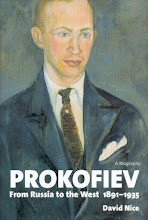
Then it came to me. First, why not just snippet from Prokofiev's extensive diary for that year? Not quite the format they wanted. So how about this: write the postcard as from one of SSP's fellow St Petersburg Conservatory student friends, waiting for his climactic participation in the student competition to claim a Schroeder grand piano as prize (he won it playing - in an unprecedented move - his own First Piano Concerto as well as Liszt's transcription of Wagner's Tannhäuser Overture)? That did it: thus I could cover not only SSP's new steps in music but also the ongoing Wagner craze and his first live hearing of Stravinsky's Rite of Spring in a Koussevitzky concert. Picture of SSP below is a bit later, from the American period.


You can hear the results this afternoon at some point during In Tune starting at 4.30pm, and thereafter for the next week on the BBC iPlayer, perhaps maybe for all time on this clip added tonight which I've just (23.00) heard (as a matter of personal pique, although I'm assuming Suzy Klein gave a credit in the back announcement, there's none as it stands in the presentation or the broadcast here, which is a bit poor; but what's a script hack compared to a 'star of stage and screen'? UPDATE: my gripe has been answered, the credit added. So I'd wipe the rest of the parenthesis were it not for the sake of the comments making sense).

My mention of a chess game Prokofiev held during the competition with a female rival got cut, but in any case I stopped short of chronicling a simultaneous,  momentous event in his life, his participation in the 1914 St Petersburg International Chess Championships held that April.


I have a fair bit about it in the biography, and there's more in the ever compelling diaries, but until today I didn't know this extraordinary photo existed. That I now do is courtesy of Edward Winter's Chess History website

Spot the composer? I thought I saw him at the back. This partial key from some diligent chess fan made me look again. You'll need to click on the pic to enlarge for the numbers.


1-Alekhine, 2- Janowski, 3-Capablanca, 4-Bernstein, 5-Marshall, 6-Blackburne, 7-Lasker, 8-Tarrasch, 9-Rubinstein, 10-Nimzowitsch, 11-Gunsberg, 12-D.D. Korelev, 13-A.I. Alekhine, 14-J. Taubenhaus, 17-N.A. Znosko-Borovsky, 21-E.I. Talvik, 22-Boris Bashkirov-Verin 23-P.A. Saburov, 24-S.S. Prokofiev, 25-J.O. Sossnitzky, 26-­A.A. Chepurnev, 27-R. Gebhardt, 29-B.E. Maliutin, 31-P.P. Saburev, 33-A. Burn, 35-Vainshtein, 36-P.A. Eftifeev, 37-Lochwitsky, 39-Ed. M. Nabel, 40-P.P. Potemkin, 56-B.Z. Kolenko, 58-Frau Lasker

So that includes not only SSP (24) but also the great contestants whose game was taking place around the time of the picture, Prokofiev's soon-to-be firm friend José Capablanca (3) and Emmanuel Lasker (7), whom the composer compared respectively to Mozart and Bach (see pages 99-100 of my Vol. 1), as well as his feckless chum Boris Bashkirov who wrote poetry under the name of Boris Verin (22). Also in the biog's appendix is the simultaneous chess game victory Prokofiev gained over Capablanca on 16 May.

As for the wider events leading up to the terrible, unanticipated* explosion of August 1914, I've been reading more about them with horror and a heavy heart in between the wit and wisdom of Simon Winder's sequel to his captivating Germania, Danubia.


Oh, the pointlessness not just of the Great War but all those lives lost in the carnage of the Habsburgs' earlier conflicts. What especially makes the heart sink is the shifting Realpolitik which dogs every conflict even today, the principle of 'my enemy's enemy is my friend' which afflicted the patchwork of nations and languages making up the ever-shifting Austrian (and Austro-Hungarian) Empire.

Even so, despite all those mid-19th century feckless battles, Winder constantly reiterates, as he did in Germania, how 1900s Vienna didn't especially see itself as the dancer on the abyss it becomes with hindsight. He's fascinated by the social life which leaves none of the traces we use as signifiers - film, music, art, literature.


Winder's most extravagant flights of fancy come in accounts of visits to often melancholy sites around the former empire. Marienbad/Mariánské Lázně gets the 'attractively brittle...pointless fraud' treatment, harmless on the surface and horrible underneath, Winder concluding that section brilliantly: 'This framework for polite, empty circulation, a regulated, closed environment for the right kind of people, now seems to stand for a lost and enviable pre-1914 world, but in practice it has always been toxic and peculiar'.


His paean to the architecture of Budapest Zoo culminates in a delirious ('demented' would be Winder's word, sometimes a bit overused in his second volume) description of the Guinea-Pig Village. Below, the 'faux-Tamerlane' Elephant House, 'possibly the maddest of all Hungarian "Turanian" fantasies about national origins in some vague but grand part of Central Asia, with the unique displacement activity of also granting the nation's elephants a shared Hungarian ancestry'. Winder goes on to tell us how during the brief, unlikely re-alignment with the Ottomans in the First World War the suggestion of a mosque for pachyderms caused offence, so the minaret had to be removed for a bit.


Buy, read, marvel at the lightness with which Winder wears his polymathy. His curiosity is boundless and he's left me with an enormous list of places to see - aforementioned zoo, the perfect Bohemian town of Český Krumlov on the Vltava and Sibiu in Romania right at the top; of literature to read - time to pick up my three-volume Banffy, but also to seek out other Czech and Hungarian novels; of films to see and music to hear (Winder is one up on me in knowing, and making attractive the prospect of listening to, the four Zemlinsky string quartets - shame I couldn't get to any of the concerts in the Hampstead Festival cycle). But to make the full 'follow up' inventory I need to go back to the book and comb through. It's certainly one for the ages.

*A tart commenter takes me to task for the irresponsible use of that word - I reply (see below) that I should have qualified it with the acnowledgment that it was the extent of the explosion, its ramifications, which could not have been anticipated.