Showing posts with label Follies. Show all posts

Saturday, 30 March 2019

Company at last - and a few Follies offcuts


Nearly missed it - and you will, too, if you don't go today (and don't ask me if there are any tickets left, though we got half-price ones from the Leicester Square booth). Marianne Elliott's endlessly inventive production of Company hit the headlines because Sondheim's evasive protagonist, whom I last saw played by the superb Adrian Lester, has become a woman, anxious about the need to settle down and start a family while the clock's still ticking. I like the way that Elliott underlines to David Benedict in the programme how this is 'not better, just different', a concept for this particular time. All production images here by Brinkhoff/Mogenburg.


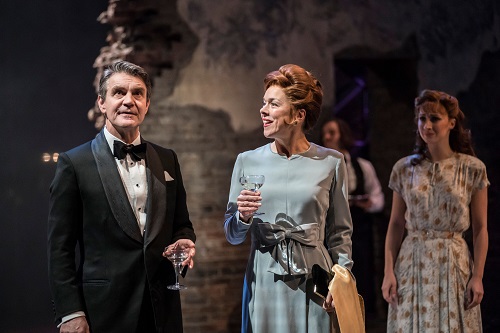
It involves some major cast changes: Bobby's lovers become men, who pull off the Andrews Sisters pastiche 'You Could Drive a Person Crazy' very much on their own terms, though one of them - George Blagden as PJ - falls a bit flat on his own, the only member of the cast to do so; it may be what his character's given to do. 'Getting Married Today' is now 'owned', as they say, by Jonathan Bailey as Jamie, not Amy (pictured above o the right with Rosalie Craig and Alex Gaumond), and that 'should I?' aspect applies equally well to the ramifications of a gay marriage (it could stay in any future production, and I don't see why Bobby - here Bobbie - shouldn't be a gay male, either).


Anyway, Rosalie Craig is bewitchingly wonderful and funny as our heroine. She has that admirable habit of delivering key numbers as if they were improvised on the spot (which stops 'Someone is Waiting' from getting sugary). 'Being Alive', which I also have difficulties with out of context (and without the spoken interjections), is rightly her magnificent zenith. Her situations are a gift to designer Bunny Christie, who springs on us an Alice 'Eat Me/Drink Me' situation shortly before the 11 o'clock number so vibrantly delivered by Patti LuPone (pictured below), 'The Ladies Who Lunch' (perhaps too vibrantly; one just can't imagine this powerful woman sensing futility or mortality).


Way more brilliant things than not so good, then. But I had some doubts. About the dynamic between Bobbie and her lovers, especially air steward Andy, camp as his breed tends to be - though I have to gush about Richard Fleeshman's Greek-god body. About the sound of the band - folk whom I'd spoken to thought that was only under-par thing about the show, but I feel the problem is due to not using Jonathan Tunick's orchestrations, still sounding splendid on the original cast recording. About the de luxe edition - were the extra movement people necessary in 'Another Hundred People'? About the dialogue, above all. Reams of it. All the songs are winners, but I found myself waiting too impatiently for some of them. Spoilt of course by having seen Follies again a couple of weeks earlier, in which, as Peter Forbes pointed out, the dialogue is so minimal and takes us up to the musical numbers which then further the action. Only a year later than Company, Sondheim had discovered how to 'do' musical theatre rather than a play with songs.

Still, when I enjoyed it, I adored it - and came back for further fixes of both Follies and Company on CD. Spent some time and small amounts downloading from Amazon Follies numbers which either hadn't made the original show or were added for the first London production. This is the most, well, beautiful, a Ben/Sally duet that is just as haunting as 'Too Many Mornings'.


The text may be unambiguous; it's the music with its bittersweet downward slips that works the magic: Sondheim in Ravel Valses nobles et sentimentales mode. Surprising he didn't re-engage it in A  Little Night Music, but then words for him come first, and the melody couldn't be twisted to fit another text. Lovers of Follies will recognise it as the opening of the Overture - ah, so that's what it is! - along with a number for Buddy, 'That Old Piano Roll'. I could only find Wynton Marsalis's arrangement on Amazon, but here it is as sung and played by the master in his demo sequence (at 7m25s). What's more, the sequence starts with the original version of what became the 'Beautiful Girls' we know (much better).


From 38m40s onwards you get three more numbers you probably won't hear in any production of Follies today. All this began because I mentioned to Peter and my friend Simon after the revival performance we attended that I preferred 'Ah! But Underneath' - composed for Diana Rigg in the only previous London production - to 'The Story of Lucy and Jessie' until I saw what was made of the latter, with Janie Dee giving us the Rita Hayworth-as-Gilda look and dancing splendidly; 'Ah! But Underneath' is for a singer, first and foremost.

No-one does it better than Cleo Laine on a treasured Sondheim disc with all orchestrations by Tunick. Heck, she could probably still sing it well at 90, as she did a fair number of songs around the time of the birthday. Weirdly neither of the YouTube clips are embeddable, but try this: https://www.youtube.com/watch?v=x4TeGlDETTs. As I couldn't find one comparable that I could embed, let's leave it there. And onwards to the Buñuel musical on which Sondheim is currently working...and that's definitely in progress, since I was told he and Thomas Adès communicated on taking The Exterminating Angel as a subject (one of two in Sondheim's case). Will mortality be the main theme? It would certainly be right.

Sunday, 3 March 2019

Follies of 2019


To declare the National Theatre's revival the best ever production, with the best ever cast, of Sondheim and Goldman's layered masterpiece, you'd have to go back as far as the 1971 premiere. My theatre editor on The Arts Desk, Matt Wolf, was sitting next to a man who'd been there, and he declared this was tops. What I do know is that I laughed, cried and cheered my way through the 2017 press night of Dominic Cooke's subtle staging, already the stuff of five-star raves like mine, and that it just got even better (Marianka Swain seems to me to hit the nail on the head, and eloquently so, for TAD this time). Production photos throughout by Johan Persson.


It sounds curmudgeonly to say so, but while Imelda Staunton brought her usual perceptiveness and truth to the role of Sally Durant Plummer, the former Weismann Girl who's been eating her heart out over decades for the man she should have married while wed to the one she doesn't really love, it didn't fit her like a glove in the way that her definitive Mamma Rose in Gypsy absolutely did. The lines lie quite high, really needing an accomplished singer - some numbers were transposed for IS, I'm told - and one hears Barbara Cook sometimes in the true show voice of Joanna Riding.


But oh, we get so much more. It's interesting that, as before, the production images don't give away what happens in the climactic 'Loveland' Follies of the four main characters, working all the better for not coming after an interval. So you see the sweet facade of Sally above, not the raging monster that breaks out of 'Losing My Mind'. The image - slight spoiler notice - of her ripping off her wig and staring terrifyingly with her clown-face at the audience is up there with the great moment of her Julie Jordan bursting out of the house in Act Two of Carousel and crying 'where is he?' (of the 'ghost' Billy Bigelow). I remember how our row rocked with tearful heavings at that point.


The way that key song is played underlines what Cooke does with so many numbers - has them start naturalistically and quietly, at a mirror ('Broadway Baby' and, more stylised, this one) or conversationally to friends, admirers or husband (Tracie Bennett's ever-stupendous 'I'm Still Here' - pictured above, given in full in the YouTube film at the end of this piece - and Janie Dee's cool-beginning 'Could I Leave You?' - Dee pictured below with Alexander Hanson and Christine Tucker) and then rise to heights either of theatrical defiance, on with the motley, or sheer fury. The stage persona can be as 'real' as the inner turmoil revealed.


I was struck this time by how much the young 'ghosts' were interacting with their older selves, more palpably aghast at the way they'd turned out. Having a drink after the show with our former Edinburgh University Theatre Company buddy, and the best Buddy you'll ever see, Peter Forbes (pictured below), he confirmed that Cooke, even in absentia for part of the rehearsal period as he was finishing off a film, had wanted more of this. The excellent junior show singers, therefore (Christine Tucker, Gemma Sutton, Harry Hepple and Ian McIntosh) had to be 'present', emotionally speaking, the whole time. So you looked at them much more often. In any case, 'Waiting for the Girls Upstairs' is as perfect an ensemble (an octet, in fact) as Sondheim ever devised.


Alexander Hanson gave us a different Ben from Philip Quast, the cracks showing from the start, some very sensitive singing going on. Perhaps that meant that the ultimate breakdown felt inevitable rather than surprising, but none the worse for that. I assumed we were seeing the same Hattie 'Broadway Baby' Walker as first time round, since they looked identical, but this was Claire Moore (pictured below) rather than Di Botcher, absolutely terrific.


I was hoping to see Felicity Lott, taking over the veteran Austrian diva Heidi Schiller from Josephine Barstow for this stretch of the run, but she was stricken with laryngitis, and though she felt better on Tuesday morning, she gave it one more day before she was back in the bosom of people she absolutely adores (and it's reciprocated).


I went, lucky me, as a guest of Meyer Sound, celebrating its new partnership with the NT, and it may come across as the kind of commercial plug you keep getting, in knowing inverted commas, throughout RuPaul's Drag Race (welcome, Season 11 - it's going to be good) if I say that, yes, the quality of orchestral balance with well-miked singers really showed their part in the overall success. But what ravishing playing! Jonathan Tunick, Sondheim's master orchestrator, is hugely, sincerely impressed. Peter told us how he was there at an orchestral rehearsal at which Peter's son, a double-bassist, was allowed to sit alongside the professional player. Tunick would tweak a note here and there, hearing everything with the ear of a Boulez, re-allocating a line or two to make all the difference.

That's professional genius. And lest you ever doubted it about the master, I came across an amazing 55 plus minutes of Sondheim in conversation with André Previn which absolutely nail it, making no allowances at all for what the TV audience might or might not know. I found it when I was looking, on the advice of my Arts Desk pal Graham Rickson, for Previn's Pittsburgh Mahler 4 to add to the TAD homage I put up yesterday. I didn't find that, but I came across this - and, better still, it has the three wonderful first performers of Side by Side by Sondheim - Julia McKenzie, Millicent Martin and David Kernan - bearing out what Sondheim says about duet form, pastiche - a chance to hear the first song he wrote for 'Phyllis's Folly', not even heard in Side by Side, and breaking the song-mould. A true and generous insight into the creator's workshop, and what a brilliant interviewer Previn makes.


And we have to end with Bennett's 'I'm Still Here', as performed at an awards ceremony feting the last run. Now, I have to catch Company before it closes. Meant to go over Xmas, but ended up in hospital instead...


Friday, 12 January 2018

Willkommen (zurück), bienvenue, welcome


It was 37 years ago this May that the Edinburgh University Theatre Company put on a production of Kander & Ebb's Cabaret in the much-loved Bedlam Theatre. It had a huge impact on all of us lucky enough to be in it. Mary New (now Amorosino), my then soon-to-be flatmate, whom I'd known (but not really since we were juvenile chalk and cheese) from All Saints Banstead Choir days and still a close friend, incarnated Sally Bowles.


Living as she does in Washington, Mary wasn't able to make a wonderful reunion held in the Stockwell home of Sarah Macnee - then the designer, now Executive Director of Crying Out Loud. Our MC, the fabulous Leonard Webster, also lives in the States, having performed the role professionally (in Leicester, I believe) since those student days. But it was still quite an assemblage.


Some of the folk in this photo - courtesy of Kerry's man Dom (more about her below), since though I was on the staircase snapping alongside him, my shots are less sharp - weren't in the production, but all had some kind of involvement with the Bedlam. So I'll add parentheses where relevant. From left to right, Eleanor Zeal (two-time Fringe First winner and co-godparent of beloved goddaughter Rosie - Rosie's  mother being our equally beloved and never forgotten late friend Nell Martin), Pat O'Connell (music director), Kerry Richardson (uncharacteristically distant, but we'll see her in a moment recreating her Fräulein Schneider), Antonia Giovanazzi, half of Simon Bell (Clifford Bradshaw, and still my best mate), Claire Hicklin (Bedlam queen when I arrived to audition at the theatre in Freshers' Week 1980, and I was always a bit intimidated by her impossibly glammy former self, all Stockbridge charity shop fur coat and smoke from pungent Gauloises; if only I knew what an eerie little person she was inside, she told me), John Stalker (director, Bedlam supremo and now big-cheese producer, predictably enough), Peter Forbes (Herr Schultz, and another big cheese, just wowed everyone as Buddy Plummer in the National Theatre Follies - back then always The One Most Likely To, despite his modesty), Gabrielle Firth (as she then was; she must forgive me for not having recognised her from those days) and Sarah.


That's Peter as Buddy, pictured for the NT by Johan Persson. I'd previously seen him as Malvolio, Max Reinhardt's business manager Rudolf 'Katie' Kommer in Michael Frayn's Afterlife - a play I liked a lot more than most - and Balvenie, Earl of Douglas in Rona Munro's magnificent James Plays, but who knew he could sing quite as stunningly as he did at the National? Herr Schultz required only a kind of crooning, but still he conveyed all the necessary quiet pathos, and Kerry made me weep every night with her rendition of 'What would you do?' I'm so glad she's become a good friend in the past few years, too. I knew I wanted the 'older couple', closer in years now to their roles, to recreate this pose.


And gamely they did - there's a whole string of diverse, fun posturings, but this one comes closest. Peter seems to have reincarnated his pose, laugh apart, more accurately than Kerry.


What filled me with a long-lasting delight about the evening was that everyone present seemed - so far as one could tell - sorted and happy. Sure, there had been some divorces and past troubles, but - touch wood - we all seemed on an even keel, contented with our lot. So very different from Follies. And John - I asked him if he still thought our Cabaret was good, and he told me he'd seen many since, and yes, it was in his view the best - would be happy to help with a 40th anniversary sing-through of the show. Maybe more (a special script?), maybe on the Edinburgh Fringe, who knows? Let's get organising, and hope no-one dies in the meantime... The extra body in the photo below, by the way, is Sarah's partner Walter, meeting and chatting to whom was another huge plus (he's a staunch and active Remainer).