Showing posts with label Felicity Lott. Show all posts

Sunday, 3 March 2019

Follies of 2019


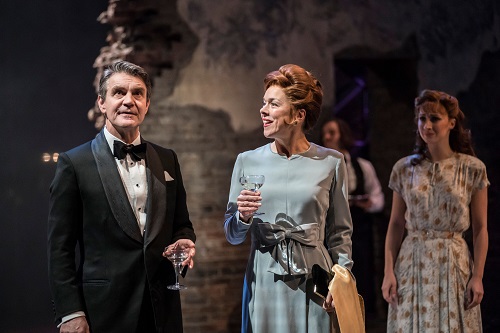
To declare the National Theatre's revival the best ever production, with the best ever cast, of Sondheim and Goldman's layered masterpiece, you'd have to go back as far as the 1971 premiere. My theatre editor on The Arts Desk, Matt Wolf, was sitting next to a man who'd been there, and he declared this was tops. What I do know is that I laughed, cried and cheered my way through the 2017 press night of Dominic Cooke's subtle staging, already the stuff of five-star raves like mine, and that it just got even better (Marianka Swain seems to me to hit the nail on the head, and eloquently so, for TAD this time). Production photos throughout by Johan Persson.


It sounds curmudgeonly to say so, but while Imelda Staunton brought her usual perceptiveness and truth to the role of Sally Durant Plummer, the former Weismann Girl who's been eating her heart out over decades for the man she should have married while wed to the one she doesn't really love, it didn't fit her like a glove in the way that her definitive Mamma Rose in Gypsy absolutely did. The lines lie quite high, really needing an accomplished singer - some numbers were transposed for IS, I'm told - and one hears Barbara Cook sometimes in the true show voice of Joanna Riding.


But oh, we get so much more. It's interesting that, as before, the production images don't give away what happens in the climactic 'Loveland' Follies of the four main characters, working all the better for not coming after an interval. So you see the sweet facade of Sally above, not the raging monster that breaks out of 'Losing My Mind'. The image - slight spoiler notice - of her ripping off her wig and staring terrifyingly with her clown-face at the audience is up there with the great moment of her Julie Jordan bursting out of the house in Act Two of Carousel and crying 'where is he?' (of the 'ghost' Billy Bigelow). I remember how our row rocked with tearful heavings at that point.


The way that key song is played underlines what Cooke does with so many numbers - has them start naturalistically and quietly, at a mirror ('Broadway Baby' and, more stylised, this one) or conversationally to friends, admirers or husband (Tracie Bennett's ever-stupendous 'I'm Still Here' - pictured above, given in full in the YouTube film at the end of this piece - and Janie Dee's cool-beginning 'Could I Leave You?' - Dee pictured below with Alexander Hanson and Christine Tucker) and then rise to heights either of theatrical defiance, on with the motley, or sheer fury. The stage persona can be as 'real' as the inner turmoil revealed.

I was struck this time by how much the young 'ghosts' were interacting with their older selves, more palpably aghast at the way they'd turned out. Having a drink after the show with our former Edinburgh University Theatre Company buddy, and the best Buddy you'll ever see, Peter Forbes (pictured below), he confirmed that Cooke, even in absentia for part of the rehearsal period as he was finishing off a film, had wanted more of this. The excellent junior show singers, therefore (Christine Tucker, Gemma Sutton, Harry Hepple and Ian McIntosh) had to be 'present', emotionally speaking, the whole time. So you looked at them much more often. In any case, 'Waiting for the Girls Upstairs' is as perfect an ensemble (an octet, in fact) as Sondheim ever devised.


Alexander Hanson gave us a different Ben from Philip Quast, the cracks showing from the start, some very sensitive singing going on. Perhaps that meant that the ultimate breakdown felt inevitable rather than surprising, but none the worse for that. I assumed we were seeing the same Hattie 'Broadway Baby' Walker as first time round, since they looked identical, but this was Claire Moore (pictured below) rather than Di Botcher, absolutely terrific.


I was hoping to see Felicity Lott, taking over the veteran Austrian diva Heidi Schiller from Josephine Barstow for this stretch of the run, but she was stricken with laryngitis, and though she felt better on Tuesday morning, she gave it one more day before she was back in the bosom of people she absolutely adores (and it's reciprocated).


I went, lucky me, as a guest of Meyer Sound, celebrating its new partnership with the NT, and it may come across as the kind of commercial plug you keep getting, in knowing inverted commas, throughout RuPaul's Drag Race (welcome, Season 11 - it's going to be good) if I say that, yes, the quality of orchestral balance with well-miked singers really showed their part in the overall success. But what ravishing playing! Jonathan Tunick, Sondheim's master orchestrator, is hugely, sincerely impressed. Peter told us how he was there at an orchestral rehearsal at which Peter's son, a double-bassist, was allowed to sit alongside the professional player. Tunick would tweak a note here and there, hearing everything with the ear of a Boulez, re-allocating a line or two to make all the difference.

That's professional genius. And lest you ever doubted it about the master, I came across an amazing 55 plus minutes of Sondheim in conversation with André Previn which absolutely nail it, making no allowances at all for what the TV audience might or might not know. I found it when I was looking, on the advice of my Arts Desk pal Graham Rickson, for Previn's Pittsburgh Mahler 4 to add to the TAD homage I put up yesterday. I didn't find that, but I came across this - and, better still, it has the three wonderful first performers of Side by Side by Sondheim - Julia McKenzie, Millicent Martin and David Kernan - bearing out what Sondheim says about duet form, pastiche - a chance to hear the first song he wrote for 'Phyllis's Folly', not even heard in Side by Side, and breaking the song-mould. A true and generous insight into the creator's workshop, and what a brilliant interviewer Previn makes.


And we have to end with Bennett's 'I'm Still Here', as performed at an awards ceremony feting the last run. Now, I have to catch Company before it closes. Meant to go over Xmas, but ended up in hospital instead...


Sunday, 19 February 2017

More great guests at the Frontline Club


Following his final performance as the best Music Director of English National Opera in my memory, Mark Wigglesworth paid another visit to my Opera in Depth class at the Frontline Club in November.


Student Frances Marshall, a professional photographer who recently took stunning photos of the wedding of a certain bass friend and the Salzburg love of his life, brought along her camera and caught a couple of great shots, including the one above, which another visitor, Susan Bullock, thought was Mark to the life - pensive, deep-thinking.

More recently, spending what now turns out to be nine glorious Monday afternoons on Der Rosenkavalier, we were blessed to have Dame Felicity Lott coming to talk Strauss. Distinguished film and documentary maker David Thompson managed some pics from his seat front left.


And last week Richard Jones returned with typically off-centre thoughts on his Glyndebourne Rosenkavalier. This photo is of a previous visit as I didn't want to wear him out with student paparazzi. He's a lot smilier these days, so wry and funny.


Fortunately the wisdom of all three is captured, with their consent, on my mp3 player - I hope I'll have cause to revisit and transcribe some time. The main thing to mark is the departure of Messrs Wigglesworth and Jones from the ENO fold - the present CEO hasn't earned the respect of either, and should be ashamed of herself for letting them go. So much to lament here. This season's Don Giovanni was their first collaboration, and while Mark is never lost for words to praise his colleague, Richard said he was - adding only, 'what class'. When he said that he wouldn't tackle the other two Mozart/Da Ponte operas, I asked him, not even with MW? Oh yes, with him, definitely, came the reply. We've also lost the collaboration on The Gondoliers - a work Carlos Kleiber longed to conduct at ENO, gospel truth - and Elektra.


FLott still has the performer's instinct - she's havering over whether to play the Devil in a Belgian company's Stravinsky Soldier's Tale, in the French she speaks so beautifully, and to see her react to recordings of Crespin and Lehmann, as well as the recording she made of the Rosenkavalier Trio with Dessay, Kirchschlager and Pappano, was very, very moving. So were her readings of three texts I'd translated. Memories of C Kleiber were so precious - always the greatest for her, as well as for the rest of us watching their Vienna Rosenkavalier on DVD. No wonder she can't tolerate slow, maudlin tempi for the Marschallin. He used to sign himself 'Uncle Greifenklau' after the relative the Marschallin tells us she's intending to visit. Huge fun - he looks it on screen - and very amusing anecdotes, including one about Pavarotti replacing the usual Italian Tenor for a performance. You can imagine he didn't take to the Kleiber style.


It's also encouraging to hear all three guests speak so warmly and enthusiastically of the best young performers coming through the ranks. FLott had been giving masterclasses at the Carnegie Hall under Marilyn Horne's guidance, did a wicked impersonation of a young soprano hitting that rapturous Strauss Lied 'Cäcilie' as if it were a nagging lecture, complete with witchy finger-jabbing. But clearly she's kind and supportive to the talented. It will do the wonderful Miranda Keys good to know how much FL admired her Duenna, and of course she's a great admirer of Louise Alder, now learning her trade in Frankfurt. The future is golden, so long as there's financing to follow it.

Which allows me to slip in a photo featuring some of my favourite twentysomething musicians. The Philharmonia Friends in the interval of Paavo Järvi's utterly engaging concert with the Philharmonia the other week didn't know what hit them when youth and beauty, a mixture of Estonians and Brits, stepped into the Level 5 reception room. The lights of the former Chelsfield Room turned them green, so I made the pic black and white (the focus isn't great as we were being hurried back to our seats and the flash wouldn't go off).


Here are three violinists - Marike Kruup on the left and her partner Benjamin Baker, second from right, as well as Jess Wadley next to him; a cellist turned agent, Maarit Kangron; a bassoonist who's also a brilliant organiser, Tea Tuhkur, my most delightful companion for the evening; and a cellist turned conductor, Jonathan Bloxham (also boyfriend of the glamorous Jess).

The programme deserves more than a mention. The first half worked at a level of communication and humour you don't often encounter, here in Haydn's Symphony No. 101 ('Clock') and Beethoven's Triple Concerto, a piece that normally loses me for whole swathes. No chance of that with Christian and Tania Tetzlaff making chamber music alongside Lars Vogt. If you sometimes strained to catch it, that was no bad thing. And what an absolute masterpiece the Haydn is, like all its late counterparts.


If Paavo's Nielsen Sixth (the conductor pictured above by Jean Christophe Uhl) wasn't the greatest performance I've heard live, that was probably because the Philharmonia, or at least its strings, needed another rehearsal or two to truly let rip. But as an interpretation, it brought out all the timely mania and discombobulation in this amazingly modernistic piece, a beacon, surely, for Shostakovich in his Fourth and Fifteenth Symphonies (though I've never found any evidence that DDS knew it).

But I digress. Back, finally, to the visitors. Jones's Rosenkavalier is returning to Glyndebourne next year - I already knew this - though directed by his very talented assistant Sara Fahie. He'd like to change quite a bit in Act One and wouldn't stay for the screening of the Levee, which he thinks needs more focus, though the students loved it. It was good to hear him standing up for Tara Erraught, and interesting to hear him say that it should have been Glyndebourne's responsibility to back her up; as he rightly points out, she has a fabulous gift for comedy, especially as 'Mariandel'. 


Sad to hear that the great Lars Woldt, perhaps the most lovable oaf of all Ochses, has retired from the role now. Here he is with Erraught, Ochs and Octavian being kept apart by Kate Royal's very attractive Marschallin - a photo by Bill Cooper of the 2015 production. The Feldmarschall in the left of the two portraits on the wall, by the way, is a former member of the stage crew, much admired by Richard, who took off for a year to travel round the world.

And then, of course, we went on to the end of the act with FLott and Von Otter, neither needing direction - nor did they get it from lazy old Otto Schenk - to communicate supreme eloquence, with Kleiber as the dramaturg. This version on YouTube breaks things up into 10 minute chunks, and there are no subtitles, but it does have the advantage of starting at the crucial soliloquy.


Three more glorious weeks to go, then all too little time on Rimsky-Korsakov's The Snow Maiden. Summer term will be devoted to Otello and Pelléas et Mélisande - contact me if you'd like to come by leaving a comment here with your e-mail; I won't publish but I promise to get back to you. Special guests TBC. Will Jonas sing the Moor? Kinda sad he cancelled the one concert in the Barbican residency I was going to - though as fellow critic Neil Fisher pointed out, 'I really can't wait to hear a tenor sing the Four Last Songs' is not a comment you're ever likely to hear...

Sunday, 5 February 2017

History rhymes: Kessler and the world today


It was because of his involvement in the scenario of the masterpiece we know as Der Rosenkavalier that I turned to a biography of Count Harry Kessler, but as usual if the personality catches one's fancy, I'm now on his trail. This is a writer as fascinating as Stefan Zweig for the picture he gives of his troubled times. Thanks to Laird M Easton's biography, published by University of California Press with an attention to detail worthy of Kessler as meticulous book-producer, I've ordered up the two volumes of diaries. One copy of the first I presented to Dame Felicity Lott on Monday as a present for her visit to my Opera in Depth class at the Frontline Club; more on those wonderful two hours in a future post, but this is a good excuse to put up one picture of the lovely lady, self looming larger only because the photographer, David Thompson, was sitting on the left side.


Suffice it to say she was charming, natural, very funny and very moving (especially on Carlos Kleiber, for her as for anyone who cares about conducting absolutely the greatest). She also read several of the Marschallin's monologues in an English translation I'd originally done for another deserving Dame, Harriet Walter, to perfection

As for Kessler, I wanted not to review, as it were, the whole book, but just to offer some quotations from the Count's post-First-World-War years, unhappy ones, inevitably, and one reads with dread of his hopes for a better world against the background of a Germany in turmoil. A brief thumbnail sketch first, and no-one could do it better than Easton in his epilogue:

Kessler was neither a professional politician nor a diplomat, neither an artist nor a professional writer [I take that to be in the narrowest sense, for he was/is a superb wordsmith], neither an academic nor a professional museum director, not quite a soldier and not quite a secret agent, not English or French, but not, in the end, fully Germanic either. He had no firm vocation, and no fixed abode [though it should be added in this context that he was immensely rich, at least up until the First World War]. Kessler's life seems to lack clear contours, spills out over all banks, meanders, in places runs into the sand. The number and scale of his concrete achievements, while impressive enough, pale admittedly against the myriad unrealized or only partially realized ambitions, schemes and projects which, like a vast nimbus of potentiality, accompanied him up until the very last years [he died, a refugee from the Nazis, in November 1937]


The other point crucial to the background here is what Easton described as Kessler's perception of 'the great axis of his life, the agonistic relation between Macht and Geist, between power and spirit'. A child of the Wilhelminian/Bismarck era, he didn't easily set aside his sense of Germany's supremacy in the early part of the First World War. But then disillusion set in, and he moved more towards socialism and pacifism. His espousal of the new when contemporaries like Hofmannsthal were turning their back on him is an attractive trait: quite often he missed the mark, one suspects because he fancied the young male artist in question, but he did also see the value in Georg Grosz, for instance. Perceptive from a man painted (splendidly and several times, see up top and lower down) by Munch in the pre-war days.


Kessler's activities in the 1920s and 30s make for depressing reading only because we have the gift of hindsight. Funny, though, how many of his observations could be made today - this is certainly a case of finding the present in the past. In the lectures published in Germany and Europe (1924), he argued that the way to mitigate suspicion of France towards Germany was to seek 'common interests recognized by both countries and sufficiently powerful to minimize the risk of aggression from either side'. As Easton points out, his plea for democratic control of both countries' industries anticipated 'by 27 years the formation of the European Coal and Steel Community, forerunner of today's European Community'.

At the same time, he misjudged Hitler as 'a local agitator endowed with some sort of magnetism for Bavarians'; sounds familiar to many of us who thought Trump and Brexit couldn't go beyond the lunatic fringe.

His visit to America at that time is fascinating for some of the judgments:

Nothing here really has roots: not the Good, nor the Bad, not the houses, not the people; neither the friendships, nor the enmities. The soil, both the spiritual and the instinctual, is still too new and too loose. Feelings and judgments grow like asparagus and like asparagus are soon "out of season"...Will America ever become deep?

And later:

I feel the old maids of both sexes will kill America like the priests killed and emasculated Spain. Nobody can have any conception of this moral oppression and tyranny who has not been here. The atmosphere of America, its fear and hatred of the truth are those of a tea party in the back parlor of a parsonage. There are a few faint signs of revolt; but up to date they do not amount to much considering the huge mass which takes its firm stand with the old ladies.


The only route that might offer help to the world, he thought, was the League of Nations, subject to certain amendments he recommended. He feared the rise of the Nationalist Party in Germany:

For us there is only the League of Nations and England or a war of revenge and Russia. Any middle path leads to the abyss just like our tacking back and forth between England and Russia under Wilhelm II...now the struggle has been finally decided and it is only disastrous to put forth the old,,,Ludendorff. Now only a united Europe can still retain her control of the world.

He noted how the paramilitary violence blocked the way in Germany and had reached an impasse: 'the narrow-minded people at home and the ghost-seeing here [in Paris] join hands in a danse macabre.' And he told his audience, in a motto for our times, too,'both here and there we must take up the fight with the same decisiveness and bitterness as our enemies or bury our hope for peace. Contentious and reckless pacifists are needed, not whining.'


Well, we know what happened. He thought that the poison of National Socialism was 'a disease of the German lower middle class'; I reckon we need to use that unfashionable term, rather than 'working class', of Trump's chief constituency if we are to move forward and stop beating ourselves up about 'the people v the elites', which may be true in part - the disease of the banks and the corporations has never been properly addressed - but isn't the whole story. There was no proper opposition to the Nazis then; it is incoherent so far in America and, as represented by Corbyn's lamentable 'command' over the Labour Party, disastrous in the UK. Anyway, I'm sure I'll have cause to return to the Kessler of the Diaries in these pages. In the meantime, I'm back to the lighter ironies of Péter Esterházy's dazzling family pseudo-history Celestial Harmonies, which is oddly comforting as well as very funny at times.

Tuesday, 10 January 2017

Rosenkavalier classes: let in the light


Yesterday's class launching the spring term of my Opera in Depth course at the Frontline Club dealt with the background of my leibsoper (ie the one I love the best), Strauss and Hofmannsthal's 'comedy for music' Der Rosenkavalier. The tube strike wrought havoc; some of the students who came - an impressive two-thirds of the 30 or so signed up - had spent over three hours battling to get to Paddington. I was relatively lucky, cycling to and fro, but I got drenched on the way back.

Yes, it was an awful day in London town. But we all went away, I fancy, beaming with the light and life of Strauss (in this first class, not just Rosenkavalier, where we reached only the Prelude, but also the beginning and end of his first opera, Guntram, and the waltz-sequence from his second, Feuersnot). What could be more of a tonic for the grim hanging-on of winter, other than Mozart's Le nozze di Figaro, Verdi's Falstaff or Wagner's Die Meistersinger, all three cited by Strauss and Hofmannsthal as role-models in one way or another? Pictured above by Catherine Ashmore, Anna Stéphany as a totally convincing Octavian in Act Two in the second (but absolutely world-class) cast of Robert Carsen's challenging Royal Opera production. Below, the equally impressive Rachel Willis-Sørensen as the Marschallin in Act Three.


This will be the third time in 28 years that I've examined my favourite opera in a lecture series (the other two were under the aegis of Opera in Focus at the City Lit, an institution I've not had any regrets about leaving other than the general one of giving up support for subsidised adult education, poorly paid though it was). I'm not looking back on notes or examples from those previous occasions, and as always I'm excited by how much more material we have to work with. Since the last time, there have been several more Rosenkavaliers on DVD, Richard Jones's Glyndebourne production the most significant, and several invaluable CD archive reissues.


I'm now the proud owner of an Austrian Archive DVD of the 1926 silent film with live accompaniment. Reading-wise, there's no end to how much more one can nose out about Hofmannsthal, though we badly need a good English language biography.


Which there is, I'm glad to say, of Count Harry Kessler, the brains behind the original scenario. I've started reading Laird M Easton's clear and sober study, and I'm hooked. This is a neat sequel to Zweig-worship, since Kessler is another of those passionate Europeans whose devotion has special resonance for our own turbulent time. More of that anon; I've also just ordered up Easton's edition of Kessler's Diaries to 1918.

In the meantime, if you're living close enough to town to join us, it's not too late: next Monday we embark on the opera proper. Dame Felicity Lott, with whom I've had the most delightful e-correspondence and whom I've interviewed on several occasions, lovely lady, will visit us on 30 January. I've been melted by her Marschallin live on three occasions - she's also on the second of the Kleiber-conducted DVDs - though I never saw her Octavian in the 1980 Glyndebourne production designed by Erté, aka Romain de Tirtoff. Below, the design which appeared on the cover of the programme.


Which I still have, because as a teenager I was taken to Glyndebourne for the first time, but to see Haydn's La fedeltà premiata conducted by one Simon Rattle, not the Rosenkavalier, worse luck (though I can tick off the Haydn on the list and hope not to see any more of his after English Touring Opera's brave shot at Il mondo della luna as Life on the Moon).

Richard Jones comes along to the Frontline the week after FLott, on 7 February. So it looks as if we'll be devoting seven weeks to Rosenkav with those chats included before moving on to Rimsky-Korsakov's The Snow Maiden (Snegurochka) for the last three. Can't wait to see that for the first time on stage in Opera North's production in a couple of weeks.

Let's end with a couple of amusing sideswipes. Can you believe that the below was the image the Dutch National Opera used to herald its new production in 2015?


I can, erm, sympathise with the idea of Octavian as delicious young fawn - though I fear anyone going on the strength of that might have been disappointed by a girl in breeches - but it's unforgivable to portrait the (32-year-old) Marschallin as the 'old woman', however elegant, she foresees herself becoming (eventually). And while we're on the side of age, here's an unexpected cavalier of a golden rose.


No less than Pope Ratz, who might well have been giving it to his handsome assistant but in fact was following the Catholic tradition of a golden rose to a deserving church. Hofmannsthal, or Kessler, got the idea from this source, though I read that the presentation was to daughters of the nobility. Anyway, there's a very elaborate papal rose in the Hofburg's treasury.

Sunday, 23 August 2015

Domestic strife at the Frontline


A cup of coffee helps to put things right in the turbulent household of Robert and Christine Storch (aka Richard and Pauline Strauss – played above in the recent Garsington production of Strauss's Intermezzo by Mark Stone and Mary Dunleavy, photo by Mike Hoban). It takes mushrooms sprinkled with rat poison, and then a good old-fashioned strangling to solve the problem among the Izmailovs of Shostakovich's Lady Macbeth of Mtsensk when bored and abused housewife Katerina wants a real man (my thanks to Eduard Straub for allowing me to reproduce two images from the ever-fascinating Dmitri Tcherniakov's production as first staged for Deutsche Oper am Rhein, heading for ENO on 26 September).

We've had several summer months to put between the Strauss comedy and Shostakovich's compassionate shocker - to which I'm devoting five weeks from Monday 28 September  - in my Opera in Depth course at the Frontline Club (update: Mark Wiggleworth, with whom I recently had a true conversation for an Arts Desk Q&A, has agreed to come and talk on both Lady Macbeth and Verdi's The Force of Destiny on 2 November).

Back in mid-July we wound up in double-quick time with the happy ending of Strauss’s autobiographical marriage opera, and after doubts seeped in with Dunleavy’s less than sympathetic Christine at Garsington, and for that matter with the only half-realised production from Bruno Ravella, Felicity Lott and John Cox in the Glyndebourne production of the 1980s – the only one, I think, on DVD – won even hardened sceptics round.


It was Elisabeth Söderström who sang the first Christine at Glyndebourne, and a half-good Chandos recording exists to testify to her own doughtier charms. Flott simply owned the role, as they say: she’d figure as a great comedienne if Strauss’s excellent libretto were merely read out. With both physical glamour – which presumably the real Pauline didn’t possess – and nervous perplexity and perversity – which clearly she did - she suspends all disbelief.

Even so questions need to be asked about one crucial issue: why, when Strauss put in nearly all his real wife’s bon mots and her less attractive qualities to boot, didn’t he mention that the wife had been a superb prima donna who gave up her singing career to look after husband and son? Clearly the flighty temperament was always there, but wouldn’t it have been exacerbated by dissatisfaction that she had sacrificed her career. Christine in Intermezzo is merely a spoilt housewife with charm, if you're lucky with the performer, and that’s unfair to the autobiographical roots.

The other question that bugs me is where Christine’s presumably naïve flirtation with the young Baron Lummer – a comic take on the Marschallin-Octavian relationship deliberately evoked in fleeting moments – had its roots in real life. Everyone who loves Strauss knows the anecdote of the mistaken telegram which nearly led to divorce on grounds of infidelity. But I, for one, would like to know about the Baron Lummer saga. The point here, though, is that it mostly shows the heroine in her most attractive and even generous lights.


We will probably never know. All I can say is that with the very first class I was back in love with the score and (most of) the situations. It was also a pleasure to get to know the splendid vocabulary of Strauss's original German libretto (both the Glyndebourne and Garsington productions were sung in Andrew Porter's fine English translation - right under the circumstances, I think). That was thanks to other supreme interpreters – Lucia Popp and Dietrich Fischer-Dieskau on the Sawallisch recording, more recently the wonderfully characterful and humorous Simone Schneider on a new CD set taken from a semi-staged Munich performance.


And Jeffrey Tate’s Rotterdam Philharmonic recording of the Four Interludes embraces a desert island track of mine in his very leisurely but glowing account of the “Reverie by the Fireside” – perhaps Strauss’s greatest slow movement.


Four of next season’s operatic choices for the course leaped out when English National Opera announced Lady Macbeth of Mtsensk as its opening production (second image of original Deutsche Oper am Rhein production above), Verdi’s La forza del destino to follow  and Tristan und Isolde as its big show of next summer, while the Royal Opera’s Boris Godunov, directed by Richard Jones and conducted by Antonio Pappano, ought to be among their best successes. I knew I couldn’t justify a whole half-term on Enescu’s Oedipe or Gerald Barry’s The Importance of Being Earnest, so why not spend three Mondays on the tragedy and two on the groundbreaking operatic comedy? Mark Wigglesworth has promised to come and talk about the first two new productions he'll be conducting in his first season as ENO's Music Director, and I hope Richard will return for Boris. Join us at the wonderful Frontline from 28 September - Mondays 2-4pm; contact me for details on david.nice@usa.net. Oh, and yes, I admit it, this is a 'shop-window' entry.

Saturday, 24 April 2010

Farewell, Noëlle


My dear, inspiring, vivacious, combative and energetic friend Noëlle Mann, doyenne of Prokofiev events and studies in recent years, died peacefully at home yesterday with her husband Chris holding her hand. There they are above. Astonishingly, I took that photo only two months ago, when Noëlle was already in extreme pain from the cancer she'd borne unknowingly for about eight years and with honesty during the shorter time she had to consciously manage it.

We realised I might not see her again, though I very much wanted to; despite her fatigue, she talked with her usual clarity and determination about tying up Prokofievian loose ends, trying to think of anyone she hadn't contacted on the organisational front, and very much wanting to know what was going on in the world. Frankly, I was expecting to be upset by how she'd changed, but she looked very much her old animated self, and the eyes had all their characteristic inquisitive sparkle. It was, paradoxically, an inspiring visit.

I first met Noëlle when I was about to embark on at least the background work for my book and she had just launched the Prokofiev Archive at Goldsmiths College (don't ask me which year that was). I liked her directness and her immediately engaging warmth - though I have to say that there were times in the early stages, as in any passionate friendship, where we might have hit a reef, since she could certainly give offence, and I was all too ready to take it. Once we'd overcome that, she enriched my life in so many ways: as conductor of the Kalina Choir, which I promptly joined and where I also met my Russian teacher, Joan Smith; as instigator of great confluences like the massive anniversary celebrations in Manchester in 2003; as editor of Three Oranges, a composer journal way above the usual standards, invaluable in the furthering of Prokofiev studies; and simply as a good friend, keeping me company during my big year of research at the Archive, coming to dine here with the ever-supportive and involved Chris and holding two big summery birthday parties in the garden of her son's house near Blackheath.

Later gatherings were rather valedictory, as she retired from Goldsmiths College, where she loved her students and they her, and withdrew from the Archive, handing over to the dependable and immensely likeable Fiona McKnight (it says much for Noëlle that she won undying loyalty from the people she needed around her). The gathering before the Barbican premiere of the Mark Morris/Simon Morrison 'original' Romeo and Juliet was huge fun, but retrospectively tinged with sadness: not only Noëlle but also her close friends Ted and Joan Downes, whose assisted suicide came as such a cruel shock to her, are no longer with us. But here she is on that occasion, beaming as ever with the invite for this Serge Prokofiev Foundation 25th anniversary bash, designed by the also-pictured Serge Junior, son of Sviatoslav and grandson of the composer.


As I told Chris this morning and seemed to startle him in what seemed to be a positive way, she came into my mind several times yesterday because it was - officially at least, though room for doubt exists - Prokofiev's birthday. Knowing that the end was close, I was thinking it would be rather grand if she could manage to take her leave on 23 April. And she did. Life without such a huge personality won't be the same, but now I just have to make more headway with that second volume, which will of course be dedicated to Noëlle.

I should have added when I first wrote this that my thoughts go not only to Chris but also to Julia and Tom and their families, who brought Noelle a lot of joy in recent years. There's a photo Noëlle showed me on our last visit of her with little Lina which is one of the loveliest I've ever seen.

Finally, an optional homage, encouraged by Serge's poetry below. I'd been sending Noëlle and Chris CDs of music I thought might provide some gentle support, and that helped me rediscover the wonderful Poulenc songs disc which I excerpted some way below. I think our grande dame bien-aimee would like the bittersweet levity of another great lady, Felicity Lott, in 'Les chemins d'amour'. Yours to take or leave, as you wish (though if you take it, it's best viewed fullscreen by clicking and going to the YouTube format). It's helped me to shed a few fond tears.
