It looks like an end-of-term line-up, though in fact this photo by the indefatigable Chris Christodoulou of cast, conductor and director of the Proms Die Walküre was taken at the mid-point of a Ring that no-one will ever forget (who ever forgets any Ring, for that, matter, but this one was special from the very first low E flat). There's an even better version, without Barenboim - who hardly stands out as the only unjolly one above - and with the immensely likeable Justin Way seemingly doing a Rhinemaiden on the laps of Terfel, O'Neill and Halfvarson, to head my Arts Desk retrospective on Wagner at the Proms.
I knew I had to honour it, having been stunned quite as much in different ways by Tannhäuser and Parsifal as I had by Das Rheingold and Die Walküre (the reason I had to miss the last two Ring instalments and the Tristan is, as I've been at pains to point out before, Norfolk and Britten related). Surely the artists would have as awed a perspective as I did? Well, they're an eminently more practical bunch, thank goodness, but I think I got some interesting results. I'd been a bit reluctant to do phone interviews as time was short, but when it seemed like the only option for a very busy Donald Runnicles, Sir John Tomlinson and Way, I took it on board and loved the results.

Runnicles, pictured in a photo from Chris's extraordinary gallery of conductors in extremis for The Arts Desk which we instigated in 2010, was a consummate pro, giving me the 200 words in almost perfect straight-off-the-top-of-the-head form. Courteous, too: 'You will be very welcome, sir, at the Deutsche Oper'. Sir John belied his title and was instantly so amiable and friendly. He'd been on a family holiday in Rome, so we talked about the new film hymning that great city, La Grande Bellezza, which I can't wait to see. He told me he'd been doing Gawain in Salzburg, and was flabbergasted when he found out that the director had a whole new concept - not working with the singers. So in effect he had to help out others who'd not done it before with the staging.
This led to the Proms's great virtue - putting the performers first, really focusing on the one to ones. Neither of us would usually say that such a context is better than a full-scale production at its best, but that special magic doesn't happen often enough in the opera house. It did with Kupfer's Bayreuth Ring, where JT cut his teeth alongside Daniel Barenboim and which occasioned my only visit there so far (and that would be enougn; I had my Bayreuth vision). There was plenty more fascinating chat once I switched the mike off.
And the beauty of retrospective? Well, I'd been thinking earlier about how much more interesting it can be to interview artists AFTER they've done something. The only reason it doesn't happen more often is because publications are reliant on the pre-performance publicity machine. But I treasure both of Richard Jones's visits to my City Lit opera class once his Welsh National Opera Meistersinger and Royal Opera Gloriana were up and running (still got to write that last up here).
It always strikes me as dishonest when critics talk about 'the best Prom of the season so far' when they won't have seen so very many; only the most fervent of season-ticketed Prommers has the right to say so. I managed 14, and the peaks stand out. Of the Wagners, which were one long high, Act 1 of Walküre was possibly the most electrifying I've encountered live (Way's personal highlights were the whole of Walküre and Act 2 of Gotterdämmerung, where I'm told Nina Stemme really came into her own, though she's never less than dependable). Otherwise, no question: the late night Malians and Azeris, Lisa Batiashvili with Oramo in the Sibelius Violin Concerto and Yannick Nézet-Séguin's Prokofiev Fifth, the best I've ever heard. His sheer, unfeigned delight and energy shine in another of Chris's best pics.
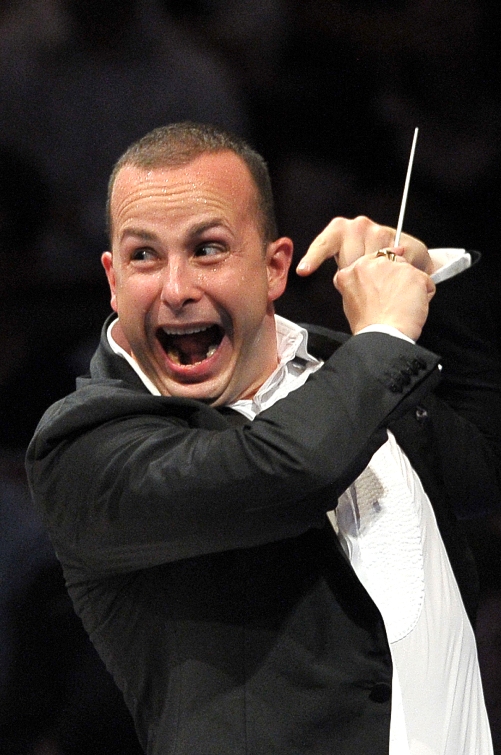
Amazingly that whole performance, as televised on BBC Four, is up there on YouTube (not for long, I shouldn't wonder, but enjoy it while you can).
Wish I'd been there for the Spanish song and dance - astonishing to think it blazed out in the middle of the big Wagner week - and no regrets about missing the Last Night (three-line whip for friend Father Andrew's 50th birthday dinner in an excellent Nepalese restaurant). We caught it on the iPlayer on Sunday night. My, the final jamboree goes on these days, as a sort of extended showcase to the world. But Alsop's discipline and her focused energy were always impressive.

Joyce DiDonato - what a trouper, looking great, plastering over the cracks in an instrument which I've never found hugely individual, but it's still a demonstration of what artistry is all about.

Nige - well, even the Diplo-mate, usually unamused by musical comedy and like me a bit troubled by the ongoing Kennedy persona ('like a down and out Irish navvy'), was in stitches at the fun and games of the much-treated Monti Csardas. Spot all the references?
New seasons have been opening and stunning in the meantime. What a scorcher is the National's Edward II, a Young Vic kind of show in a usually much more conventional space.

Attractive John Heffernan (pictured for the NT by Johan Persson) didn't dominate, but only because it was such an ensemble production. On Monday lunchtime, heavenly Anne Schwanewilms's Schumann Op. 39 Liederkreis was a perfect partnership with Roger Vignoles (only connect: when I met him after Kozhukhin's Prokofiev triple bill, he expressed his surprise at the connection between the Seventh Sonata's Andante caloroso and Schumann's 'Widmung', and here he was playing it). Anne's website man and a loyal student of mine, Howard Lichterman, introduced me to her and I took a shot of the perfect duo which wasn't professional enough to appear on TAD.

A renewed Weill crush has just been put on hold as I rediscover Paul Bunyan in the wake of the British Youth Opera staging (which was good, but not as dazzling as their staging of Cimarosa's The Secret Marriage). I fiercely defend the total brilliance of the collaboration with Auden, which given that I've also been listening to The Rise and Fall of the City of Mahagonny strikes me now as a determinedly optimistic riposte to Weill and Brecht. If you have any criticisms about the poetry, just ask who apart from Da Ponte, Hofmannsthal or Brecht could come anywhere close to the best of this genius text.

I went back to the Plymouth Music Series' 1988 classic recording, coinciding with the epoch-making Aldeburgh revival, and I don't think it can be beaten for American authenticity. Love Pop Wagner as the balladeer. And isn't this Britten's most unambiguously joyous stage work?
New seasons elsewhere: the now old chestnut about the 'show solidarity' petition and the Met opening rumbles on, with signatures being added all the time and further dissatisfaction with Gergiev, who now echoes Putin's equation of homosexuality with paedophilia: disgraceful (scroll down the Onegin piece and the comment at the foot of the companion article on The Arts Desk for an update). Michael Petrelis and his loyal companions have been making the right kind of stand at the San Francisco Opera opening gala - ie no disruption of the performance itself, in which married lesbian soprano Patricia Racette stars - and have got a very decent statement out of the San Francisco Symphony Orchestra (how could it not so reply with Michael Tilson Thomas at the helm?)

I love this photo of a grande dame* showing her solidarity with the friendly protest before the opera gala - from Petrelis's blog, courtesy of him and the photographer Bill Wilson. What a great redemption of that famous Weegee shot in which two overmadeup socialites with tiaras sweep in to the Met past a gaping pauper.
So towards an annual interlude: our walk for the Norfolk Churches Trust. Jill has planned out a route of 15 or so miles and 13 churches. The forecast, alas, is for less good weather than we've had over the past few years. Maybe that will encourage folk to give more generously - though I hope I don't have to invoke the kind of disaster scenario we experienced back in 2006. By way of reminder, here's last year's report and a photo of St Margaret, King's Lynn, alongside which we stay each time, so it's always our starting point.

And, at last, another sunny farewell. This one will mean going over to a page on the Emerging Indie Bands site where godson Alexander's Lieutenant Tango has just been feted. Makes me wonder why he never enlightened me over the 'kwela beat', and what it is. Happy to plug away at a third track, 'So, Go', because, while the million-sellers J sometimes plays on his iPad - following a Facebook commendation, just dipping - sound like dross to me, this is dance music with a genuinely creative edge.
*The lady, Michael now tells me, is glamorous grandmother Joy Venturini Bianchi, owner of San Fran's Helpers House of Couture, at 74 still a redoubtable socialite and staunch friend of the gay community. For the charitable origin of 'Helpers', read the linked article. What a woman! I love the comment on fashion's Alexander the Great: 'McQueen, Jesus Christ almighty. I have a dress by him with a hood so chic that I can't even stand it.'


 Posts
Posts