Showing posts with label Lucy Crowe. Show all posts

Wednesday, 30 October 2019

Handel's Roman romp


Let's be honest, I was wary of devoting even three classes, rather than the usual five, of my Opera in Depth class to Handel's Agrippina. Could I do much more than just play various performances of the arias, touch on the loosely-adapted history? Would I find a good version on film? The answer to both questions, happily, was a , certo.


You can't help regretting the sometimes lumbering succession of arias in later Handel operas compared to the dramatic speed and agility with which, for instance, he deals with Agrippina's manipulation of the crowds in Act One or the swift reversal in Ottone's fortunes on the Capitol in Act Two (those three ariettas, albeit called arias, in which the two leading ladies and Nerone in quick succession kick him when he's down, one of the best things about Barrie Kosky's hit and miss Royal Opera production, pictured up top by Bill Cooper with Joyce DiDonato in the title role). This is true music-theatre, partly thanks to Cardinal Grimani's agile libretto: closer to L'incoronazione di Poppea than to a later Handel opera like Ariodante.


Filling its energy rather than overdoing it like Kosky is Robert Carsen's ever-stylish production for the Theater an der Wien (pictured second down), and having got hold of that on DVD I decided in the second class that we'd actually have four, and trim Gluck's Orfeo ed Euridice back by one (making four, four and two - on Weill's Der Silbersee - in a rather unusual term). For screening, I took sequences from each act in the Carsen production - Agrippina's deception of Poppea with Claudius's first visit to the younger woman's bedchamber (Patricia Bardon and Danielle de Niese, amazingly good, Mika Kares as a Berlusconi emperor, pictured below); the desertion of Ottone (countertenor Filippo Mineccia, new to me, is well complemented by Jake Arditt's well-acted, kid-psycho Nero); and the bedroom farce of Act 3. Never thought I'd find myself objecting to cuts and re-ordering, but I missed the arias Carsen axes, and some of the dramatic sequencing.


Aria-wise, there was one top recording to use as a benchmark, orchestrally the liveliest of the lot from John Eliot Gardiner and the English Baroque soloists -


and a good chance to catch great Handel voices, among them Ann Hallenberg, Lorraine Hunt Lieberson, Catherine Robbin (whatever happened to her?), Veronique Gens and Philippe Jaroussky. Most interesting to me were the comparisons to be made with Handel's later adaptations of many of the arias, already drawn from his many Italian cantatas. For these, I'm immensely grateful to Winton Dean and John Merrill Knapp in Handel's Operas 1704-26 (Oxford), providing a table at the back showing just what was re-used where. Admittedly this only got me as far as Rodelinda, but I was already tying myself in knots searching for correspondences. Three are particularly interesting, only one of them, I think, as successful as the original: Agrippina's 'Alma mia', splendid in itself - this is Anna Bonitatibus, vocally splendid at the Grange Festival, though the orchestral support is not ideally well sprung -


only needs a couple of notes turning around as Armida's 'Molto voglio' in Rinaldo (Carsen's durable Glyndebourne schoolroom production, with Brenda Rae - a marvellous Lulu at ENO).


Postscript: listening around, as I often do when I don't want to let a subject go, I found an old LP with Janet Baker singing two of Handel's Italian cantatas, a labour of love between her and the late Raymond Leppard conducting the English Chamber Orchestra. Contrary to his assertion that 'Ah! crudel, nel pianto mio' 'was probably composed in England towards the end of Handel's life', it's one of the many Rome works dating from 1707. And here, in the extended Sinfonia which has very little to do, mood wise, with what follows, is what can safely be said to be the first version of the oboe tune used in the two arias above. With apologies for the artwork, here's that performance on YouTube.


Ottone's aria which marks the high expressive point and lowest ebb of fortune in Agrippina's Act Two, 'Voi che udite', loses the emotional twist of the first oboe so important throughout the opera (was there a master exponent in Venice?) and some of its depth as Teofane's 'Affanni del pensier' in Ottone; while Claudio's 'Io di Roma' - magnificently rethought as a moment where everything turns nasty for Poppea in Carsen's production - is just the right length, but becomes over-extended as Polyphemus's 'Cease to beauty' in Acis and Galatea. Most surprising is that the splendid and seriously underrated chorus-for-the-principals 'Di timpani e trombe' becomes in part Argante's utterly memorable 'Sibillar gli angui d'Aletto' in Rinaldo (so well sung by Gerald Finley on the Hogwood recording).


There's more, but I mustn't regurgitate everything the students got to hear. Gluck should be a very different 18th century experience. Delighted that Ian Page of Classical Opera, whose performance of the trimmed Orfeo for ducal nuptials was fascinating to hear, and Iestyn Davies - Ottone in the Royal Opera Agrippina (pictured above with the equally fabulous Lucy Crowe ar Covent Garden) and Orfeo in a new recording of the Gluck - will be our very special guests on two of the Mondays.

Sunday, 7 February 2016

In the footsteps of Mackerras


It was hard sitting on the news for so long: the six of us privileged to spend a long but rewarding day adjudicating the final for English National Opera's Mackerras Fellowship, which offers a promising conductor a chance to work in depth with the company for two years, more or less made up our minds at 6pm that evening. Details and approval needed thrashing out by Mark Wigglesworth and the trustees of the Fellowship, but my suggestion that since we couldn't agree between us on two, we should split it, was essentially adopted. Thus the two were chosen, still young by conducting standards - Toby Purser, enterprising founder of the Orion Orchestra,


and Matthew Waldren, whose conducting of Delibes's Lakmé at Opera Holland Park I'd already admired, with only a qualification about pace (photo by Fritz Curzon).


They're no spring chickens, and I suppose we might have hoped for a) younger talent and b) a woman or two, at least in earlier rounds, but you have to choose the best. I also had a soft spot for Christopher Stark, co-ordinator of the Multi-Story Orchestra which gives concerts in a Camberwell car park (I have yet to hear one). He spoke very eloquently and clearly - we could hear every word right at the back, from where we were sitting just behind the brass and alongside the percussion - and showed flashes of brilliance, especially for Tom's first aria in The Rake's Progress, which he's conducted.


The snag with the morning's three competitors was that they didn't really seem to take into account the singers, standing on a platform just to the conductor's left, and slightly behind him. This was the first time any of them had got their hands on the ENO Orchestra, sounding rich and lovely from the start, so it was perhaps understandable that most of the work went on orchestral detail. And I wondered if there had been more liaising with soprano Eleanor Dennis, mezzo Rachael Lloyd, tenor Rupert Charlesworth and baritone Matthew Durkin in the piano sessions the day before, but apparently not.

So it was hardly surprising that, when Waldren got Charlesworth to come and stand right in front of the orchestra, my vivacious fellow-outsider whom I already know and like a lot through a mutual friend, Phillip Thomas, and from our Brunch with Brünnhildes, that great Wagnerian soprano Susan Bullock, exclaimed 'thank you, God!' Sue and I were additions to a panel that already included ENO Head of Music Martin Fitzpatrick, Senior Artistic Advisor John McMurray, Head of Casting Sophie Joyce and of course Mark himself.

Waldren was the only one we witnessed to make true music-theatre with both singers and orchestra; the Dorabella-Guglielmo duet from Cosi really changed and developed as a result. Invidious to say too much about the other conductors, but here's the weirdest thing: the one who baffled us the most was the players' favourite, adduced from a questionnaire they'd been given. And yet from the minute he stood up in front of them, the orchestra suddenly lost all its tonal beauty and sounded a bit like a brass band. It may just be that this was in the dead spot of the day, mid-afternoon, but I remembered John Carewe's comment that the sound of an orchestra adapts to a conductor the minute he or she first raises the baton.

The main point is that, as I've already written in replies to comments on previous posts, I found it one of the most exhilarating if exhausting days of my professional life, and I learnt a huge amount (never noticed, to take one small example, that a harp softens the processional theme of the Mastersingers - two of the competitors drew attention to it). Discussions at lunchtime and afterwards were very lively, and I found the perspective of leader Janice Graham - she who played Leonora's theme in Act Two of The Force of Destiny so seraphically - especially fascinating. I must have been nuts to go on to the first of Dudamel's concerts with the Simón Bolívar Symphony Orchestra of Venezuela - by the time I reached the Festival Hall I just wanted to sleep. But there's no kipping through Stravinsky's Petrushka or The Rite of Spring, even in erratic performances.


This is perhaps the right moment to hail a by all accounts fabulous new Music Director for the City of Birmingham Symphony Orchestra, 29-year-old Lithuanian Mirga Gražinytė-Tyla. I haven't caught Gražinytė-Tyla in action yet but Richard Bratby, who heard a specially scheduled CBSO concert with her in January, is someone whose opinion I trust completely. I asked him if he'd react on the morning of the announcement for The Arts Desk and he did so, beautifully. It's especially felicitous for another potentially great Balt to follow Latvian Andris Nelsons.

Bad times, not artistically but financially, for ENO just got worse with the Board's proposal to cut salaries for the chorus by 25 per cent. As last year's Mastersingers triumph showed most powerfully at a similarly vital time, they are a backbone of the company; I know Richard Jones especially adores them. If morale drops just at the time when Mark Wigglesworth is invigorating, by all accounts, everyone who works there, it could be the beginning of the end. I don't know the figures - I must find out - but bearing in mind something has to give, I wonder whether it shouldn't be in the very large administration. Why are the artists always the first to suffer? If you want to defend the company, you should sign both the petition set up by 'the Spirit of Lilian Baylis' and the one on Equity's site.


As with Mastersingers last year, one in the eye for the ludicrous Arts Council 'punishment' which had just been meted out, along came a first night yesterday of such brilliance that one could only wish to fight the proposed cuts with fiercest might (pictured above, ENO principal flautist Claire Wicks in the first of production photos by Robbie Jack). I hadn't much enjoyed Simon McBurney of Complicite's production of The Magic Flute the first time round; this revival was as different from the ENO premiere as day from night. Much of that must be ascribed to the electrification of Mark Wigglesworth and his players, raised up virtually to stage level as before so that the interaction between singers and orchestra could only be the stronger (and there was no problem at all hearing just about every word).


It's a truism that pace is everything in Mozart, but I hadn't really taken that on board until I heard Jonathan Cohen conducting a Glyndebourne on Tour Marriage of Figaro that just zinged; you thought, especially in the first two acts, 'how on earth does Mozart keep it up?'

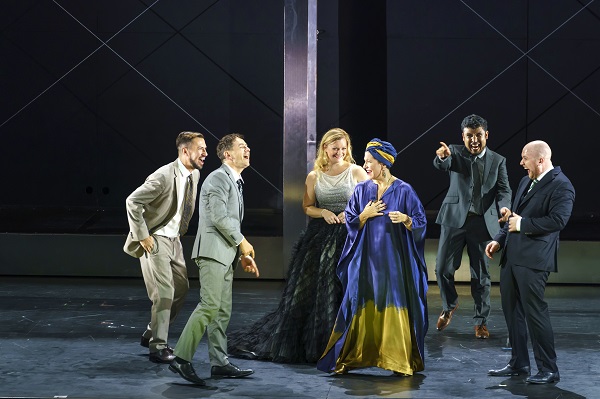
Here you could only feel the cumulative effect at an incandescent lick, which is probably why I found myself weeping with sheer pleasure just into the Act One Quintet. But there was plenty of space for Tamino's and Pamina's great arias to breathe. And I doubt if I''ll ever see a better, and certainly never a more sympathetic, pair than Allan Clayton and Lucy Crowe.


Clayton (pictured above with the Three Ladies, Eleanor Dennis, Catherine Young and Rachael Lloyd, and also of course above that with Sarastro's brotherhood) has a flawless technique and a fearless sense of engagement; what joy to hear a real tenor in the role after all those choral-scholar ombre pallide.


I wept again at lovely Lucy's 'Ach, ich fühl's' and almost sobbed out loud at 'Tamino mein' - as one should. The buzz in the house at the end was palpable. I won't go into further detail - my colleague Alexandra Coghlan has said it all on The Arts Desk - except to give a special accolade to the Three Boys (Jayden Tejuoso, Fabian Tindale Greene and Louis Lodder), perfectly together with the orchestra throughout,


and to say that the production which had left me cold first time round now seemed near-perfect; I laughed a lot. So, a huge triumph again for ENO. And Wigglesworth has now proved his versatility with Shostakovich, Verdi and Mozart in the first half of the season.