Wednesday, 5 January 2011

Why we need The Arts Desk


OK, so picturing arts coverage in print as a sinking ship, and even metaphoring our thriving online Arts Desk as Gericault's struggling Raft of the Medusa, is a bit hyperbolic. But it struck me just how much the set-up to which I've become so devoted has thrown out a lifeline in the sea of sinking arts pages.

The only time I buy papers is for a train trip (sometimes). Otherwise I might just look up the odd colleague's review online and go to the BBC for news. Should have known better than to pick up an Observer for the Sunday journey to King's Lynn. In the colour supplement there was a fatuous piece about the Top 20 cultural 'don't misses' of 2011. Was there a single concert or opera in the whole batch? Of course not. As for the paper's Arts Review, well, I know it's a fallow time for 'classical music' and the regulars were on holiday. But apart from Peter Conrad's piece about the mess that was Anna Nicole - which seemed to be entirely about her Traviata-without-the-redemption life, and not at all about what Turnage and Jones might make of the story at the Royal Opera - nothing.

Not even a bit about Radio 3's twelve-day Mozartfest, which I thought could do with a bit of a Buzz on The Arts Desk today. And, very well, we've not exactly been teeming with concert or opera reviews either. But I did try to fill the breach with an as it turned out ill-advised 1/11/11 trip to the Gabrielis' Wassail at the Globe (not entirely wasted: the initially stumbling thrown-together pottage did pick up in the short second half, when Paul McCreesh engagingly filled us in on the village bands of Thomas Hardy's Under the Greenwood Tree).


TAD also had its pick of the classical/opera year on the 31st. From tomorrow, the concert scene begins to stir again. But the papers really are floundering, though nowhere near as badly as in the States. Still, the Times does the best coverage and the Telegraph, by all accounts, has an arts editor who's as painstaking with his contributors as our Ismene Brown and Jasper Rees. But when will the more out-of-touch pundits realise that 'classical music and opera' shouldn't be marginalised some way down the line from 'music', and why is it so hard to find them? No, I think we're doing the right thing by featuring each event as and when it appears. Sermon over.

Tuesday, 4 January 2011

Swan songs at twilight


It was a serendipitous connection with one of the life-changing visits of 2010 I'd been thinking over: the chance to hear in honking hordes the laulojoutsen, the singing swans so dear to Sibelius when groups flew over his home at Jarvenpaa. Every year about 4000 Bewick's swans - though the numbers are falling, largely due to huntsmen on their home territory - make their way from the Russian Arctic to the magical area of wetlands between two artificial channels of the Norfolk fens around Welney. They're complemented by their larger, more aggressive relatives from Iceland, the whooper swans, who arrive in similar (this year, record) numbers. And while the Bewick's brigades keep their distance, the whoopers are happy, it seems, to share the wetlands with a smaller group of native mute swans (not as mute, apparently, as their name indicates - they do have their own 'sneezing snort', and the sighing sound their wings make in flight is their call-sound, to be heard as far as a mile away) as well as pretty pochards and other ducks.


Not great light here, I'm afraid, but just enough to see the difference between a whooper (left) and a flapping mute (right).


And just to put my own half-blind camera efforts to shame, here's a Wikimedia image of three Bewick's swans in flight.


Back in March, I spent the second of five blog entries about Ainola reflecting on Sibelius's lifelong need for the swans and their calls. Forgive me for just repeating a bit from one of the diary entries I reproduced there, where he describes the laulojoutsen's cries as 'of the same woodwind timbre as the cranes [which he depicts so evocatively on two clarinets in one of his Kuolema pieces] but without any tremolo. The swans are closer to trumpets, though there is an element of the sarrusophone. A low suppressed memory of a small child's cry. Nature's mystery and life's melancholy. The Fifth Symphony's final theme [that's to say the wide-spanning call which starts as two notes a fifth apart but in the original version widens to discordant intervals].'

Rautavaara uses recordings of swans' calls in his Cantus Arcticus, which I included back in the March entry. But now I'm able to put up my own sound of the various swan songs - the rather poor filming is almost incidental. I can't tell which is which, but I suspect that the predominant sound in the first of these little films is that of the noisy whooper swans just before feeding.


The Bewick's swans keep their distance, but I'm guessing that they add their voices from a distance to the increasing racket as darkness falls - this is about 4.30pm.


We timed our visit yesterday to arrive some time before the daily 3.30pm feeding (for us, as it turned out, as well as the swans and ducks) at the Welney Wetlands Centre after a morning and early afternoon filling in on the big Fenland churches we hadn't managed to see on our 2009 Norfolk Churches Trust walk (more on that appendix soon). Welney is admirably run by the Wildfowl and Wetlands Trust. They've built a big wooden visitors and educational centre which connects to the hides by a big wooden bridge across one of the two artificial Bedford rivers constructed in the 1630s by the Dutch engineer Cornelius Vermuyden. The mile's width of winter floodplain between the rivers served then, as now, to facilitate drainage of the Great Ouse and to save the fenland farmland as best it might from flooding (this flood board in West Walton Church indeed tells us how bad it was in 1613 and 1614, then again in 1670).


The Washes were certainly a thing of beauty, even before we reached the centre, on a bitterly cold January day which seemed to be bathed in a perpetual promise of a faint sunset. Crossing the bridge from Welney proper, we suddenly left behind the monotonous fields and stopped to take a walk along the edge of the road and have a good look at all this, the struggling sun reflected on the semi-frozen waters.


But that was only the early afternoon, and the feeling of twilight/sunset persisted at Welney. It only began to get dark at Welney between a well-narrated feeding time and our departure. We took a walk northwards


by the end of which it was too late to make out the flocks of swans flying in overhead. But their sound grew ever louder and, disembodied, more magical. I must have stood on that path a good ten minutes, transfixed by the supernatural hullabaloo. Not a bad thing to do at the bleak start of the New Year.


So let's take comfort from a not so lugubrious Sibelius, writing from Ainola: '...the weeks before and after my birthday [8 December], when the sun sinks lower and lower, have always been very gloomy...Things take a turn for the better soon after Christmas. All in all, life begins to feel better.' Any excuse to go back to the warm interior at Jarvenpaa last March, when the snow still lay very thick on the ground but the days had already grown longer and brighter.

Friday, 31 December 2010

2010: not over 'til the fat man sings


That's Johan Botha, whose Tannhauser we finally saw and heard for ourselves at the Royal Opera last night (production photos for the RO by Clive Barda). He is, as my controversial colleague Igor put it in a hyperbolic but mostly spot-on Arts Desk review, 'the size of a small Eastern European country', which wouldn't matter if, like Jane Eaglen in her brief golden era around the early 1990s, he acted with the voice. But he doesn't, really: one thrilling moment when he pauses before doing his no-absolution-Pope impersonation apart, the valve to his soul is indeed sealed shut. Laser-like, the heldentenor voice is infallibly secure and useful, but I'd rather hear a half-golden singer-actor able to put across the fathomless anguish of Tannhauser's state in Act 3.

The native German speakers were the ones who best expressed what meaning is still to be found in Wagner's hopelessly dated tale (Rome, shmome): sensual indulgence bad, pure Marian love good. I've admired Michaela Schuster since we saw what must have been an early performance as Kundry in Graz. The voice isn't sensuous, but it is rich and clear. Unfortunately Venus's clunky entreaties, mostly 1840s stuff, come on the heels of Wagner's most radical music, the 1860 Paris ballet, which ultimately was the most thrilling thing in the show as choreographer Jasmin Vardomon got her dancers to roll across a big table at furious speed. No mean achievement to sustain given that the curtain rose a third of the way through the overture and wave upon wave of orgiastic sound had to be varied.


Everyone said that the top-quality Gesamtkunstwerk package of the evening was baritone Christian Gerhaher, and everyone was right. How refreshing not to hear a manufactured dark sound, every colour in place and a fullness to match Botha's when necessary. He even got around the problem of the recit to 'O du mein holder Abendstern', low-lying enough to justify a bass-baritone like Terfel (who sings it gloriously on a Wagner solos disc conducted by Abbado). So Gerhaher slips in at the last minute as one of my singers of the year, along with Terfel as Sachs and the lustrous double act of Anna Samuil and William Burden as the best Donna Anna and Don Ottavio I've heard in the much-better-than-anticipated Glyndebourne Don Giovanni. Here's Gerhaher with Eva-Maria Westbroek's slightly spread Elisabeth at the end of her tether.


Everyone also said that Bychkov's conducting was a revelation. I part company a bit here: the balances were exemplary, details and colours superb. But he lacks the forward-moving sense of phrase which would paper over the longueurs in the score, and which did when Welser-Most, not a conductor of whom I'm hugely fond and due to conduct the New Year's Day concert tomorrow, brought Zurich forces to London for a concert performance. I still think that Tannhauser is the Wagner opera which gains least by being staged, and though I liked Albery's idea of Venusberg, the shelled Balkan Wartburg didn't communicate much to me. And had I spent a fortune on my seat, I'd have wanted a bit more design for my money. So, a good and at times classy evening, not a great one. And roll on six or seven weeks on the opera back at the City Lit.

Heck, I got more frisson out of Salad Days at the Riverside two evenings earlier, but that was probably partly because, as I wrote in my Arts Desk review, I was reliving a teenage am-dram production. Anyway, it really is all the more charming for not sending Julian Slade's froth up too much. And the piano playing with its intricate improvisatory counterpoint is a joy. Here are young Katie Moore and Sam Harrison as Jane and Timothy leaning on Minnie the magic piano (photo for Tete a Tete by Roy Tan).


Following the novel pattern of last year's break with travel and instead spending the hols at home or with friends was again the right thing to do. We watched selective TV between earthshattering bouts of reading and eating, and enjoyed most of what we saw. I was utterly smitten with the Birmingham Royal Ballet Cinderella shown on the 25th and still available on the BBC iPlayer for two more days - not just with the predictable beauty of that genius John Macfarlane's designs, but also with aspects of David Bintley's graceful storytelling and the captivating mug of Elisha Willis in downtrodden mode. The two production photos by Bill Cooper also feature Iain McKay's personable prince.


Above all, I was amazed by the suppleness and nuance of Koen Kessel's Prokofiev conducting (have you any idea how hard it is to find his name among various credits?). Another ballet master to watch, like Paris's Vello Pahn. Lucky Brum not to get the piped, overamplified music which accompanied Matthew Bourne's New Adventures version. Which still has its own special claim in making narrative sense of the Act 3 divertissement cut by Ashton, Bintley and Page.

Wasn't to be honest expecting great things of 'the Rattle Nutcracker', on the evidence of recent Berlin Phil disappointments. I'd got it into my head that Rattle, like Bychkov, does the sound but not the longer vision. But this doesn't always apply - there are revelations in his latest Mahler Resurrection, shame about Kozena, and here the Berlin team as well as their sound team are so obviously in love with Tchaikovsky's layered score (who wouldn't be?) Sometimes the finessing is a little over-finicky, but the spirit seems right.


There's a terrific crescendo in the Christmas Tree transformation, wonderful spotlighting for celesta and harp, a joyous Mother Gigogne and a swooningly beautiful Pas de deux. I wonder where this would stand if it had come out in time for my Building a Library. Whizz-bang Gergiev was then tops, but it's not only Rattle who's appeared in lights since: Lanchbery's light and fizzy Philharmonia version has been reissued, complete with specially orchestrated English jig (I saw this, and Mother Gigogne, danced when I went as an eight-year old to the London Festival Ballet production). God, how I adore this ballet - its bright lights are such a tonic after the slightly subdued parade of carols.

Choice of the year? Timely you asked, since Igor has just put up all our bests of classical and opera on The Arts Desk. No competition for the operatic prize, Bryn as Sachs in Richard Jones's Welsh National Opera Meistersinger, alongside my Best Concert of All Time, Abbado's Lucerne Festival Mahler Nine. Rumours abound that ENO may be encouraged to take on Jones's fabulous Wagner production - but could it ever work without Terfel? Here's one shot we didn't get to use of his Proms performance, where he got a little more tired towards the end, but that's understandable, given the cameras, the heat and the emotional demands of the occasion. The snapper is musical photographer of the year Chris Christodoulou (just look at his Proms gallery of conductors and tell me anyone catches the mood better).


Which leads me finally to Ideal Opera Production of The Future (for it can't be thrown together in the next few seasons). That would have to feature Bryn as Jupiter and Anne Schwanewilms as his beloved mortal in Strauss's Die Liebe der Danae. Those two are essential; to stage it, take your pick between Jones, Robert Carsen or David McVicar on top form; to conduct it, Fabio Luisi or Antonio Pappano. Some hope, but I can dream, can't I? Happy New Year!

Wednesday, 29 December 2010

The year of reading Ulysses


I must have cast my eyes over those opening words at least a dozen times (opening of the 'Telemachus' chapter as illustrated by Robert Berry courtesy of the excellent ulyssesseen website. Or rather, courtesy assumed, as they adopted one of my pix in their blog section, so I'm assuming mutual fair use). But only this year did I get to the end with, if not exactly full understanding, an awed appreciation of what Joyce was trying to do, the breadth and humour of his references, the ephiphanic attitude to the everyday.

Much of what I felt was neatly summed up in Declan Kiberd's Ulysses and Us: The Art of Everyday Living (Faber), which adopts the Bryan Magee approach of explaining the complicated in simple, direct language. Kibberd's basic premise is that Ulysses follows the great traditions of the Odyssey, the New Testament, Dante's Divine Comedy and Hamlet, as 'wisdom literature' - the wisdom reposing mostly in the everyday living of Leopold Bloom rather than the thickety consciousness of Stephen Dedalus. Of course it doesn't make us feel better to know that the third episode, getting inside young Stephen's head, is precisely the one at which most readers give up because it's so knotty, and is supposed to be.


Kiberd sometimes seems to lose his way, and his style: why does 'Singing', on the Sirens instalment, read so badly? But I like his opposition to the navel-gazing academic approach, which is why I gave up fairly soon on Richard Ellman's Ulysses on the Liffey.

Anyway, life's too short to read piles of secondary literature. And I don't think I've ever had a more rewarding year in terms of discoveries. It began with Hilary Mantel - J's reading Wolf Hall was the lynchpin, but I started with Beyond Black in January and only worked my way through to the historical novels much later. Very much on a par with them is the Norfolk/Africa family saga A Change of Climate. I've only got Eight Months on Ghazzah Street still to go, but I've been steeling myself to feeling robust when I read it.

Which is a bit rich bearing in mind that I've been steeped in misery lit for the past six weeks. Yet never was there a better saying than the epigraph to Dostoyevsky's From the House of the Dead, 'in every human being a spark of God'. Clearly not every, as Hans Fallada's Alone in Berlin so hideously demonstrated*. But it only needs some to make it worth going on living.


No-one puts that better than the steely-brilliant Hannah Arendt in Eichmann in Jerusalem: A Report on the Banality of Evil. She's been holding to account the testimony of a German army physician on the killing of Jews in Sevastopol. He points out that totalitarianism's skill in 'disappearing' people makes a visible protest useless. She counters:

It is true that totalitarian domination tried to establish holes of oblivion into which all deeds, good and evil, would disappear, but just as the Nazis' feverish attempt, from June, 1942, on, to erase all traces of massacres - through cremation, through burning in open pits, through the use of explosives and flame-throwers and bone-crushing machinery - were doomed to failure, so all efforts to let their opponents 'disappear in silent anonymity' were in vain. The holes of oblivion do not exist. Nothing human is perfect, and there are simply too many people in the world to make oblivion posssible. One man will always be left alive to tell the story. Hence, nothing can ever be 'practically useless', at least, not in the long run. It would be of great practical usefulness for Germany today [Arendt's account was first published in 1963], not merely for her prestige abroad but for her sadly confused inner condition, if there were more such stories to be told. For the lesson of such stories is simple and within everybody's grasp. Politically speaking, it is that under conditions of terror most people will comply but some people will not, just as the lesson of the countries to which the Final Solution was proposed is that 'it could happen' in most places but it did not happen everywhere. Humanly speaking, no more is required, and no more can reasonably be asked, for this planet to remain a place fit for human habitation.

I ought to quit while Arendt is so splendidly ahead, but I haven't finished with the peak of the year's reading. Margaret Atwood constantly points out in her futuristic nightmares the lesson that 'some people will not', but what makes Oryx and Crake a great book are the flights of stylistic fantasy, especially in the warped games played by the dystopic adolescents. Who else writes like this? Mantel, Martin Amis - name me others, please, whose manner doesn't seem flat after reading these supreme manipulators of the English language, and I'll be happy to read them. But if high stylishness isn't your metier as a novelist, then simplicity is always best. Which is why Tove Jansson's books for adults seem to translate so well, and why of all this year's novels, The Summer Book remains for me absolutely of the essence.


I'm now a third of the way through another Fallada masterpiece, Wolf among Wolves, a panorama of German life in the big inflation of 1923, and I'm looking forward to more thrillers and detective stories from Robert Littell and Ian Rankin, but I know it's La Jansson to whom I'll return for rooting.

*BTW, if anyone's still interested in the upshot of that A&E story, I went back to the Harrow hospital for the verdict on whether I needed an op or not and - the nice but clearly embarrassed specialist told me the CT scan hadn't been sent to him as promised, nor could it be obtained over the net on the spot. A waste of both our times. But he thinks a) it's pretty sure the damage is merely cosmetic and b) they need to do a much more detailed CT scan to make sure. And so it rolls on in to late January.

Sunday, 26 December 2010

Boxing Day hats: faux-exotic, real thing


Some people say I dress too gay,
But ev’ry day, I feel so gay;
And when I’m gay, I dress that way,
Is something wrong with that?


You've got to love a woman who sings that, and in perhaps the most outrageous Hollywood production number ever (see below). I feel a little, just a little guilty about twinning the great Carmen Miranda with hats of a slightly more sacral variety. These come courtesy of our beloved and equally fearless drottning-diva Sophie Sarin, whose Djenne Djenno blog - as I've written many times before - was the inspiration for this far less exotic specimen.

Anyway, it takes me back to the witnessing of a real festival this time three years ago, when our Christmas and New Year visit to Mali coincided with the big tabaski festival. So all of male Djenne was out in its finest boubous, with rivers of blood from sacrificed sheep and goat running through the streets. All less authentic ritual thereafter, not least the horribly packages maskdancingfordollars of the Cotswoldised Dogon Country, was a disappointment.

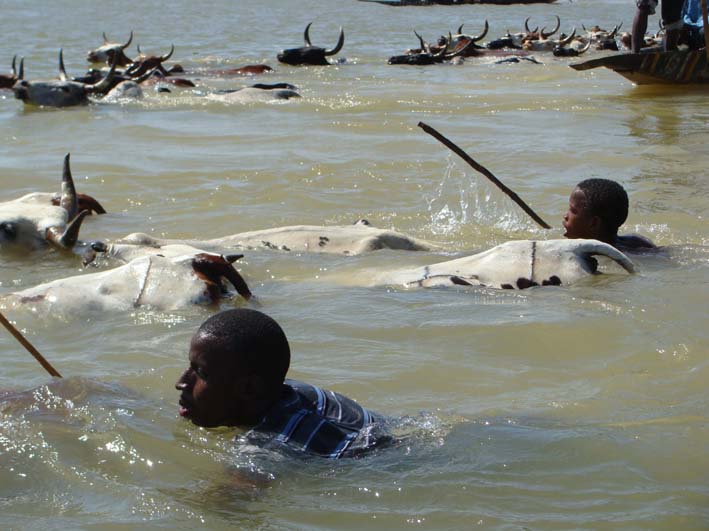
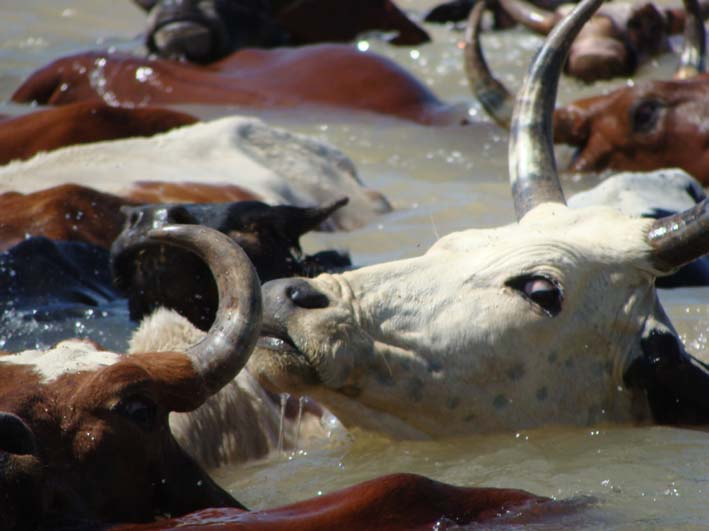
So what I wouldn't have given to see an even more elusive rite, by virtue of the fact that it's only usually decided a day or so in advance, thus evading all but the luckiest and well-placed of tourists: the Fulani tribal shepherds crossing their cattle from the pasturelands across the Niger to Diafarabe, where they're greeted with prizes for the best-kept herd - the least impressive gets a peanut - and the demure arms of the local girls. Whose headgear is, in its way, just as impressive as Carmen's, with real amber and gold.


Sophie was thrilled to see hunters gracing the ceremony this year, and so of course was I.


Two more she didn't put on the blog, but sent me anyway, of the rite itself.


I seem to remember from our two day journey down the Niger from Timbuktu that the bodies of the less unfortunate cattle were still floating in the river in late December. Most, I assume, make it.

Anyway, yes, they have some bananas in the Hotel Djenne Djenno garden. But none as big as the ones waggled by the chorenes in this. The musical arrangement is positively Milhaudesque. Enjoy.

Friday, 24 December 2010

The Sun King in winter


The gods and goddesses of his French rivers lay frozen and snowladen around the iced-over pools of the Parterre d'Eau's Grande Commande, just the start of the back-garden wonders Andre Le Notre wrought for Louis XIV at Versailles. I couldn't believe my luck at seeing them in this almost Narnian state. The last time we beheld Versailles was in an August heatwave, when only gentle cycling round the Grand Bassin relieved the general oppressiveness of a Parisian summer.

This, on the other hand, was the bleak winter morning after our treat at the Opera Royal, seeing Lully's Bellerophon in the theatre actually opened in 1770 during the Sun King's great-grandson's* reign - but even then, to celebrate the Dauphin's marriage to Marie Antoinette, Lully was still on the menu.

We checked into the cosy and wonderfully situated if over-decorated Hotel de France on a sunny Friday afternoon - the flight delays just beginning over at Heathrow - and walked over to the Hotel du Trianon on the edge of the park along icy streets.


A gourmet lunch, an over-long tour of the Theatre followed by an all too quick but much better one (on a certain person's insistence) of the Royal Apartments and the Galerie des Glaces needed recovering from, especially as we'd been up at 4.30 in the morning. So that meant skipping, hmmm, lectures, napping at the hotel and arriving fresh for the Rousset experience. Which you can read about on The Arts Desk. Here's the chapel and the entrance to the wing which leads to the theatre.


and here I am wondering what I've done to deserve being in a rather exceptional royal box - bang in the middle, unlike our own, and with voices and orchestra pinging to the back in exceptional wooden acoustics.


A professional shot of the theatre, lavishly restored to original specifications in the 1950s


and cut to the next day, roaming at large in the snow. Bronze urns on the South Parterre


looking down on the Parterre du midi


and west to the central avenue, Gaspard and Balthasar Marsy's Fountain of Latona in the foreground.


If that winter wonderland isn't seasonal enough for you, let's end with French music for the day. We were lucky to get prime seats under the dome of St Paul's on the afternoon of this grey Eve, courtesy of succentor friend Fr Andrew Hammond. Above us the organ thundered Dupre's naughty carol variations, and from the distant chancel the choir projected beautifully. A marvellous sequence, kindling Banstead memories of 'Gaudete', Mathias and Ord as well as introducing to me a couple of gems by Cecilia McDowall and Warlock. The tears flowed, though, for Poulenc's 'O magnum mysterium'. Partly it's because I only have to think of the Carmelites' 'Salve regina' when I hear any of Poulenc's religious music, but this is a piece of the very essence. Here it is sung by the Westminster Cathedral Choir. Joyeux Noel a tous!


*correct genealogy courtesy of Sir D Damant below.

Thursday, 23 December 2010

Big blizzard afternoon


Snowflakes the size of which I've never seen, not even in Moscow or Petersburg, fell on Paris during the afternoon of the 18th, spelling trouble ahead for our journey home. And it wasn't much fun trying to follow the map as we scuttled through the backstreets from Place Clichy to the Musee de la Vie Romantique, where the first of three superb exhibitions we saw celebrating the nearly-concluded Russia-France year was to be found.

Bad tempers and bickerings duly soothed by discovering it at last, we made our way up the charming little cobbled alley to the rusticated 1830 house where Ary Scheffer (possibly known to most English art-lovers solely for that overwrought Francesca and Paolo in the Wallace Collection; there are much worse canvases to be seen here) lived and George Sand visited.


The reception from the incredibly rude staff (well, it's a long time since I've been called 'jeune homme', so I suppose that was something) left much to be desired, but once inside the first of the two studios where the exhibition was held, all was calm. The French, of course, never do these things by half, and the Tretyakov Gallery had obliged with, if not all its best known paintings, certainly some real connoisseurs' pieces to flesh out our understanding of Russian art around the 1830s, many of which I hadn't seen in Moscow. My enthusiasm usually begins with Kramskoi, so I was very pleased to admire the consummate portraiture and the eastern scenes of Bryullov. Indeed, the exhibition constantly reminded you that the Russian empire always embraced the supposed 'exotic', as did Delacroix and his French colleagues.

In the first room, a sketch for Bryullov's famous but not too lovable Last Days of Pompeii is complemented by several large scale canvases including Anton Ivanov's Gogol crossing the Dnieper


and some splendid portraits, including Fyodor Moller's famous one of the same, hardly romantic author.


I've been hard pressed to find anything on the web about Nikolay Gerene, whose wry depiction of a bespectacled, effete orientalist aristocrat's 'cabinet' is the highlight among a neat group of interiors. Nor is there much about Fyodor Tolstoy apart from his bas reliefs (only connect - this one marks 1812).


Yet Tolstoy-not-Lev-nor-Alexey's watercolours of flowers and fruits are exquisite, if upstaged by the Bryullovs on the nearby wall. One final main studio room shows off grander portraits to great effect, with one more intimate specimen by the master, of Nicholas I's cultured daughter Maria Nikolayevna.


As for the house itself, the Scheffers on the upper floor make poor comparison with the Russian masterpieces. Downstairs, though, the room of George Sand memorabilia donated by her granddaughter has some charming choses, including a pretty swallow brooch among the jewellery she valued merely for its personal associations. And here's Chopin's tiny hand between his lover's lock of hair and her swan-like arm:


The museum itself is free, with admission to the exhibition well worth the price. And I gather that in spring and summer, dainty teas are to be had in the conservatory, which must add to the Violetta-Alfredo/Marguerite-Armand bourgeois idyll of it all.

By now the snow had gathered momentum. We dived into a patisserie, shared a coffee and a cake with a figure looking like my idea of Balzac's Vautrin and headed up to Pigalle. Without flash, the downpour looks like this.


The only thing to do was to plunge into the Metro and take Line 2 to Termes, as close as we could get to the Salle Pleyel. And it was no hardship to while away an hour or so there before the Russian National Orchestra concert which our friends had so thoughtfully booked for us (frankly, I'd have been up for Lady Gaga at the Palais de Bercy, but I hear she cancelled, driving her French fans to despair).


The foyer has recently been beautifully restored to its original 1930 Art Deco state


with typical attention to detail that extends to the lift


and the plaques commemorating Ginette Neveu and Chaliapin, among others.


For the extraordinary circumstances of a concert blighted by the glacial hand of, hmm, Mikhail Pletnev, flick over to my Arts Desk Buzz piece. Tomorrow I'll go back to where it all began last Friday, the Opera Royale at Versailles, just in time for Christmas, as there are more snow-laden statue shots in store.