Thursday, 11 July 2013
Webmalice
It's not something we like to contemplate as we airily exchange views with like-minded souls - the lurking troll* who views and spits and goes back to his (it's surely always, or nearly always 'his', not 'her') befouled nest to pour out bile against someone who's never knowingly harmed him. It surfaces in a much more public way every day on Twitter and Facebook, the latest scandal involving horrible abuse of the Wimbledon champion Marion Bartoli. To compare greatly awful with small, I came up against some unwelcome knowledge a couple of days ago.
One thing I learned several years back, having been warned all too often by the diplo-mate, was to stop going in to the school playground of message boards - other than those of soulmate bloggers - because the bullies would always shout the loudest. On Parterre, the most waspish of them all (is there anything nastier than an opera queen crossed?), I didn't learn quickly enough. I'd dared to say I thought Christopher Purves was a better Wozzeck than Matthias Goerne. This, of course, goes against the grain of the anti-English contingent on that very Metcentric site. I can take a couple of howls of derision, but one poster, a certain 'Drew', started dogging every explanatory step I took. I was, it transpired, after a mountain of increasingly vitriolic responses, like some weird little old lady from Des Moines who didn't realise how provincial she was.
Enough. Out. Gone. I was aware this abusive personage had a blog, which Parterre had linked to, called 'andrewandjoshua'. He purported to be an attorney from Chicago whose ma and pa were everything to him and who had a nice boyfriend called Joshua who mirrored back his every thought. And boy, were those thoughts poisonous, on performers and works of art he hated and harmless ordinary folk who didn't share his ultra right wing views, all of this expressed in a peculiarly stiff and self-regarding style. Again, one look was enough. I didn't go back.
On Tuesday, with - as I've already explained - the laptop in rehab, I found the quickest route to fiddling with my blog was simply to enter my own name on the iPad's Yahoo facility (I don't often go Googling myself, I hasten to add, though I won't say never). Up came a tranche of pictures very different from the ones I usually get on Google. One was half of an image I'd posted of myself in my shalvar kemis, dressed up to sing G&S's Nightmare Song at the local church; the other half, Father Martin Eastwood, had been excised.
It turned out this picture had been posted on, wait for it, not andrewandjoshua but joshuaandandrew, as an example of terrible English dentistry. You laugh; so do I, because I have more than once been told that my teeth are like Prague's Jewish cemetery, but frankly it's never bothered me enough to do anything about it. The abuse, though, after the announcement that this was 'David Nice, of London', got a bit nasty: 'It is a very brave man - as well as an alarmingly fruity one - who would display himself in such a way and then publicise the repelling results'.
This edifying series on 'Adventures in British Dentistry', which has been sitting there unnoticed by me since 2009, continued with another photo, which could only have come from my blog again, of my friends in the Merchant Quartet. The mockery was the same and oddly, there was once again one comment in a very similar style agreeing with Joshua/Andrew. Further photos of 'morons' were put up for no other reason than that Joshua/Andrew didn't like their looks or their political views. To which, of course, the only answer is that there's no such thing as an ugly appearance, only an ugly soul (which in a few cases may lead to the former, but that's a different issue).
More recent abuse was hurled at a 'hillbilly' violinist who'd left the Minnesota Orchestra for the excellent - though in J/A's view low-grade - Zurich Tonhalle Orchestra because he wasn't prepared to put up with a 43 per cent pay cut (this is a whole other area I'm glad my attacker has directed me towards, because the detail of what's gone on in Minnesota beggars belief). I found further personal attacks against me over on andrewandjoshua which managed to label me an anti-Semite - the very thought! - and a degenerate of low intelligence (usually in the imaginary conversations held in the messages section).
My lawyer friend Isabel did some quick and effective detective work. She tracked down a brilliant deconstruction of the a&j/j&a looking-glass world on well-respected Chicago critic Andrew Patner's site The View from Here (which has also educated me on the sorry case of decent critic Don Rosenberg v the far from perfect Welser-Most). He, too, had been playing Sherlock Holmes, though as he writes he may only have got as far as being Watson - as are we are all until the perpetrator is uncovered (and frankly, if he isn't, it hardly matters, though it would be fair to witness some sort of exposure). Scroll down the above link to Andrew P's site to get the full story.
I won't repeat it. Suffice it to say there would seem to be no Chicago attorney - Isabel exploded several of the claims there - no boyfriend, no loving parents, at least as recounted on the phantom site. All the commenters with the curiously similar style and giveaway vocabulary are Andrew 'Norman Bates' Vanz having an imaginary conversation with himself. He does exist, of course, in some very dark place in America, but his power to harm has somehow dissolved with the picture thus built up of a sad soul projecting evil thoughts.
The good in all this is that I've had a delightful exchange with the admirable Andrew P and shall be very happy to meet him in the UK when he visits**. Of course I know I shouldn't feed the troll, and the purpose of this entry isn't to solicit any 'poor you's, but forewarned is forearmed: others who have tried to hunt the slanderer down, which I've no intention of doing - and of course even if I tried Google would do nothing about it - have had various e-tamperings, so if you ever receive anything weird or offensive purporting to be from me, let me know.
Anyway, hello birds, hello sky; it's been a sunny day tending to the newly-returned weeping mulberry in the back yard, writing up reviews of the weird Britten Canticles performance last night for The Arts Desk and of Sakari Oramo's fascinating Elgar Two for the BBC Music Magazine, basking in the friendly e-mails from Cheltenham folk following the appearance of the festival review which has only bolstered happy memories. Sweetness and light to you all. And of course I'm not going back to the offending site or even giving the troll headspace if I can help it. You might all like to flood our mystery man's blog(s) with pictures of imperfect dentistry, of course. On the other hand, best not feed the troll either.
*Tanya Gold in The Guardian, writing on the latest bout of obscene misogyny: 'To call them trolls make them sound almost magical when they are actually lonely, fearful and dumb – in the truest sense'.
**Update - alas, I was shocked to hear that Andrew died suddenly in February 2015.
Second image is from that fabulously unsettling French masterpiece of a film Le Corbeau; the last is one of Byam Shaw's illustrations for The Pilgrim's Progress.
Wednesday, 10 July 2013
Rameau and other revelations
I'd never have believed until Sunday that I could be so intoxicated with both the genius of Rameau and a production by Jonathan Kent, a director I'd always had down as a magpie plundering the ideas of others. But Glyndebourne worked its special magic and there we were, treading on air after five crammed-to-bursting acts. Hippolyte et Aricie, Rameau's first tragédie lyrique composed in 1733 when he was 50 years old, is a masterpiece, no doubt about it.
This is, above all, what you get when a fine team of singers and players - the magnificent, muscled Orchestra of the Age of Enlightenment - works for over six weeks with a man who knows his Rameau inside out. As William Christie unquestionably does. I hear hair-raising tales about him from performers, but he gets the results, above all in the sometimes ferocious projection of that phenomenal string writing which puts Rameau in the top league of orchestration, the true ancestor of Berlioz and Ravel.
The composer brings on two tremendous frissons toward the respective ends of his third and fourth acts: the extraordinary effect of rushing waters as Theseus, believing himself wronged by his son Hippolytus rather than his wife Phaedra, invokes father Neptune (François Lis and Stéphane Degout pictured below as father and son) to punish the adulterer; and the grave divisions after the curse becomes a reality, Phaedra's exit to suicide.
Melodically, there are more pleasures than I'd have thought possible. Rameau is not all declamation, like Lully - who of course also has his exceptions - and among the loveliest set pieces are Phaedra's two arias of torment, the idyll of Aricia- drafted in as pallid contrast to the bad stepmother - having rediscovered her Hippolytus, a nightingale number and, most memorable of all, a luminous Musette for chorus and orchestra (Glyndebourne Chorus, it should go without saying, superlative throughout).
To say that all these were well performed is an understatement. Style came hand in glove with beauty of tone from everyone involved, Sarah Connolly's Phaedra matched every inch by soprano Christiane Karg as Aricia. Ed Lyon (pictured with her above in the wonderful woodland scene), travelling down on the train in a muscle-freeing vest, is not quite the hunk vocally, but cut the mustard; even more spirited tenor contributions came from Matthias Vidal in the first act and Loic Felix in the second.
And how some of us love it that Rameau has no cause for countertenors here, but favours the virile male voice, in which respect we could not have asked for more from Degout's tormented Theseus and Lis as three gods in one person (Jupiter, Pluto and Neptune).
The drama is as piled high with incident as the score, though we got the nub of the Phaedra-Hippolytus-Theseus tangle in a third act which Kent has been careful to locate downstage, making it a domestic drama in a clinical modern home.
Each act deserves a different style, which is where the genius of designer Paul Brown comes in so useful. The joky fridge-machinations of ice goddess Diana versus furry Cupid were fine given that the Prologues of tragédies lyriques tend to be a little bit boring and need as much livening-up as they can get.
In Act One, Diana's votaries frolic in white, blithely cut stag throats and roll around in blood; Connolly's Phaedra appears among them in striking red, while the lovers keep their purity costume-wise throughout.
The second act in Hades is an odd 'un, purely there for infernal spectacle - especially since this is our first meeting with Theseus. Pluto lives at the back of the fridge with sundry flies and spiders, cue for the more outlandish of Ashley Page's dances (which are pretty safe for the most part, more's the pity).
Great music only accumulates from the third act onwards, though. The pink-lit sailor ballet, so at odds with the domestic crisis, kept its queasiness, I thought, and the forest scene matched the 21st and 18th centuries with garish aplomb. Kent also, quite uncharacteristically, tied it all together with a finale in a mortuary (more iceboxes, of course). I didn't entirely buy the undermining of the happy end - and what's with the Fura dels Baus style old man's head on the curtain: old Theseus looking back? - but there was nothing to deflate our helium-filled delight. Another afternoon/evening of Glyndebourne perfection.
Unfortunately I can't detain you with any more shots of another summer idyll by the lake, because my laptop's gone into rehab and there are many things I can't do on the machine Juliette has so kindly loaned me. There's just time to recap on all the other new or live-new hearings I've been stunned by recently. Report on Britten's startlingly profound, almost Wagnerian Noye's Fludde in heavenly Tewkesbury Cathedral is now up on The Arts Desk, with glimpses of sundry other Cheltenham delights (including Poulenc two-piano stunners heard in concert for the first time). Here's a further flavour of my new/old hero James Mayhew's design for the ark with its dove-prow, photo by Malcolm Pollock.
On the listening front, I've had too few words (30 a disc on a BBC Music Mag 'In Brief' roundup) to wax lyrical about the sheer lacy beauty of a symphony and Shakespeare 'preludes' by that lovely romantic Joachim Raff; Neeme Järvi and the Suisse Romande Orchestra do it all proud.
Who says the Second Symphony doesn't have tunes? It starts with middle-European bucolics almost on a par with the beginning of Dvorak's Sixth, and its scherzo has wondrous woodwind writing. Best of all, perhaps, is the Ariel music in the Tempest tone-poem, though all four Shakespeare settings have their sensitivities.
It was serendipity that just after I'd been banner-headlining my hope of hearing the comic opera The Sacred Goose by Hans Gál (pictured above) following what Michael Haas had written about it in Forbidden Music, along came a recording of the Second Symphony. It's part of a cycle pairing the Austrian's four symphonies with Schumann's and comes from Kenneth Woods and the Orchestra of the Swan, which sounds like such a fine orchestra in the exemplary Avie recording.
The Second ought to be a profoundly tragic work; when he composed it in 1942, Gál was an exile in England. In that year, his mother died, his sister and aunt escaped Auschwitz only by taking their own lives and his youngest son committed suicide. Instead of darkness, though, the Second is more remarkable for the radiance and rigour of its laments. I find it incredible that it should end so peacefully. There's a comparison here with Martinů's Third, a greater work no doubt; and yet Gál's nostalgic style is so obviously the man, and a good man at that. Time now to investigate the other three symphonies.
All Glyndebourne production images by Bill Cooper
Tuesday, 2 July 2013
Deller, VW and the Melodians
That's acclaimed artist Jeremy, not late countertenor Alfred, and his masterly fusion of music and image in the 'English Magic' film which is currently part of his British Pavilion exhibit at the Venice Biennale*. I'm indebted to old friend and frequent commenter Howard Lane for drawing my attention to it. Howard and his daughter Rowan headed to Venice as part of the amazing Melodians, an English/Trinidadian steel band from south London whose talents Deller engaged for his genius selection of British sounds and sights. Here they are on a wet Abbey Road zebra crossing having recorded the soundtrack in an appropriately famous UK institution.
I could hardly believe my ears as the film proper got underway with the mystic chords of the Romanza from Vaughan Williams's Fifth Symphony rippling on steel. That's another one in the eye for the Ukippers who would claim VW and Elgar as their own. It not only sounds exceptionally haunting in that arrangement by the Melodians' conductor Anne Hornby, but it somehow fits with the two other choice transcriptions, of 'Voodoo Ray' by A Guy Called Gerald and 'The Man Who Sold the World' by David Bowie.
There's no need for me to interpret for you the haunting juxtapositions Deller finds between birds of prey and VW, claws of natural and mechanical kinds, the timely exuberant human bounce on an inflatable Stonehenge or the selective images of the Lord Mayor's Show to the Bowie (title not irrelevant - and did you know the army paraded tanks through the City on that day? I didn't). Just watch the 14 minute film here (the Vaughan Williams for the birds begins one minute in). Then watch it again. A little masterpiece, and the EP might be worth buying
Howard commends Jeremy Deller as a Thoroughly Good Bloke who was happy to share the Venice limelight with his steel banders. Here they all are outside the Pavilion. Howard is peering over shoulders at the back; Rowan - how she's grown since I last saw her - is third from the right of the sitters.
Hearing the Bowie again serendipitously coincided with a delightful blog entry from dear Sophie in Mali, who has been getting hotel staff turned bogolan workshop assistants Baba and Papa dancing to Bowie - and they are very choosy, I know, about what non-Malian imports they will embrace (the DVDs we took of Fawlty Towers had them in stitches about their very own irascible hotelier). This photo of our Sophe wearing her MaliMali designs (of course, never the one to miss an advertising opportunity, for I can't believe she drifts around the hotel in that ensemble) jigging with Baba belongs to her blog, but if I put it up here too, it will make me jolly just to look at it.
This is irresistible to dance to, too: Lulu's Bowie-approved cover version of 'The Man Who Sold the World'.
A couple more YouTube specials to make you smile. I have a feeling that if Austria had entered 23-year old Martin Piskorski, ex-Vienna Boys Choir member currently training at the European Opera Centre in Liverpool, for the BBC Cardiff Singer of the World Competition, there might have been a tenor in the final. The below, his moment in the sun, was THE goosebumps moment of the diplo-mate-facilitated Europe Day Concert 2013 at St John's Smith Square, with Laurent Pillot conducting the great European Union Youth Orchestra.
To celebrate the Irish presidency, some rarities had been unearthed, including the Overture and an aria from Stanford's Shamus O'Brien. Who knew? The Overture is a gem worthy of Sullivan at his absolute best - I hope not to demean Stanford by saying so - and I'll probably put it up on another post. And young Piskorski has the money note in the big phrase towards the end of 'My heart is thrall to Kitty's beauty'. The instant 'bravo' at the end comes from my guest Debbie York, and she knows what she's talking/singing about.
I could kick J as much as myself for not finding out more beforehand about last night's concert to inaugurate the Lithuanian presidency, also at St John's. 'Some accordionist', he'd said when I asked who was performing, not knowing more - this is THE accordionist of the moment with his charismatic band, Martynas Levickis, just signed up to Decca. Whether he is more than a good player - ie up to the standards of the phenomenal Mythos Duo whose Petrushka transcription is my CD of the year so far - I can't yet tell, but he certainly has musicianship and charisma. This is such a moody picture of him duetting with the band's handsome violinist yesterday, courtesy of the Lithuanian Embassy. And I missed it!
Levickis sprang to fame, unlikely as it may seem, on Lithuania's Got Talent in 2010, competing alongside the likes of a man who played tunes on his teeth. He baffled the half-witted audience and judges by playing Piazzolla's Libertango, but readily played something more obviously crowd-pleasing, and of course much less interesting, on request. 'This is more like it' gurn the lardier versions of Ant and Dec from the wings. Anyway, he won.
*And I'm afraid it's usually been a 'his': only two female artists in 40 years. Shame on you, British Council.
Saturday, 29 June 2013
The talented Mr Ripploh
I thought I must have seen Frank Ripploh's Taxi Zum Kloh during my closeted but curious student days in the early 1980s, so talked about was it at the time. But if I had, I would have remembered at least the scenes which made it notorious then and which still had us sometimes squirming and looking away last night*: non-simulated sex which makes the grubby rendezvous of Mark Rylance and Kerry Fox in Patrice Chéreau's Intimacy - and what a surprise we got stumbling into that one out of the heat of a Paris July - seem tame, a shock through a lavatory glory-hole (I'm too prudish online to show you what happens next below, as our hero sits on the bog casually marking school work),
a golden shower, a graphic clinical inspection for STD and a surprising take on child abuse. That last is thankfully moral: two of the gay characters waspishly comment on what would seem to be a genuine German film-warning to children to beware paedophiles with the same repugnance we feel, while Frank fends off an over-frisky pupil who's there for home tuition in the kitchen.
None of the extremes, the censors decided at the time, could be thought of as pornographic because all support, if sometimes contradict, the tender love story at the heart of the film.
There are no drums and trumpets for any of the things that just happen to the characters, as they do in life (Ripploh, playing himself, claimed that most of the incidents were autobiographical). Still surprising is how natural and funny it remains as an, ahem, warts and all picture of one type of gay life - or maybe two running parallel - lacking the gym-worked bodies and soft centres of later movies as director, writer and protagonist Ripploh tells us how it was for him in 1980s Berlin.
The anti-hero is a good teacher and the classroom scenes delight through the smart responses of the kids. One wonders how much they were told about the film they were in. But then this was West Berlin in the early 1980s, where, we're told, everyone took such things in their remarkably tolerant stride.
Frank is unapologetically promiscuous, and frankly the kind of shit who wouldn't have hesitated to pass on a deadlier virus in the AIDS era then to come (hospitalised for six weeks, he's off to the nearest Herren Klo, which of course is men's toilet, at the first opportunity). His lover Bernd is sweet, homeloving, dreams of a retreat to a farm; it ain't going to work. Or is it? I said to J halfway through, 'I'm going to love this film if no-one has to die at the end'**. So I love this film.
It was a huge hit in the astonishingly direct-speaking Germany of the period. Heterosexuals went in droves to see what the gay life might be like. Sympathetic as the UK censor seems to have been in 1981, there was no way he could give any kind of certificate to the more outlandish scenes. The director of London's ICA at the time agreed with him that cutting would deprive the film of its balance, and ran it under film-club conditions with black pen scrawled over one sequence which could have been against the law.
Police and councillors up in Edinburgh threatened to seize the reels and destroy them. As the print happened to be the only one with English subtitles, done at the cost of thousands, each reel was bagged the minute it finished, plonked into a car at the back door of the cinema and driven off to a secret Morningside address. The threatened impounding, in any case, failed to happen, though a wild party to celebrate resulted in several arrests.
Success seems to have gone to Ripploh's head. That made his mentor Rosa von Praunheim, pictured above in 2008, very sad. Von Praunheim and other friends who remember Ripploh in an accompanying documentary on the DVD testify to a man who was funny, spontaneous and enthusiastic, but fundamentally as unreliable as his screen self. The next couple of films were by all accounts (and to judge from the handful of clips shown) absolutely terrible. But as von Praunheim records without rancour, Taxi Zum Klo remains infinitely more popular than any of his own more earnest this-is-what-it's-like-to-be-gay-in-today's-society homilies.
Ripploh died of cancer in 2002 at the age of 52 , but his masterpiece lives on with a vitality missing in all gay-themed movies I've seen of late (anything by Ferzan Özpetek before the recent disappointment of Magnifica presenza, in which the gay element is in any case a given, honorourably excepted). On Pride Day, when it turns out that there's still more to fight for than we thought ten years ago and much of the bigotry which had gone underground has now popped up, especially in France, to try and beat up the marriage issue, we need a film as insouciant and in-your-face as this more than ever. And who's making them now? German trailer follows.
*The evening had begun with an attempt to watch Written on Skin again, this time as televised on BBC Four, and maybe write about it for The Arts Desk. But only minutes in, I confirmed my existing opinion by finding it every bit as frigid and pointless, magnificent performances notwithstanding, as I had when I went to see it at the Royal Opera. So there was nothing more to say, and I switched off after 20 minutes. All the human interest missing therein was to be found abundantly in Taxi Zum Klo.
**At least in Behind the Candelabra it isn't the victim who dies. I enjoyed its quiet coda as well, of course, as impeccable performances by Matt Damon, Michael Douglas and Rob Lowe.
Wednesday, 26 June 2013
Monreale 1: mosaics
Dresden's baroque treasures are still glinting in my mind's eye, clamouring for the attention they'll eventually get, but Palermo and surroundings haven't been dislodged since our March visit. To whit, I've just finished reading John Dickie's Cosa Nostra, which places the city unequivocally at the centre of 150 years' mafia hell recently brought to light. So much for the legend that what turns out to be a precisely rooted secret society, a kind of horrifying shadow state with murder as its main tenet, has been part of the Sicilian mentality for time immemorial.
Dickie - that rare bird*, a scholar capable of writing an impeccably researched book that reads like a series of high-level thrillers - mixes savage indignation with celebration of the heroic men and women who laid down their lives in the hope of a better future, among whom Borsellino and Falcone stand only as the most conspicuous because the most recent.
In every one of the western Sicilian territories there have always been these brave souls, including courageous priests to counter the corrupt ones. Don Gaetano Millunzi of Monreale is merely listed in one of Dickie's remember-this roll calls, but he helps redress the balance of mafioso skullduggery in that town so discrete from Palermo, and yet so inextricably linked with it.
Monreale's greatest glory was born of rivalry at the highest level. Building on the old establishment of a modest bishopric away from Arab-invaded Palermo before the Norman conquest of 1072, King William II created Monreale's supremacy in a power struggle with the English Bishop Walter of Palermo, his former teacher and would-be master.
Walter 'of the mill' (Offamilias) was still having Palermo's cathedral built when William quickly outstripped it with the duomo of a new monastery in his Monreale hunting grounds, finished by the time of the young king's death in 1189. Without, it's far less remarkable than Palermo Cathedral. What make it one of the wonders of the world are both the mosaics - similar to those in the Cappella Palatina of WII's grandfather Roger II, but on a larger scale if less refined - and, above all, the no-two-the-same capitals on the 216 marble columns in the massive cloister. Since those truly are unique, they'll get an entry on their own in due course.
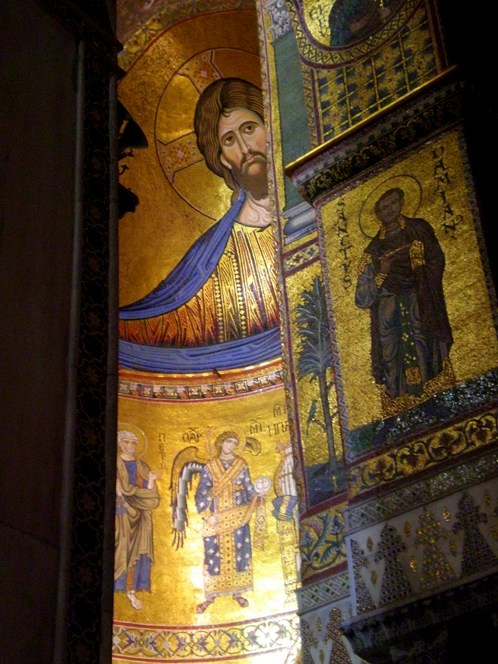
What stunned about the interior on our arrival at around 4pm was that the sun was blazing in through the west window, passing straight through the nave to ligh up the eastern apse with its colossal half-length figure of Christ.
Below the giant figure (13 metres across and seven metres high, if you want to know) are the Virgin and Child, flanked by saints and angels.
Just like the cycle in the Cappella Palatina, the Old Testament narrative in the nave runs first in one strip along the top of the south and north walls, from the seven days of creation to Noah receiving the command to build the ark, and then below in the same sequence, from the construction of the ark to Jacob wrestling with the angel. Thus close to the twin beginnings on the south wall,
a detail of Noah building the ark,
part of the north nave wall
and a segment with Adam, Eve, serpent, God and fig-leaf shame above, angel preventing Abraham's sacrifice of Isaac and Rebecca offering Isaac water below.
and that's only a fraction of the nave's riches; scenes from the New Testament up to Mary Magdalene's washing of Christ's feet similarly enrich the outer arcades. There's even the first known representation of St Thomas à Becket, murdered at the command of William II's father-in-law Henry II of England. The two side apses are mosaic-ed to the respective glories of Peter and Paul; here's one final glimpse of Christ from Peter's side.
But clearly I should have bought at the time a lavishly illustrated, reasonably scholarly volume on the mosaics I found in a bookshop in Palermo; I briefly tracked it down on the internet back home and lost it before I decided to splash out. Anyway, this marks the tenth of 12 'chapters' on the year's Sicilian experience and I am duty bound to see it all through eventually (unlike the Bach cantatas project which, some of you will have noticed, lapsed dismally as soon as we started spending Sundays away. Next year, I promise).
By the time we came to catch our bus back to Palermo, the whole of Monreale was out for a Saturday evening promenade, just like in any Italian town. It seemed so impossible to believe in a population cowed. Nor elsewhere - except, perhaps, for the smashed-up hotel in the Madonie mountains - did we catch a glimpse of mafia consequences. Only in a good way, perhaps, in the results springing from the numerous stickers applied by Addiopizzo, a Palermo organisation fierce in gathering together to refuse to pay the pizzo or mafia 'tax'/protection money. The text reads (if my translation is correct): 'an entire people which pays the pizzo is a people without dignity'.
Many shops now bravely sport the Addiopizzo insignia.
If you have anything to say, do leave a message of support on the website linked to above. And bear in mind the splendid couplet quoted in Dickie's superlative study, written about the lethal Don Calò of Villalba who 'rebirthed' the dormant Cosa Nostra at the end of the Second World War. It might just as well apply to Berlusconi, whose supposed connections with Italy's secret society may yet come to light: 'Cui avi dinari e amicizia, teni 'nculu la giustizia' - 'He who has friends and cash, can take justice up the ass'. Fortunately there's quite a movement in the new Italy, for all its seeming chaos and systematized corruption, which is trying to make sure that doesn't happen. Though it looks as if Berlusconi will never serve his prison sentences.
While I'm on my high-horse campaign to set the world to rights, finally, can I urge you to sign in solidarity with magnificent teenager Malala Yousafzai, about whom I hope I don't need to tell you, in her tireless fight for worldwide children's education? A woolly-liberal old friend of mine, when I sent the petition out to a select few, said 'but I don't know that we in the west should be interfering in other cultures'.
Goddamn it, does a girl have to be nearly killed for wanting the noblest thing in the world? Does one third of the world's married women have to suffer abuse within their relationships, as a recent survey pointed out? Such shame has nothing to do with a truly evolving Islam. Away with false scruples and parallel universes/centuries on the planet we share, please. And it's so easy to offer your name at the click of a button.
LATER: one big wrong in the world righted, 83 year old Edie Windsor and the late Thea Spyer vindicated. Susan Scheid broke it, to me at any rate, giving the pith of the judge's summing-up before I could check the news. One extraordinary aspect I hadn't realiased was that Clinton introduced the iniquitous DOMA (Defence of Marriage Act - to which I would add, with no idea whether it's been written a thousand times already, there's dumb and then there's DOMA) now quashed. But I'd rather celebrate with this picture history of a 'great American love story'. Now got to get the above DVD from Bless Bless Productions.
*no wordlink was consciously intended between 'Dickie' and 'bird' when I wrote that.
Sunday, 23 June 2013
The importance of composing comedy
Great comic opera, that is. Let's say it with carnation flinging and shout it through megaphones: the filleted-Wilde, stylised anarchy that is Gerald Barry's The Importance of Being Earnest has to be the best work of musical theatre since MacMillan's The Sacrifice. At times it's tear-jerkingly funny, always contradictory and unexpected (in the first of Stephen Cummiskey's production photos above, that's Miss Prism on the left as played by Hilary Summers, not Lady Bracknell, who's the pin striped gentleman in the ensemble).
Lucky those who were present at the already historic Barbican concert performance last year. As was my hard-to-please Arts Desk colleague Igor, who wrote a dazzling review of it but was less impressed by the first UK staging in the Royal Opera's Linbury Theatre. I couldn't fault it as a production. We got into the final performance yesterday evening only at the last minute, when nice Emily Benson in Kasper Holten's office found a couple of tickets to buy (the show was sold out the minute booking opened). And was it worth it.
As the best chamber opera, surely, since Britten's The Turn of the Screw, Barry's Earnest could not be better placed than it was in the Linbury, on Ben Clark's stage of shallow steps with the superlative Britten Sinfonia's ensemble of 22 players, flawless under Tim Murray, taking up half the space and the singing-actors, along with minimal props including a plate-rack and vases of white flowers, the rest.
Since the music goes against the grain of Wilde's crisp if subversive Victoriana, scattergunning a perceived subtext of rage, director Ramin Gray underlined the absurdity with an everyday contemporary look going increasingly awry - but not, dramatically speaking, out of control or overegged. Lady Bracknell was taken for granted as a megalomaniac businessman, the lovers ordinary young people - until they opened their mouths. Franz Peter David's quick-change lighting was a stripped-down version of the wonders Mimi Jordan Sherin is simultaneously achieving in the main house's Gloriana - what a parallel universe - and Christina Cunningham's costume colour scheme clashed deliciously.
Barry's style is now unmistakeable: the text is pattered out, sometimes robotically, on regular beats while the wind- and brass-dominated ensemble burps and shrieks between the words. The fury beneath what's said or sung is blatantly exposed. I first realised Barry's genius, having been totally baffled by his first opera The Intelligence Park at the Almeida, when English National Opera got Richard Jones to stage The Bitter Tears of Petra von Kant: now there was a Prelude to grab you by the scruff of the neck.
The abrasive style could quickly become wearing and/or enervating. But Barry is a master of scenic contrast. Lady Bracknell and Jack repeat some of their lines to a G&S jig-duet; there are two hilarious non-Beethovenesque settings of Schiller's Ode to Joy for bass and contralto in first and second acts respectively (if the Ninth Symphony has been re-ordered therein, I couldn't make it out); and many of the orchestral interludes grab the imagination. Horns buzz like monster-mutant flies or bees in between the Act Two pastoral and there's a refrain punctuating one-note declamation which for some odd reason reminded me of Strauss in Ariadne mode, very memorable. The four-note refrain in the introduction to Act Three is unforgettable, and the players' vocal participations a delight.
Hysterical highlight, though, is a Cecily v Gwendolen bitchfest as funny as in the Australian two-hander Wilde production I saw in the Barbican's Pit, where drag Gwendolen was a bunny-boiler from the start. Timed declamation through megaphones is punctuated by the ear-splitting smash-up of plates by percussionist Helen Edordu (above with Stephanie Marshall's Gwendolen), complemented by mallet, welly boots, buzzer, pistol shots and wind-machine: the wildest operatic percussion tour de force since the mould-breaking chase in Shostakovich's The Nose.
The vocal writing is of an insanely wide compass. The two singers who coped with it most flawlessly were the dazzling high/coloratura soprano Ida Falk Winland (above) and tenor Paul Curievici, more impactful lovers than the perfectly good Marshall and the OK Benedict Nelson (below, Curievici with Marshall).
Alan Ewing's Bracknell and Hilary Summers's Prism, consummate actors both, had a bit more trouble with the upper reaches; but then Barry probably wants the sense of strain. Anyhow, the musically irreproachable ensemble work's the thing. Though, sadly, the Linbury performances are now over, this opera will run and run. Must get hold of the full score and can't wait for the NMC release of the Barbican concert recording, scheduled for release later this year. On a more pressing note, finally, don't forget the livescreening to cinemas around the world of the Royal Opera Gloriana tomorrow. There's a link which should eventually get you to venues at the foot of my Arts Desk review.
28/8 Trying to track down the plate-smashing duet for Sue Scheid, I found various short clips in amongst interesting talking heads, but perhaps the most intriguing snippet is here with Gerald Barry demonstrating alongside Thomas Adès. Stephen Fry seems fixated on the play in this five-minute precis of a 28 minute conversation and hasn't seen the opera, but he does come up with the treasurable image of Barry's applying a machete to a soufflé.
Friday, 21 June 2013
Birthplace of the rose-bearer
Strictly speaking, it should have been to salute Wagner's Dresden era in his anniversary year that I returned to the Semperoper (pictured above) after 23 years; I last saw Joachim Herz's so-so production of The Love for Three Oranges here, and still have one of the foam oranges chucked at the audience to prove it. That was a bonus to a recording-session visit for Gramophone; the occasion was Haitink's EMI recording of Der Rosenkavalier in the Lukaskirche, with Kiri te Kanawa and Anne Sofie von Otter (the highlight for me was getting to talk to the Staatskapelle Dresden's then first horn, Peter Damm, whose Kempe recording of the Strauss concertos I'd long adored). Subject for another entry must be the transformation of this once-beleaguered city that's taken place in the interim.
My Strauss Leibsoper - or is that Ariadne auf Naxos or Intermezzo or Daphne, I can't decide - had its first performance here in 1911, and this time we had a chance to catch it at home. Below, Robert Sterl's painting of Ernst von Schuch conducting at the opening run.
The prompt was our good friend Peter Rose, giving his latest showing of the role which has truly become his own, Baron Ochs; but he'd have to have paid my air fare and hotel to see him, say, with Simone Young conducting - as she so often seems to be, and I'm truly sorry not to think more highly of one of the few maestras on the scene - or a less than diamond cast. But the Marschallin was the glorious Anne Schwanewilms, her Octavian Elina Garanča (whom I also saw in Vienna years ago when Peter should also have been singing, but had to pull out). Thielemann was conducting, too, and he knows the score inside out.
So what could go wrong? Well, truth to tell, not enough to matter to the essentials, but all-round perfection, alas, it was not. By no means the biggest drawback was that the sets had got stuck in the floods and for some reason I didn't understand never made it even for the second performance. Elbe waters were still high after the heroic salvation of the city the previous week by sandbagging Dresdeners, but all else seemed back to normal and the locals were breathing huge sighs of relief by drinking and/or picnicking on the riverbanks during two perfect summer evenings.
I don't think we missed a great deal, having seen Uwe Eric Laufenberg's underanimated production WITH the sets on DVD; the 1950s costumes are the thing, and everyone wears them with style. Only occasionally was the perfunctory back wall, globe lamps above and shabby doors beneath, a liability. In the first act it helped throw the action forward, giving three fine singer-actors space to operate and impress. Photographer Klaus Gigga's images for the Semperoper often capture that superbly.
Garanča is such a hyper-feminine mezzo that she seemed more in her element as 'Mariandel' than Octavian, though always singing with that unique and connected upper-range fullness that makes her one of the world's top opera stars (and, for me, THE best Carmen). Peter has enlarged his repertoire of grins and tricks, making Ochs a more than usually lovable country cousin in his rustic get-up while singing the parlando with incredible elegance and beauty of tone when the opportunity arose. He told us he'd added some business with the naughty pugs in the levee scene mainly for our benefit, and sure enough I laughed so loud that the dowdy Dresden bourgeoisie around us cast disapproving looks. Below: cutting short the Italian tenor (Bryan Hymel, not visible here but excellent, though having to be followed by the orchestral players rather than following them) with 'Als Morgengabe!'
I complimented Peter first on the apparent rapport with Thielemann, but he told me they'd got by on just one rehearsal. Can you imagine? The conductor's one of the very best, but collegiality would not seem to be a forte; he barely acknowledges his singers offstage and sometimes trips them up with the marvellous but seemingly capricious flexibility for which he's famous (this information not from Peter, by the way, who got the thumbs up from the pit on more than one occasion). It's standard for continental repertory opera - not so the EXTRA rehearsal with the orchestra alone - but contrasts markedly with the Glyndebourne Ariadne, for which Jurowski was present from the first at the seven week of rehearsals.
Schwanewilms, anyway, was beyond sublime in the Marschallin's Monologue - phrases so delicately inflected that you strained to catch them - drawing an audience in is always a much greater art than reaching out - and such pointing of the German text that I never expect to hear it bettered. She certainly brought on the heartbreak and the tears in her changed-mood misalliance with her uncomprehending Quinquin.
Well, what can I say? Wanderer (see previous blog entry; and see now - 22/6 - his own take on the evening, capturing far more eloquently than mine the essence of heavenly Anne, which I should have highlighted more) and I couldn't stop blubbing in the interval. It's singing-acting on a level very few achieve. And throughout the interval we had the balmy Dresden evening to enhance the bittersweetness, not to mention the astonishing view across the Theatrerplatz to Augustus the Fat's Hofkirche - an unpopular Catholic riposte to the citizens' Frauenkirche, about which more anon - the Residenzschloss and the Hausmann Tower, a great ensemble complemented by the Zwinger Palace out of sight to the right.
The location gave as much to gawp at as the crowds (though I have to say I've never encountered a more frigid audience, which seemed more local than international. They did, it's true, give a standing ovation at the end).
Oh, we were so anticipating the Presentation of the Rose, but from the minute the Sophie opened her mouth I knew we had a liability on our hands. Ungainly of phrase, lacking charm in sound and appearance, useful only for her top notes, Daniela Fally was not on the level of her colleagues. And frankly, you do need a bit of scenic glitz - even if it's nouveau-riche Faninal bling - for the famous Hofmannsthal-concocted ritual. At least the splendid Irmgard Vilsmaier, whose Hänsel Mother had made such an impact at Glyndebourne and who is also a Brünnhilde as you could tell, made some amends as a full-voiced Marianne Leitmetzerin (pictured on the right here).
Bit parts were a mixed blessing. Apparently Thielemann had sacked some of the house singers on a single hearing, putting the Dresden admin in a funk to find international replacements double-quick. For every plus there was a minus: vivacious Helene Schneiderman as a stylish Annina was let down by her unfunny, self-conducting Valzacchi (no name needed). The Faninal (also nnn) was a cipher; the Police Commissar in Act Three, house bass Peter Lobert, more than stood up to Peter vocally and demonstrated how threatening this usually saggy bit of the drama could be if it were moved back from Laufenberg's setting to the 1940s. Excellent pint-sized tavern owner from Dan Karlström; the footmen at the end of Act 1 the usual gabbled mess. The extras in the Lerchenau retinue wambled around grotesquely and without discipline.
But the main thing is that without a sympathetic Sophie, in effect the Marschallin's younger self who escapes the older woman's fate of a loveless arranged marriage, you do miss the senior soprano for an act and a half. Her comeback in Act Three was, naturally, highly emotional, and Peter made the most of Ochs's dashed hopes in that fascinating disentanglement before his waltz-exit: his 'mit dieser Stund' vorbei' gave the final threesome's entanglement a run for its money.
Trio? To be fair, Fally sang well enough and was even rather touching as a forlorn schoolgirl standing apart; Schwanewilms crowned it with hyper-pathos and Garanca provided lustre, though I inwardly groaned when she missed a big phrase - Thielemann-anxiety, perhaps? - and the magic took a while to return. Again, I just don't think this sort of thing would happen given Glyndebourne or even Covent Garden preparation time. You have to hand it to these international singers, exposing their reputations to an audience who knows nothing of the rollercoaster circumstances. Although Thielemann still gets results, and no-one does late-romantic rubato quite as easily as he does, the collegial way is surely better.
Anyway, we filed out with hearts tugged at, though not so much as in Act One, and wafted past the 19th century homages to Roman grottesco style in the foyers
down the stairs to the bust of Wagner (I wanted to find another to Strauss, but the attendants denied knowledge of one),
out into the fragrant Dresden summer night
and on to a meal with Peter and co. Our Dresden experience had only just begun - I have much more to write about the bewildering treasures we saw the next day - but our reason for being there was already fully vindicated.
In the meantime, my very long eulogy on Richard Jones's Royal Opera staging of Britten's Gloriana yesterday evening - a well-nigh perfect entertainment from first to last - is up on The Arts Desk. Shame I didn't make it to Aldeburgh for an against-the-odds amazing Peter Grimes beach show on Monday, but a migraine peaked at just the wrong time, and it was a fair old trek to north London for the press bus - shudder - and back in the wee small hours.
Subscribe to:
Posts (Atom)