Thursday, 13 February 2014

Moralists adrift: Kästner and Walser


I was going to put 'idealists' but strictly speaking while Swiss genius Robert Walser's alter ego, the sublimely detached Simon Tanner in his 1906 novel about the siblings of that name, fits the bill, Erich Kästner's advertising copywriter Jacob Fabian, more or less alone in 1930s Berlin, tends rather to an ironic pessimism. I read the novels in quick albeit unhistoric succession, finding as many correspondences as differences.


Their styles could not be more different. As as you'd expect from the author of Emil and the Detectives, the prose of Kästner's Going to the Dogs (published in the original German as Fabian: The Story of a Moralist) is laconic and ironic. Walser's unique, unbearable lightness is expressed in lyric flights of fancy and long speeches in which the bizarre characters think aloud, stream-of-consciousness wise. I bought The Tanners, incidentally, partly on what my blogging friend Susan Scheid has written about Walser's microscripts, partly because the introduction was written by the late, great W G Sebald, whose seemingly free-flowing style takes a cue from Walser and who characteristically includes plenty of intriguing photographs as in his bigger works.


Both provide equally fascinating portraits of their times. Tanner's novel is very difficult to date, for a while at least - and since my edition didn't give the publication year, I was guessing for some time. It's the poetic descriptions of summer evenings in the city with big-hatted, long-dressed women drifting along, that suggest fin-de-siecle pictures of Edwardian ladies. I'm especially thinking, though the background scenes are completely different, of the Skagen painters in northern Denmark, not least Peter Severin Krøyer in his Summer evening on the Skagen southern beach with Anna Anker and Marie Krøyer.


The lightness I mention is also, of course, an evasion. One senses that Simon Tanner can't go on for ever, moving on from job to job until he ends up in a charitable copywriting institution which doesn't even pay his rent (a dea ex machina hovers at the end). He seems to remain, like Mark Tapley in Dickens's Martin Chuzzlewit, jolly in unpromising circumstances, but the sands of time are running out. As they did for Tanner, who spent decades in a mental asylum, soon restored, it seems, to health but refusing to leave. His death is as uncannily anticipated in The Tanners as was Pushkin's by the killing of callow young poet Vladimir Lensky by Eugene Onegin in a senseless duel.


In short, Walser went out for one of his walks from the asylum, this time in the snow of Christmas Day 1956, and was found dead of a heart attack, lying there, captured thus by a photograph which has been much reproduced and turned into art. Just so, on one of his many mountain ascents, Simon discovers the poet Sebastian. 'Looking at him, one couldn't help feeling he hadn't been strong enough for life and its cold demands'. And in his self-communing eulogy, he declares:

What splendid peace: reposing and growing stiff beneath fir branches in the snow. You couldn't have chosen anything better. People tend to inflict harm upon eccentrics - and this is what you were - and then laugh at their pain. Give my greetings to the dear, silent, dead beneath the earth and don't get too badly scorched in the eternal fires of nonexistence...Farewell. If I had flowers, I'd strew them over you. For a poet one never has flowers enough...I cannot know what you have suffered. Your death beneath the open stars is beautiful. I shall not soon forget it. 


There's another surprising death of a friend in Going to the Dogs. Not to mention a shockingly abrupt ending. But the actions of hero Fabian, faced with even more desperate employment prospects in post-1929 Berlin, have such a daily beauty about them. It's a picaresque ramble round the clubs, brothels, offices and private rooms of the city, knitted together symphonically in the kind of dream-sequence also favoured in Emil and told from a perspective which, even if this weren't such fine literature, would be more valuable as insider documentation than, say, Isherwood's novellas (and Going to the Dogs doesn't even have the benefit of hindsight; it was published in 1931, not long after Emil). So, of course, are those in the novels of Hans Fallada, but I sense an even greater all-round candour here. Sex is portrayed realistically, sometimes comically, perversions accepted without censure; political idealism is dismissed by Fabian, apologising to a friend who wants to initiate a 'radical bourgeois pressure group' among the young for

not believing that you can ever make reason and power lie down together. Here you have, unfortunately, an antinomy. My conviction is that there are only two alternatives for mankind in its present state. Either mankind is dissatisfied with its lot, and then we bash each other over the head to improve things, or, and this is a purely hypothetical situation, we are content with ourselves and the universe, and then we commit suicide out of sheer boredom. The result is the same. What use is the most perfect system as long as people remain a lot of swine?


Nevertheless Kästner did have a blueprint for 'the triumph of decency' and human change, and he was still around for the post-1945 West German government to take some notice. He campaigned for peace and on anti-nuclear issues up to his death in 1974. A Mensch indeed, and nothing sums up him or his writing for adults - which essentially is the same as that for children - better than this passage. Fabian has just seen his mother off on the train back to the provincial town where he grew up, and returns to his flat.

There were flowers on the table, and a letter. He opened it. A twenty-mark note dropped out, and a scrap of paper. 'A little present. Love. Mother,' was written on it. There was something else at the bottom of the sheet: 'Eat the cutlet first. The sausage will keep for some days in grease-proof paper.'

He put the twenty-mark note in his pocket. There was his mother in the train; very soon she would find the twenty-mark note he had slipped into her handbag. Mathematically considered, the result equalled nothing. For both were now as poor as they had been before. But good deeds are beyond book-keeping. The moral and the arithmetical equations work out differently.

Tuesday, 11 February 2014

Northern journeys


In late January there was Oslo, courtesy of the fabulous Barokksolistene, a city completely new to me. Sentry on duty at the Akershus Fortress:


Then it was back to Reykjavík for the Dark Music Days Festival, the city almost unfamiliar in the freeze after our glorious summer initiation. Whooper swans on Tjörnin, which, believe it or not, is in the middle of town:


Flanking those were return visits to Glasgow and the Borders, where host Christopher took me with my two beloved oldest godchildren to Stobo Castle's Japanese Water Garden:


and to Edinburgh for the Scottish Chamber Orchestra's 40th birthday concert, where the situation of my hotel, the very characteristic Parliament House on Calton Hill, led me on a walk I'd never taken during my four student years in the city, past the Burns monument with stunning views over Arthur's Seat and Salisbury Crags:


Glasgow is always a delight to visit, however gloomy the weather, and my talks before BBC Scottish Symphony Orchestra concerts have become regular fixtures. On the last two occasions I was able to take godson Alexander, and dine him beforehand at the Italian Caffè. This time dad was in attendance, and goddaughter Evi, who's now also at Glasgow University, came too. All three have permitted a rare personal shot of them at Stobo:


This is a big year: Alexander and Evi will be 21, their respective sisters Kitty and Maddie 18. We're planning a big Garrick supper midway between the four birthdays.

I think A and E enjoyed the concert. Personally I'd never programme Shostakovich's First Symphony in a second half, but predictably the great Donald Runnicles made much of it, and was a sleek partner to Lars Vogt in a memorably idiosyncratic Grieg Piano Concerto. The wonderful venue is 'City Halls' because there's another hall next door to the classical concert venue, but it can never be used simultaneously as there's no soundproofing. We snuck in to take a peek at the empty, freezing cold alternative venue during the interval:


Stobo and Chapelgill ought to be one of four 'northern walks' I need to chronicle following this general spiel if I ever get round to it. The second will be a tour of Oslo in the snow and the third a windy wander to the lighthouse on the Seltjarnarnes peninsula outside Reykjavík, but in the meantime it's worth underlining the similarities between the two newish buildings which were my headquarters on both weekends. Harpa of course I already knew and loved, having been present at the grand summer opening. Again, it's very different in the foreground of snowy cliffs around Reykjavík harbour in the winter


while Oslo Opera House must be white in all weathers.


Both are the only nordic edifices so far to receive the Mies van der Rohe Award of the European Union Prize for Contemporary Architecture - Oslo in 2009, Harpa in 2013 . Of course I knew all about Danish-Icelandic genius Olafur Eliasson's work on most details of Harpa, not least the three-dimensional windowpanes representing basalt columns,


but I only read later that he was responsible for The Other Wall in Oslo, four box volumes inspired by the space beneath glaciers where ice crystals form.


They look across the marble floor to the oak 'tree' surrounding the auditorium, reflected in mirrors above:


The other connection, this time between all four jaunts, is Rooms with Views, starting with the known quantity of Chapelgill in Broughton,where outside my window the brook was rattling away restfully. Normally I wouldn't put a high price on what I see from a hotel window, since you can usually be out in it, but given the cold in Oslo and Reykjavík, it was good to sit still and look. We were on the 28th floor of a dauntingly large and impersonal Radisson in Oslo, looking down on the Opera House and the harbour in unrelentingly grey, snowy weather


and especially held by the compass-point picture made by a roundabout so far down.


The Centerhotel Arnhovall in Reykjavik looks like a barracks or a Soviet headquarters from the outside but it's not only superbly placed for dashing across in knockdown winds to Harpa, it also has the best views in the city if you get a seaward facing room.


And though again grey was the predominant colour - or at least 20 shades - the light shifted by the hour as it always seems to in supernatural Iceland, so sun did touch the peaks of the mountain over the harbour.


Edinburgh, too, yielded a surprise. I've been up Calton Hill, of course, but never up Calton Hill The Street, the steep cobbled incline at the top of which sits the Parliament House Hotel. Nor had I ever been in Calton Cemetery, bisected by Waterloo Place so that a segment of it is in the hotel garden. The rest is a tourist attraction I'd never visited. More on that anon, but here in a somewhat fuzzy dawn are its obelisk and the castle-like building which, as the governor's house, is all that remains of Edinburgh's ill-starred prison.


A little later, the sun waiting to rise from behind Salisbury Crags (yes, that's a natural wonder, not a roof, on the left)


and in full sunlight,


beckoning a walk that lasted me the better part of the day after the SCO concert.  Here's just a taster in the view from the cemetery over to Parliament House Hotel (on the left) and Calton Hill.


For further steps that reminded me how Edinburgh is the most beautifully-situated city in the world, at least of all those I know, more in the series to follow.

Tuesday, 4 February 2014

Gone too soon: Sasha Ivashkin


When great artists take their leave in their 80s, like Rostropovich and Vishnevskaya, Abbado and Mackerras, it's time to celebrate a life well lived. When they go too soon, the feeling is much more unsettling. Even in the case of an actor familiar to me only through his chameleonic galaxy of screen personas, Philip Seymour Hoffman, the sadness weighs heavy on the soul. But learning from Gavin Dixon's blog of Alexander Ivashkin's death at the age of 65 while I was in Reykjavik over the weekend, with no-one around who knew him to share the burden, was a uniquely disorienting experience.

Having stepped in to take his place on several recent occasions - not least for the huge pleasure and honour of talking to Vladimir Jurowski's conductor father Michail before my greatest concert experience of 2013 - I found that Sasha evaded my concerned enquiries regarding his health. That was disquieting, but I couldn't press, and I put it out of mind. As it turned out he was suffering from that awful disease, pancreatic cancer.

I've known Sasha personally since he arrived here in 2000 to take up the professorship of Russian music at Goldsmiths College, where I've intermittently taught (and would have done so, replacing Sasha, this term had the workload not already been enormous). He was a gentle and humorous person to talk to, though of course intense when we conversed about the great master he knew so well, Alfred Schnittke.


His short monograph on the composer for Phaidon is an absolute model of its kind: how do these Russians, and fellow musicologist Marina Frolova-Walker is another such, write English that's much more stylish than that of so many native academics? Only a few weeks ago I serendipitously picked up a copy of  the Schnittke Reader edited by Sasha in its Indiana University Press incarnation (cover of the Russian original pictured above). a priceless reference source.


I took this photo on what was possibly the last occasion I got together with Sasha, chairing a Schnittke discussion which also included the composer's pianist widow Irina (centre), a regular recital partner, and Vladimir Jurowski*. Sasha was of course an entertaining and enlightening speaker; none of us present at his 2003 Prokofiev conference lecture-performance on the differences between Prokofiev's Cello Concerto No. 1 and its offspring, the Symphony Concerto, will ever forget it. He demonstrated how the Symphony Concerto seems more difficult to play than the original work, and yet is much easier because of the collaboration with Rostropovich on natural positioning. And Sasha had his own image of the last frenetic flight into the stratosphere, remembering the Russian image of entering heaven through the narrowest of entrances.

Unfortunately our last exchanges were unhappy ones, over our mutual dismay at the impending removal of the Prokofiev Archive from Goldsmiths to Columbia University. But I prefer to remember Sasha championing the Russian and contemporary repertoire as an outstanding cellist. Gavin Dixon's tribute ends rightly with the haunting epilogue to Schnittke's Peer Gynt ballet, another great dematerialisation for the cellist, this time with tape. Go over, read Gavin's wonderful memories as a Goldsmiths student and listen to that; but meanwhile let me give you instead the second movement of Prokofiev's Sonata for Cello and Piano encasing one of the composer's most beautiful melodies. It was a track I also chose for Radio 3 when Slava died - and that happened to be the world premiere performance, with Richter as the pianist and the ailing composer in the audience.


This was the second time I heard Sasha play the sonata with the great Dmitri Alexeev. The first was at the superb 2003 anniversary concert at St John's Smith Square organised by the seemingly indomitable Noëlle Mann. This performance took place - I think I'm right in saying - at her memorial concert, by which time we were also lamenting the loss of Prokofiev's older son Sviatoslav. I miss Noëlle especially and my unthinking first reaction was to phone her to talk about Sasha's death. It only took a few seconds to realise that of course I couldn't.


It weighs heavily with me that of the ten speakers photographed at this 2003 Prokofiev conference talk, four are untimely gone: the collegial Lynne Walker (second from left), Sir Edward Downes, Noëlle and Sasha. Sometimes life doesn't make the sense we think it should.

Sasha's cremation ceremony, open to all, will take place at Mortlake Crematorium, Kew Meadow Path, Townmead Road, Richmond TW9 4EN this coming Saturday, 8 February, at 10.40am.

*who added his own homage in an e-mail this morning (5/2) and I reproduce it here with his permission: 'the loss of Sasha Ivashkin came as a terrible shock to many of us, though some knew he was battling with cancer since last autumn. Sasha was an incredibly kind and generous person, a real all-round musician. I feel really privileged to have known him, if not for too long - I only met him after starting the LPO job in London. His support of all our projects (especially the ones devoted to Prokofiev and Schnittke) was huge and I still have the sound of  his cello in that performance of Schnittke's Second Cello Concerto in my ears! I don't think I would ever have understood Schnittke's persona and music so well without having read Sasha's book.'

Tuesday, 28 January 2014

My Borgen Hamlet


It came to me before the second series of Denmark's West Wing-worthy political drama was out. Nationality had nothing to do with it; I only saw Pilou Asbæk's magnificent acting as the tormented Kasper Juul fit for Shakespeare's Prince of Denmark, Sidse Babett Knudsen's authority tuned to a different pitch as Gertrude, Birgitte Hjort Sørensen's vocally well modulated beauty ripe for the steel that enters Ophelia's grief-maddened speeches.

Any number of fine Danish actors in the series would fit the bill of Claudius, depending on what the director wanted: inscrutability from Søren Malling  (TV editor Torben Friis and pictured below with Hjort Sørensen) or rugged threat from Mikael Birkkjær (the now ex-husband Phillip, so much more compelling than Birgitte's new love and 'celebrated British architect' Jeremy, a nasal-voiced blank canvas; let's not even look up the actor). Then there's old former communist Soren Ravn, as played by Lars Mikkelsen whom I find almost as attractive as his brother Mads: he could be a seemingly ice-cold Claudius who goes into meltdown. I'm usually a bit perplexed that Polonius, as the father of Laertes and Ophelia, should be as old as he's usually portrayed but were that the case, then Lars Knudson, the avuncular Bent, fits the bill.


Since I spun that fantasy, the thespian influx has already begun, given our national mania for what is so broadly and erroneously termed 'Nordic Noir' (they're trying to sell Borgen as a 'political thriller', which it only occasionally is, though there's always a nail-biting dilemma per episode). Hjort Sørensen is possibly wasted in Coriolanus at the Donmar -  I haven't seen it yet and I'm no great fan of the play, brilliant though it is - while Knudsen is due on stage here anon, I forget in what. Now The Killing's Sarah Lund, aka Sofie Gråbøl, is down to play Queen Margaret in The James Plays at the Edinburgh Festival. It's one in the eye for American starpower on the British stage, and of course it says much for Danes' impeccable English - though my 'Borgen Hamlet' would be performed in the actors' native language.

We've been gripped by the interior psychology of The Killing - well, the first and third seasons, anyway, since the second was ruled out for me by a ludicrous spoiler-identification of the criminal on The Arts Desk - and the rather gorier, incredible scenarios of The Bridge, because in spite of the loose ends crimebusters Saga and Martin make a compelling double-act.

But it's Borgen which takes the palm for subtle characterisations down to every member, in Series Three, of Birgitte's New Democrats. We've been devouring it, somewhat late, on DVD.  I love the way each episode investigates the complexities of various issues - in this season, harsh immigration laws, pig-farming, prostitutes and the spectre of communism, to name but four. And have we not all shed tears over - spoiler notice - Birgitte's finally coming clean about her pre-cancerous treatment?


As in The West Wing, we're stirred - unless we're right-wingers, who of course would not enjoy the disciplined liberal sentiments - by the big speeches. I was interested to read creator Adam Price - a Dane, too, despite the English name - talking about how Borgen was never aimed at an international market; they'd be lucky, he reckoned, to get their neighbours picking it up out of solidarity. But of course truthfulness crosses national boundaries.

Maybe you have to watch Birgitte acting out the big what-we-stand-for speech in episode two of the third series, but I'll reproduce a bit of it here. She's reacting to the media pressing her on the group's defection from the Moderates: 'I know the journalists don't understand idealism, but at the core of this is a desire to change the world.' And later, with reference to the Moderates' intention of deporting immigrant citizens for small misdemeanours:

We're passing more bills which border dangerously on breaching the Constitution and human rights. Bills that are the waste product of political horse-trades. They're rushed through because they're too shameful to discuss. The people don't get to have their say and it's not just slovenliness. It's decidedly undemocratic. Democracy is dialogue. And that dialogue is fading out. New Democrats will fight to re-open that dialogue.

Sound familiar? Of course. And that's the beauty of it: how Borgen began by being local and ended up touching the universal.

Monday, 20 January 2014

Addio to the master


I can add little more to the Guardian obit now up, various blog posts and Arts Desk features - a joint tribute with Ed Seckerson being the latest - jammed with superlatives about Claudio Abbado, who has died surrounded by his family in Bologna at the age of 80. His Indian summer with the Lucerne Festival Orchestra yielded simply the best Mahler I've ever heard: I got myself out there on the strength of the Second Symphony on DVD, to be stunned first by the Seventh, later by the First; as for the Ninth, it was simply an out of body experience.

Likewise, surprisingly, Tchaikovsky's The Tempest in Rome with another super-orchestra made up of the Orchestra Mozart based in his home town of Bologna and the Accademia di Santa Cecilia. Abbado's Tchaikovsky Sixth with the Simon Bolivar then-still-Youth Orchestra in Lucerne was only part of a poleaxing programme. Bruckner Five at the Festival Hall didn't quite do it for me - blame my problems with the piece - but the preceding Schumann Piano Concerto with Mitsuko Uchida was one of THE great partnerships. Both concert photos here by the great Chris Christodoulou.


All the qualities which made these performances peerless I've ennumerated elsewhere, not least in the obit -  strange to think it was begun before the Lucerne dream took wing - but I'll just recall a few more. Live, way back, Debussy and Tchaikovsky with the LSO, more recently, Brahms with the Berlin Phil. On CD, the early Prokofiev Romeo and Juliet and Chout excerpts, Verdi's Simon Boccanegra with a dream cast, a Wagner disc with Bryn Terfel.  


Later: in the City Lit class, too swamped by Abbadiana to do justice to Tippett's King Priam, I put together a sequence, mostly operatic to suit the students:

Wagner, Prelude to Act 1 of Lohengrin  Vienna Philharmonic Orchestra (Arthaus Music DVD of the 1990 Vienna production)

Verdi, Prelude to Aida  Berlin Philharmonic Orchestra (DG CD, 1997)

Prokofiev: Dance with Mandolins from Romeo and Juliet and Final Dance from Chout  London Symphony Orchestra (Decca CD, 1966)

Berg: Lulu Suite (first three movements) Anna Prohaska, Simón Bolívar Symphony Orchestra (Accentus Music DVD of  2010 Lucerne concert with encore: 'Ach, ich fühls' from Mozart's Die Zauberflöte). To my amazement, I see the entire performance is there on YouTube. It starts with the most blistering opener ever, 'The Adoration of Veles and Ala' launching Prokofiev's Scythian Suite, and ends with a great Tchaikovsky Pathétique. I remarked at the time that Abbado brought his own sound with him, especially in the beauty of the Berg, and that was especially evident when Dudamel took over the following night, good as he was.


Then there should have been something from the Rossini Il Viaggio a Reims, but time was short.

Finally, Mahler: Symphony No. 4 - third and fourth movements  Juliane Banse, Gustav Mahler Youth Orchestra (Medici Arts DVD of 2006 Vienna Musikverein concert).


And what could have been more appropriately bittersweet than that?

Anyway, I wish Abbado had recorded more Wagner - it's criminal that we don't have his Parsifal preserved for posterity - and my one great regret is that he never tackled the two Elgar symphonies, for which his own supreme gift of the most flexible rubato in the business would seem to have been made. Back now, anyway, to listen to the Mendelssohn A Midsummer Night's Dream music which he performed with the Berlin Philharmonic last year (friend Debbie was first soprano in 'Ye spotted snakes'). I was so looking forward to hearing the same with the Orchestra Mozart in Dresden's Frauenkirche this June; sadly it's not to be, but we've had our visions. Though we'll hugely miss him, there's nothing to regret: no-one lived a fuller life, one so much longer than illness would have led anyone to expect.

Sunday, 19 January 2014

Down Mabey's way


Back in late September, three of us were on the train bound for Tring station in the Chilterns, my plan being that we should walk the ridge of common land above it back to Berkhamstead via the most massive and haunting trees I've ever seen apart from the redwoods of California and the kauris of New Zealand's north island, the grove of coppiced giants known as Frithsden Beeches. Our acquaintance with them two years earlier was due to Beechcombings by that finest of writers about nature, Richard Mabey, who grew up and lived in the area until a severe depression prompted a move to pastures new (the very different landscape of Norfolk).


All that he describes in perhaps his wisest and most pithily poetic book yet, Nature Cure. The actual description of the dark days takes up a relatively small part of his second chapter, 'Lair'. But it hits the spot for me in so many of its paragraphs. Not least the way Mabey describes his (our, though no one experience is entirely the same) depression, throughout which nature was no more a cure in his case than music was in mine:

There's no random physical 'accident' behind it and nothing which benefits, no opportunist virus or evolutionary climber. It seems to have no connection with the biological business of living at all. And what it did to me was unearthly, in that it negated, cut dead, all the things in which I most believed: the importance of sensual engagement with the world, the link between feeling and intelligence, the inseparability of nature and culture.

I couldn't have, haven't, put it better myself. I agree, too, when he takes up Oliver Sacks' definition of 'vegetative retreat'. And what I haven't seen anywhere put better is the way Mabey describes the slow return to life as we know it, the convalescing which one is so unprepared to acknowledge:

If my illness was a vegetative retreat, this was a kind of vegetative advance, a slow, grinding, mindless pull back to some semblance of self-sustaining behaviour.

Well, my own experience took a year in between the Frithsden excursion and this trip, which has since been followed by an all too short return on a brilliantly sunny afternoon towards the end of last year (second picture above of heading towards the model village of Aldbury). On that intended return visit I realised before we arrived that the now-famous wood purchased by Mabey in 1981 and subsequently kept open for all to use thanks to Heritage Lottery Funds after he sold it could be part of a different route, heading south west to Wigginton before recrossing the railway line up towards the ridge.


Mabey writes beguilingly about Hardings Wood in both Beechcombings - now somewhat cynically repackaged, itself an 'opportunist virus' of the publishing world, with a new preface and epilogue as The Ash and the Beech, more fool me for buying it online - and the earlier Home Country, which uses as its cover one of Paul Nash's many emblematic renderings of the beech clumps which distinguish this part of the world. The group which fascinated Nash from 1911 to the end of his life were the groves on top of neolithic earthworks known as Wittenham Clumps.


We saw a presumably younger but still impressive relative group as we headed along what turned out to be part of the Ridgeway from Tring station


before crossing the A41 towards Wigginton. It had always lodged in my mind somewhat mockingly, as the childhood home of an old friend, and truth to tell it's more a commuter village of no great interest, but still it's charmingly situated and we met a humorous old man at the church lych gate who invited us to an afternoon bridge drive. When I asked him if he'd lived in Wigginton all his life, he said 'not yet'; and as it turned out he'd come from Worcester in the 1960s.


St Bartholomew's Church, essentially 13th century with a 15th century west chapel but (over) restored in the 19th, is one of those that would never make the selective guide books (as for Pevsner, I don't know because his guide to Hertfordshire is a serious omission in my collection). Yet as usual with such places it had charms of its own, not least the Victorian archangel windows and a funny old organ with a trompe l'oeil book ready for the organist. My leaflet has vanished and all I could find about it was an English Heritage note that it's painted in medieval style, but thats all. No matter; it's quaint.


The church's mid-Victorian curate wrote a report to the diocesan bishop, kept secret for 150 years as Mabey tells us, lamenting the loss of picturesque Wigginton after the odious enclosures. In 1766, Mabey discovered from an old map, Hardings Wood was part of a much bigger woodland, one mile and a half long and a mile wide, adjoining the Tring and Wigginton commonland which was lost owing to the greed of the landowners. Fortunately we know that the other side of the canal and the railway line, things turned out differently thanks to momentous local engagement stirred up by a London man of the people, preserving wood and meadow free to all from Norman times and now preserved for the same by the National Trust.


Hardings is, Mabey writes, 'slung like a hammock across a dry coombe'. It is 'two woods really, an old and a new':

The ancient part, by far the largest, had both species of native oak, hornbeam, ash, cherry, holly and hazel, mostly grown up from stumps and seeds since the last war...Next to this old wood was a plantation of 90-year-old beeches. It occupied a third of Hardings' seven hectares, but I barely glanced at it in those early days...The trees were magnificent. They had never been thinned, and rose to immense heights.


When we began working in the old wood we ignored these soaring columns. They were out of scale with what we were doing. Too remote. Trees for grown-ups, as they had been when I was a child.

The first change was when the primary school held its Ascension Day service in this 'green cathedral'. And once Mabey had learned to relax and stop thinking of managerial priorities, he came to respect this area's rhythms and unexpected life.


It certainly seemed magical that sunny afternoon, the tracks bright browny-red with fallen leaves but the green canopy still there higher up. Everything felt that much more fragile because we knew that another major storm was on its way which would break that evening, destroying swathes of trees across the south but leaving Hertfordshire more or less undamaged. In any case, as Mabey teaches us, a big hurricane is not the disaster for nature the media whips us into believing.. The spring after the big 'un of 87, regeneration had already begun. Beeches, despite their shallow roots, are extraoardinarily resilient. And so it proved this time and the next.


All this felt very enfolded and secluded. But the main road, to be recrossed, was not far away, And then we wound our way up to join the Ickneld Way in the bigger woods on the opposite rise. Darkness was falling quicker than I'd anticipated, so we carried on to descend into the village of Aldbury, which with its duckpond, stocks, church and pub now very gastro-oriented - but none the worse for that - is quintessentual old Hertfordshire (and, like Lacock, has been used for film shoots so many times). We had tea there before walking back to Tring station in darkness, only to pick up the route a month ago and to approach it from the opposite direction.


This time, too, it was already late afternoon and there was to be no lunch-idling. So we got the very friendly pub staff to make us up some sandwiches, had a quick drink and sped on our way westwards (walking, as it turned out, the last hour past Frithsden beeches, in mud and dark, but none the worse for that). The Church of St John the Baptist, however, I wanted to revisit in brighter light.


The outstanding treasures come from elsewhere - namely the monastery at nearby Ashridge. The gem is the
Pendley Chapel, enclosed by Edmund Verney in 1575. He had the chest tomb of Sir Robert Whittingham (d.1471)


and his wife brought here along with the wonderful stone parclose ('clunch traceried', says one guide) screen.


It seems so wonderfully apt for the way that Aldbury is half-cradled by the forests - and presumably the monastery was encircled by them - that Sir Robert has at his feet a wild man of the woods complete with knobbled club.


The detail on this hairy man is, literally, fabulous.


Lady W has to make do with a now-worn hind, keeping up the forest imagery.


The two look noble enough in repose


and now face Sir Richard and Lady Anderson, deceased much later in 1699 and 1698 respectively as the wigs atop their not too solemn busts tell us.


Also from Ashridge is the Purbeck marble altar tomb with brasses of Sir Ralph Verney (d.1546) and his wife with four shields, the two above clearest here,


and their 12 children (nine boys here, three girls to their right) in between.


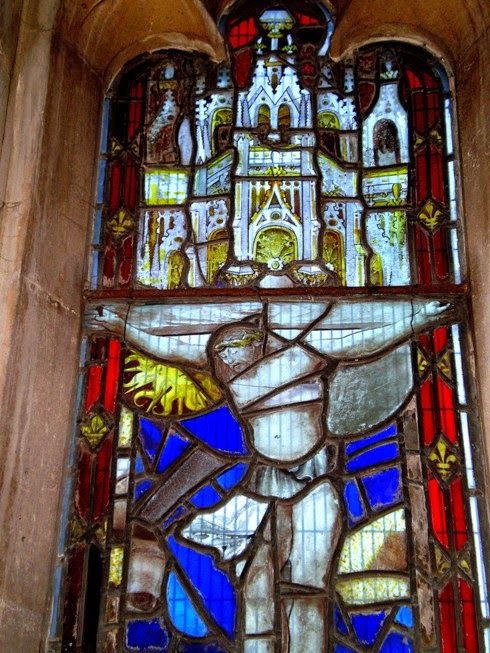
Plenty of other details from various ages catch the eye in various odd places, including - and I missed this on the first visit in the dark - 16th century German stained glass of the Crucifixion and Christ of Piety with original 15th century English canopies in the heads.


There, that's one more church done in cursory fashion, but others have accumulated, so expect the usual punctuation of things musical, literary and dramatic in the months to come. And I've just returned from a post-concert stay in the Scottish Borders with two of the godchildren and my dear friend Christopher Lambton, the ultimate woodsman, so more treestories are bound to follow.