Monday, 16 May 2011

Supping in Wonderland


Dining with Alice was the focal point and original purpose of our two days in Norwich, though it was bracing to crack the nut of at least a handful of city churches, and no doubt Moroccan-tumbler-team-in-artshow Chouf Ouchouf, which we caught in the Theatre Royal, outstripped the dramatic side of the Wonderland experience.

Yet strange and disconcerting, at times, Alice certainly was, and impeccably handled as a logistical nightmare of what has now become hugely popular as 'site-specific theatre'. Let's not forget that the Bubble company got there first, and my benchmark for wanders around old houses and through park and woodland with a purpose remains their Chiswick House Midsummer Night's Dream (Through the Looking Glass in Greenwich Park running it a very close second). Dining with Alice's motley crew of Carroll characters and their random knockabout couldn't compare, but maybe that's not the point; this was chaotic and without the logic a more prominent Alice would have brought to it, and no doubt deliberately so. In terms of the 'script', I can only agree with the shrewd theatre critic who turned up on one of our tables, Susannah Clapp, and her comment in yesterday's Observer that 'it is too light on incident and too leisurely always to capture the disconcerting jostle, the eerie fright of Carroll's nonsensicality.'

But I haven't explained the setting or the concept. We were bussed out from Norwich in the company of Mad Hattered youth - some, perhaps, encouraged by the sellout Punchdrunk experience - to Elsing Hall, which as you can see from the above is a (much-restored) 15th century house in the country. The show is the enterprising Artichoke's resurrection of a 1999 hit at the Salisbury Festival, presumably much re-adapted.

I'm told I should put in a *spoiler alert* here for anyone who's going and wants to be surprised. If not, read on. Next two photos, more people-friendly than mine, are by Sophie Laslert for Artichoke.


You walk through a formal garden with a darting Alice and a wood with amplified sounds of peacocks, crows and unidentifiable birds to a marquee where you quaff gin and ginger ale. The show begins. The actors spout some slightly alienating, half-Carrollesque nonsense. It's the melee of the two Alice books I always get a bit hot-under-the-collar about. But no matter; the tale isn't being told and Alice only pops up at a late stage to protest at her own inventions. I would have liked flamingoes and hedgehogs on the croquet lawn, though, Humpty Dumpty perched on the wall above the herbaceous border and perhaps a helium-filled Cheshire Cat. But that's my production, not theirs.


A gong sounds. 56 waiters in turbans of diverse colours come to lead the 240-odd guests to separate tables. That's right: one per person. It's like the Mad Tea Party - so many places laid, the visible guest at one end - except for the fact that you're completely on your own.


Solo musicians serenade you with assorted Victoriana: a viola here, a cornet there, sometimes counterpointing in Ivesian manner. The nine characters dart around, declaiming their little set-pieces. You're not really supposed to interact or comment; largely they ignore you, though when I asked the Duchess if I'd change shape on drinking the little phial, she managed 'I do hope so!' before bustling off.


The mock turtle soup, not what the Victorians made of it which was a calf's head dressed with condiments and sauces to resemble a turtle (which is why the creature in Tenniel's illustration is a combination of the two), consists of 'potatoes, olive oil, onion, watercress, spinach, vegetable stock, lemon juice, perfumed quail's egg [which I took up expecting to bite into a radish], basil seeds, nettles'. It's accompanied by the 'drink me' phial of quinine and bitter orange.


Gong sounds again. Your waiter leads you to another table under the trees (this one I liked, overlooking a grand old oak, though truth to tell it was cold and damp, Norfolk having that afternoon experienced its first downpour in months. But beautiful skies atoned). I think the idea was that the table should be for two, but I was still alone, which I didn't mind at all.

Third gong. This time we reached the walled garden, and our nearest and dearest fellow guests. Cue one more Laslert/Artichoke shot of the White Queen (Tamsin Dalley) accosting diners.


There I found J and our Norwich friend Kate sitting ready to share an excellent Holkham Pie. This is where Susannah joined us. Queen of Hearts and White Rabbit had an unseemly spat before us.


Fourth gong. Now the real magic began: lights everywhere as darkness fell, not least across the waters of the moat as we all processed to tables on a pontoon. There we watched a masque or divertissement of the Alice folk played out on a stage in front of the house.

Don't you like my nippled violet-and-elderflower Jellateena?
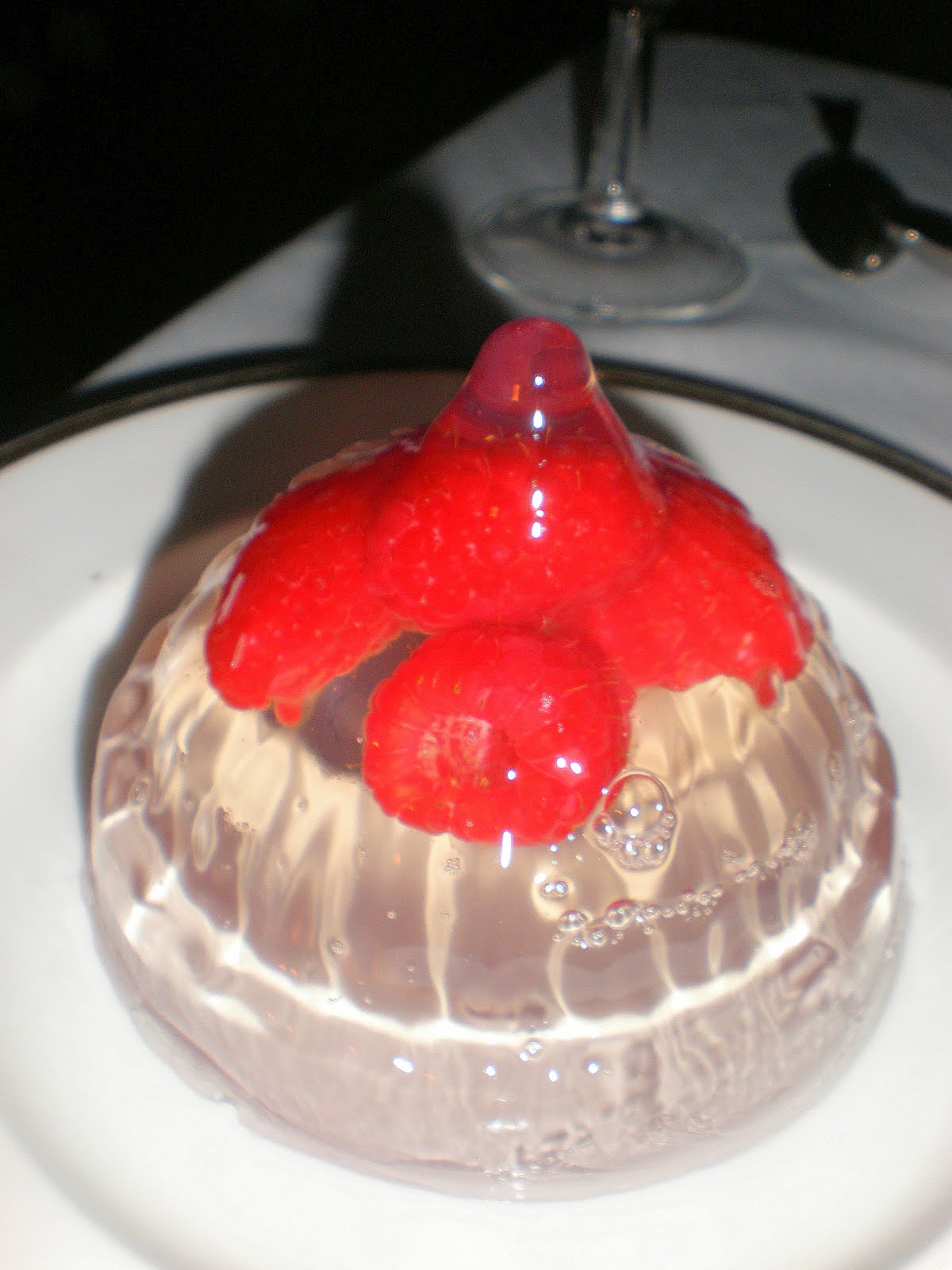

Surely that's the piece de (non) resistance of Bompas and Parr's food experience. And it was just as well we were all so chilled in both senses now, because the entertainment went on at purposefully purposeless length. We all sang 'Come into the garden, Maud'; a (deliberately?) banal setting of the spider's invitation to the fly went on for ever; we liked the White Rabbit's idea of a good trick, pulling a man out of a hat; and a raucous screechfest was terminated by the five Alices, who like the waiters had not perhaps played as big a part as the flagging up of local involvement might have suggested. Here's a final Laslert/Artichoke shot of Queen of Hearts (Di Sherlock) and Duchess (Heather Keen) in full vocal flight.


And so back on the bus after a chat in the field with Susannah and Lyn Gardner, who saw the original back in 1999 and thought some intimacy, but not the splendour, had been lost on this occasion. As for me, well, I gave up on the expected telling link between book and drama, and eventually succumbed to the weirdness of it all. One fact will surely be true for all: the experience will stick in the mind long after more shapely and better-performed theatre has vanished from the memory.

Sunday, 15 May 2011

Flag-flying on Europe Day


No. 10 Downing Street, it was baldly reported, wouldn't be waving the gold stars on the blue background, as apparently it had under a different regime the previous 9 May; only Vince Cable's lot would set a good example. Cameron's cravenness seemed to be a concession not only to the anti-European wing of the Tory party but also to those dismal organs of supposed popular opinion the Express and the Mail. Not to mention the thousands, it seems, who hate the idea of Europe so much they want to put a bomb under the European Commission Representation in London (as gleefully reflected in a dodgy Telegraph article which I won't give the benefit of a link).

Fortunately, I'm told, the Europe Day celebrations in St John's Smith Square, which has Europe House - the former Thatcher HQ - as neighbour, were marred last Monday by not much more than a stink bomb. I was far too Fotherington-Thomas in mood to notice, having skipped down Whitehall after my first Verdi Macbeth class looking for blue flags, not finding one but then coming across Parliament Square, where Westminster Council had done the 9th of May proud by flying the banners of all the member states as well as their symbol of unification. And how good they looked in the declining sun of a perfect Spring evening.


The light was also picking out the tower of the original Westminster Abbey, so often overshadowed by the Wren-Hawksmoor west end:


And so, past the Slovenian Embassy proudly waving the blue-and-gold as it always does, to Smith Square and its upturned footstool.


Very well, so Dickens thought it was some 'petrified monster, frightful and gigantic, on its back, with its legs in the air', but I like it and have so many fond memories of fine concerts there. The Europe Day concert, performance-wise, was certainly in that happy league, and the 13-year-old Liszt's one-act opera Don Sanche, wisely abridged for the occasion, occasions a bit more than amazement at the competence of its young master, chiefly a memorable tenor aria which I reproduced at the foot of my Arts Desk 'buzz' piece about the event and am happy to regurgitate here. No credit's given to the tenor, but he's good.


Catchy, no? More so than the duffer output of Donizetti, at any rate. For more detail, see the TAD article; I'll leave you with a shot of the excellent young soloists from the European Opera Centre along with the beaming players of the European Union Youth Orchestra - whose cellos and basses found fun even in their endless V-Is - conducted by Laurent Pillot (no, I wasn't snapping during the performance; this one's a publicity shot commissioned by the hosts).


Worth reporting that, although I don't much like standing for anything except a great performance, the EUYO's pure rendition of that orchestral portion of Beethoven's Ninth Symphony serving as Europe's 'Ode to Joy' brought many people not only to their feet but also to the brink of tears. Not me, but still I could see the good in welcoming an anthem that celebrates not narrow nationality but universal brotherhood.

Wednesday, 11 May 2011

Volubilis: an outpost of empire


Sites, shmites: it's easy to become cynical about yet another tourist-attracting antiquity. Actually, when I come to think about it, those that have been worth running varying degrees of the fairground gamut to see are more numerous than I'd casually remembered: the pyramids and sphinx, Ephesus, Nemrut Dag, the Acropolis of Athens, Persepolis, Tyre, Palmyra, Qalaat Samaan, Petra, Thanjavur...probably I've left something spectacular off the list. The point is that Roman Volubilis, about which I'd heard nothing before we went to Morocco, wasn't high on the list: the feeling was, we're in Meknes, we ought to go. And it turned it to be one of the most breathtakingly-located, mosaic-rich set of ruins we'd ever seen. The rains had brought the flowers out in abundance, of course, and even the edge of the site looking over to the basilica and forum was a wonder to behold. The ruins are spread out on a ridge above the high and fertile Zerhoun plateau. Above are abundant olive groves and copper-rich hills forming an amphitheatre, in the middle of which nestles the shrine-town of Moulay Idriss. Volubilis may have been a Berber settlement before the first century BC, when the Romans arrived. Its era of prosperity began when Augustus gave the combined kingdoms of Mauritania and Numidia to the Berber prince Juba II. So Volubilis became the seat of the provincial governor of Mauritania Tingitana (love that name, comes from Tingi which was the original name for equally influential Roman Tangiers). It exported wheat and oil - easy still to see why - as well as wild beasts for Roman games. And just as Lebanon was all but stripped of its cedars to provide timber for ships, so ancient Morocco lost its lions, bears and elephants. They became extinct in 200 years, about the length of the Roman rule here. After it, the mixed population continued to speak Latin well into the seventh century. The city was all but abandoned a century later, with the coming of Islam, and plundered in the eighteenth, when Moulay Ismail plundered the site for its marble. The animals are at least depicted in what for me is the most charming of the many mosaics which still preserve their brilliant colours in full sun and are subjected to only the minimum of cordoning-off (we saw not a single guard, and 1990s plans for expansion with a new museum and visitors' centre seemed to have come to a full stop). The so-called House of Orpheus is a sizeable mansion, formerly of three storeys. Its finest floor has a design I'd want in my own palace: the great musician at the centre, taming the birds and beasts who radiate outwards from the centre. There's also a more basic, black and white marine picture with a stocky Amphitrite in a chariot drawn by a sea horse and sundry exotic sea creatures. The prospect of basilica, capitol and forum then leads you forward - as do the storks nesting peacefully on several of the columns, unperturbed by the sparrows which flit noisily in and out of the twigging beneath them. The complex here seems to have been rebuilt in 217 AD during the reign of the African-born Emperor Septimus Severus. The path then leads onwards to a triumphal arch erected in the year of Caracalla's death. It would have been lavishly adorned with statues, many of which along with bronzes which give their names to some of the houses have gone to the museum in Rabat and seem, given the present building lethargy at Volubilis, unlikely to return here in the near future. The Decumanus Maximus which rises upwards from the arch is lined with many of the more prosperous residences. Most of the mosaics are slightly crudely executed - especially as compared with those in Tunis's splendid Bardo Museum - but the colours, where not over-restored, are very jolly. Bacchus discovers a half-lost Ariadne in the Knight's House while the labours of Hercules are portrayed in roundels to the north and there's an even finer mosaic of Bacchus flanked by the four seasons (only two of them reproduced in full below) and with what is - I think, but the guidebooks can't reach a consensus about this - a Bacchante beneath him. The best-executed mosaics are on the other side of the Decumanus Maximus, in the House of Venus. In the most celebrated of them, Diana is discovered at her bath by Actaeon. The surprised nymph on the left and the love-goddess's Roman hairdo are marvellously executed. And in the next room, Hylas is captured by frolicking nymphs. No doubt more will come to life if the indolent archaeological team can get its act together. But it's a wonderful site to spend an afternoon strolling around, and it certainly wasn't swamped by tour groups when we went. By 5.30 when I returned to the capitol, there was just a handful of visitors and the stork welcomed her hunter-gatherer mate back to the nest. I missed snapping that, but here she is anyway looking haughtily at a cheeky sparrow. There was no time to stop in Moulay Idriss, other than to take a view from above of the camel-humped town with the mausoleum to Morocco's influential sultan-pioneer of Islam in its dip. Then we sped back to Meknes to enjoy the early-evening entertainment on the square.

Monday, 9 May 2011

Immortal Sir Charles


We can't stop talking about the great Mackerras and/or playing the encyclopedic music dear to him: after last year's blockbuster memorial concert, there's going to be an ENO operatic spectacular at the London Coliseum on 26 June, and next season the Orchestra of the Age of Enlightenment will be dedicating its 4 November performance of Beethoven's Missa Solemnis to his memory*. The above photo by the wonderful Clive Barda is just as so many remember the man in his last year - the radiant smiles came thick and fast for both the OAE and the Philharmonia.

I was so delighted to be asked to talk to three of the OAE's players about him before a concert he had been scheduled to conduct last Wednesday (shame on me; owing to Arts Desk duties I sloped over after the interview to the Festival Hall for Christine Brewer and Jurowski conducting the LPO; no way would I have deserted the other bunch if Mackerras had still been at the helm). Having already experienced this team's generosity of spirit when I had the daunting task of lecturing them on Tchaikovsky two seasons back, I was confident in advance that we'd engage and that they'd have plenty to say.

In the end it was the effervescent Chi-chi Nwanoku, most expressive of double-bass players and an experienced Radio 3 presenter, who said she was nervous just before we went on. Here's one of those wacky publicity shots the OAE releases from time to time. Sadly was too involved chatting to think of photographing the team, so she'll have to be the figurehead (and well chosen, by the way, as one of the 100 on the Independent's Happy list, a feelgood antidote to another paper's World's Richest. Other candidates include a retired sniffer dog, the cuckoo, Juliet Stevenson and Miriam Margolyes).


And we'd had such a lovely, slightly waspish four-way chat backstage, some of it not for the public platform (let's say it involved a certain tenor and a certain heavier-handed Mozartian conductor), that I did inwardly think we might lose the spontaneity in front of an audience.

But we didn't. The contrasting temperaments certainly helped: the other speakers were violinist Catherine Weiss, quietly sincere, more than able to hold her own, and that splendid anecdotalist (and a hero of mine as an oboist whose example I only wish I'd ever been able to emulate) Anthony Robson. I started out by focusing on each in turn: Catherine on the finale run of Cosis at Glyndebourne last summer, not long before Sir Charles's death; Anthony on first encountering him in the D'Oyly Carte Orchestra, tales of which, given my G&S mania, I could have happily have kept running for the rest of the half-hour; and Chi-chi on a performance which meant the most to her, an early (1989) Haydn Creation like no other, about which she talks so eloquently in the excellent little OAE book by Helen Wallace.


You'll eventually be able to hear the talk when the OAE puts up the recording on its website in the next couple of weeks. In the meantime, I have to say that the greatest delight came with the questions, when we were discussing the possible existence of rehearsal footage. And a lady in the audience said, 'I believe there's quite a bit from his work in Prague. I'm Catherine, Charles's daughter, by the way'. And there she was with Lady Judy, his wife, and, as it turned out a fair swathe of the Mackerras/Briger clan. I'd heard there was a possibility they might be coming, but didn't see any of them until that point. Cue a cheerful QEH foyer shot.


Pictured are Sir Charles's nephew Ambrose Hall, who'd come and spoken to me about Martinu after a BBCSO pre-performance talk, his mother Joan - can't you see the resemblance to brother Charles? - and husband Graham Hall, niece Christina de Briger, Frances Edwards (stepdaughter of a brother of Charles), Lady Judy Mackerras and daughter Catherine.

Have had an e-mail correspondence with the very friendly Christina, sister of conductor Alex Briger who did such a splendid job at the memorial concert and whom we hope will be able to conduct the complete Pineapple Poll at the Proms (I'm working on it). She's given me permission to reproduce some of her comments about beloved Uncle Charlie: 'still can't believe that he has gone - feel he's simply on tour somewhere and will be returning soon...he was SO present and giving to us all in the family, not just musically but through his love and care, always there in times of ups and downs.'

Catherine later added that he was still full of quotes and quips in the final weeks - on the ambulance to the hospital in Elba when he was taken ill again, she told him she wouldn't abandon him, and he mock-melodramatically declaimed 'Sola, perduta, abandonnata'. Apparently kept the other folk in the hospital amused with his operatic Italian. I miss him as well, though not in a painful way, and I wasn't even a member of the family. As I observed to Christina, there was always something of a longing for the father figure he became during our many 'tutorials' (a different subject each time: Beethoven's Leonore, Martinu's The Greek Passion, his work on Pineapple Poll, Mozart's operas etc) at Hamilton Terrace.

*The family also tells me that Alex's big project, the Australian World Orchestra, will dedicated its inaugural concert in Sydney on 26 August to his uncle's memory. Sir Charles was due out there to conduct the AWO's Beethoven Nine. It's still on the list, with a fine team of soloists.

Saturday, 7 May 2011

Morocco's Versailles


He may have been less than half a sun-king, but God knows the Alouite tyrant Moulay Ismail Ibn Sharif (reigned 1672–1727) went flat-out in emulation. Playing, as so many of those bastards did, on lineage traceable back to Mohammed always helps. Overloaded with 25 kilometres of threefold walls and gates enclosing palaces, gardens and water-features, the small town of Meknes looked set under Moulay Ismail to overtake the splendours of Fes. Which it did, for a while, but now - despite royal interest and investment - it's returned to slightly sleepy provincial status. The Lisbon earthquake didn't help; after it the centres of power shifted to Marrakesh and back to Fes.


There was a low-level buzz when we were in Meknes because Mohammed VI - still popular, I'm told, partly because he claims descent, like Moulay Ismail (pictured above), from the Prophet - was about to arrive to preside over an international agricultural fair. Walls were whitewashed, flowerbeds watered and lines painted in the roads - I thought of Lewis Carroll's hapless card-courtiers painting the white roses red for the Queen of Hearts - but you knew it would all go back to what it was once he departed (with rather more on his plate, as it turned out due to the Marrakesh bombing, than anyone could have imagined).


Moulay Ismail did in fact have dealings with Louis XIV, but through an ambassador. Picture his indignation at the outcome: 'I asked for one of his daughters' hand in marriage and all I got were four lousy longcase clocks'. They stand in the corners of his surprisingly unimpressive mausoleum. You're only supposed to be able to see two, but the others can be glimpsed through a grille - here's one.


More impressive are the antechamber and the path to it through a splendid doorway


and several austere courtyards.


I especially like the sundial in the last.


Exactly how much of the work is the result of Mohammed V's 1959 restoration I don't know, but it's only thanks to him that we farafins can get to glimpse the shrine at all. It's only one of three holy places open to non-Muslims - all this thanks to a misreading of the Islamic decree that foreigners should not be allowed inside mosques et al on Fridays. But every day is non-viewing day for the infidel in Morocco, unlike many other countries we've visited. One good reason for not going to Fes; I do so want to see inside the Karouine Mosque there. Anyway, here's splendour enough, if not on a par with Istanbul or Isfahan:


The pillars are not, like the ones which support the Bab Mansour, plundered from Roman Volubilis, but obviously fashioned afresh - from Italian marble, it turns out, exchanged for sugar on an ounce for ounce basis (I love the tales of salt-for-gold swaps, carried out in the highest secrecy in the middle of the Sahara).


Other than this, there is size but not much splendour to be seen in the Imperial City. The mind boggles at all the statistics, no doubt exaggerated by legend: 10,000 enemy heads hung on the walls; 25, 000 slaves used (and mostly disposed of) in the construction - which makes the accidental deaths of Louis XIV's Versailles projects seem like childsplay; 859 kids, for which Moulay Ismail holds some sort of record; 30,000 killed in the campaigns which gave Morocco a greater degree of independence. I shouldn't forget the 150,000 members of the Black Guard, a sort of Moroccan oprichnik or iron ring. They hung out in the stables and granaries. There is, it's true, something impressive about the ruins of the stables with their 23 naves (room, forgive another statistic, for 12,000 horses).


It was here that my dear companion had a familiar fit of touristic ennui, thunderously opining that even Doctor Johnson's celebrated 'worth seeing but not worth going to see' wasn't applicable to this not even very ancient pile of rubble. Equanimity returned just beyond the crumbling walls by the Aguedal Basin, a nice place of repose for the Meknesi, or whatever you call them.


You can take a horse and carriage to get this far, but we preferred a half-hour walk. I'll be boring you with more gates in another entry, so let's get some of these out of the way. I've no longer got the detailed French guide, but these are all in the north-east quarter of the imperial city


and, passing the nesting storks on all that's left of the old imperial palace,


you walk (or ride) through the Bab el Rih


to get some idea of the grim monumentality of it all.


Give me the human touch of the medina or the ruined charm and location of Roman Volubilis any time. But those are for another day.