Showing posts with label Mallorca. Show all posts

Tuesday, 14 April 2020

Virtual timetravel: the glory of Palma


It was just before the last big religious/seasonal festival that I first encountered one of the wonders of the architectural world, and at a time when one could still go inside one (remember?) This is Palma Cathedral, according to legend-gilded history the offering of Jaume I, caught with his fleet in a gale off Mallorca in 1229 before victory over the Moors. Salvation resulted in a very grand project, known by its Catalan name of La Seu. Built on the site of the citadel's Great Mosque - little remains of the Moorish years in Palma's Old Town apart from two sets of Arab baths - it took 500 years to complete. Yet the Gothic essence of what we see, begun in 1300 by Jaume II seems very much of a piece, thanks also to an early 20th century restoration overseen between 1904 and 1914 by the great Catalan architect Antoni Gaudí, and its buttressed sandstone walls glow at sunset.


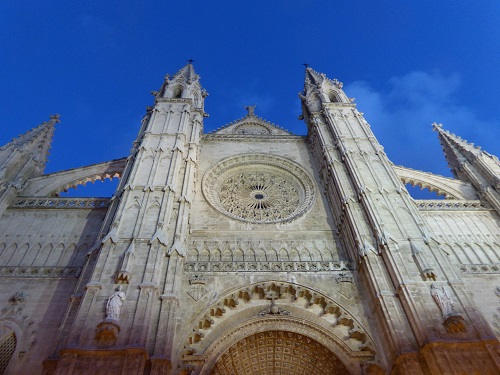
The above wasn't how I saw it until near the end of our 10-day idyll, returning from Deià in time to catch the honey-coloured vision. We approached it on our first early evening excursion into Palma's old town via the west-end Portal Major (Great Door), described in my Rough Guide as 'a neo-Gothic disaster', but its rose window (one of seven) and the bits of old statuary applied to it don't seem that bad to me. The necessary effect of grandeur is certainly still achieved.


Later in the week, on one of the few days when the weather threatened to be less than clement (and turned out to be nothing of the sort), we dedicated a full morning to the interior, essential even if you begrudge paying 8 euros (I certainly didn't). You enter via the Vermells Sacristy, one of the 21 side chapels, and that's a grand enough first impression of the nave with this Renaissance arch (detail online has not been of much help here).


The slender beauty of the 14 pillars, rising to 21 metres, came as a surprise.


The palm-like effect at the top is trumped by the perfection of the 15th century former exchange, the Sa Llotja, which I must attempt to do some justice in a future post, but there's no harm in putting in a photo for comparison now.


To take it all, you must do the usual thing in cathedrals and stand at the west end looking towards the high altar.


Before the steps into the chancel a fine pavement prepares the way (I also lack more detail here).
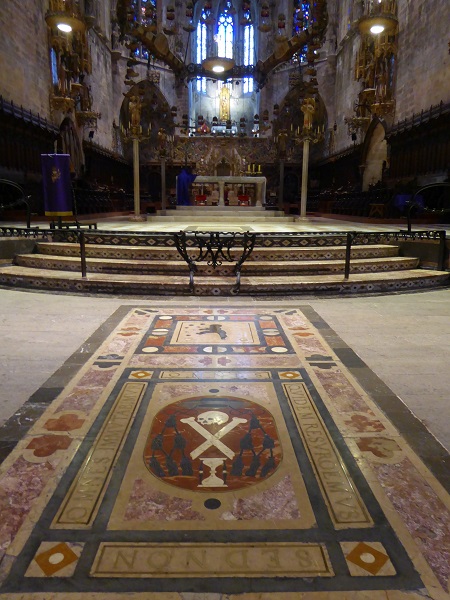


The baldachin is quite a pretty thing with its twinkling lights, a sparkly crown of thorns begun by Gaudí but not quite executed as he would have wished.


Gaudí also moved the stone pulpit of 1531, 'supported' by telamons (male caryatids) to the left of the entrance to the sanctuary.


Maybe it was a Christmastime seduction by all things gaudy, but the blend of new(ish) with old seemed succesful, a lightening of potential Gothic gloom. Oddest is the plasterand ceramic decoration by Miquel Barceló (b. 1957) of the Chapel of the Blessed Sacrament to the right of the high altar. The fishes go with the loaves as signs of Christ and of multiplying abundance.


The 16th century Chapel of Corpus Christi on the other side is more what you might expect from a grand east end, with a three-layered altarpiece.


The Last Supper at the bottom is remarkable, while above it are the Presentation in the Temple and the Temptation of St Anthony.


My inadequate guide is sniffy about the other chapels - 'dull affairs for the most part' - but most had something of interest. The Chapel of St Jerome has another fine altarpiece


with an especially fine statue of the saint and his lion at the centre


and I love these life-sized angels in the Chapel of Our Lady of the Crown.


The route out takes you into the Gothic chapter house, a gallery-room with works by the Mallorcan primitives, including here on the left the life of Catalan St Eulalia by the Master of the Privileges


and another fine doorway


leads into the Baroque chapter house, with more treasures; but the eye is drawn upwards.


The surroundings of the cathedral are especially attractive given the amount of money spent on the city in recent years. The park around the water basin is airy and spacious - this from a day when a storm was bowling in -


and of course the best views are from the other side, taking in the Almudaina Palace.


In the next post on this wonderful city, I need to do justice to the rest of the old town within the walls. There was infinitely more to see and explore than I could ever have imagined, and this is a lived-in place, full of character - though I guess we were lucky to see it with a dearth of tourists around.

Thursday, 12 March 2020

Miró in Palma


Of our 12 pre-Xmas days in Mallorca, a revelation about which I've already written thrice, only two were overcast and/or blusterous. On the first, a haar-some day with choppy seas, it seemed sensible to spend the afternoon a short distance along the coast at the Fundació Pilar i Joan Miró (founded by the artist and his wife two years before his death in 1983 and not to be confused with plain Fundació Joan Miró in Barcelona,) though I hadn't taken into account how a clear blue sky would have complemented the spacious and extensive grounds. Pilar Juncosa, Miró's wife, was Mallorcan, as was his mother. He found refuge here in 1940-2, a refugee from Nazi-occupied France, but it was probably happy memories of childhood summers which led the couple to settle here in 1956.

The pleasures actually began at the Marivent Palace garden, open when the Spanish king isn't using the place as his summer or easter residence, and entered by a gate near the bus stop; the Fundació has loaned 12 sculptures, most of modest proportions, to commemorate the Catalan artist's friendship with Juan Carlos I. The strategic placings are attractive, especially of this one under a tree in seasonal fruit with tangerines


and another with perspective towards the lawn with only giant beyond.


Ribbon development has grown up unattractively along this coastal stip, a legacy of the build-anything Franco years which have blighted a fair bit of Mallorca (though not the Sierra de Tramuntana to the north-west). We could have walked from our peaceful residence, but having done it once in search of a decent restaurant - which we didn't really find - thought the bus would do. Then it's a short walk uphill as the housing estates begin to thin out. For the preservation of much-needed green space here as well as the site for an exciting new gallery building by Rafael Moneo we have the foresight of the artist and his wife to thank.


The area also includes the studio designed by Miró's friend Josep Lluis Sert, who figures much in the chronicles of the Ballets Russes and who much later, between 1954 and 1957, saw his remarkable designs realised


and Son Boter up the hill through a beautifully landscaped garden, a 18th century Mallorcan house acquired in 1959 with money from the Guggenheim International Award.


This I loved the best, for reasons I'll explain later. But let's first go through the gallery entrance to the big sculptures in the lower garden. Femme tends to cover a multitude of shapes in the Miró mythology, but I love this one from 1981.


The most impressive from every angle is Personnage gothique, oiseau éclair, 1976.


In the room at the eastern end on the  level at which you enter are mostly black and white canvases of the 1970s


while the main gallery space below opens up and around, with plenty of arresting perspectives. Spot the yellow I love in Miró's work below.


The Allegro vivace graphic series looks especially good from here


and there are two fun carpets.


In fact the sense of childsplay in so much of Miró's work is what I find especially life-enhancing. Some of it makes me laugh out loud, which reminds me of the pleasures of going round the Barbican's The Bride and the Batchelors exhibition, with Duchamp as the master of joie de vivre. In the biggest space, a piano was central; it turns out it was waiting to be played in a free evening recital on the Fundació's open day.


For that I returned on the evening that Storm Clara was breaking. The audience was, sadly, small, and the pianist, Joan-Ramon Company, came and went too quickly for me to snap him before and after the programme. But I did catch the last page of Nadia Boulanger's wonderful, relatively early (1917) odyssey Vers la vie nouvelle which was the last, transcendent work in the concert.


Before it we heard two Nocturnes, two Preludes and the ninth Barcarolle in a chronological procession through Fauré's ever more harmonically enriched works. Difficult to judge the quality of the performance because the acoustic turned much to mush, but it was an intelligent programme, interestingly at odds with the artist's work around it (with the possible exception of the Boulanger).

Back to the day of the main visit, and to the Sert studio, which is so full not only of canvases but of postcards and odd litle cultural artefacts which had a special significance for Miró.


Then up to the Son Boter, entered by a door with a lovely old nativity carving above to the right, picked up in a Palma antique shop.


As with the Sert studio, we had this one to ourselves and an attendant - in this case a very friendly and talkative older man, who was anxious to explain everything about Miró's special work and time here. I'll just leave the different rooms with their graffiti and carefully-placed objects relating to them to speak for themselves, but there was certainly a special magic to the place at dusk.


The Sert studio which we passed on the way out had a further attraction in the semi-darkness. I suppose you could say this was 'l'heure bleue'.


So much time has passed with other exhibitions unrecorded here, though I'd longed to hold forth. Let me just photo-feature some impressions from them without further comment on the individual works. First the revelatory (to me) Bridget Riley exhibition which suited the renovated Hayward Gallery spaces so well, and which I'm so pleased I saw in a planned double-bill with the Queen Elizabeth Hall concert devoted mostly to singular genius Georg Friedrich Haas's homage to her work. Most important about this, as I stressed in my review for The Arts Desk, was that images weren't allowed to conflict with the performance; we saw them before and after.


The White Cube Bermondsey continues to amaze with the gigantic exhibitions it holds - here was another more or less unified Kiefer spectacular to follow not so long after Walhalla. This time I've chosen canvases with people looking at Superstrings, Runes, The Norns, Gordian Knot. The most evocative for me was a perfect evocation of the Hall of the Gibichung as featured in Götterdämmerung . I still wonder about Kiefer designing a Ring. His images are perhaps too strong and would be in competition with music and drama.


By chance I happened to find myself down Bermondsey High Street a few weeks later. popped back into the White Cube and found the vast spaces somewhat more thinly, but still evocatively, filled by the work of another artist, Cerith Wyn Evans.


This is where I overlap with my Jabberwocky post, so I've just put up a final image and shall leave it at that for now.