Thursday, 16 December 2010

Anglo-Russo-Japanese alliance


Forged, not least, by what Hiyoko's website describes in quaint English as 'the famous confection loved throughout Japan for its pretty baby chick shape'. I received my first box of these beautifully-presented delights from a former Goldsmiths student of mine now back in Japan, Yumiko Nunokawa, who travelled all the way to London with Shin-ichi Numabe, at the evening to remember Noelle last Thursday.

More about the serious stuff shortly, but can I trouble you with Hiyoko's legend about its chicks, information about which I am grateful to both Shin-ichi and Christopher Cook's partner Mitsuo for supplying?

'About the famous confection Hiyoko

'Hiyoko is produced in 1912 by Shigeru Ishizaka, the owner of a confectionary shop who wishes to make a Japanese sweet that will become a favorite of sorts among many more people unlike ordinary circle-shaped buns. Now, after a hundred years since then, Hiyoko is loved and well known to everybody in Japan.


'Commitment to ingredients

'The secret of Hiyoko’s daintiness is the carefully selected ingredients. The savory bun is made of flour from Kyushu to give a distinctive flavor. Mildly sweet yellow filling is made of fine choice of haricot beans. We select well-grown beans only and mush them deliberately. After our experienced confectioner puts the bun and filling together and bakes it in an oven until it becomes moist, melting texture, a delicious ‘Hiyoko’ is ready for you!'


Here at home, though we both loved their little staring eyes (with just a hint of the blandly malevolent penguin Feathers McGraw in Wallace and Gromit's The Wrong Trousers), we are divided over the deliciousness of the Hiyoko chicks. I like them very much indeed, J does not, but he was quite wrong that the various recipients wouldn't care for them either.

Though this was the most delightful surprise of my all too brief meeting with Yumiko and Shin-ichi, they came bearing even more valuable intelligence. I had already had a fascinating email exchange with Yumiko about Prokofiev's duo partnership as pianists with the French-Belgian violinist Robert Soetens, during which I saw a photo of them playing together which was completely new to me.

Now we know that perhaps my favourite photograph of the young Prokofiev


was taken not in 1915, as the archive and my book both have it, but in 1918 on his visit to Japan, as both the white suit and the same background reveal. For here is the young wizard meeting his greatest Japanese supporter, Motoo Ohtaguro (right), and A N Other on 2 July 1918.


Noelle, who wrote an article in an early Three Oranges journal called 'getting it right', would have been delighted.

After the big event last week, the obvious next step was to go and hear what Matthew Bourne had made of Prokofiev's score for Cinderella. I didn't see that production the first time round, when it was regarded as a bit of a mess. And to my mind it still is, though my Arts Desk colleague Ismene Brown thinks otherwise, and doesn't even worry about the over-amplified, pre-recorded orchestra. Granted, the idea of setting the fairy-story in the London Blitz of 1940, around the time Prokofiev composed the score, yields increasingly beautiful ideas amid the confusion.

The best thing in Act 1 is bespectacled Cinders' routine with a tailor's dummy that turns into her dream airman. Here are Sam Archer and Kerry Biggin in the first of four production photographs by Simon Annand for New Adventures Productions.


Quite how the airman's wounded self ties in with the Fairy Godfather's plans I didn't quite grasp. And the flight through the strafed streets is confusing, too, though the 'Autumn' variation of Prokofiev's seasonal divertissement - the wistful 'Winter' number is unique in getting the chop - strikes a not inappropriate note of terror as gasmasked 'dogs' create havoc.

Loud explosions and timewarp chaos reign in Act 2, too. It's clever how the Godfather turns the clock back on the carnage at the West End's Cafe de Paris and lets his Cinders make her glammed-up entrance down the big staircase.


Incidentally, one of the last times I danced around someone's handbag (and to that terrific Kylie number then all the rage) was at the Cafe de Paris, many hours into an absinthe-fuelled Gotterdammerung for the consultants of the cable radio station I used to opera-advise, Music Choice. The lethal alcohol plied by a small personage dressed up as Toulouse Lautrec left several folk unconscious, though having knocked back only three glasses I just about got home in one piece.


Anyway, as in the Bourne Nutcracker, Act 2 'was only a dream' (as four-year-old Carla said very loudly the second time we went to see that wonderful show). Bourne's coup is really the last act. Like that even wackier genius of the stage, Richard Jones, he can pull haunting theatre out of a composer's less inspired moments.

I felt Jones did that with the very sinister party scene of his Queen of Spades, and Bourne is determined to claw back the world-travelogue dances Ashton and most others cut from Act Three. And here the narrative tightens up, as the battered airman runs around London with the single lost slipper - down the Underground, where tarts straight out of the film Waterloo Bridge strut, and along the Embankment. Lez Brotherston's quick-change designs really come into their own here. And then there's a very disturbing scene in a hospital, for which, sadly, no press images had been approved. Frightened they might scare the punters away? Well they might be.

All ends well, and better than the visual inspiration, Brief Encounter, at Paddington Station. I wished they hadn't done an encore to 'In the Mood', which dispelled the disquieting aspects of Prokofiev's music in a feelgood sham. The recording was much too loud, muffled and boomy, but from what I could make out the woodwind soloists played especially well for that conducting doyen of New Adventures, Brett Morris. And though there's even less real ballet than usual in Bourne's choreography, he is always sensitive to the score's finer nuances.


Like I said, many good and striking ideas derived from the Blitz setting, but for a more coherent homage to A Matter of Life and Death et al I'd have to give the palm to the supposedly more impressionistic and very low budget brilliance of Pants on Fire's treatment of Ovid's Metamorphoses, the best thing I saw at Edinburgh and indeed in the theatre during the whole of 2010. And, hurrah, they've finally got their publicity act together with a brand new website, production photos and a little film they've put on YouTube which should whet your appetite.


Pants on Fire take up their prize visit to the New York fringe in January, and then they're back on tour, with only one performance in London at Islington's Little Angel Theatre in March. More, please, much more: this show deserves a proper West End run.

Wednesday, 15 December 2010

Turkish family heartbreak


Die Fremde by Feo Aladag, the winner of the European Parliament's 2010 Lux Prize, will be hitting the screens here some time next year as When We Leave. A lucky few had a chance to see it on Monday evening as part of the new Europe House's minifestival.

It's a masterpiece. The story, you might have thought, would have been told before: a Turkish woman leaves her abusive husband in Istanbul and travels with her young son back to her family in Berlin, only to face the immutable codes of tradition and community which cast such a pall even on a seemingly ordinary and recognisable home life. All this is done with such painful sensitivity and in performances of often restrained realism. The cinematography captures the inner lives of the characters in mundane surroundings, especially during the blue light of the hour of the wolf and the dawn, celebrating the everyday without a false note.

Which is why the inexorable logic with which all too familiar family disputes unfold into tragedy is the more shocking. You could hear the incredulous gasps of the comfortable European audience at the entrenched attitudes which would separate mother and child, but you come to understand, if not entirely to sympathise, with the motivations of the protagonist's humiliated father and fearful mother.


As this isn't yet released here - though already available on a German DVD with English subtitles - I won't say more about the plot except to note that the beautiful, dignified actress in the central role, Sibel Kekilli (pictured above), deserves every accolade. Watch the trailer (German subtitles only) below. You'll need to go fullscreen over on YouTube by clicking on the picture once it's started.


Diplomacy requested the removal of a central tranche here about the obscene adversaries of Europe House and their terrorist proposals (as well as the comments). So let's move on and wash away the unpleasant taste with a glimpse of the far from over-lavish reception for Maggi Hambling last Tuesday (all the following photos taken for the European Commission).


Maggi made a great speech, of course, though sadly I couldn't hang around beyond that because I had a class to teach. Here is the redoubtable lady by her biggest wave


a few smaller ones


and the resplendent Andrew Logan, whose cufflinks I wear with pride.


And so it continues. I missed the jazz concert last night, but I hope to be there for a discussion about Pinter in translation tomorrow. This in fact all came about because J asked the great man shortly before his death whether he thought the taciturn, long-pausing Finns would have a concept of what was Pinteresque. To which came the immortal reply 'fuck Pinteresque!' As Harold Pinter once said...

Monday, 13 December 2010

Restorative tidings


I owe all those of you who donated so generously to our Norfolk Churches Trust walk a final figure, which in the face of bad weather has been sent by our tour leader express delivery to Mary Heather of Burnham Thorpe. Between the four of us, we raised £1003.94.

That's not quite our record, but it's been less of a giving year. And much as we love to honour the memory of Jill's mother, one-time stalwart warden of 'the Nelson Church', by doing a different route every year - and we're well past the hundred mark in the number of churches we've 'collected' - it is a bit of a drag on friends and acquaintances to be chugged* at the same time for the same thing every year. But thank you: the restoration of deserving, sometimes deconsecrated causes in this delightfully over-churched county is much needed.

I've duly posted church pics throughout the year, but a few worthy edifices much further from the Norfolk epicentre got through the net, so I thought we'd stick to the angelic theme. The voluptuously winged Gabriel above and below is one of Henry Holliday's pre-Raphaelite windows for Oxford's Worcester College Chapel (Millais's original designs were rejected).


The chapel, lavishly restored in 2001, makes an interesting ensemble: Wyatt's original 1791 interior was redecorated, and not entirely obliterated, by William Burges in 1864-6. The ceiling is very much his.


Of course no handsome winged thing could quite outstrip the Vidal Sassooned St Michael of Eastbourne - he attracted some attention way back, so let's have another look at him here.


Among the casualties of excessive impressions was an account I wanted to post of our several hours in Udine on the way between Trieste and Tarvisio in June. The splendid ensemble of the central piazza will have to wait for another time, but above all Udine is Tiepolo Central, and though I was thwarted in my attempts to see the big Tiepolo exhibition there and the selectively open Oratorio della Purita, I did get to see inside the Duomo. Its hotchpotch of styles includes quite a few treasures, not least the painted organ shutters and the south chapel so elaborately frescoed by Giovanni Battista Tiepolo and Urbani. The guide is hopelessly confusing on who did what, but I'm assuming GBT was responsible for the angels.


The trompe-l'oeil winged chap who looks out so beguilingly is part of this ensemble.


Up the hill on which the castle is situated, there's a bronze angel atop the church of Santa Maria di Castello which spins in the direction of the wind. We stopped off on the way north in baking heat


and returned between violent storms, when he was more inclined to swivel.


Last but not least, let's return to St Nicholas's Chapel King's Lynn and one of the finest of all angel roofs.


This I've covered before, but since the chapel of ease is run by the Churches Conservation Trust, it's a perfect example of the first-rate treasures we're walking to help finance.

*that necessary footnote again: 'chugging' = 'charity mugging'. Though since we do it by email rather than putting the poor unfortunate on the spot, I think ours is more in the manner of a friendly suggestion.

Friday, 10 December 2010

Remembering Noelle - and Sviatoslav


Sviatoslav Sergeyevich Prokofiev, the composer's elder son, died in Paris on 7 December. He was 86, a grander age than I'd (mis)remembered, but I feel sad that I hadn't seen him over the past couple of years - he was too unwell to travel for any of the more recent Prokofiev events. We were not expecting to have to mourn/celebrate anyone other than our dear Noelle Mann at her memorial concert on Wednesday, but in the event Sviatoslav's death cast me back to all the others we have lost in this sphere - his younger brother Oleg, his wife Nadezhda, Christopher Palmer, Ted and Joan Downes, Viktor Varunts...I'm sure there are others I haven't recalled.

The above photograph was taken when I visited Sviatoslav at his Paris apartment and was royally welcomed by both him and the warmly hospitable Nadezhda, who died not long after our meeting. In addition to going over his memories, he'd kindly looked over the chapters of the book in which he played a part, and made detailed, helpful suggestions. He was always courteous, slightly shy but not exactly reserved, and like his brother suggested that, whatever the problems over the years, Sergey and Lina had always been loving parents who instilled decent human values in their boys. There's a fine interview with him on one of the Prokofiev websites. As I've said many times before Sviatoslav's son Serge Junior looks more like the great man than either of the sons; it's always quite uncanny meeting him. Our thoughts to him and his family. On which note, while looking at the memorial on the sprkfv website, I came across this lovely group picture taken in 1997.


By no means everybody's there, but the ones featured are, left to right, Nadezhda and Sviatoslav, Beatrice, Oleg, Cordelia, Gabriel, Nika, Lina, Serge Jr. and Irina.

The concert, which inevitably Serge Jr. wasn't able to attend, was a total triumph - I imagine that anyone in the surprisingly large audience who had come just to hear the music and hadn't known Noelle would have been very much enriched. As we knew they would be by Dmitri Alexeev's almost frighteningly well articulated account of the Sixth Piano Sonata, which had most of us leaning forward in our seats no doubt with hair standing literally on end.

But I was also especially moved by hearing Barbara Nissman's big, warm piano sound in the perfect space of the Queen Elizabeth Hall. It took me aback when Chris Mann came on to introduce the programme and the applause just went on and on. So, feeling like blubbing out loud, I was duly centred when Barbara launched into Liszt's surprisingly restrained transcription of Bach's Organ Prelude and Fugue in A minor BWV543, followed by crisp Prokofiev and the ineffable Rachmaninov G flat major Prelude.

Sasha Ivashkin, I'll hazard, gave his best ever performance of Prokofiev's Cello Sonata, cushioned and given room to breathe by Alexeev's incredibly sensitive piano partnership (at the 2003 St John's Smith Square concert organised by Noelle, Sasha had been partnered by Mikhail Rudy, while Alexeev made a superb team with Dmitry Sitkovetsky in the First Violin Sonata). I always turn to the cello sonata's middle movement in Rostropovich's world premiere recording with Richter, when of course the ailing composer would have been in the audience, for the gorgeous melody at its heart. But I hadn't rated so highly its counterpart in the finale until I heard the way Ivashkin and Alexeev conveyed its introspective soul. Alas, there are no professional shots of the event, so you'll have to make do with my makeshift pic of the three artists receiving flowers at the end.


There were so many interesting folk to see in the interval that I was almost late for joining the Goldsmiths Chamber Choir at the beginning of the second half (out came the horrid black Armani shirt which I'd bought half-price in Jermyn Street before my first Kalina Choir concert with Noelle). As Chris said, Noelle had never been able to marshal as large a choir as this in her lifetime, so she would have been pleased. We sang Tsar Fyodor's 'Dostoino yest' as harmonised by Ossorguine and Kastalsky's Cherubic Hymn.

I had the option of joining Goldsmiths forces for Prokofiev's apocalyptic trailblazer Semero ikh (Seven, they are Seven), but declined with two excuses: that one afternoon rehearsal probably wasn't enough, and that I wanted to hear it in the hall. I'm glad I did, because it sounded extraordinary: what quality from the glissandoing, growling augmented brass section, what a wail the sopranos set up in one of the weirder incantations. Here's a suggestion of the forces at the end of a very varied and emotionally rather exhausting evening.


Glad we had the chance to recollect in tranquillity at Deptford Town Hall last night. Sasha chaired reminiscences from myself, Barbara, Simon Morrison, Nelly Kravets (who nearly had us all lose it by reading Noelle's last e-mail to her) and Fiona McKnight of the archive.That, too, has been recorded so I'd like to recapture what passed in a bit of a haze. But I was delighted to see a former student, Yumiko Nunokawa, who travelled all the way from Japan with Shin-Ichi Numabe (Nelly, by the way, had come from Tel Aviv, Barbara and Simon from America). More on our meeting in another shorter entry.

Afterwards, Chris treated us to a meal in the Greenwich Cafe Rouge, a lively occasion which I know Noelle would have liked (could earlier hear her saying 'enough already!' as we got to the end of our tributes). Here's the stalwart Mr Mann, who's very blunt about simply getting through the time since Noelle's death but always seems able to pull himself together and rises to the occasion, with Barbara (partly because I loved her winter wear).


We promised more get-together music making and feasting to remember our doyenne at least once a year.

Thursday, 9 December 2010

Listen!


Or rather 'Slushay!', the title of an early revolutionary song used in the atmospheric first movement of Shostakovich's Eleventh Symphony. Its text was crucial to the composer, beginning 'the autumn night is as black as treason, black as the tyrant's conscience'. 'Listen to the Banned' is a collection of tracks by artists around the world whose free expression has been curtailed by censorship. It's been very carefully assembled by the multitalented Deeyah, born in Norway of Punjabi/Pashtun parents.

It's better than I could have hoped, since many of the artists represented aren't merely giving us plain protest songs. Most are superb and refined musicians, starting with Iranian singer Mahsa Vahdat.


She takes me back to our Christmas day in Isfahan some years ago, when our hotelier invited us to his home and gave us a concert featuring his teenage son, a superb player of that weird and wonderful big drum with jingles the daf (we have one sitting here at home, a handsome beast; I think that's what Mahsa is holding in the above photo), and his wife, a first-class singer who, like Mahsa and many others, can't perform in public except in the company of a male singer.

I suppose it's because I have a special, if unversed, affection for middle-eastern artistry that I love the subtle art of Afghanistan's Farhad Darya, Lebanon's Marcel Khalife and the Israeli Palestinian Kamilya Jubran. But the marimba/mbira accompaniment to the song of Zimbabwe's Chiwoniso Maraire is enchanting too. And there's a real note of exuberant protest in the number 'to freedom' Uighur Kurah Sultan composed while in prison under Chinese orders (sadly he died in 2006).


I especially like the segue from Sultan into the solo voice of the Alevit Kurd Ferhat Tunc.

One quibble, the usual when it comes to the loose title of 'world music'. It's not enough just to have a paragraph on the artists, however handsomely produced the booklet; we need texts and translations of all the songs. But this is a good 'beat the Xmas mush' present: read about it here and buy it on Amazon; you'll be promoting the work of Freemuse, disseminating freedom of song throughout the world.

And you can help another deserving cause make it to Xmas slot no. 1 (though sadly the X Factor winner is no doubt the firm favourite; to paraphrase George Bernard Shaw on inferior French farce, 'ten million teenage girls can't be right'). I like the subversive idea of a specially recorded Cage 4'33, but I also like this, not exactly as music, but the idea and the film are good. You'll need to click again on the screen once it's started to get the full YouTube picture.


And all power to the students and lecturers who yesterday claimed public spaces to fight back with classes and speeches, not brickbats. Hope they manage the same today. How proud I was of Goldsmiths forces last night at Noelle's memorial concert for flinging out Prokofiev's quasi-revolutionary 1917/18 incantation Seven, they are seven so superbly. They'll need a bit of that eloquent, focused fire for their protests. More on the superlatively moving and engaging concert when I get some pictures through.

Tuesday, 7 December 2010

Making waves for Europe


The adorable Maggi Hambling, who has become our Newest Best Friend since her partner Tory Lawrence - also a remarkable artist - had an exhibition in the 12-Star Gallery, launches what promise to be ten days of enlightening events at the new Europe House in Smith Square. This seemingly shameless piece of diplo-mate promotion (goddamit, it's my blog, I can write what I want) comes about because I Believe in European Culture to connect us as much as he does, and because it's about as good an arts spectrum for a minifestival as it gets.


There should be something to please everyone. Quite a start to have one of Britain's leading artists kicking off with a sequence of North Sea pictures. Tomorrow there's a free screening of archive European films showing a vanished world from 1909-21 (I've seen the DVD, I know how extraordinary it all is).


Plus, inter alia, major poets, a Proust round table and another free musikfest with the vivacious London Bulgarian Choir and others...all details here.

It's been a productive year for Maggi, with earlier exhibitions at the Fitzwilliam and the Freud Museum (that one's still running, I believe) and the launch of a book about her magnificent Aldeburgh scallop.


We're waiting to receive our copy as a present from another friend who bought it at the launch and is coming to the Exotic Europe event, but of course I know and love the object itself.

I popped over on my bike to south London in September to pick up the birthday present I'd bought for J - one of Maggi's Oscar lithographs - and was regaled with a glass of whisky and tales of her and Tory's recent trip to Moscow. Hence the hat.


As I was leaving, Maggi pressed on me a bag of apples, given to her by a taxidriver on the way back to Sheremetovo Airport. They'd come from his maminka's dacha apple-tree (I see I'm repeating myself a bit, but only in part). I managed to cycle back safely with the framed picture in my pannier, but just as I was rounding the home strait, the pannier came off and the apples spilled all over the road. One kind neighbour who stopped to help me pick them up was impressed to be rewarded with a handful for her pains. Another became a provisional christening present for baby Mirabel (hurrah, We Are a Godparent again), who was probably happier with this shiny round rednyellow yabloko than a silver spoon.


A neat parable of the joy (if that's the right word, considering the fierce aspects of the senior and junior artists) of giving and receiving, I reckon, if that doesn't sound too seasonally pious.

Sunday, 5 December 2010

A second dog's dinner


Glad I took up my programme-article prerogative of two more tickets to revisit A Dog's Heart, English National Opera's surprise hit of the season so far, on its last night. It was enough to confirm that the score isn't just a jumpy bag of polystylistic tricks*: some of the more pathetic ideas in the accumulating tension of the second act have lodged in my mind. And I do love the music for Sharik's dreams as well as the extra cut and thrust the splendid Garry Walker has been able to draw from his brass-in-ten-league-boots.

Performance-wise, Steven Page and Leigh Melrose (pictured above, with Nancy Allen Lundy's hyper maid, and below by Stephen Cummiskey for ENO) seem to have really wrapped their voices around those unkind, all-over-the-shop lines. And I'm sure the puppeteers had added detail to the uncannily realistic Giacomettiesque stray. Peter Hoare never seemed to have any trouble with man-dog Sharikov, a supremely touching and funny portrayal.

It was, in short, a trumph in every department, and won a deserved standing ovation last night (ENO audiences don't rise to their feet easily, though I suspect the Complicite fans probably do). I haven't enjoyed every Complicite show I've seen - least of all the Kharms nightmare Out of a house walked a man, which would have been 'out of a theatre walked a punter' if I'd been able to extract myself from the middle of a Lyttleton row - but, yes, Simon McBurney is a genius. I hope ENO can sign him up immediately to tackle Shostakovich's The Nose, long overdue a visit to the Coliseum. And hopefully this production will be back, too.


Setting aside memories of the vomit-inducing silhouette operation above, and parallel with the sybaritic tastes of Professor Preobrazhensky, we've been dipping into some of London's restaurants in the past week as seasonal gatherings accumulate. With, thank God, nary a line of tinsel in sight nor a piped Xmas carol in earshot. Fabulous discovery yesterday lunchtime of the unbelievably good and fresh food of the Spanish Casa Brindisa in South Kensington.


Best potatoes I've eaten out in a long time; the garlicky prawns and the bacalao (salt cod, like the Italians' baccala) with apple all tasted of themselves. Worth knowing, now that humble Daquise nearby has transformed into a pretentious Polish haute-cuisine (oxymoron) joint.

Earlier jollies were a Monday lunch arranged by my stalwart class monitor at the City Lit, Margaret Beaton, at Le Deuxieme on Covent Garden's Long Acre - for a lunchtime set meal, simple but tasty, this beat all the others we've tried, with superlative steak in pepper sauce - and a gathering of old Edinburghians 30 years on chez Julie's of Notting Hill. I've just read that this famous establishment, once a Sloane pitstop then a film-stars' haunt, was fined for claiming organic products when it was saving itself a fortune on unhappy chicken. Well, its nooks and crannies with a Marian theme were very cosy on a snowy, freezing night, and the eight of us who materialised in 'adverse weather conditions' had a whale of a time (sadly the hostess was stuck in Switzerland and couldn't make it), but the food wasn't great - though I can't complain about my lamb chops.

Where else might you try if you want to escape false seasonal cheer? My own favourites are two Italians - the unpretentious Rosso di Sera on Neal Street, run by Samuele and Igor from the Marche. It's one of the few of its kind where you really do feel you're getting good, straightforward cucina tipica as you would in Italy itself.


We were a bit taken aback by the huge portions at Bocca di Lupo (above) in the heart of Soho; I suffered from indigestion after eating too much there. But it was good quality, and of course the new Gelupo gelato bar over the road is ideal for doing as the Russians do and consuming your ices on the freezing streets. Salute!

*interesting that Grange Park doyenne Wasfi Kani, who said she didn't want to hear it again, was gainsaid by other, surprisingly articulate and sympathetic guests on BBC2's Arts Review, one of whom sagely pointed out that the music perfectly illustrated each and every character. Kirsty, meanwhile, told us about 'Bulgarov', reacted to Prof Carey's commendation of the coloratura prospective bride with illustration of Vassilieva barking through her megaphone, and this week issued an apology for misattributing the puppeteers.

Thursday, 2 December 2010

Peter Hofmann: off to Valhalla


Yes, he was a very 70s/80s kind of crossover guy with a spectacular mullet (the LP above, by the way, with the then Mrs H, is rather good), and the voice wore out quickly under heldentenor strain but, gosh, was Peter Hofmann handsome of form and voice as Siegmund in the revelatory Chereau production of Wagner's Ring at Bayreuth. He died earlier this week, at the very untimely age of 66, and if there's a hall for heroes out there, he'll be part of it.

Vivid memories flooded back of how I came to know the Ring, an act a week on television, as a student in early 1980s Edinburgh. How we used to look forward to the next instalment of our operatic soap, as did over a million others. I remember being so worked up after Dame Gwyneth's curses as Brunnhilde in Act 2 of Gotterdammerung that I had to run around the New Town block a couple of times afterwards (ah, youth!) And there was the revelation that, after tricksy Rheingold, Act 1 of Walkure contained the most passionate love music ever. Not sure if I'd heard Jessye Norman and then Linda Esther Gray sing Sieglinde in concert at the Usher Hall by then, but Chereau's Ring was the full dramatic thing, and how electric seemed the connection between Jeanine Altmeyer and Hofmann. Darn it, they even looked like brother and sister with their pleading close-together eyes.

Alas, YouTube only has the two set-pieces and not the magnificent pulling of the sword from the tree. So probably the best choice is the reaction of Hofmann's life-devoted hero to the death-announcement of Jones's Brunnhilde in Act 2.


While we're on the subject of commemorations, I should say that yesterday did not pass unobserved; nice young people were out in force selling AIDS ribbons for the Terence Higgins Trust. Will has several poignant connections to make on his blog.


I'll just leave it at a nasty piece of negativity: the award for Shit of the Year must be shared equally between Cardinal Bertone ('I have been told recently that there is a relationship between homosexuality and paedophilia. That is true. That is the problem', April 2010) and Archbishop Andre-Joseph Leonard, the head of the Belgian church, for his published remark that AIDS was 'a sort of inherent justice' for a promiscuous lifestyle. Typically, it was his spokesman, describing him as a motorist driving the wrong way when everyone else is travelling in the opposite direction, who resigned; as far as I know the Archbishop is still squatting toad-like in his powerful position. Only in the Catholic Church...

And a reminder that the memorial concert for our dear Noelle Mann takes place next Wednesday in the Queen Elizabeth Hall: a fabulous programme, including perhaps the greatest living interpreter of Prokofiev's Sixth Piano Sonata, Dmitry Alexeev, reprising his 2003 performance and Goldsmiths forces tackling the colossal Semero Ikh cantata. I'll be singing in the choir for the two Russian liturgical pieces, remembering Kalina days with Noelle in charge. Further details here on the Arts Desk, with links to booking. There's also a gathering at Deptford Town Hall the following evening to remember Noelle in words.

Tuesday, 30 November 2010

Golden October, sombre November


Where, oh where - paraphrasing/adapting Pushkin's and Tchaikovsky's Lensky - have you gone, golden October days? Every Sunday in that month was one of brilliant sunshine, whether in Sandwich, Oxford, Athens or Samos. It hardly seems less than four weeks ago that we were hiking the hills of that wonderful Greek island, discovering fruit bursting and dropping ungathered from the trees. And there I was, today, one low ebb of the year - though I'm tolerably jolly in myself - hanging around on freezing outlying Piccadilly and Bakerloo line stations waiting to go and get a verdict on the fracture from the maxillary department at Northwick Park Hospital, Harrow (the second picture, obviously). Not at all grim inside, in fact, as NHS hospitals go. I'm getting to compare them all these days, split as I have been between six of them.

It cast me back to a bleak January day in Edinburgh in 1984 when I took a journey through the snows from our mice-ridden Dalry Cemetery Gatehouse to Portobello Cat and Dog Home, hoping to lay my hands on a mouser only - very reasonably - to be told that the carers didn't like to let cats loose with students who might desert them or, at best, shunt them around (eventually we got Sinope/Snoopy on loan from Iqbal and Sharif over the road).

Not to detain you with the boring details of this morning, but I must side- or even up-grade the 'supraorbital' wound to a fracture of the left sinus wall. Whether it needs to be operated on will depend on the CT scan which should reveal how far back the damage goes. Ho hum: only another fortnight's wait, with the comforting intelligence that if I start bleeding or vomiting again, I must take me back to A&E immediately (unlikely, insha'Allah).

In the meanwhile, preferring to turn the calendar back a month as November comes to a close rather than forward to Christmas as everyone seems so hell-bent on doing, I think of our Samian time, not all blessed with clear blue skies but all of them fresh and bracing. We harvested a good crop of local produce to keep us going in our Potami retreat.


The day of our fruit walk saw a rather bigger detour than we'd intended around mountain villages through valleys of silvers, greens, reds and greys


and eventually down to the coast path between Megalo and Mikro Seitani beaches, which we'd explore the following day after the storm had passed.


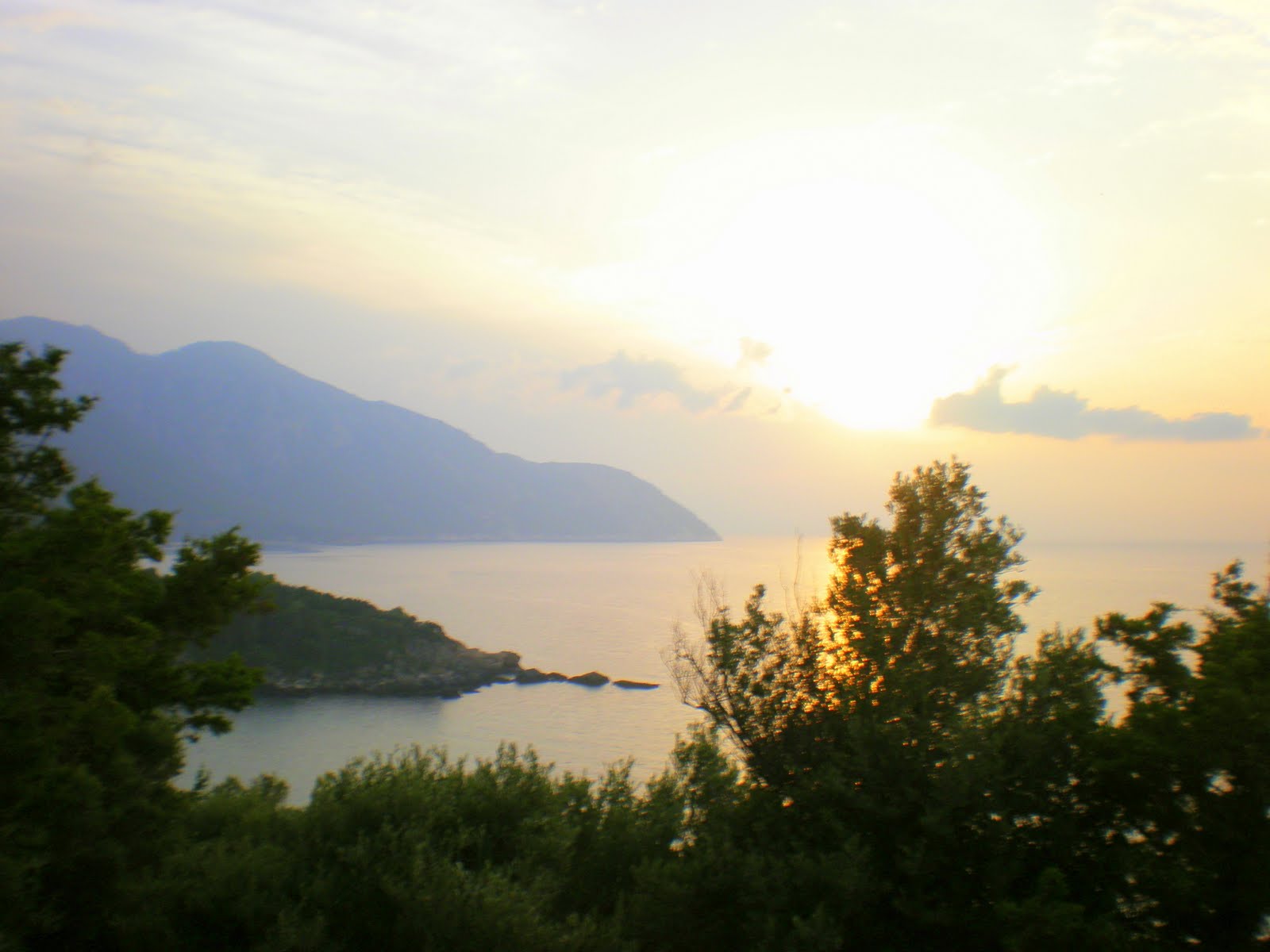
Even the coldest day of the week, when we froze above Manolates, was rather beautiful, with the Turkish coast at its clearest in the sun while we shivered under a grey pall.


The pomegranate up top, of course, plays a key part in the Persephone myth of the seasons. I'm just in the mood for the restrained emotions of Stravinsky's melodrama, the highlights of its Hades scene including the quietly ravishing 'Lullaby for Vera' to be heard here in Sir Andrew Davis's Proms performance with the BBC Symphony Orchestra, Paul Groves and Nicole Tibbels. Forgive the artwork; it's beyond my control.