Showing posts with label Helmuth Rilling. Show all posts

Sunday, 17 June 2018

Ever upwards with Bach and Dante


You can see I'm in danger of being left behind on terra firma in both my big pursuits of the year, with four out of seven Bach cantatas to catch up on here - I'll deal with the other three alongside next today's in a future post - and four Dante lectures to comment upon, of which I missed one. Nevertheless I'll make some effort to be light and airy like the masters.

It seems I was premature in leaving Purgatorio behind in my previous Dante/Bach post: there turned out to be one more Warburg Institute class on the middle cantica. The most treasurable utterance, of many, that I took away from Professor Took, of many, was a very helpful summary of the Dantean essence in response to one of the questions in the discussion: 'Peope's lives are mixed, ambiguous in the extreme, simultaneously in hell, purgatory and paradise. In order to explore [the issue], he divides it out. The moment of truth lies somewhere in the unutterable complexity of the here and now'.


Even so, Dr Scafi prepared us for 'a difficult and allegorical Canto' (33, the last, of Purgatorio) in the shape of the final processional which represents the triumph of the church (sketched above by Botticelli, no less), complete with the four cardinal virtues, three theological virtues and Beast of the Apocalypse. The difficulties pale into insignificance once we reach Paradiso. Dante warns the slackers among us - and there must be many more now than in that religiously obsessive age - at the beginning of Canto 2 (with acknowledgment to Robert W Durling's literal translation):

   O voi chi siete in piccioletta barca,
desiderosi d'ascoltar, seguiti
dietro al mio legno, ché cantando varca:
   tornate a riveder li vostri liti,
non vi mettete in pelago, che forse,
perdendo me, rimarreste smarriti;
   l'acqua ch'io prendo già mai non si corse;
Minerva spira, e conducemi Appollo,
e nove Muse mi dimostran l'Orse.

O you who in little barks, desirous of listening, have followed after my ship that sails onward singing, turn back to see your shores again, do not put out on the deep sea, for perhaps, losing me, you would be lost; the waters that I enter have never before been crossed; Minerva inspires and Apollo leads me, and nine Muses point out to me the Bears.

Despite the comfort of mythological and classical signposts, the Christian theology, albeit that Dante has such a singular take on much of it, is what makes so many of Beatrice's homilies rather hard for the contemporary reader. So is the assurance of a now outdated cosmology; it can't all be taken as poetic metaphor, after all. Nevertheless, the guidance of our Warburg Dante and Virgil (who has long disappeared from the scene in the Divina Commedia, of course), and the thoroughness of the notes to the Durling edition (of which the Paradiso volume runs to 873 pages) make the most difficult journey worthwhile.


The best of our two most recent classes, for me, has been in the discussions. I'm getting antsy: why should Piccarda Donati and the empress Constanza be in the lowest sphere, the moon, in Canto 3 (pictured above), simply because men snatched them out of their nunneries and forced them into unspeakable wedlock? And why does the narrative of Dante's Thomas Aquinas about St Francis seem so hard and charmless to us, expecting at least something of the goodly saint's conversation with nature?

Dante's Beatrice provides part of the answer when it comes to the two paradisical ladies in Canto 4: they merely appear in the moon, and actually adorn the first sphere, the Empyrean. It's a matter of conscience. Well, that's half satisfactory. And Prof. Took thinks that the narrator Dante is playing the serpent when he asks them if they don't desire a higher place. Smiling and joyful Piccarda replies that 'it is constitutive of this blessed to stay within God's will, and thus .our very wills become one' ('Anzi e formale ad esto beato esse/tenersi dentro a la divina voglia/per ch'una fansi nostre voglie stesse', 3.79-81).


As for Francis, the harshness is to do, as Prof. Took put it, with Dante's 'stringent selectivity' - he has an axe to grind with the Dominicans and their tendency towards luxury in opposition to the Franciscans, led by a man who took Poverty as his Bride. He's 'too angry', has 'too much of an agenda' to spend time on the birds and the beasts.

Bach doesn't always do the expected thing, either, though his line of communication is always direct thanks to the expressive power of music. His first Ascension cantata for Leipzig, 'Wer da gläubert und getauft wird' comes not with trumpets and drums but an exquisite halo of two oboi d'amore, a short if uplifting opening chorus and an affirmative tenor aria with ardent violin obbligato. Loveliest is the chorale for soprano and mezzo in imitation with dancing continuo support, as Brides of Christ complete with joyous 'eia's- irresistible when Rilling's soloists here are Arleen Auger and Carolyn Watkinson.


That fine alto distinguishes BWV 44, 'Sie werden euch in den Bann tun', with a superb aria alongside oboe and bassoon. The opening is surprising: two parts of the text run respectively as a duet for tenor and bass and a harmonically wayward chorus in faster tempo. The chorale for tenor here has a distinctly weird, chromatic accompaniment from bassoon, there are fabulous adventures from the bass line in the virtuoso soprano aria, verging on the Handelian, and the closing chorale is familiar from its similar setting in the Matthew Passion.

BWV 172, 'Erschallet, ihr Lieder, erklinget, ihr Saiten!' for Whitsunday, is much more what one might expect for Ascension. It comes as no surprise to learn that its three celebratory trumpets, which go virtuoso-crazy in the bass aria (a good, if short alternative to Handel's 'The Trumpet Shall Sound'), were originally meant for a secular celebration, but they suit the celestial setting of the Weimar chapel (pictured below, no longer extant, alas) for which they were destined in 1714. The tenor aria offers some room for reflection, and a presumably deliberate harping on minor seconds in the 'weh' of 'wehet'.


Intimacy is apt for the Whitsun Monday and Tuesday cantatas, both of which begin with charming recitatives. BWV 173, 'Erhöhtes Fleisch und Blut", is another cantata adapted from a profane congratulatory set. It haas a radiant beginning (plus a non-chorale final number, unusual but not unique among the cantatas) and a lilting 6/8 tenor aria (beautifully sung on the Rilling set by his regular, Adalbert Kraus) with flute doubling first violin line to strong effect. The most original number, in which each of three verses, first for bass, then soprano, then the two together, is treated with increasing elaboration, is ruined by the only inadequate soprano I've heard on the Rilling set so far; let's hope she's a one-off.


BWV 175, 'Er rufet seinen Schafen mit Namen' captures the good-shepherd pastoral aspect with three recorders - and we're back to excellent soloists - Watkinson, Schreier, Huttenlocher - exchanged for two very florid trumpets before the finale choral reverts to the original colouring. Last night, in the only one of the three Gardiner cantata sequences I was able to catch over the Bach weekend at the Barbican, there was equal rustic beauty in the perfect correspondence between countertenor Reginald Mobley and Rachel Beckett and Christine Garratt on two transverse flautes for the aria 'Wohl euch, ihr auserwählten Seelen' in BWV 20. But I feel that's all I can write on the evening's cornucopia of riches for now, lest you feel drowned in BWV numbers. More anon.

Sunday, 6 May 2018

Dante in Eden, Bach after Easter


Maybe there was a part of me mildly disappointed by Dante's arrival in the Garden of Eden at the very top of Mount Purgatory for his crucial meeting with Beatrice. I guess I'd expected more description of the natural paradise à la Milton, whereas it's subordinate to allegory and rather too much theologising towards the end of Purgatorio. But then I missed the chance to hear Dr. Scafi and Professor Took spread their own special love for these Cantos, overrunning as I did on the last class devoted to Janáček's From the House of the Dead (we had to see two acts of Chéreau's production, and even the extra time I'd allocated overran).


Certainly, though, the official leavetaking speech of Virgil is moving, and concise. I ought to reproduce it here so that, like the examples quoted in my previous Dante/Bach entry, I can try and memorise the Italian when I have time. Translation once again the literal but effective one by Robert M Durling.

in me ficcò Virgilio li occhi suoi, 
    e disse: "Il temporal foco e l’etterno
veduto hai, figlio, e se’ venuto in parte
dov’io per me più oltre non discerno. 

   Tratto t’ ho qui con ingegno e con arte;
lo tuo piacere omai prendi per duce;
fuor se’ de l’erte vie, fuor se’ de l’arte.
    Vedi lo sol che ’n fronte ti riluce;
vedi l’erbette, i fiori e li arbuscelli
che qui la terra sol da sé produce.
    Mentre che vegnan lieti li occhi belli
che, lagrimando, a te venir mi fenno,
seder ti puoi e puoi andar tra elli.
    Non aspettar mio dir più né mio cenno;
libero, dritto e sano è tuo arbitrio,
e fallo fora non fare a suo senno.

   Per ch’io te sovra te corono e mitrio"

Virgil fixed his eyes on me
   and said: "The temporal fire and the eternal
have you seen, my son, and you have come to a 
place where I by myself discern no further.
   I have drawn you here with wit and with art;
your own pleasure now take as leader: you are
beyond the steep ways, beyond the narrow.
   See the sun that shines on your brow, see the
grasses, the flowers, and the bushes that here the
earth brings forth of itself alone.
   Until the lovely eyes arrive in their gladness
which weeping made me come to you, you can sit
and you can walk among them.
   No longer await any word or sign from me: free,
upright and whole is your will, and it would be a 
fault not to act according to its intent.
   Therefore you over yourself I crown and mitre. 


The interrupted dialogue between Beatrice and Dante is certainly unusual. At first, 'regal and haughty in bearing, she upbraids him, and only deigns eventually to show the warmth he craves, finally smiling towards the end of the last Canto, 33. On with the summer term, anyway, where our Dante and our still present Virgil at the Warburg will lead us through Paradiso.

It seems ages since we last met for the final Purgatorio class I was able to attend; and it's been too long since I actually listened to a Bach cantata on the Sunday for which it was intended. I have the five after Easter to deal with here, and since sharp memory of all of them fades - I have the notes in my book still - I must head only for the high points, and three arias especially.


BWV 42, 'Am abend aber desselbigen Sabbats' begins with an almost Handelian sinfonia - the only cantata to start that way in Bach's second Leipzig cycle - before the tenor introduces the opening text over throbbing strings (perhaps the beating hearts of the Disciples as Christ walks among them). And then, and then, one of the loveliest arias in all the cantatas, surely, and that's saying something (one would probably have to include at least two dozen in the top list). The first of the two oboes made me want to get my long-neglected instrument out of its case. Gardiner describes how he found 'Wo zwei und drei versammlet sind' 'unbearably pained and sad at our first performance, and far more serene and consoling at the second'. Can't find a recording to match Rilling's two oboes and mezzo Julia Hamari, so here's the whole thing from the cycle to which I'm adhering. The aria is at 6m42s.


BWV 85, 'Ich bin ein guter Hirt' starts with bittersweet pastoral and flows beautifully. BWV 146 begins originally with a surprising adaptation of the D minor Harpsichord Concerto - brilliantly rendered, incidentally, on the Jean Rondeau disc we nominated as BBC Music Magazine concerto disc of the year, and I'd have been happy had it won. Wonder of wonders, there's even a film of the first movement to go with the recording on YouTube. If, like me, you're not usually excited by the harpsichord, this should help you change your mind.


The cantata continnues with a slow, astringent choral movement, also concerto-based. It has the next ineffable aria of my three, 'Ich säe meine Zähren', conjoined with a very expressive recitative, also for the soprano, haloed by sustained strings. Helen Donath is the best possible substitute for Arleen Auger, Rilling's most frequent soprano. One wonders if Mozart's exquisite woodwind ensemble writing stemmed from Bach - nothing could be lovelier than the quartet of flute, two oboes d'amore and bassoon on the bass line. Because I don't actually like Rilling's organ in a couple of stops, I've chosen Gardiner for the complete recording. Recit and aria are at 24m13s


It's a contrasting expression of sowing with tears and reaping with joy. These 'twixt-Easter-and-Ascension cantatas seem much to do with earthly sorrows, heavenly promise, but maybe that's the essence of the Lutheran texts throughout. I'm going to pass swiftly over BWV 166, with its striking short phrases for oboes and violins around the bass's 'Wo gehest du hin?'s and another lovely weave of solo violin and oboe around the tenor aria, and end with BWV 87, 'Bisher habt ihr nichts gebeten'. The winner here is another alto aria, 'Vergib, o Vater, unsre Schuld', with elaborate writing for oboes da caccia, a rising bass line and one of Bach's most involved middle sections, winsome when it breaks out into triplets. The mezzo/alto needs superb breath control here. Alas, no Rilling on YouTube, and some weedy countertenors are no substitute, so I had to make do with Koopman - too slow, I think - because of Bogna Bartosz at 2m44s.


The tenor's recit ties in nicely with Dante's far from easy journey to the top of Purgatorio: 'When our guilt climbs all the way to heaven, you see and know my heart, which hides nothing from you; so seek to comfort me'.

Thursday, 5 April 2018

Bach and Dante over Easter


The Bach cantata pilgrimage with Rilling and company came to a halt over Lent, for obvious reasons. And since the only Palm Sunday cantata, BWV 182, was among the last I reached in my 2013 attempt to make a whole year of cantatas, Easter weekend marked the pick-up point. First, though, an essential Passion for Good Friday, since this year I didn't get to hear one live (the nearest I came was the unforgettable Lucerne staging of Schumann's Scenes from Faust). I have the Britten set of the St John on LP, unheard until now, with its bold reproduction of Graham Sutherland's Northampton Crucifixion on the cover, and it proved a very moving listening experience.

Having started with another boxed set I picked up recently in a quest to try and take unfashionable large-scale Bach seriously, Karajan's St Matthew Passion, and given up when faced with the sludge and the dim sound - back that goes to another charity shop - Britten's is a whole new world of biting passion and inscaped sadness. It's sung in English, with Peter Pears having worked on the recitatives and Imogen Holst collaborating on the rest; Colin Matthews writes briefly but eloquently on the changes in an essential booklet note. And I've been reading Imogen H on Britten and Byrd recently; what a superb clarifier she was (pictured below with Britten and Pears in the Red House garden).


Pears's burning delivery - the famous setting of Peter's weeping is as searing as any - makes it work. And there's plenty of thrust in the meaning from the Wandsworth School Boys' Choir - really, no extra voices? - and the superb soloists. John Shirley-Quirk helps realise Britten's special spirituality in the last bass aria with chorale, and Alfreda Hodgson is peerless in both Parts, much abetted by the English Chamber Orchestra oboes in No. 11. A great mezzo, easily the equal of Janet Baker and yet so overlooked by comparison.


Later I turned to another LP box I picked up recently, Britten's 'new concert version' of Purcell's music for The Fairy Queen, in which Hodgson sings Mopsa to Pears's Corydon (no all-male bad camp here, then, but plenty of esprit). Again, the stylishness and engagement leap out over a distance of 45 years, and I like what Britten does with the messy hybrid better than any other version. I've now ordered up his Schumann Faust-Szenen with Fischer-Dieskau as a third LP set to make a handsome trilogy.


Easter Day, Monday and Tuesday brought with them new cantatas to hear, so finally it was back to Rilling. 'Der Himmel lacht! Die Erde jubilieret,' BWV 31, was composed by the 30-year old Bach for Weimar - the size of it suggests the original venue as not the court chapel but the main parish church known as the Herderkirche where we were lucky to attend an Easter Sunday service back in 2015, looking on the splendid Cranach altarpiece -


and probably reused in Leipzig. Gardiner suggests a parallel between the five-part chorus and the Gloria of the B minor Mass, down to the slowing of tempo and rest for the brass in the middle. It's exactly what one would expect for a 'Christ is risen' Cantata, though the ensuing recits are perhaps more striking in their word-painting than the bravura arias. There's a sublime trumpet descant to the final chorale.

Our Easter Sunday anthem this year, by the way, was Hadley's 'My beloved spake,' which we all used to love in the choir of All Saints Banstead - I realise it also enable me to recite this bit of the Song of Solomon - and which was sung on Sunday by the choir of St Paul's Cathedral. So we went there through the drear and heard the music only from a great distance, among masses of tourists. Still, Hadley's juicy harmonic shifts and two big blazes made their mark. I'm hoping close friends Juliette and Rory will choose it for their wedding this summer.


Most fascinating on the Bach front is the extreme contrast between the Easter Day jubilation and the inwardness of 'Bleib bei uns, denn es will Abend werden,' BWV 6, composed for 1725's Easter Monday in Leipzig. The comparison here in the opening chorus is even more marked, with the bittersweet genius of 'Ruht wohl' at the end of the St John Passion, C minor key and sarabande movement included.


How wonderful the harmonies of the two oboes and oboe da caccia and the power of the chorus in Rilling's superlative performance; likewise the oboe da caccia's solo in counterpoint with mezzo Carolyn Watkinson, a singer I always liked and who appears in the Rilling Bach cantatas for the first time, and the piccolo cello against Edith Wiens (another unexpected name in the set) singing the central chorale. Profound music throughout in a great performance.


Gardiner is a thoughtful commentator again; he compares the contrast between the absence of Christ in a light-diminished world and a holding on to Word and sacrament, a contrast between dark and bright, with Caravaggio's first representation of the Supper at Emmaus, pictured above; it made me look up the second, where Christ has a beard.


Still, although it's less pertinent here (daylight is preferred to the night setting), Titian's representation, often overlooked in the Louvre because it hangs opposite Leonardo's Mona Lisa and currently in the stunning Charles I exhibition at the Royal Academy, is the one closest to my heart. Such gorgeous coloured silks, such an amazing composition.


Easter Tuesday's cantata is a little satyr-play by comparison with the Big Ones; it seems that a Telemann opening chorus was added, probably in performances after Bach's death. 'Ich lebe, mein Herze, zu deinem Ergötzen,' BWV 145, putatively reworks secular numbers lost to us. It dances its nine-minute way in a delicious opening duet with solo violin and a tenor aria with trumpet solo. A concert of all three cantatas would be as good a demonstration as any of Bach's phenomenal emotional range.

Dante's encyclopaedic frame of reference, in the meantime, continues to stun. Frail follower that I am, I missed the climactic Warburg class on Purgatorio, in which I'm told Dr Alessandro Scafi read Dante's meeting with Beatrice in the Garden of Eden with special tenderness; I'd only just back from Lucerne last Monday, and the extra half hour I'd promised the Opera in Depth students so that we could see the second and third acts of From the House of the Dead in Chéreau's production ran over; a furious pedal from Paddington to Bloomsbury would still have made me miss at least ten minutes of the class.


Anyway I shall reach the top of Purgatory Mountain under my own steam, and meanwhile I've had time to reflect on what my dual-language Dante edition calls 'the great expositions of doctrine at the centre of the Purgatorio'. That therefore means at the centre of the entire Divina Commedia. They appear in Cantos 15-18, and in our first class on the second instalment of the mighty work, Dr. Scafi and Professor Took chose three key passges from two of these Cantos. I'm going to gloze superficially in order, starting most skimmingly with the sharing of heavenly goods, which Dante adapts from Gregory the Great. Earthly ones, according to Dante's Virgil, cannot be shared without a lessening for each sharer; our democratic societies with their libraries, museums and hospitals, albeit under threat, would deny that, as translator Robert Durling points out.


Nevertheless the sharing in Purgatory which began in Canto 2 with the communal hymn in the boat bearing Dante's beloved composer Casella and others is one of the loveliest things about this second book after the total solipsism of the characters in hell. The language strikes me as especially beautiful in these central Cantos, so I'm going to quote at well with Durling's literal translation to follow.

     ...per quanti si dice più li 'nostro',
tanto possiede più di ben ciascuno,
e più di caritate arde in quel chiostro.

For the more say 'our' up there, the more good each one possesses, and the more charity burns in that cloister (15,  55-7).

    Quello infinito e ineffabil Bene
che la su è, così corre ad amore
com' a lucido corpo raggio vène.

That infinite and ineffable Good which is up there runs to love just as a ray comes to a shining body. (15, 67-9).

     E quanta gente più s'intende.
piu v'è da bene amare, e piu si v'ama,
e come specchio l'uno a l'altra rende. 

And the more people bend toward each other up there, the more there is to love well and the more love there is, and, like a mirror, each reflects it to the other. (15, 73-5)

Well, we can at least aspire to that down here, can't we? 'We must love one another and die'.


By the way, I'm typing out the Italian in the hope that I can memorise more here, as I have of three-line segments of the Inferno. I don't really know where to start or end in Marco Lombardo's explanation of the relationship between fate/the stars and free will in Canto 16 (the soul trying to cleanse himself in the murk is illustrated by Doré above). But I'll try to keep it down. This is the beginning of Marco's exposition to Dante.

     Alto sospir, che duolo strinse in 'uhi!'
mise fuor prima; e poi cominciò: 'Frate,
lo mondo è cieco, e tu vien ben da lui.
     Voi che vivete ogne cagion recate
pur suso al cielo, pur come se tutto
movesse seco di necessitate.
     Se così fosse, in voi fura distutto
libero arbitrio, e non fora giustizia
per ben letizia, e per male aver lutto.

A deep sigh, which sorrow dragged out into 'uhi!', he uttered first, and then began: 'Brother, the world is blind, and you surely come from there. You who are alive still refer every cause up to the heavens, just as if they moved everything with them by necessity. If that were so, free choice would be destroyed in you, and it would not be just to have joy for good and mourning for evil. (16, 64-72)

'Lume v'è dato a bene e a malizia,' 'a light is given you to know good and evil,' Marco continues, tracing the origins with a lovely image which follows the feminine gender of 'anima',

     Esce di mano a lui che la vagheggia
prima che sia, a guisa di fanciulla
che piangendo e ridendo pargoleggia,
     l'anima semplicetta, che sa nulla,
salvo che, mosso da lieto fattore,
volontier torna a ciò che la trastulla.
     Di picciol bene in pria sente sapore;
quivi s'inganna, e dietro ad esso corre
se guida o fren non torce suo amore.

From the hand of him who desires it before it exists, like a little girl who weeps and laughs childishly, the simple little soul comes forth, knowing nothing except that, set in motion by a happy Maker, it gladly turns to what amuses it. Of some lesser good it first tastes the flavour; there it is deceived and runs after it, if a guide or rein does not turn away its love. (16, 85-93)


This is a fine amendment of Augustine's concept of original sin: Dante is telling us that human nature as such is not corrupt, but simply makes bad choices (by the way, God, please send me a Virgil who looks like Hippolyte Flandrin's above). No wonder Dante wanted to reinforce and expand on Marco's words with Virgil's in Cantos 17 and 18. Although the language is drier, more theoretical, I love these lines:

     'Né creator né creatura mai,'
comincio el, 'figliuol, fu sanza amore,
o naturale o d'animo, e tu 'l sai. 
     Lo natural è sempre sanza errore,
ma l'altro puote errar per male obietto
o per troppo o per poco di vigore.

'Neither Creator nor creature ever,' he began, 'son, has been without love, whether natural or of the mind, and this you know. Natural love is always unerring, but the other can err with an evil object or with too much or too little vigour.  (17, 91-6).

More on love natural and elective, with further subdivisions, is to be found in the continuation of Virgil's observations in Canto 19, but this is probably more than enough to try and digest for now. Mighty Dante - intellect and poetry perfectly conjoined to make independent thought that is anything but simplistically moralising.

Friday, 2 February 2018

Magnificent severity from Bach and Dante


This week's Monday lecture-reading at the Warburg with our Dante and Virgil (though it would be hard to say which was which), Dr. Alessandro Scafi and Prof. John Took, seemed daunting: we entered the Inferno's Forest of Suicides with harpies above in Canto XIII and heard the unhappy end of Pie(t)ro delle Vigne (della Vigna, 1190-1249). Frederick II's right-hand man, he was brought low by envy and slander, and in desperation took his own life (the scene below, of Piero in prison before his suicide, is taken from a 1911 silent film based on the Inferno).


Our artists, including Blake up top and Joseph Anton Koch below, are at a bit of a loss how to illustrate Dante's depiction of the suicidal souls. He has them not as human figures trapped within trees, but voices coming from the spiny branches, which ARE the souls. The one which Dante snaps off, on Virgil's instruction, asks: 'Have you no spirit of pity at all? We were men, and we have become plants'. That seems a harsh fate when people are driven to take their own lives for all sorts of desperate reasons; one of the students in the class asked how it would be applied, say, to Holocaust survivors who years after their persecution can no longer live with themselves.


John Took's answer was, as before, that Dante's overwhelming compassion tempers the harshness (and I also read online a reader who had toyed with suicide during a depression deciding that the thorny-tree image is apt for how one feels when every moment of life is pain - I know something about that from my past episode too). The key stanza is

   L'animo mio, per disdegnoso gusto,
credendo col morir fuggir disdegno,
ingiusto fece me contra me giusto.

 ('My spirit, at the taste of disdain, believing by death to flee disdain, made me unjust against my just self'). There it is, in one line, the essence of so many of the Inferno's suffering souls, no less applicable to Francesca whom we visited the previous week - 'ingiusto fece contra me giusto'. Again there is the alienation of blame, the strategy for self-justification, the infernal circularity with no way out. We all know about that, so we can identify with Piero, too.


But there's more. As a master of Latin prose and rhetorical skill, Piero needs the eloquence of his calling, and Dante provides it in the arrangement of repetitions, extending even - slightly absurdly - to the surrounding narrative as well as the speech: 'Cred'io ch'ei credette ch'io credesse', 'My belief is that he [Virgil] believed that I must believe...'). Whereupon someone recalled Sir Humphrey saying something similar in Yes Minister ('oo eez Sir Amphrey?' asked Dr. Scafi, to general amusement - and why, as an Italian, should he know - though while in India, we saw a candidate on that country's Mastermind answering questions in his specialist round on that classic BBC comedy). And there was a fun parallel - for Sir Humphrey, too, was 'he who held both the keys to the heart' of his master.


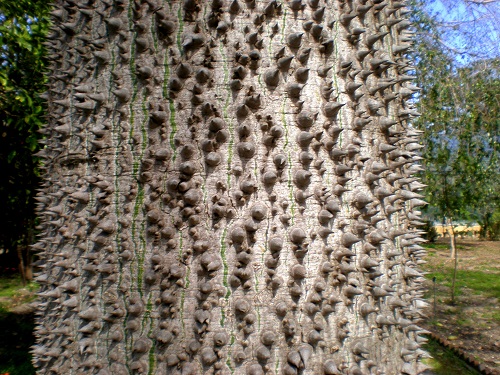
As for the topology, which stays the same for the rather puzzling sequel to Piero's explanation (the chase of prodigals pictured above), although Dante talks about Piero being a 'great thornbush' ('gran pruno') in Line 32, he has earlier described 'not green leaves, but dark in colour, not smooth branches but knotted and twisted no fruit was there, but thorns with poison', which gives me licence to think of those terrifying thorny giants from Brazil which are to be found in abundance in Palermo's amazing Botanical Gardens. Any excuse to wheel out three specimens I snapped on our first visit:


I find fascinating the link between these mortal trees and the metamorphoses of antiquity; Dr. Scafi cited Daphne and the three sisters of Phaeton, while Dante seems to invoke Virgil's tree-bound Polydorus whom Aeneas discovers transformed in Thrace. My question was whether Dante was doing something completely new in giving his trees the voices of former humans - again, not figures within the wood, but the wood itself? Yes, came the answer, as with so much else, he has transformed the original transformations.


I expected to find something sweeter in the Bach cantata for Septuagesima Sunday, BWV 144, which takes its title from Matthew 20. 14 - 'Nimm, was dein ist, unde gehe hin' ('take what is yours, and go your way'), from the Parable of the Workers in the Vineyard. But all is austerity here. The men plunge in without preface in the opening chorus, a short fugal elaboration with multiple repetitions of 'gehe hin'; the alto air is wonderfully severe, with its low, rich pulsing strings. Rilling and that superb contralto Helen Watts conjure the necessary grandeur here.


There's some softening with the two chorales, but even the soprano solo (Auger again) is in the minor, with spare support from oboe d'amore and bassoon.  A short but far from conventional cantata for the Leipzig choristers in 1724 to get through quickly before the winter cold inside the Thomaskirche froze them to the spot.

It's such a rich time, with this weekly Bach and Dante running alongside my Monday classes on another work of inexhaustible riches, Wagner's Das Rheingold. Our only genius of the stage Richard Jones returned this week to talk about his Ring, as well as his recent Royal Opera production of La bohème, and he was more relaxed and funnier than ever. Maybe more on that anon; but suffice it to say that once we've left Wagner's 'preliminary evening' behind, we'll be moving on to another strange masterpiece, Janáček's From the House of the Dead, so the revelations should keep on coming.

Wednesday, 17 January 2018

BWV 3


Having got the long-festering cri de coeur of the previous entry off my chest (forgive the mixed topography), let's turn the water into wine by backtracking (or Bachtracking) to Wedding at Cana day (detail above from Duccio; below, Tintoretto's version). Last Sunday's Bach cantata looks from the numbering like it might be an early one, but it continues the strain I've been finding especially wonderful in the new works for the Leipzig year of 1725.

Like BWVs 123 and 124, for Epiphany and the first Sunday thereafter, 'Ach Gott, wie manches Herzeleid' begins with  a choral movements offering heavenly roles for oboe(s) d'amore. And maybe it's only because I heard this one recently that I think it the most amazing of all. Maze-y, too; though the cantus firmus of the basses is doubled with trombone, what goes on above and around includes some of Bach's most giddying harmonic progressions. I'd call it gorgeous and sensual, though it's essentially there to underline the 'deep affliction' and 'sorrow' out of which mankind must struggle. Nevertheless the key is that bright A major which will return in the duet of soprano and alto before the final chorale (Gardiner calls that the 'most winning music' of the cantata, but I disagree again - it's chaste compared to the opening number, for all the dancing vigour of a typical upper-voices duet, and the oboes d'amore double the violin line).


The water which must be turned into wine - Bach doesn't even make a passing reference in this cantata for the day of the Cana reading - is there, in complex form, in the recitatives and the bass aria, deliberately uneasy in its writing, with plenty of minor seconds and accents on 'angst' and 'pein'. It's so beautifully negotiated by the finest bass-baritone on Rilling's set, Philippe Huttenlocher, whom I also remember as an excellent Papageno. Though I'm equally happy to visit Gardiner's set now for Gerald Finley.


More revolutionary, if not necessarily greater, is another No. 3, Beethoven's 'Eroica' Symphony. I joke with my young pal Jonathan Bloxham that I'm collecting his Beethoven cycle; 6 and 7 he conducted with shining graduates, while this excellent concert in the beautifully situated church of St Mary-at-Hill down Lovat Lane close to the Monument was with the hard-working mostly amateur players of the Hertfordshire Chamber Orchestra.


Still, he got the same energy levels, powerful accents - those repeated chords in the first movement I've never found more impressive -  and some fine phrasing, while the general approach is one I like best, fast-moving but never rushed. What's interesting is where the challenges lie for amateurs - all those pattery string notes in the scherzo, the constant chatter of the finale, which meant the first half of the symphony, the 'heroic' side, was better than the second. But it was all good.


Fabulous, too, to hear Jonathan as cellist-conductor duetting with his confrere at the Yehudi Menuhin School and the Guildhall Michael Petrov in Vivaldi's G minor Concerto for two cellos (amazing finale, sounds like syncopated Elgar). Michael, who came here from Bulgaria as a teenager and seems to me to have unaccented English, has a natural projection and golden sound which bode well for his appearance at what may be the last Europe Day Concert on 9 May - Bulgaria has just taken up the Presidency of the European Council (and the first and third photos were taken by Jonathan's assistant Dorian Todorov, another Bulgarian and forging a parallel career as conductor). Full steam ahead now.


Brilliant Bulgarians marked the new Presidency of the European Council, also at St John's Smith Square, on 9 January.  Mastery in any sphere is to be applauded, and though I'm not sure I would sit through more than about 45 minutes of a jazz duo like the Wladigeroff Brothers, I found the sound if not always the substance (the compositions were mostly theirs) compelling - not least because St John's, from the back row at least, turns out to be a fabulous acoustic not just for piano but also trumpet.


Scions of a distinguished composing family - grandfather Pancho is a big figure in Bulgaria - Alexander and Konstantin aren't just brothers; they're identical twins, and the statement that music in their blood isn't just an empty cliche. There were some stunning novelty moments; Alexander at several points played two trumpets at once, in Roma-style thirds (pictured above in the second of three photos by Jamie Smith). The range of 'horns', too, made for some surprising changes of timbre, along with some splendid forays into 5/4 and 7/8 time.


Even so, it was just as well that they were offset by the London Bulgarian Choir. An amateur group, its women have been trained by the vivacious Dessislava Stefanova to sing in that open manner familiar in many eastern folk choirs (I missed the throat singing at the beginning). Brave of them and the Wladigeroff Brothers to try their own, poppy version of the Ode to Joy sung in three languages, but the musical highlight of European co-operation for me was one on film, Swiss animation brilliantly timed to a very lively number.


Meanwhile, BWV 3 seems to be one of the few from the Rilling cantatas series on YouTube. I see from the last time I tried to embed performances that many eventually vanish. And I do recommend that you buy the big 71-CD box. But this will show you why I like the interpretations so much.

Saturday, 6 January 2018

Three Kings, Three Rhinemaidens

Epiphany today brings Casper, Balthazar and Melchior, though not in the Bach cantata for the day (but here they are in Dürer's Adoration of the Magi anyway),


while on Monday in the first of this term's Opera in Depth course classes we embark on a four-year journey through Wagner's Ring, starting in the depths of the Rhine with Woglinde, Wellgunde and Flosshilde (pictured here by Arthur Rackham teasing Alberich).


Cantata first. This time in 2013, on my first attempted Bach cantatas journey, it was the resplendent BWV 65, 'Sie werden aus Saba alle kommen', decking out the arrival of the kings with the panoply of strings, two oboes, two oboi da caccia and two recorders. Clearly Bach wanted to do something completely different for the following year in Leipzig, 1725. BWV 123, 'Liebster Immanuel, Herzog der Frommen' continues at its heart two deeply expressive arias - as in BWV 65, also for tenor and bass. The tenor's expressively emphatic  refusal to be daunted by the 'cruel journey of the cross' is  underlined by two oboi d'amore (such a different sound from the caccia variety, for inwardness, of course).


I don't for once buy John Eliot Gardiner's description of the bass's 'Lass, o Welt, mich aus Verachtung' as 'one of the loneliest arias Bach ever wrote' - how can it be when the flute hovers above the voice and the continuo line, and the major key prevails? Admittedly the text of the outer sections is bleak, and there's a plaintive cadenza in one of the settings of the word 'Einsamkeit', 'loneliness'. The opening chorus is in the dominating minor, but in a lilting 9/8 with pastoral trills and grace notes for the wind, and the concluding chorale, in another flowing metre, ends piano. Another treasure at the highest level.

So looking forward to my second Ring journey in the 28 years I've been taking an opera appreciation course. Our Rheingold half of term - the second half is devoted to Janacek's From the House of the Dead to tie in with the new Royal Opera production, now conducted by regular Opera in Depth visitor Mark Wigglesworth - links with Vladimir Jurowski's four-year adventure at the Royal Festival Hall. Das Rheingold is on 27 January; predictably, tickets are like gold dust. Singing Alberich for the first time is Robert Hayward, who came to the Frontline Club at the end of last term to talk to us not only about his Wagner roles but also - since we had just brought it to an end after five weeks which confirmed for me that it's even more astounding than I used to think - about Musorgsky's Khovanshchina.


Last autumn Robert sang the role of Ivan Khovansky in the revival of David Poutney's Welsh National Opera production (pictured above by Clive Barda for WNO shortly before the prince-in-decline is assassinated. He was also very nearly in the superlative Prom performance conducted, and never better, by Semyon Bychkov).

Robert also portrayed the Walküre Wotan in Opera North's semi-staged Ring, as involved and moving a performance of that killer role as any I've seen.


He says it will be interesting to find the humanity in Alberich, as he has also done with Ivan Khovansky and Scarpia, a role which he says could happily sing in three runs a year for total contentment.

Here he is with me at the Frontline - should have got a student to snap us spontaneously while we were in conversation. But you get the idea, that he's a very affable, modest and down-to-earth person. Extraordinary that he started out as a counter-tenor - he is going lower, which is to say higher, by the year.


You can see him in the Barbican performance of Bartok's Bluebeard's Castle with Rinat Shaham and the National Youth Orchestra conducted by Mark Elder tomorrow night. Here's what Robert Beale thought of yesterday evening's Manchester performance on The Arts Desk. Meanwhile, if you're willing or able to come to this term's Opera in Depth, just leave me a message here with your email - I won't publish it but I promise to respond. Further details here in The Wagnerian (my own flyer is rather different).


UPDATE (7/01) - the first Sunday after Epiphany, its subject Christ lost and found by his parents in the temple (cue another Dürer above) follows directly on its heels this year, so here we are with the next in line to the one which moved me so much - the (by contrast) three-quarters bright BWV 124, 'Meinen Jesum laß ich nicht' (it was performed on 7 January in 1725, too). I find it intriguing that Bach should carry over one oboe d'amore from BWV 123, because the context is wholly joyful this time - you'd have thought he'd want a straight oboe, but maybe this exquisite variety creates an extra sense of intimacy against the horn-doubled cantus firmus of the opening chorus (Rilling's oboists, as I've already mentioned, are superlative). The pain comes in the tenor's 'Und wenn der harte Todesschlag', so very operatic with the jabbing repeated notes of the strings to which the oboe d'amore and the voice respond. Operatic, too, is the bass recitative, with its chromatics and it run on the word 'Lauf'. The soprano/alto duet which follows is sheer dancing delight, albeit with only continuo complement. Delicious, of course, from Arleen Auger and Helen Watts - what a joy these soloists are on the Rilling set.

Thursday, 4 January 2018

Ending and beginning with Bach


This year's attempt to play a Bach cantata on every appropriate Sunday and holy day of the year stands a better chance of lasting than my 2013 attempt, which fizzled out at Easter because I hadn't ordered up the right CDs in time (I could have done it via YouTube, but I was too sound- and performance-fussy). With the Hänssler box of Rilling's Bachakademie Edition to hand, and a good online guide to what cantatas should be heard/performed when, I'm all set. I describe how I came round to Rilling, with his superb team of soloists led by Arleen Auger, a choir projecting the meaning of the German texts and various magnificent oboes, in a feature on The Arts Desk.


Properly the listening should have begun at advent, but I started with the perfect aria, "Bereitet die Wege, bereitet die Bahn", launching BWV 132, from Auger with oboe obbligato, the day before Christmas Day, and then followed the seasonal route with individual cantatas rather than those making up the Christmas Oratorio. I've made due notes, but should start here by observing the latest two beauties, BWV 28 "Gottlob! Nun geht des Jahren Ende" on New Year's Eve and BWV 171, "Gott, wie dein Name, so ist auch dein Ruhm", which we listened to on Jill's Bose up in Southrepps on New Year's Day, aka the Feast of the Circumcision or Snip Day. Apologies if in the ensuing I don't dwell much on the text - I shall when Bach illuminates the words in a special way.


Again, Auger led the way, heralded by striking figures from two oboes and oboe da caccia in harmony, in BWV 28, composed in Bach's third year at Leipzig for the end of 1725. There's a double whammy of glory here - the ensuing motet treatment of a chorale is one of Bach's most giddying contrapuntal inspirations, and Gardiner had it performed at the very end of his 2000 Bach Pilgrimage. A tenor recit is haloed by strings and leads to a dancing duet; the final chorale is enhanced by brass (cornet and three trombones).


BWV 171 comes after the three Leipzig cycles and was first performed on New Year's Day 1729. The opening choral fugue starts in old-fashioned style, but the entry of the first trumpet with the theme is a real wake-up call. In Gardiner's words, 'the music suddenly acquires a new lustre and seems propelled forwards to a different era for this assertion of God's all-encompassing dominion and power'. Violin obbligati enrich the tenor and soprano arias (the latter adapted from a number in a secular cantata where the instrument illustrates a 'gentle wind'), while there's typical originality from Bach in the bass's arioso-recitative, with striking illumination from the two oboes. As in BWV 28, but even more strikingly, the brass adds glory to the final chorale.


The above photos of Leipzig's Thomaskirche were taken on what turned out to be a wonderful trip just before Christmas, ostensibly to see and write about the Blüthner Piano Factory - it was enlightening, and write I shall anon - but which opened up to embrace two performances at the Opera (already described lower down the blog) and an afternoon/evening at large in the centre of town.


I won't deny that I got pleasantly teary sitting as near as I could to Bach's grave in the Thomaskirche chancel. His bones had been dug up from the cemetery of the Johanniskirche, placed inside the church in 1900 and moved here following that church's destruction in World War Two in 1949 (it is perhaps even more shocking that the Soviets dynamited the University Church, where Bach was director of holiday services, as late as 1968).


At last I completed the journey which had begun with the unforgettable performance of the B minor Mass by Collegium 1704 around the font where Bach was baptised in Eisenach.


So much has happened to honour Bach in the last few decades. The Nikolaikirche was stripped of the Baroque refurbishing which the composer would have known during his tenure in the 1880s; further re-Gothicization, returning the 'hall' church to how it looked in 1496, took place in the early 1960s. But the biggest restoration took place in time for the 250th anniversary of Bach's death on 28 July 2000. Much of the funding for this and other projects has come from the Thomaskirche-Bach 2000 Assocation, and it's heartening to see the list of names involved in the state-of-the-art Bach Museum opposite the church.


The Bachs lived in the old St Thomas School, which no longer survives, but this house at Thomaskirchof 16 was the residence of their good friends the Boses, a merchant family which had the 16th century building refurbished in Baroque style. The beautifully designed museum rooms are mostly geared towards education about the essence of Bach's music and his life, with plenty of listening posts, but they do include a chest which was identified as late as 2009 as coming from Bach's household (thanks to a seal)


and the restored organ console from the destroyed Johanneskirche at which Bach played in 1743.


There's a nicely displayed room of musical instruments to complement the ones to be seen in the Thomaskirche, including this handsome viola d'amore.


Holiest of holies, though, in the 'Treasure Room' is a magnificent bequest, by far the more brilliant of the only two portraits of Bach painted in his lifetime by Leipzig artist Elias Gottlob Haussmann in 174 and showing Bach holding a score entitled ‘Canon triplex à 6 Voc: per J. S. Bach’. It was bequeathed to the Leipzig Bach Archive by American musicologist and philanthropist William H Scheide, who died last November aged 101 (the other work, far duller, is in the main city museum, which I didn't have time to visit).


This is manuscript heaven, too. The full autograph score and the individual parts of the Cantata BWV 20, 'O Ewigkeit, du Donnerwort', can be seen in the museum together for the first time ever. The former is in a superb little exhibition on Bach and Luther, finishing on 28 January, which also includes a grand Luther Bible with Bach's name inscribed in his own hand. 

I left the Museum after dark, though there was abundant life in town as the Leipzigers flocked to the stalls of the Christmas Market, which spreads outwards along most streets from the central Markt. And I did just manage to see the outlandish interior of the Nikolaikirche, redone long after Bach was master there, between 1784 and 1797, in neo-classical style by J F C Dauthe. The palm columns are something else.


Handsome as it unquestionably is from the exterior, the Nikolaikirche is celebrated now as the peaceful source of protests which led to the fall of the East German regime in Autumn 1989. The Rev. C Führer's description of those events in the green pamphlet is movingly phrased, especially as it heads towards the quiet denouement of 7 October:

...the prayers for peace took place in unbelievable calm and concentration. Shortly before the end, before the Bishop gave his blessing, appeals by Professor Masur, chief conductor of the Gewandhaus Orchestra, and others who supported our call for non-violence, were read out. The solidarity between church, art, music and the gospel was of importance in the threatening situation of those days.

The prayers for peace ended with the Bishop's blessing and the urgent call for non-violence. More than 2,000 people leaving the church were welcomed by tens of thousands waiting outside with candles in their hands - an unforgettable moment. Two hands are necessary to carry a candle and to protect it from extinguishing so that you cannot carry stones or clubs at the same time. The miracle occurred.