Thursday, 8 April 2010

Sibelius at home V: instruments


This is the last entry on Ainola, I promise. And it might seem to be a bit of an empty shell, like the violin case above. It's precious in itself, because it housed the instrument of the musician who declared he was 'too nervous to be a really good player'. I hope I'm right in saying that Sibelius kept with him the Steiner violin passed on by his Uncle Pehr, and that he passed it on to a granddaughter who still plays and teaches in Parma (correct me, Hilkka, if I misremembered; I should have brought out my notebook).


There is, however, one very beautiful instrument in the same upstairs room where odds and ends are housed, by and large away from the prying eyes of regular visitors to Ainola: a 38-string kantele on its own matching table, given to Sibelius in 1950 by a local craftsman. It's of handsome design and sonority.


The more primitive, five-string variety was, of course, essential in folk music, and Sibelius was certainly inspired by it when he went out hunting down runic songs and listening to the singer Larin Paraske, whose song-range would seem to correspond to the five notes of the folk instrument. Only the evocative name of the kantele is truly unique to the Finns - the Persians have their santoor, the Austrians the zither, the Russians the comparable gusli - but nevertheless its revival has been quite extraordinary, incorporated into popular music and very popular with the young. I won't claim any great musical revelation about this clip of Finnish schoolchildren, but it does tie in nicely with the country's amazing musical education programme.


And here's a Japanese exponent, Mitsuko Sato, playing the famous patriotic song at the heart of Finlandia:


I could go on; YouTube is the most extraordinary medium for leading you from one thing to another. Little did I imagine I'd end up hearing one Peter Pringle playing the electric kantele, theremin and even accompanying himself on the hurdy-gurdy in stanzas from Beowulf...rich pickings indeed.

Wednesday, 7 April 2010

Orieltown


Erkerstadt or 'town of oriel windows' has long been the well-deserved nickname of Schaffhausen, thanks to the 170-odd adornments the good burghers had built to show their wealth in Renaissance times. Lottie and I hadn't intended to spend so much time there on her day off from duties at the Zurich Opera and the last of my visit: a short wander, perhaps, lunch and then on to the celebrated river falls downstream at Stein-am-Rhein.

In fact we were captivated. A good lunch certainly helped: we chose a winner down near the Schwabentor by virtue of a table in the hazy March sun: the SchuetzenStube, a restaurant popular with the locals which has a small theatre inside. It's run by two delightful ladies, Annegreth Eggenberg and Anita Schwegler, who've been together for twenty years. 'As business partners?' asked Lot. 'Business - and family' one replied, affectionately pinching the other's cheek. You see, we may abhor Switzerland for its minaret-banning and suchlike insularity, but in other ways it can be surprisingly tolerant (horrid word) and bordertown Schaffhausen is a good example of integration, host to a large Sri Lankan community. Just how well integrated, though, I couldn't say.

Anyway, it was after this that we began to examine the oriel windows more closely. Two of the finest houses are on Vorstadt: the Grossen Kafig at No. 43, with a mural of Tamerlane's triumphal procession


and the 1608 decoration of Zum Ochsen at No. 17. The ladies on the oriel window depict the five senses with mirror, glove, flower, musical instrument and cake.


Rococo elaboration adorns Zum Steinbock round the corner at Oberstadt 16.


The most famous Renaissance fresco north of the Alps, we're told, is that of Zum Ritter, with knightly virtues on display including Odysseus's constancy in the Land of the Lotus Eaters.


Alas, though, this isn't the 1570 original, which is in the local museum, but a 1930s copy. Our route then took us round the corner to the Munster, with more handsome oriel-windowed houses up the slope opposite.


Even some of the less elaborate oriels have the charm of a dragon waterspout or two aloft: was there a citizen-craftsman who specialised in these, I wonder?


The Munster precincts include a neat herb-garden, favoured by a couple of resting citizens basking in the afternoon sun, and a grand Romanesque-Gothic cloister with spring flowers emerging in its pretty garden.


I'd like to have lingered longer, but there was a flight to catch later in the afternoon, so we hastened on to the Rhine falls and then back to Zurich. And I've finally done my willing duty by the Lucerne Easter Festival and written up some of the best concerts ever in my Arts Desk letter from Lucerne. So let's end by coming back up to date with Jean Nouvel's KKL Luzern.

Tuesday, 6 April 2010

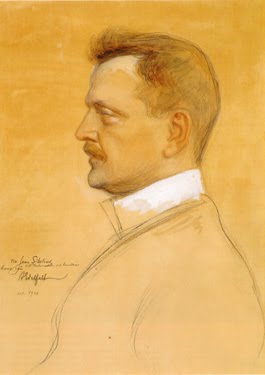
Sibelius at home IV: portraits


In addition to John Munsterhjelm's 1909 bronze of the composer - into which Sibelius inserted a lucky horseshoe - two of the most important portraits are to be found at Ainola. One faces you on the other side of the window to the bust as you enter the drawing room.


This is Albert Edelfeldt's study, made in 1904 as a preparatory sketch for his three-part mural in the University of Helsinki's main auditorium. I had a feeling I might get to see it on my much-anticipated visit to hear the Helsinki Philharmonic that evening. The deplorable situation with the main Finlandia Concert Hall means that either of the city's two main orchestras can be ousted if a more lucrative conference booking so decrees, and that's what happened on Thursday evening - with the result that, owing to the subscription sales outstripping the seating facilities at the university, I was told a ticket at the smaller venue would be very hard to come by. And this for a programme of Walton and Hindemith you'd be lucky to get half an audience for in London.

Anyway, I did get in, and as it turned out there were plenty of empty seats owing to the subscribers' prerogative of turning up or not (the still very large audience, though, proved a healthy mix, attentive and enthusiastic). I had the huge pleasure of top Finnish designer (and very modest gentleman) Markku Piri's company, and he took me down from our balcony seats to look at the main hall in the interval. I think that, for all his knowledge, he was rather surprised to find that Sibelius did indeed feature in the mural. There he is in the procession of figures in 17th century dress leading the Turku University inauguration, just behind Governor Per Brahe.


Forgive the pointillist overlay, but I couldn't find any better image than my own on the web. Here's a more professional shot of the handsome neoclassical hall.


It's a rather small venue for a large symphony orchestra, and there was nowhere for the Helsinki Phil players to hide from the audience. Not that they needed to: John Storgards did a splendid job with a brilliant programme, three-quarters of which I've never heard in a UK concert. First half started with Walton's Spitfire Prelude and Fugue, followed by the Hindemith Cello Concerto, its cheeky march-finale anticipating the pleasures of the more familiar Weber Metamorphoses. Spot-on Torlef Thedeen formed a true concerto partnership with this lively team (characterful principal clarinet, later first flautist and oboist, had a very individual sound). After the interval, the orchestration of Walton's Hindemith Variations, its theme derived from the slow movement of the Concerto, was pure sleek pleasure, an altogether trickier fugue to cap it all followed by a decadent slow fade. I told Markku he was in for a treat with the Turandot March of the Hindemith Variations; sure enough, he smiled and even laughed at the jazzy bit. Lots to think about, he said at the end, and so there was.

One notorious artistic glimpse of Sibelius at large in Helsinki I didn't get to see: while I've already noted the surprise of Gallen-Kallela's triptych, his celebrated take on a drinking 'symposium' at the happening Kamp Hotel was, we were told by the hotel's reception, locked in a safe. Yet there seems to be a version at the Gosta Serlachius Foundation.


No prizes for guessing why the depiction of Sibelius on the right gave him a bad name, and almost led the Jarvenpaa worthies to refuse him the land at Ainola (the other reprobates, left to right, are the artist, Merikanto and Kajanus). Another drinking bout may be the reason why Aino looks so weary in this marvellous portrait by her brother Eero Jarnefelt, hanging to the left of the Ainola dining-room entrance.


Only someone close, I reckon, could have caught that look - it reminded me of something similar in Thomas Eakins's study of his embittered wife. But I don't think Aino was embittered long-term. She looks rather jolly in some later photographs; Sibelius rarely, but there is just one equivalent to 'Garbo laughs', which seems like a good way to end this penultimate instalment about the house.

Saturday, 3 April 2010

Interstitial


Without quite understanding why or necessarily believing, I always find the space between Good Friday and Easter Sunday the best limbo of the year – a time full of leisurely possibilities. The crucifixes and reliquaries remain shrouded in purple, like the one above at the Hofkirche of St Leodegar in Lucerne when I visited it less than a fortnight ago, feeling deliciously suspended between concerts and away from the Easter Festival hurly-burly. In fact that Christ crucified on the elaborate choir screen, as I saw from what my postcard told me, boasts real hair (‘mit echten Haaren’, hmm, creepy).


Of unequivocal splendour, on the other hand, is the pair of silver and parcel-gilt gates thought to have been presented by Catherine the Great around 1784 to the Monastery of the Caves in Kiev, now in the Gilbert Collection so opulently housed on the first floor of the Victoria and Albert Museum.

The gates have had a more profane recent life, if you can call it that, glimmering in Randolph Hearst’s Citizen Kane mansion and then in the California swimming pool of the equally wealthy Sir Arthur Gilbert. But they would, of course, have stood at the centre of the iconostasis, to be flung open at the climax of the Eucharist. If I’ve understood this right, their parting would play an even more dramatic part at the end of the all-night vigil to the cries of ‘Christos voskreseniye’ – ‘Christ is arisen’. The top two panels illustrate the annunciation and Christ’s entry into Jerusalem


while beneath are the four evangelists.


Here’s a little more detail of St Mark with his lion.


I think at this suspended time of year especially of quite a few friends and acquaintances who are suffering terrible, in several cases terminal illnesses. Been listening, of course, to devotional Bach, but in a secular context what touched me no less were the once so golden tones of Anthony Rolfe Johnson accompanied by Graham Johnson in Poulenc’s painfully sensitive setting of Apollinaire’s ‘Bleuet’, a poem from the trenches.


Since no translation is given above, and it’s essential, I provide it here, unpunctuated like the original French:

Young man
Of twenty
You who have seen such terrible things
What do you think of the men from your childhood
You know what bravery is and cunning
You have faced death more than a hundred times
You do not know what life is
Hand down your fearlessness
To those who shall come
After you
Young man
You are joyous your memory is steeped in blood
Your soul is red also
With joy
You have absorbed the life of those who died beside you
You are resolute
It is 1700 hours and you would know
How to die
If not better than your elders
At least with great piety
For you are better acquainted with death than life
O sweetness of bygone days
Slow moving
beyond all memory.

Friday, 2 April 2010

Sibelius at home III: tributes


The gramophone collection at Ainola is mostly a comprehensive collection of Sibelius's own music, in test pressings and finished 78s. Possibly all the outsiders were unsolicited gifts, which is maybe why the library of scores gives us a better idea of his extra-Finnish tastes. The middle-period Vaughan Williams symphonies, for instance, are all there, complementing the above gift - pictured above left - from the British Council of the masterly Sixth (VW dedicated his rather less eventful Fifth to Sibelius; I always think it should be heard between 4 and 6, just as the last three Sibelius symphonies can be played together).

On the right above is the first test disc of two signed by Eugene Ormandy and all the players of the Philadelphia Orchestra in 1951 of their recording of 'The Swan of Tuonela' from the Lemminkainen Suite (in which Ormandy excelled, and to which he returned for EMI in later life).

I was especially curious to hear a pressing or two, especially some Leeds Festival discs of The Tempest music - were these simply forerunners, I wonder, of Beecham's wonderful recording? - but curator Hilkka Helminen didn't quite trust the needle of Sibelius's trusty but possibly rusty radiogram.


Picking up on my Russian connections, Hilkka also showed me a real treasure - a beautifully bound homage from the Union of Soviet Composers to Sibelius on his 80th birthday. Of course I nearly gasped with astonishment to see that my main man had written the opening theme of his newly-composed Fifth Symphony in his entry


and that Shostakovich, with a few words of respectful birthday greetings, proferred the finale of his Ninth


both of them reminding us of the symphony's continuing vitality as a form in 1945, long after Sibelius had officially given up on it. Hilkka also told me that Vladimir Jurowski, visiting Ainola a couple of years ago, had been both moved and surprised to find a dedication in the same volume from his grandfather.

An apt footnote, while we're on the subject of Sibelius on disc: I've only just learned that Danish conductor Ole Schmidt has died at the age of 81.


I've heard precious few of Schmidt's recordings but I became addicted to his Sibelius Five with the RPO when it was reissued on the bargain Regis label and was listening to it only a couple of days ago. His style is bracing - clear and bright, no chiaroscuro - and I was quite taken aback by the anguished peak of his 'Swan of Tuonela'. Unlike Vanska, whose Sibelius I found so disappointing live, Schmidt seems to know when and how to unleash the big climaxes - no easy task in the opening composite-movement of the revised Fifth.

Thursday, 1 April 2010

No fooling with Maurice


When friends Lars and Jan bought tickets for a pub-theatre adaptation of E M Forster's coming-out classic - J's battered but treasured old paperback copy, not long after publication, is illustrated above - I was wary. Some of the worst productions I've ever seen have been above or below the bar: sub-student Genet at the White Bear in Kennington, some nightmare the name of which I forget at our local, the Curtain's Up, in which Nazis stagily pondered the Final Solution in a dank basement (Sara Kestelman was in it, for the playwright's sake, and did her charismatic best to dignify the whole farrago). At least the latter was where we first met our now great muse and Djenne Djenno doyenne Sophie Sarin, having been asked to take her to something to cheer her up at the time. Well, we laughed, but for the wrong reasons.

Pleasantly surprised, then, by our visit to the Stag in Victoria, though, and at times amazed. Roger Parsley and Andy Graham had taken all the significant one-to-ones from the novel and, not stinting on the intellectual name-dropping, given them space to breathe. So, for a start, there was naturalistic dialogue for the actors to get their teeth into. Which they did with varying success; but there could be no doubt about Adam Lilley's hero. A bit of an everyman, by no means unattractive, this Maurice grew convincingly from wide-eyed schoolboy to priggish student to real man.


He had some fine actors to spark off. Not so much Rob Stott's Durham (pictured left above - all production photos by Derek Drescher), who looked the intellectual-nervous type but didn't quite sound it, though he cried convincingly; oddly, the scenes with Persia Lawson's very touching sister Ada had more fire.


There were two consummate cameos from Jonathan Hansler, giving the audience confidence in the start and popping up as the soft-spoken hypnotist Mr Lasker Jones who gets the most famous line ('England has always been disinclined to accept human nature').


And the Scudder did not let us down, unless you're fixated on Rupert Graves's cute young thing in the Merchant-Ivory film (I'm not). Bright-eyed and responsive, fight man Stevie Raine's gamekeeper seemed plausible enough on first acquaintance


and in a sweet bed scene, rather less raunchy than I suspect the Above the Stag Theatre regulars are accustomed to seeing.


Intelligent use of music, practical costuming and adaptable lighting in Tim McArthur's seamless production added to the pleasure of the close-up experience, though if this Maurice transfers - and I hope it will - it'll need a better backdrop than the boarding-house walls. The show's been completely sold out and there aren't even any tickets left for the extended run, which ends on Saturday. I wish it a bright future, especially as these excellent actors can't have made much money even with full houses of 60 or so every night.

Had a bit of a shock last night, apropos of our Bedlam Theatre nostalgia trip. Remember how I apologised to director David Bannerman, wherever he might be, for dissing the second-week revue which helped us young things to bond in mirth agin him? Well, where he was last night was on the telly, being snapped at by Paxman on Newsnight as he spoke up for the risible UK Independence Party. So this one-time would-be man of the theatre and scriptwriter who back then sported a dodgy moustache is now one of those 'fruitcakes, loonies and closet racists', as even Cameron denounced them back in 2006; more than that, he's the right-hand man of Nigel Farage, so embarrassing in his recent European Parliament attack on the president of the EU Council. It's official, then: for the Edinburgh class of 1980-84 Bannerman (who's added 'Campbell' to his surname thanks to a distant connection with the more famous liberal) IS Widmerpool from Anthony Powell's Dance to the Music of Time.

On which note, and by no means unconnected to the English prejudices exposed in Maurice, let me leave you with a gem, Dan and Dan's 'Daily Mail song'. You'll need to go over to YouTube to see 'both' Dans, but the essential visuals are leftscreen. Enjoy.

Wednesday, 31 March 2010

Sibelius at home II: swan songs


This atmospheric gouache on paper by Lennart Segerstrale hangs above the entrance to the Ainola dining room. It has a special meaning for curator Hilkka Helminen, who always watches out for the migrating swans flying south in the autumn and back to the lake near Jarvenpaa in the spring; in fact several of her neighbours had reported isolated sightings, but in the protracted winter those had up to now been few and far between. One recent development has been that the migratory paths are now almost exclusively over Finland, and not Russia, because the fields lie fallow there.


That the swans, and the singing variety especially (the laulujoutsen), were of profound significance for Sibelius can be heard in his music and read in his diaries. There are two crucial entries as he worked on the Fifth Symphony in April 1915:

[21 April] Just before ten-to-eleven saw sixteen swans. One of the greatest experiences in life. Oh God, what beauty: they circled over me for a long time. Disappeared into the hazy sun like a silver ribbon, which glittered from time to time. Their cries were of the same woodwind timbre as the cranes but without any tremolo. The swans are closer to trumpets, though there is an element of the sarrusophone. A low suppressed memory of a small child's cry [probably a reference to his daughter Kirsti, who died in infancy]. Nature's mystery and life's melancholy. The Fifth Symphony's final theme.

[24 April] The swans are always in my thoughts and give life its lustre. It is curious that nothing in the whole world, be it art, literature or music, has anything like the same effect on me as these swans, cranes and wild geese. Their sound and their very being.

Hilkka reminded me that Einojuhani Rautavaara, a composer very much loved by her and many other Finns, incorporates recorded swansongs into the final movement of his Cantus Arcticus. The Italian posting on YouTube rather bizarrely calls it a 'concerto for birds', but I like it because of all the photos of swans in flight.

Tuesday, 30 March 2010

Swapping angels for balls...and sunflowers


Until I had a closer look at it with my BBC Symphony class, I'd been sad at the prespect of missing Friday's Barbican concert performance of Peter Eotvos's operatic Angels in America. I did somehow doubt that Tony Kushner's seven-hour millennial work of genius could be distilled into two hours of singing featuring less than ten per cent of the text. And I was right - though the big set pieces could have had really inspired treatment. The jangling celestials of the portentous angel conjured up by much-drugged HIV-positive Prior Walter, the trips taken by neglected Mormon wife Harper Pitt, scenes of love and tenderness in hard times; all these might work in more inspired hands. What I guess I most resented in what I watched - a really rather awful Chatelet production - was the proportion of cop-out spoken dialogue delivered over minimal mood music.

The students, an open-minded and diverse bunch, confirmed my doubts last Tuesday. I only had to show them fifteen of the opera's best minutes and then a stretch of Mike Nichols's masterly movie for them to wonder what they'd let themselves in for and whether it mightn't be better to stay at home with the DVD. Don't get me wrong: I'm delighted that such a hard-hitting subject has made the operatic stage. But after you've had Meryl, Em, Al Pacino giving the performance of a lifetime, the wondrous Jeffrey Wright and an unbeatable team of young actors scouring your soul, the opera does seem third best, stuffing in as much of the plot as possible when it could have been something completely different.

All this, anyway, is just preliminary to relating what I did see on Friday night at the Finnish National Opera. The Finns I'd met told me to expect a serious new slant on Verdi's Ballo in maschera from all-rounder director Vilppu Kiljunen. The idea of a Berlusconiesque Italian reality-TV setting isn't necessarily bad in principle. But it turned out to be a bit of a muddle, with confusion over what's supposed to be private and public in the drama, and, worse, Kiljunen didn't get the cast I saw to relate to each other. The ball was fabulously, gaudily costumed, and the lady string quintet shone, but Kiljunen desparately needed the kind of movement co-ordinator/choreographer we take for granted in the UK.

The men, apart from the house Sam and Tom, were disappointing, and that includes the erratic conductor, Alberto Hold-Garrido. A useful but hardly poetic Riccardo, Giorgio Cascarri, simply stood and delivered, though at least all the top notes were totally secure; Hannu Niemala's Renato had the right Verdi-baritone colour but belted, rarely phrased.

It was worth seeing, though, for the revelation of Chilean mezzo Isabel Vera, one-time Cardiff finalist and born to play Ulrica, Amneris, Azucena and Eboli.


Also very much the real Verdian thing is our Claire Rutter. She was pretty good when I saw her as Amelia in Bieito's diminishing-returns shock Masked Ball at the Coli. Now she has an absolutely secure spinto technique, ringing top and artistry with melismas, messa di voces, you name it. She didn't look great in power suits, it has to be said, and like the other singers was more or less left to her own devices, but the rapturous ovation she richly deserved shows that this isn't the famed Britcentricity so derided by La Cieca on Parterre (and it was good to hear her singing in Italian). Wouldn't mind hearing her as Brunnhilde in due time. Here she is in the 'Truth Time' section of 'Il Nido d'amore' with Niemala's Renato:


Anyway, the aria and duet in Act 2 caught fire, which was quite enough. And I'd already had my vision when charming press officer Heidi Almi took me to see a children's opera performed before parents and friends. I know from the Savonlinna premiere of Markus Fagerudd's Seven Dog Brothers how seriously Finns take these more-than-merely-educational projects. Auringonkukat (Sunflowers), composed by the prolific Atso Almila and led by repetiteur Kari Hänninen at the piano, used the life of Vincent Van Gogh to involve the children not just in some very hard to memorise, sometimes rhythmically complex choruses but also in issues around art and mental health.


It was all very responsible, unpatronising and musically memorable. I couldn't understand much of the Finnish, to say the least, but I did grasp that the children dressed in capes with Van Gogh's night picture on them played not only disapproving forces of society but also Vincent's dark side, repeating a haunting ostinato as he sinks in to depression. The ending, too, was far from blandly celebratory. The three adult singers involved proved immensely sympathetic, though I reckoned the Vincent in the cast I saw, Ville Salonen, was probably a baritone rather than a tenor. Company member Olli Tuovinen, playing Theo Van Gogh, had one of those Finnish oaky voices we all know and admire so much - surely he'll make an excellent Renato in time. Here he is with the other Vincent, Tero Harjuniemi (also pictured above), and the kids.


Finally, no visit to the Finnish Opera would be complete without an interval mustaherukkaleivos or blackcurrant pastry (if you think that's a mouthful - and of course it is, in reality - I reeled at a 27-letter Finnish word in the leader of a newspaper the man in front of me was reading on the plane. Which beats my favourite, the Russian for highly-qualified, which is viisokiqvalifikatsirovaniye).


My good friend Anneli, holding one of these sinful creations above in the first interval of Ballo, says she can't find them outside the hallowed sanctum of the opera house. A weird Google translation tells me that the mustaherukkaleivos consists of 'mustaherukkainen cream pastry, which tastes like lemon humidification' with 'blackcurrent jelly cakes on the surface'. Never mind, it tastes wonderful.