Thursday, 6 December 2012

From Bronze to Carmen


It was one of those embarrassingly rich London days, preceded by a convivial evening (drinks at the Garrick, the perfect meal at Terroirs). Our dear friend and terrific artist Ruth Addinall had come down from Edinburgh to see us and catch the Royal Academy’s Bronze exhibition before it closes on Sunday. So I took most of Tuesday off and accompanied her around town. The exhibition at  the RA and the opera at the Coliseum were our two mainstays, though the unplanned interludes turned out to be fun – Ruthie trying on trousers and jumpers, and I searching in vain for more bright blue moleskins, in Cording’s, and snatching a falafel in Gaby’s (reprieved, it seems, from its threatened demise).

Sculptor Jon Edgar, whom we've come to know through Ruth, joined us for the exhibition, and it was good to have his expert knowledge, though once past the first big room we went our separate ways. The keynote piece at the start would be worth the price of the admission alone. In the late 1990s, Sicilian fisherman dredged up first a leg and, a year later, the torso of what is known as the Dancing Satyr (though as Bryan Sewell points out, since the foot is not a goat’s hoof it is much more likely a human follower of Dionysus). It would be exciting to accept the attribution to Praxiteles and date it to the fourth century BC, though probably it's Hellenistic. The flowing-haired beauty is skilfully lit and comes alive in his celebration from every angle you look.


Follow that? Well, the first room did pretty well with the human figure, mixing up centuries and races with delicious abandon. A noble Roman towers over a Nigerian bowman. A stick-thin figure looks like a Giacometti; it turns out to be an Etruscan votive figure from the second century BC. The giant ensemble of Rustici’s John the Baptist preaching to a Levite and a Pharisee stands at the end of the room alongside a cast of Cellini’s Perseus, their monumentality gently mocked by Donatello’s tiny Putto with Tambourine.


To the left of the big saloon is a crystal-clear exposition of the process from wax model to treated bronze (I won’t attempt to précis the technique); to the right the exhibition continues with a slight diminishing of interest in the subject matter, from animals to functional objects, though the Etruscan Chimera of Arezzo is a fabulous sight


and it’s fun to have a Louise Bourgeois spider (IV)on the wall.


In between the feral animate and the inanimate is a room of group figures, again ranging from the monumental to a real miniature beauty, Riccio’s tender Satyr and Satyress. The scope expands to early wonders like the 14th century BC Chariot of the Sun from Denmark, Chola bronzes and Buddhist figures. Those look especially handsome in the Gods and Goddesses room, eastern ascetics sitting alongside elegant Renaissance divinities; en route, the reliefs section has Adriaen de Vries’s magnificent muscled blacksmiths at work in Vulcan’s forge.


The last room rises to the heights again with heads of all ages. I’m at one with Ruth and J in adoring the Ife brass Head with Crown, its fascination compounded by striated lines down the face.


Hard to say which object to take away, this or the Dancing Satyr – probably the latter,  if I’m to be true to myself and let an ideal of male beauty take the palm.


So onwards, eventually, to the Coli. Calixto Bieito’s production of Carmen, which had quite a few attractive masculine torsos on show, arrives at English National Opera bronzed and polished after ten years doing the rounds. I enjoyed it far, far more than I expected after the aimless shenanigans of his Don Giovanni – I was bored rather than shocked by the mess he made of the Act One Finale – and his Ballo in maschera, which started well but suffered from the law of diminishing returns in its random sexual violence. There was probably too much not terribly convincing prodding and fondling in the first half of this Carmen, a few non-readable ideas (the man in white at the start, for instance – fateful controller? He turned out to be Lillas Pastia, king of the gypsies, but I wouldn’t have known that without reading the programme). Nor was Bieito's avowed period, Franco's Spain in the late 1970s, evoked by the action as far as I could see.


Acts Three and Four, though, were much the best I’ve seen in the opera house (Ruxandra Donose as Carmen and Adam Diegel as Don José in both the above pictures). The five Mercedes – six, as has been often pointed out, if you include Carmen’s girl-friend and add the French accents – were terrific props to animate a scene where all you normally get is brooding gypsies hunkering on a dimly lit stage. And the silhouette bull sign looked good at the back of Alfons Flores’s often unencumbered arena (huge variety of lighting, too, from Bruno Poet).

The act also contained the two musical highlights: Donose, possessed of a beautiful if not tonally very varied mezzo instrument she takes some time to engage, rose to the most dignified Card Scene aria I’ve heard. Then there was Elizabeth Llewellyn’s powerful Micaela, hints of Leontyne Price honey at the top of the voice. Shame her characterization was ill defined by Bieito – first she’s too forward with José in Act One, then too timid, and the fuck-you gesture to Carmen as she goes off with him to the supposedly dying mother didn’t work.

Musically, there was good co-ordination between soloists, chorus and orchestra. On Tuesday night the conductor was ENO Head of Music Martin Fitzpatrick. I’d hazard a guess that he pulled out more stops than Ryan Wigglesworth, responsible for the worst conducted concert I’ve heard in a long time (a couple of years back with the BBC Symphony Orchestra). But the less accomplished of the two Wigglesworths – no way to be confused with the masterly Mark – may have improved since then.


Hunky Duncan Rock’s Corporal Morales (pictured above with the fabulous Llewellyn) and Leigh Melrose’s slightly seedy bullfighter Escamillo should probably have swapped roles, since Rock’s voice is more ample; but Melrose is an excellent musician and played with the phrases rather well. American tenor Diegel as Don José has a slightly nervy, raw sound which came into its own for the nailbiting final duet, though before that he sang flat too often for comfort and didn't unbend enough for the physical violence. Promising sounds came from the Mercédès, mezzo Madeleine Shaw. As with Bronze, Sunday is the last day to catch the show, though no doubt it will be back for a good many seasons: I'm glad that ENO has at last hit on a lively production for a core component of its more pack-em-in rep.


My apprehension about going to see it at all was based on how spoiled we’d been throughout the seven glorious Opera in Focus classes we spent on Carmen at the City Lit. It’s a hell of a role to pitch at the right level between sex and dignity. On disc the voice can do it alone: of the Habaneras we compared – from Supervia, Dusolina Giannini, Troyanos, Obraztsova, Moffo, Callas, de los Angeles  and a young Marilyn Horne dubbing Dorothy Dandridge in Carmen Jones – de los Angeles (pictured below) and Moffo were the most liked by the students, Giannini the least, while Troyanos tended to steal the show in the Seguidille and the Card Scene.


Yet having never seen a totally convincing Carmen on stage, I and the students were knocked for six by Elina Garanca in the DVD of Richard Eyre’s Metropolitan Opera production. You know what it feels like when the ideal for a role pops up once in a lifetime – Gheorghiu in her first Covent Garden Traviata, Bryn as Hans Sachs? Garanca is in that league. Though she’s a natural blonde, she looks utterly convincing all dusked up. The voice is vibrant and utterly consistent from top to bottom of the register – actually in that respect the same could be said of Donose – and as sexual predator she’s dangerous, wild and funny without being tarty. There’s real electricity between her and Alagna’s compelling José. Judge for yourselves in the final scene, though do try to get to see the characterization as a whole.


Credits: all ENO Carmen photographs by Alastair Muir

Bronze images kindly supplied by the Royal Academy (except for the top picture which is mine) with the following credit details:

Dancing Satyr, Greek, Hellenistic perios, 3rd - 2nd centuries BC Museo del Satiro, Church of Sant'Egidio, Mazaro del Vallo
Photo Sicily, Regione Siciliana - Assessorato Regionale dei Beni Culturali e dell'identita Siciliana/© 2012. Photo Scala, Florence

Donatello, Putto with Tambourine, 1429
© Staaliche Museen zu Berlin - Preussicher Kulturbesitz, Skulpturensammlung und Museum fur Byzantische Kunst, J P Anders, Berlin

Chimera of Arezzo, Etruscan, c. 400 BC
Soprintendenza per i Beni Archeologici della Toscana
Photo Antonio Quattrone, Florence

Louise Bourgeois, Spider IV, 1996
The Easton Foundation, courtesy Hauser & Wirth and Cheim & Read
Photo Peter Bellamy/ © Louise Bourgeois Trust

Adriaen de Vries, Forge of Vulcan, 1611
Bayerisches Nationalmuseum, Munich
Photo © Bayerisches Nationalmuseum, Walter Haberland

Head with Crown, Nigeria, Ife, 14th - early 15th centuries
National Museum, Lagos, National Commission for Museums and Monuments, Nigeria
©  2012. Photo Scala, Florence

Wednesday, 5 December 2012

Klezmer for two


BBC Symphony Orchestra violinists Celia Waterhouse and Danny Meyer visited the class last week to play and chat (I missed my chance to snap them before the instruments returned to their cases, so they obliged by getting colleague Anna Smith to take a fine double portrait in Maida Vale the following day). The outer panels of their triptych tied in with last Saturday's Mahler Resurrection and this coming Friday's Berio. Either side of very pretty 1791 variations on 'Der Vogelfänger bin ich ja' and 'Bei Männern' from Mozart's Magic Flute, they played a selection of Berio's elliptical, effect-full and melodically striking duos and three klezmer pieces (to tie in with that passage in the ever-amazing slow movement of Mahler's First Symphony, which they also demonstrated).

The klezmer arrangements were by a name I blush to say I hadn't heard before, Aleksey Igudesman. His 7/8 version of  'Hava Nagila' makes it sound absolutely fresh; there was a lively wedding number with an out-of-kilter rondo refrain, and a well-tempered meeting of Valkyries and bridesmaids in 'Richard wouldn't like it'.

The Petersburg (Leningrad) born violinist/arranger is well known - though less so in the UK, it seems - as part of a musical comedy duo, Igudesman and Joo (who is as brilliant a pianist as AI is a violinist). Now I don't usually warm to such stuff, despite - or more likely because of - being dragged along to Victor Borge concerts at a young age. Danny told me to go home and look up on YouTube  'Rachmaninov had big hands', which involves Igudesman handing Joo various notched wedges of wood to add a plethora of notes to the C sharp minor Prelude. A clip which gives a better example of both their skills submits Mozart's Rondo alla Turca to orientalisation. Do stick with this longish strand for the klezmer/eastern effect on an old favourite.


There's plenty more worth watching where that came from (try the collaboration with Kremer and Co in 'I will survive'). Anyway, we learnt a lot from Celia and Danny in the conversation which followed their playing. Danny's role as union representative and his knowledge of the politicking reassured us, among other things, that the BBC orchestras will be taking a ten rather than 20 per cent cut; had it been the latter, one of them might not have survived. But a couple of other institutions may not be with us for much longer; it would be presumptuous to name them.

Danny was interesting on one crucial  difference between two visiting conductors. The first, who shall also remain nameless though named he was and Danny made clear he certainly respects him, comes to rehearsals with everything already planned out for his interpretation. The other, Haitink, gets the orchestra to play through the work(s) in question, listens to their sound and adapts, which surely gets more inspiring results.

We also talked about contemporary pieces which get the violin to do everything under the sun except play what (perhaps narrowly) we think of as 'violinistically', in other words to make a phrase with the bow on the string. That was very much the impression in two out of the four new (or newish) pieces in the Mercury Quartet's 'Inspired by Debussy' concert at King's Place last Monday. I went with the diplo-mate, who had co-ordinated the event and supported the commissions via EUNIC. The two pieces in question were a short bit of mood-music which might as well have been an improvisation by a Polish composer and a more dynamic journey in Cypriot Evis Sammoutis's Metioron, which started randomly but gradually coalesced into a piano-led scherzo and haunting final slow section.


The real excitement was seeing the youthful commitment the Mercuries (pictured above, and led by Romanian violinist Vlad Maistorovici, who I'm told is a rather brilliant composer in his own right) brought to their contributions. There was also a trio-Nocturne for flute (Ana de la Vega), harp (Claire Iselin) and voice (soprano Patricia Rozario, who had learnt her parts at 24 hours' notice, and seemed totally in command) by Estonian Malle Maltis - pure Debussy pastiche, but superior of its kind; and a short assemblage of fragments, including the only direct reference to Debussy in a descending phrase from Nuages, by Thomas Oehler. The Debussy works we heard were a surprisingly blowsy early song, Flots, palmes, sables, with a strange, rather redundant meeting of piano and harp, and the chimerical Cello Sonata, in which pianist Antoine Francoise especially excelled. An uneven programme, then, but what vivacious guides we had in the performers.

Thursday, 29 November 2012

Pilgrim(s) progressing


Before returning to the knotty problem of Vaughan Williams, I ought to make the long overdue announcement that the sum total of invoking a benign Mammon for this September's Norfolk Churches Walk was £764. That’s well down on last year, but times are harder and our dear friends are no doubt suffering from annual chchugging* fatigue. Anyway, the amount will be no doubt be gladly received by All Saints Burnham Thorpe, the ‘Nelson church’ where fellow-walker Jill’s mother was warden (we carry on walking annually in her memory as well as for the good of our health). Thank you, all and sundry.

Some folk get the impression from all this that I’m seriously religious. Decidely not, except in the vaguest sense: I’m happy to cast myself in the role of VW’s Pilgrim and not Bunyan’s Christian. So a not untopical farewell to this year's venture with a detail of one of the misericords in St Margaret's Minster back at King's Lynn, our town base for the walks. The cockleshells on the shield are pertinent as symbol of that pioneering pilgrim Saint James.


The City Lit students and I carry on making headway with the operatic Pilgrim’s Progress in class. It makes a lot more sense to me now that I’ve heard much of the music’s origins in a 1942 Radio 3 dramatization of Bunyan starring John Gielgud as Pilgrim. No wonder much of the opera sounds like film music, as Sarah Playfair in a neighbouring seat on the night remarked. It works much better in two or three minute chunksworths of incidental music, as the late Christopher Palmer’s excellent truncation of the 1942 venture on Hyperion allows us to hear. Gielgud reprises a small part of his role, and Richard Pasco is smooth-tongued as just about everyone/thing else.


Here foul fiend Apollyon does not outstay his welcome (and his seventh-leaping intervals return in a terrific brass fugato for Giant Despair, sadly not represented in the opera). The first half of the radio Vanity Fair sequence is divided into three pithy set pieces: the hustle and bustle; a waltz for a solitary Wanton which, kicking off with two violins and harp, is much less overloaded than its counterpart in the opera; and a splendidly extended whirling-dervish number for jongleurs (we get only a bit of it, with voices pasted over it, in the opera). The Tallis Fantasia-related Alleluias for the Celestial City’s reception of burnt-up Faithful, Christian’s companion in the book who meets his end at Vanity Fair, are more moving in their simplicity than the later apotheosis for Pilgrim in the opera.


Coming to the stage Vanity Fair, I felt I had to apologise for it not only with the radio music but with more varied, inventive VW dissonance/naughtiness in the Sixth Symphony, the ‘John Jayberd of Diss’ sequence from the Five Tudor Portraits and that outstanding ballet score of 1931 Job. Here’s the sax music for Job’s comforters followed by the vision of Satan on God’s throne. Vernon Handley’s London Philharmonic insinuaters don’t smooch as splendidly as Boult’s, but it’s another Handley performance I like very much as a whole. And it’s good to have Youtube presenting some of the Blake illustrations which inspired VW.


Thinking about it, though, the grinding monotony of all those parallel fourths and fifths in the opera might work better if the town crowd were less dolled up for fun than they were in Oida’s production. I see them, as well as Apollyon, in black and grey. For there is no mirth, no light entertainment here. How about a production where Pilgrim’s progress is mostly through Samuel Palmer landscapes – no cells, no electric chair, if you please – but, encountering real opposition, hits the reality of the post-war grimness which must still have been on VW’s mind in 1951.

I’m reminded of Bill Bryden at the Royal Opera setting Parsifal in a bombed-out Coventry Cathedral. Not everybody liked it, and there were a few incidental sillinesses, but I found the ritual conducted by plainly dressed folk angled along long wooden tables convincing, for once (it helped that Haitink’s conducting had such a naturalness about it). Below, Abraham Pisarek’s photograph of a Saxon flea-market in 1945. Draft in a few whores, roaring boys and legal types, and there’s your Vanity Fair.


So that’s it: my idea for staging The Pilgrim’s Progress. Though I very much doubt that anyone else after ENO will want to put it in to action. Anyway, on with some trepidation to the Bieito Carmen next week. Over the last, I’ve had such a rewarding trio of concerts to review for The Arts Desk: the perfect servings of Haydn and Strauss from the incandescent Yannick Nézet-Séguin – three cheers, incidentally, for an out-and-proud gay conductor, there aren’t many; Alice Coote, the Janet Baker of our age, as Britten’s Phaedra at the end of a jam-packed Wigmore concert from the Britten Sinfonia also weaving in Purcell, Handel and Tippett; and an intriguing if not entirely successful BBCSO programme cannily following the eastern inspirations of Rolf Hind’s often compelling The Tiniest House of Time with Rimsky-Korsakov’s Scheherazade in the ‘deep sound’ Bělohlávek protégé Jakub Hrůša likes to command. The Radio 3 broadcast is scheduled for Sunday afternoon.

*once again, that's church charity mugging

Thursday, 22 November 2012

A fish-sermon transmogrified


With apologies to Veronese for the acidification of his St Anthony preaching to the fish

Praise be to the BBC Symphony Orchestra for programming Mahler’s Second Symphony and Luciano Berio’s Sinfonia less than a week apart in December, and making our life on the City Lit BBCSO course that much more fun. Famously, or infamously, the giddying centrepiece of Berio’s 1968-9 experiment takes the carcase of Mahler’s Scherzo and allows other music from Bach to Boulez to batten on it, against a barrage of song and speech from the eight vocalists (originally the Swingle Singers). Mahler's tempo indication, In ruhig fließender Bewegung (With quietly flowing movement), is also used by Berio.


Refreshingly, and rare in a composer who as a Darmstadt terror in the 1950s declared war on the past, Berio’s care in never letting the Mahler movement go under for long through his 11-minute movement makes us think even more of the original's extraordinary modernism. Herrgott, to think it was composed in 1893 (and last night in a stunning LPO concert which I’ve eulogized over on The Arts Desk, we had further food for wonder in how much of the mature Schoenberg Strauss pre-empts in the fabulous labyrinth of Don Quixote, premiered only three years after the Resurrection Symphony).


It seems that by 1893, when he gave shape to three of the Second Symphony's five movements, Mahler had already written the song from the folk-anthology Des Knaben Wunderhorn which the symphonic scherzo daringly expands. St Anthony of Padua’s sermon to the fish for voice and piano needed working up instrumentally, which Mahler did alongside the scherzo in the fertile summer preceding his ‘flash of inspiration’ that the Second Symphony should be crowned by Klopstock’s 'Resurrection' chorale-text.

The gist of this slithery satire is that the piscean congregation listens open mouthed to the sermon, only to go on and behave as before – surely a connection with the human hurly-burly suggested in the symphony, against which a ‘cry of disgust’ proves powerless. Here's the song, which happily precipitates a belated tribute to the late, great Dietrich Fischer-Dieskau. Have patience with the delayed start and the background buzz.


The futility of action seems to be part of Berio’s point, too, and there's an aqueous undertow which seems to refer both to Mahler's song and the first-movement quotations from Claude Levi-Strauss's Le cru et le cuit, which relates water-myths to musical forms. If Berio is dissing the waltz-crazy decadence of the 19th and early 20th centuries, it has to be said that his multiple references sound marvellous. I only picked up some of them on a first hearing: several waves of Debussy’s La Mer, the Part One conclusion to Stravinsky’s Rite of Spring and a bit of woodwind dancing from Agon, Strauss’s Rosenkavalier morphing into Ravel’s La Valse, a bar of Beethoven’s Pastoral Symphony, the drowning in Berg's Wozzeck. But here too are Schoenberg’s Peripetaia from the Five Orchestral Pieces, Bach’s Brandenburg Concerto No. 2, the idée fixe from Berlioz’s Symphonie fantastique (still can’t hear it), Webern, Hindemith, Boulez’s Pli selon pli…that’s by no means the full list.

Meanwhile the amplified voices pick up Mahler’s tunes or recite Beckett (The Unnamable), student slogans from ’68, Joyce, lines from Berio’s notebooks. Sometimes the text is pertinent (‘Keep going, going on, call that going, call that on'; ‘there was even, for a second, hope of resurrection, or almost’), more often it just sounds like radio interference. The head spins with so much going on at once, which is surely the point. I can’t wait to hear it live at the Barbican on 7 December. Jiří Bělohlávek's long term Mahler cycle with the BBCSO has been one of the best so far, so his Resurrection on 1 December should be remarkable, too. In the meantime, here's the Berio centrepiece from Pappano with Swinglers at the Proms.

Wednesday, 14 November 2012

Pilgrim revisited


I dreamed a Dream – it must be about four years ago now – that Vaughan Williams’s very selective, semi-operatic take on Bunyan’s The Pilgrim’s Progress had enough in it to attain the celestial city of masterpiece status. I saw a man in the very likeness of a good pilgrim – Roderick Williams – and a conductor, Richard Hickox, whom I’d been wary of in dynamic, intensely rhythmic scores but who had the spiritual measure of the music. This was the Philharmonia performance, which turned out to be one of Hickox's last, at Sadler’s Wells Theatre, minimally but movingly staged by the director I knew so well from City Opera days, David Edwards.

It’s curious to look back on what I wrote then and see how drastically it differed from my experience of what might have been another work altogether at English National Opera last week. Very decently conducted it was by Martyn Brabbins, and the chorus seized their multiple roles with fervour. But it seemed to me that a lot of the music, especially in the first half, was mired in a handful of chord progressions or else horribly invertebrate. The male soloists weren’t a patch on their Philharmonia counterparts, and I now conclude – especially as I take my City Lit students through the Boult and Hickox recordings – that much of the spiritual inner light must have been missing, at least until the scene (composed by VW back in the 1920s, decades before the finished ceremonial) where Pilgrim meets the Shepherds of the Delectable Mountains.

Musically that was so affecting in its restraint; but since director Yoshi Oida had the simple men got up as establishment figures – a priest, a lawyer and a doctor - telling prisoner Pilgrim to ready himself for death, the message was confused. As I thought it was throughout this very fitfully interesting interpretation of Bunyan’s allegorical dream. The prison walls and grills moved around the stage very malleably, and there is of course cause in the circumstances under which Bunyan wrote the work (in Bedford Gaol). Certain tableaux like the dramatically redundant and rather old-fashioned spectacle of Pilgrim’s setting out on the King’s Highway were visually interesting (ENO production photos by Mike Hoban).


Yet the prison re-enactment didn’t always mesh with the rest. That musically interminable conflict with fiend Apollyon seemed like a flimsy pretext for a bit of puppetry


while the Vanity Fair scene, which likewise came across as screamingly monotonous on the musical front as it had not at Sadler’s Wells, lavished a lot of expensive colourful costumes to an effect no naughtier than a camp carnival. There has to be threat here, doesn’t there?


Similarly the World War 1 footage in the second half, which often seemed hard pressed to remind us of the prison ritual, served only to nod rather vaguely at VW’s participation as stretcher-bearer. And the electric chair as gateway to paradise spelled out a messsage that was ambivalent at best. Roland Wood’s rather bottled baritone, doubling Bunyan and Pilgrim, improved as the evening wore on, but never touched any spiritual sympathy for me, and George von Bergen in various roles forced the voice into a colossal wobble. The celestial women were better, Eleanor Dennis especially, but never did I get any sense that VW had given anybody anything really grateful to sing.

There was cause for dread, then, that I’d allotted three classes on the work for my Opera in Focus course. But after one session – admittedly dealing with the best music apart from the Shepherds sequence, Act One – I felt much happier. There’s real radiance in Hickox’s Chandos recording, and it boasts Gerald Finley as Pilgrim alongside a stalwart supporting cast.  We looked at the background of VW’s seminal work on the English Hymnal from 1904 to 1906, which in part ties in with his folksong hunt: it was fun to find the original, ‘Our Captain cried all hands’, of ‘He who would valiant be’ (the original text of which, beginning 'Who would true valour see', appears in the lesser-known Second Part of Bunyan's book, the journey of Christian/Pilgrim's wife Christiana and their four sons). I've chosen instead of 'Our captain' here the great Maddy Prior singing the hymn with consciousness of its roots.


Why, incidentally – and contrary to what’s twice stated in some factually dodgy ENO programme notes – does VW not use his original setting when ‘He who would valiant be’ pops up in the opera’s King’s Highway scene? It’s so much better than the alternative, which comes from I know not where. Anyway, I have such a soft spot for the Hymnal setting, as I do now for Bunyan’s book. It puzzles me why VW adapts so little of it, especially as he drafts in new 'types' (above all in the interminable Vanity Fair sequence) and even whole scenes. Some of Bunyan’s dialogues lose me, but I love the homespun, anyone-can-read-this approach to the fantastical. Bunyan’s most eloquent critic, as Alasdair Gray points out in his splendid Book of Prefaces, was Thomas Macaulay in the 1830 Edinburgh Review:

The vocabulary is the vocabulary of the common people. There is not an expression, if we except a few technical terms of theology, which would puzzle the rudest peasant. Many pages do not contain a single word of more than two syllables. Yet no writer has said more exactly what he meant to say. For magnificence, for pathos, for vehement exhortation, for every purpose of the poet, the orator and the divine, this homely dialect – the dialect of plain working men – was sufficient. There is no book in our literature which shows how rich the old unpolluted English language is in its own proper wealth, and how little it has been improved by all it has borrowed.


And to think that Milton’s Paradise Lost, the antithesis of Bunyan, had appeared only a decade earlier. I wonder if something of what Macaulay writes about doesn’t hover behind the purpose of Vaughan Williams’s sacred rite too. So much depends on the dedication of the performers. The same goes for the composer's perhaps greater symphonies. I don't always melt to the Romanza of the Fifth Symphony - part of which corresponds to the 'House Beautiful' sequence of the opera - but it shines with a rare light in the late Vernon Handley's phenomenal performance with the Royal Liverpool Philharmonic Orchestra.

Thursday, 18 October 2012

Other Annas, other Rings


Forgive the note of unusual negativity in a blog which is mostly about sounding enthusiasms: this is a post about why I’m not going to the movies to see Keira Knightley as Anna Karenina, and why I’ve not returned to Keith Warner’s Royal Opera production of Wagner's Ring after an underwhelmed first visit. The positives are rather retrospective, but ideals are difficult to shift once you’ve witnessed them. There can only be new experiences of visions which work very differently but on the same level or else disappointments in store.

As for Anna Karenina, first of course you should read (or re-read: note to self) Tolstoy’s novel, and  then head not to the cinema but to DVD to see the old BBC serialization with an unforgettable central performance by Nicola Pagett (pictured above).

Why? Most obviously because the leisure of a multi-parter is always going to be more apposite to Tolstoy’s panorama than a film, even one that’s more than the standard 90 minutes long (a notable exception is Sergei Bondarchuk’s epic, still selective take on War and Peace). The Garbo version, by the way, is beyond bad. But above all I think the BBC casting of Tolstoy's protagonist was so right, possibly because for me as a teenager Pagett WAS Anna before I came to read the book, and even the reading didn't change that. A revisit suggests she’s still apt in so many ways – not least for the nervous intensity, the hectic flushes, which we now know were part of this talented, bipolar actress’s burden in real life. Pagett’s is a vulnerable heroine for whom you want the best, even when you know she’s doomed not to realize it.


The BBC series also gave proper weight to the parallel, equally significant strand of Tolstoy’s self-portrait – following bits of himself projected into both Prince Andrey and Pierre in War and Peace – as Levin. When I heard that the new film doesn’t bring Levin and Anna together, as they must be brought in any adaptation, that was another nail in the coffin of its reputation.

Of course the 1970s television production values were not as high as they’ve become in recent classic serials: Bleak House and Little Dorrit being atmospheric good examples, the recent Great Expectations a misapplication of misty gloom (and vanity casting) over the vitality of Dickens’s novel. But when the performances are as good as they were in the BBC Anna – and that includes Stuart Wilson, Eric Porter and Robert Swann – they overcome the creaky sets and garish studio lighting. A return to the BBC War and Peace, on the other hand, proved disillusioning: though Anthony Hopkins plays Pierre with extraordinary nuance, Morag Hood’s Natasha is too old for the impetuous teenager and lacks charm throughout. The 70s hairstyles, too, are more than a circumstantial liability.


Reports from trusted sources have suggested that many of the major drawbacks in the Royal Opera’s Ring revival still loom large. Not that I probably could have got a ticket even if I wanted to: the house was not giving any to The Arts Desk or any online reviews site, and getting a paid seat was going to be next to impossible. But on my previous visit I hadn't taken away any favourable impressions of the way Keith Warner swilled around a lot of half-cooked ideas, not at least beyond Rheingold, which is in any case a rather theoretical box of tricks and in this case promised more than the rest delivered. And Warner’s real weakness was to pay too little attention to the chemistry of all the crucial one-to-ones; this is where any great Ring production, whatever you think of its mises-en-scene, makes its mark.

I’m glad if Pappano has more grasp of the oceanic tides than back in 2006-7, and if great Bryn now has the strength to make it as Wotan and Wanderer (he was tired out by the end of Walküre when I saw it, but still a major reason for going). Yet while Covent Garden has done right by Sue Bullock, as it should have in the first place when the house cast Lisa Gasteen, she of the shot top, as Brünnhilde, the Siegfried problem continues: Stefan Vinke makes a horrid noise, or did when I heard him labour his way through Proms performances of Mahler’s Eighth and Janáček’s Glagolitic Mass. I wouldn’t hold out much for his skill as an actor, either. (UPDATE - 11/2/2019 - how wrong I was on that count, seeing him as the Siegfried Siegfried this season. Fabulous forging scene too)

The point is, if you're keen to experience the whole marathon for its own sake, your money will at least have been decently spent. It might be worth while tuning in to Radio 3, currently halfway through its broadcasts from the Royal Opera. But the Ring remains, for me, the sum of the great cycles I’ve seen which worked: Chéreau’s incendiary Bayreuth Centenary staging – my way in as watched, one act per week, on TV during my student years; Kupfer’s first take, which I was lucky enough to see at Wagner’s home shrine, and if I never get there again, I’ll at least have had my vision; and the Richard Jones production at Covent Garden. Not all of it worked, but there Jones's radical ideas resonated throughout the four operas as Warner's much less rigorous rattlebag did not (and Jones's Siegfried was sheer genius). Even the Phyllida Lloyd staging for ENO had unforgettable hits among the misses – I nearly left her Valkyrie after Act One, but Lloyd upped its game from Brünnhilde’s annunciation of death to Siegmund onwards, and the Twilight was inspired as a production from start to finish.


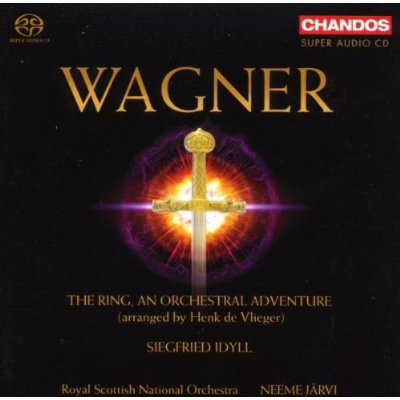
Anyway, talking of potted adaptations, I wonder what we shall make of Henk de Vlieger’s 60-plus minute symphonic tour of Ring orchestral highlights, due from the BBC Symphony Orchestra under the excellent Mark Wigglesworth tomorrow night (and already espoused by Neeme Järvi and the Royal Scottish National Orchestra on Chandos, a recording I have yet to hear). On Tuesday with the BBCSO course students, I had one hour on Tippett’s Triple Concerto, the first work in the concert – triggering a heated debate of pros versus cons, with me somewhere in the middle – and one on the essence of the Ring, with glimpses of the beginning and the end and in between, a couple of selections from the momentous later stages of Rheingold and Walküre to deal with transformation/dramatic introduction of the leifmotifs, and a gallery of nature pictures – water, air, fire and earth.

Those should all be there tomorrow, but will the experience add up? Sometimes charisma can make it work - I love mad Stokowski's 'symphonic syntheses' from the Ring, Tristan and Parsifal, especially in his portamenti-laden Philadelphia recordings from the 1930s. Here's his take sans voices on Act Three of Parsifal.


As for Wigglesworth's Wagner (and Tippett), if you can't be there at the Barbican, the concert is broadcast live on Radio 3. STOP PRESS (20/10): It worked, it truly did (and the Tippett was compelling, too). Listen to the concert for the next seven days here and read the Arts Desk review here.

Tuesday, 9 October 2012

One crazy day


Referring, of course, to the action packed world of Mozart’s Le nozze di Figaro, currently running at Glyndebourne in a very classy touring version of Michael Grandage’s production, rather than the Study Day before it, masterminded by Sarah Lenton with a pair of excellent actors (Anna Brecon and Marcus Hutton) to take on multiple roles and in which I played my part as the morning's musical guide. In the afternoon's session, singers who will take over the roles of Susanna and Figaro later in the tour, Ellie Laugharne and Derek Welton, were joined by Marcellina Jean Rigby for a guided tour around some of the treasures.

Preparing to condense the joys of Figaro into one hour (!) only made me fall head over heels in love again with this most flawless of all musical comedies – though I wasn’t expecting so much from the Grandage show as revived by Ian Rutherford; production photos suggested a facile disjunction between the late 60s costumes and the crumbling elegance of a Moorish palace (fabulously designed by Christopher Oram and often evocatively lit by Paule Constable).

While I’m not convinced that the chosen era and its fashions went much beyond the decorative, I did suspend my disbelief at the whole shifting of the class boundaries from social to financial – ‘l’argent fait tout’, as Marcellina sings, in this bohemian world – and thought the evocation of the time added mostly a sense of fun. Jiving and twisting lent a groovy weirdness to the behaviour of Bartolo (Andrew Slater, most amusing) as well as a delightful exuberance to the wedding fandango. Floppy hats made the ladies’ disguises in Act Four more plausible than usual, despite the difference in their heights. And a terrific wig + Zapata moustache + funky flares + flowery shirts + a nice array of waistcoats dolled up the Count to make him a mixture of sexiness and absurdity.


American John Moore, who plays Almaviva until the tour shifts base, couldn’t have been better: an assured actor, reining in any caricatural aspect by striking a fine balance between preening and insecurity, and as a singer of impressive control never overdoing or forcing the big vengeance aria in Act Three. Which was where, in this musically brilliant and up until then pacy Figaro, we finally took a breather and allowed the aristocratic characters their display.


Layla Claire’s Countess, drifting around in floaty dresses and platform shoes, was more than equal to hers, drawing on luscious resources of colour and ornamental prowess so that you felt she could do anything in ‘Dove sono’: likewise, a finer Rosina I’ve not seen on stage (though Dorothea Röschmann at the Royal Opera was wonderful on a bigger scale; but Glyndebourne's is really the ideal for this work - no need to test the singers' projection any further).


Joélle Harvey, a petite Susanna with excellent eyes for comedy, followed the distinction of Claire's set piece with a heavenly Act Four serenade. Taking the Study Day folk through it, I’d mixed and matched Reri Grist (regal for very slow Klemperer), Barbara Bonney and Lucia Popp, but Harvey had her own subtle charms to rival them all, including a last-minute gem of gorgeous ornamentation. Only the Figaro pictured with her above, Guido Loconsolo, fell behind the other three principals – and behind conductor Jonathan Cohen’s vigilant beat; the only times in the whole evening where energy levels dropped were in his ‘Non piu andrai’ and ‘Aprite un po’ quegli occhi’. I must say I didn’t mind the Marcellina and Basilio arias being cut from Act Four; to have heard them would have marred what felt like structural perfection. And, as we'd discussed earlier, it makes you realise all the more how Mozart and Da Ponte raise the servants to the level of their masters when their arias stand in similar relief.

Cohen did a superlative job of making the numbers flow so that the first two acts dazzled with their action: fast tempi, very often, but with plenty of breathing expression from strings and wind. And the deftness of the Overture was well worth keeping down the curtain for (in the main season, the Count and Countess drove up to Aguas Frescas in a sports car - not a touring option, if you see what I mean, and the revolve which revealed the different rooms of the palace had to go, too. Optional-opulent extras both, I'm guessing).

So much depends, in comic terms, on the right pace from the conductor: I got goosebumps of sheer pleasure when the music slowed to reveal Cherubino hiding, or Susanna stepping mock-innocently out of the closet. The recits were delivered with gilding style from fortepiano continuo player Ashok Gupta, and such quick-witted meaning from the singers that you’d have thought all the members of the cast were native Italian speakers (whom to credit most? Grandage? Rutherford? The conductor? The language coach?)


Kathryn Rudge may not have been quite the most quicksilver of Cherubinos, but Cohen got such a spring from the furtive ecstasy of pizzicato strings lining ‘Voi che sapete’ that the spirit of delight steered us happily through. The superhuman happiness of the great Sextet and the Countess’s pardon rose to the heights, too. Not much more to ask, then (except a stronger Figaro); and if the production found no novel ways of expressing the ensemble oppositions and the comic twists, then we were fairly comfortable with that since the singers all seemed happy in their characters’ skins.


Glyndebourne rehearsal standards had clearly wrought the usual high-level results. The work's the thing, and thanks especially to Cohen, his Count, Countess and Susanna, we all came out reeling afresh at Mozart’s comic genius.


As for Glyndebourne, it was looking especially enchanting on a sunny Sunday morning, when I arrived for the soundchecks: dew on the lawns and mist on the fields. Something of that brilliance had faded by the time I took these pictures in the late afternoon, but the essence of the early autumn mood down by the lake remains.


All production photos by Bill Cooper for Glyndebourne

Tuesday, 2 October 2012

Concert afterchat: bells and Poe


At the end of his hard working week with the London Philharmonic Orchestra, and just after Rachmaninov’s serene epilogue to all the doom of Poe’s funeral bells had sent us floating down from the Festival Hall, a beaming and relaxed Vladimir Jurowski joined me for a post-concert dialogue in the RFH’s ballroom zone. That’s another prime pick from Chris Christodoulou’s Proms shots above – we annually present a selection on The Arts Desk – which seemed like a better lead than the diplo-mate’s loyal phoneshot of the afterchat, though here it is anyway.


We talked about the weird disappointment of this brilliantly planned Bells ‘n Poe programme having been cancelled a month ago on what should have been its first airing: the lights failed at the Usher Hall during the Edinburgh Festival so – no concert (and they’d even flown in a baritone to replace indisposed Vladimir Chernov at 24 hours’ notice). VJ mused on The Bells’ ill-starred history - it has a reputation, it seems, somewhat akin to the Scottish Play - despite its highest place in the composer’s self-esteem, starting with the misplaced dedication to Mengelberg who’d only just dissed the work (hard to understand why). 


Although the ‘choral symphony’ has plenty of light and shade, it fascinates me especially how Rachmaninov goes beyond the bleak finality of Poe’s death-ode and provides the most levitational – I have to repeat that word, especially in the context of Saturday’s performance – conclusion imaginable. Jurowski remembered, as so well do I, Svetlanov’s last concert with the BBC Symphony Orchestra and how, knowing he was very shortly to die, the great man stretched out the transcendence to seeming infinity. That searing event has been issued on CD, but isn’t on YouTube, but another classic Russian recording is, albeit somewhat oddly via a crackly LP rather than the CD transfer – Kondrashin’s Moscow Philharmonic stunner. The final Lento lugubre begins at 23’36; the levitation comes at 32’40 though needs to be prefaced with at least a bit of the preceding gloom to have its due effect.


Here's some more of Poe's text if you feel like accompanying your listening with a bit of authentic English-language flavour (though even enlarged, it's not always easy to decipher):


VJ seemed pleased with his own matured interpretation of a work he loves: I mentioned the exceptional balances in the glitter of the sleigh-bells movement, and he felt that tenor Sergei Skorokhodov and the amalgamated London Symphony and London Philharmonic Choirs had really, for once, come through the orchestral busy-ness. He wanted a feeling of exultation, not craven terror, in the ‘Alarm Bells’ movement: this, after all, was 1913, when the imaginative anticipation of sweeping away the old order was far from the horrifying reality it would become.


I was impressed how little Jurowski repeated of what he’d recorded for the LPO’s website, where he expounded so eloquently on the place of bells in Russian culture as the only instruments heard in Orthodox services and on the Russification of Edgar Allan Poe. Even so, he is clearly so involved with the poetry of Konstantin Balmont, Poe’s distinguished Russian (hyper) translator, that he had more to say about this silver-age master. We to- and fro-d a bit about the other bell pieces on the programme, post-war collages by Shchedrin and Denisov which I think I’ve written just enough about on the Arts Desk review. Curiously there is a performance of Denisov's impressionistic Bells in the Fog on YouTube, though alas the audience is not as receptive to its cusp-of-silence beginning as Saturday night's crowd was.The big picture, by the way, is of Sofia Gubaidulina, for me the greatest voice of contemporary Russian music.


Jurowski also passionately defended the other Poe-inspired piece on the programme, Myaskovsky’s Silentium. As he pointed out, the Poe fable of a man who can withstand anything the Devil throws at him except silence is a tale for our times, perhaps even more so than for the late 1830s when it was written. So far as the symphonic parable is concerned, there’s a loyal Jurowski family connection with the honourable, somewhat lugubrious Myaskovsky, and I couldn’t help but admire the dogged sombreness of this early piece, so often mentioned in the correspondence with Prokofiev. Jurowski sticks to the line that ‘Myaskusya’ develops his symphonic ideas better than Prokofiev, who was often openly dismissive of his musical substance – as was I when VJ conducted the Sixth Symphony, a work I’d been hoping to like as well as I had on a first recorded hearing.

So I suspect VJ was being a bit naughty in passing a passionate Myaskovsky admirer’s question about why we didn’t hear more of the 27 symphonies over to me, and what I thought might be the problem. But I voiced my mixed feelings about the unevenness and deferred back to him again, since he’s spent time studying the works as I have not.


Come question time, I was glad one lady took us back to the earlier concert in the week, and – observing how the players seemed to have a whale of a time in the ‘symphonic picture’ drawn from Strauss’s Die Frau ohne Schatten - asked whose selection it was. Jurowski’s, of course, and I’m glad we agreed on the awfulness of Strauss’s own ‘fantasia’, which VJ pointed out contains much of the worst music in the opera. There was another great critical split along the lines of the Martinů divide on how effective this much more interesting selection was; having accepted that we weren’t going to get the voices, I tried to enjoy it for what it was, and found myself seduced by all those odd extra instruments on full display: the Chinese gongs, the glass harmonica (pictured below in hands-on by Thomas Bloch; no working one in either of the big Russian cities, Jurowski told me about a performance there), the four tenor tubas. It gave me a fresh perspective on Strauss’s extraordinary score, and you can’t ask for more than that. 


Coming up: three titanic programmes from the tireless Jurowski, linking British and Russian attitudes to ‘War and Peace’, marking the bicentenary of the Battle of Borodino and 70 years since the premiere of Shostakovich’s Leningrad Symphony. It should be amazing to hear the Russian National Orchestra tackle Vaughan Williams’s Sixth – VJ reports that Muscovite audiences were stunned by that unique, drifting finale – and combined Anglo-Russian forces in Shostakovich 7. Too much choice this week, alas: to be loyal to my BBC Symphony Orchestra class, I have to attend that band’s first concert of the season tomorrow and miss Jurowski’s Prokofiev War and Peace scenes: not too great a wrench when the alternative is to hear Jukka-Pekka Saraste conduct Shostakovich’s Fourth Symphony and the peerless Alice Coote singing the most beautiful song in the world, Mahler’s ‘Ich bin der Welt abhanden gekommen’, among the Rückert Lieder. 

Image of a lighthouse bell in Primorsky Krai in Russia's far east above by V Kotelnikov, courtesy of Russian language Wikipedia

Friday, 28 September 2012

Churches of the Arun Valley


The second of these two gems, St Mary the Virgin North Stoke pictured below St Michael Amberley, was belatedly added to the list, and our route diverted, as I sat on the train down to Sussex last Saturday scouring my Pevsner/Nairn. The intention had been to build on our 19-mile Norfolk churches walk with a heady loop from Amberley to Arundel around the glorious South Downs, both ends of which we know from two-day expeditions but not the middle. Churches, Amberley excepted (and possibly St Nicholas Arundel if we got there in time), were not the object of the exercise. The highly critical Nairn’s praise of North Stoke, however, was unusually warm – ‘delightful, outside and in’ – so I worked out a shorter detour around the Downs and a trail that would then take us along the meanders of the river Arun.

Amberley was always going to be our starting point, and a model village it is too, with its ensemble of castle, church and thatched cottages; all needs of the day-tripper helpfully provided with a tea shoppe, pottery, local store – helpful for assembling a a rather odd sort of picnic – and further refreshments in the village hall, where we succumbed to a cuppa and excellent home made cakes after a longer than expected time in the church. One-time inhabitants include Arthur Rackham and Arnold Bennett, visited by John Cowper Powys who walked over from Burpham to see him (later we met an American on the Downs coming from Burpham who might well been purposefully following in Powys’s footsteps).


At the time of Nairn’s writing, the wall paintings on the south side of St Michael's chancel arch had not been revealed, and he is extraordinarily rude about this splendid Norman arch’s ‘tragic’ scale of detail, its ‘finicky zig-zag ornament’. Well, I love that sort of zig-zagging, so my feelings about it are quite the opposite.


The 12th or 13th century paintings crudely yet clearly depict scenes from Christ’s passion.


The eye is drawn to this and the great arch, but probably first, as one enters through the south doorway, to the stained glass in the window of the north directly facing the visitor. It strikes me as a very beautiful combination of the lamentatory and the joyful. The main image of the deposition is taken from a painting by the local artist to whom the window was dedicated in 1919, Edward Stott.


The designer, quite a discovery for me, was Robert Anning Bell, who has framed the central scene with denizens of art and nature – farm animals along the bottom frieze


and what turn out to be characteristic Anning Bell angels around the arch.


There’s also a memorial plaque to ‘dear child’ Joan Mary Stratton by Eric Gill and his assistant Joseph Cribb


and more superior stained glass, this time from the 1930s, by Veronica Whall of St Edith and an angel.


We had to lift off a harvest festival arrangement to reveal the 1424 brass to John Wantele.


Otherwise, and despite a major Victorian restoration - from which time I assume the wacky floor patterns stems (thought-food for Sophie's floorcloth designs?) -


the impression remains resolutely Norman, including the font


and a west window giving out on to the belfry.


Having given a passing glance to the castle, more a retreat-home to bishops of Chichester in the Middle Ages


we retraced our steps along a shady lane


and walked a little along the South Downs Way, looking down on Amberley


before branching off towards Burpham. Clear views towards the south coast opened up, suggesting time for lunch (including an excellent local pork pie) and a steep sheep-filled valley offered a half-hour of total seclusion


after which we reluctantly left the Downs by taking a track down towards North Stoke, with the sea now very much in evidence.


The tucked-away church here has been lovingly, unfussily restored by the Churches Conservation Trust, not deconsecrated but left usable for the odd service throughout the year.


The beauty of St Mary is that it has hardly been changed since the early 14th century, and – apart from the altered east end – its windows range a century of even earlier design, from lancets of c.1200 to the two- and three-lighters introduced about 70 or so years later.

As with all the work of the excellent CCT, the bare interior highlights the basic colours on the stonework – in this case yellow, ochre and pinkish-red. They certainly enhance the pleasure of the cunningly constructed piscine and sedilia, adjusted to the chancel’s different levels.


Details are few but striking, like the hand which serves as a corbel to hold up a niche, and a sheep’s head in the south transept. Cursed be flash for flattening out the impact.


There are also four fragments of medieval glass, both pairs seeming to indicate the coronation of the Virgin (though some say the male figure here is King David, who knows?). The more finely executed of the two is sited in the east window.


The chancel arch in this instance, so the model guide produced by the CCT tells me, is ‘mainly built of chalky clunch’; seen here from the font.


Around it are fragments of medieval wall-painting - this time purely decorative, flowers and birds.


St Mary is shy of revealing herself, at least from our approach, and only as we walked down a field towards South Stoke did she become briefly visible.


We crossed a surprisingly elaborate bridge across a meander of the Arun, restored with gurkhas’ help in 2009


And made a brief detour to another well-hidden church, well away from any proper road, at South Stoke. The tower of this essentially 11th century building has what Nairn calls a ‘frilly C19 cap to it'.


Otherwise, nothing much to report about the interior. Harvest festival here was clearly not to be the feast of plenty Amberley’s display indicated: in South Stoke's case, cereal packets on the altar and apples lined up beneath the windows, which had a certain piquancy.


We were now tracing the meanders of the Arun, heading towards Burpham


where the church was resolutely shut. It probably would have been anyway after 5, but I took agin the tenor of the notice on the door, which apologized for lockup and alarming owing to recent theft, but gave no hint of where a dedicated visitor might find the key.


And so along the water meadows to Arundel, past a boatwreck which looked like it was grounded in a dried-up Sea of Azof


and with the meanders causing the castle to advance and retreat.


Way too late for an Arundel investigation – we’ll make it the starting point next time - we had a quick drink in an unlovely hotel and then hobbled to the station for the train back to London. The afternoon's sun was now all blurred over in early evening grey skies, and sure enough this was the abrupt end of an Indian summer: on Sunday, originally earmarked for our walk, quite a bit of the country was under water from a month’s worth of rain in a single day.